
ScubaLab Gear Review: 4 New Equipment Trends You Should Know About
One of the high points of our year is The DEMA Show, where we meander among booths and revel in shiny new gear. This year we noticed exciting trends in drysuits, fins, BCs and LED lights. In the gallery above you'll see the models that particularly caught our eye. We can't wait to take them into the water for some test dives.
Fins - Say Bye-bye to Splits?
Split fins appeared on the diving scene some 15 years ago. ScubaLab tested its first split in 1999 — the Apollo Bio-Fin — and it was an instant hit. In no time at all, more split fins were being brought to market than paddle fins, because when it came to kicking performance, most traditional paddle fins simply couldn’t keep up. Paddle-fin makers just hated hearing ScubaLab report this, so they put their R&D departments into high gear and emerged with some innovative fin designs now referred to as “modified” paddles. These fins were fast and responsive, and didn’t trash leg muscles — and divers ate them up. By the late 2000s, more modified paddle fins were coming onto the market than splits (this was also due in part to the complex licensing requirements that have dogged split fins from the start, plus caused them to be pricey). Fast-forward to 2013: Based on what we saw at DEMA, for the first time in more than a decade, not a single new or redesigned split fin is slated to be released this year. Not a one. While a number of high-performance split fins continue to maintain a firm grasp on the fin market (Apollo’s Bio-Fin Pro, Atomic Aquatics’ Split Fin and SCUBAPRO’s Twin Jet are three of the best), modified paddles are definitely in ascendance.
BCs - The Trend Toward Rec/Tec
Virtually everyone who has successfully made the transition from floundering beginner to seasoned recreational diver will at some point get the urge to take the adventure just a little bit further. This might mean jumping with both feet into technical diving; more likely, it will mean preparing yourself, when the opportunity arises, to maybe go a little deeper, stay a little longer, or carry more equipment. Let’s call it rec/tec diving — an experience more aggressive than typical recreational diving, but not as specialized or complex as full-on technical diving. Rec/tec divers are growing in number as they log more bottom time and start looking for new ways to keep their diving fresh, whether it be through photography, wreck penetration, or greater depths. Gear manufacturers are responding by building equipment better suited to a heavy-rec/light-tec style of diving — especially BCs. While simple and comfortable enough for recreational diving, rec/tec BCs are much more rugged than standard BCs, they provide lots of buoyant lift, and they offer large ballast pouches and cargo pockets, and heavy-duty D-rings — all good to have when it comes time to take it to the next level.
Drysuits - Can you say Bulletproof?
Experienced divers spend a lot of time in the water, shelling out big dollars for their gear, so they expect a lot from it. This is especially true when it comes to drysuits. After dropping from $1,500 to often more than $3,000 on a quality fabric suit, you want to know it will stand up to aggressive use —and, yeah, even abuse — dive after dive, well into the future. If what we saw on display at DEMA is any indication, drysuit manufacturers are definitely listening. Heavy-duty materials designed to withstand virtually anything short of a nuclear explosion are all the rage this year. And we’re not talking about simply laying on more Kevlar; on the contrary, the mission is to use materials that can withstand lacerations, abrasions and punctures better than anything currently on the market, while still being lightweight and stretchable. This seems like a daunting task, but a number of drysuit manufacturers have come up with some truly amazing high-tech materials: strong yet lightweight, flexible yet resistant to chemicals, all packed with convenience features and designed for easy maintenance.
LED Lights - Powerful, Versatile, Dependable
Multitasking — it’s the way of the modern world. And now it seems to have invaded the underwater world. A dive light is no longer necessarily just a dive light. The push today is to be multipurpose, and some of the models being released in 2013 have this in spades. Powerful enough to be used as a primary light for night diving, compact enough to be stowed in a BC pocket to be used as a backup light, with beams well suited for photographic applications — and an additional trick or two up the proverbial sleeve — you won’t find better examples of tomorrow’s dive lights today.

Katy Danca Galli
Sleek and lightweight, the WARP1 is built with multiple composite materials, and just hums high-tech with its actuator arms, polymer “Film Hinges,” and pleated membrane. According to designers, these engineering goodies are integral parts of a new approach to underwater propulsion revolving around what’s called WARP (water adapting responsive propulsion) technology. So does it work? Based on a review in a European magazine and some celebrity testimonials, yeah — like a champ. We’ll need to collect our own data before casting our vote, but if its performance comes anywhere close to its marketing hype, this will be a fin to be reckoned with.
Info: cetatek.com
The Avanti Quattro has been around for a long time. Touted as the first fin to offer a four-channel blade, the fin placed near the top of the pack for speed when ScubaLab first wet-tested it back in 2003, plus it was stable and highly maneuverable in close quarters. However, it was considered a little too stiff. This year, Mares’ designers have addressed this by incorporating a new high-flex material into the blade and renaming it the Quattro+. Just handling the fin you can feel the increased flex. The new bungee fin strap is a smart feature too.
Info: mares.com

Katy Danca Galli
We actually got a chance to test-dive a prototype of the Accel a few months ago, and this simple fin far exceeded our expectations. It is shorter and lighter than virtually any other open-heel fin out there, yet our preliminary tests found it able to outpace the best of them in speed, power and maneuverability. The blade is made of Monprene, a durable old-school material, yet the short, flexy blade design is totally modern, enabling good propulsion without honking leg muscles or straining ankles. Plus, its compact size makes it a great travel companion.
Info: diveaeris.com
The Probe HLC is a jacket-style BC — with a little rear inflation thrown in for balance — that definitely has “tec” cred. Constructed of 1,600-denier ballistic nylon, super-stretch BioFlex is used for the air cell, and heavy-duty padding on a hard backpack helps cushion against the extra gear and weight you’ll be carrying. Stainless-steel D-rings are prebent for one-handed attachment, and they’re backed up by a pair of zippered cargo pockets.
Info: oceanicworldwide.com

Katy Danca Galli
The Black Ice epitomizes the rec/tec trend. Its heavy-duty construction looks capable of handling anything you can throw at it — or hang on it. The rear air cell has several passthroughs for easy transfer of air from side to side. Dual-channel weight pouches in front, coupled with trim pouches in back, provide a total ballast capacity of 42 pounds. You get four exhaust valves, two cargo pockets and five prebent stainless-steel D-rings. And when you really want to get serious, there’s an optional kit for rigging twin cylinders.
Info: aqualung.com
The BCJ-8000 X-Wing back-buoyancy BC offers a nice blend of recreational and technical. Its clutter-free design can be deceptive; a closer look reveals advanced-level features like the Independent Harness System that isolates the harness from the air cell, plus a new version of Tusa’s A.W.L.S. II integrated-weight system. It also has Tusa’s Active Purge Assist, which we’ve checked out before; it’s a really interesting approach to power inflator/deflator systems. Like the Black Ice, the X-Wing has four exhaust valves (you can never have too many), plus it offers 40 pounds of lift in the larger sizes.
Info: tusa.com

Katy Danca Galli
Upping the ante for high-tech materials being integrated into drysuit construction, USIA has teamed up with a company called Nanosonic, the developer of HybridShield technology. This is a process that can infuse virtually any fabric with molecularly engineered nanocomposite materials, creating a composite fabric 15 times stronger than steel and 40 percent stronger than aramid fibers like Kevlar and Nomex — but it’s still lightweight and flexible. USIA plans to build entire drysuits out of fabrics infused with this HybridShield technology. For now, however, they are taking their already heavy-duty Techniflex drysuit and overlaying its high-wear areas with Nanosonic “Dive Armor.”
Info: usia.com
This drysuit looks like you could wear it through an underwater meat grinder and emerge without a scratch. Designed with tec divers in mind, the D7’s trilaminate body is covered with an outer shell made entirely of Cordura for both maximum durability and abrasion resistance. Virtually everything about this drysuit shouts “heavy duty,” from its massive kneepads made of military-grade Kevlar to its anatomically cut Kevlar boots, polyurethane overlays for extra abrasion resistance in the seat area, wrist cuffs that cover the silicone wrist seals, and a double-zip system to protect the dry zipper.
Info: waterproof-usa.com

Katy Danca Galli
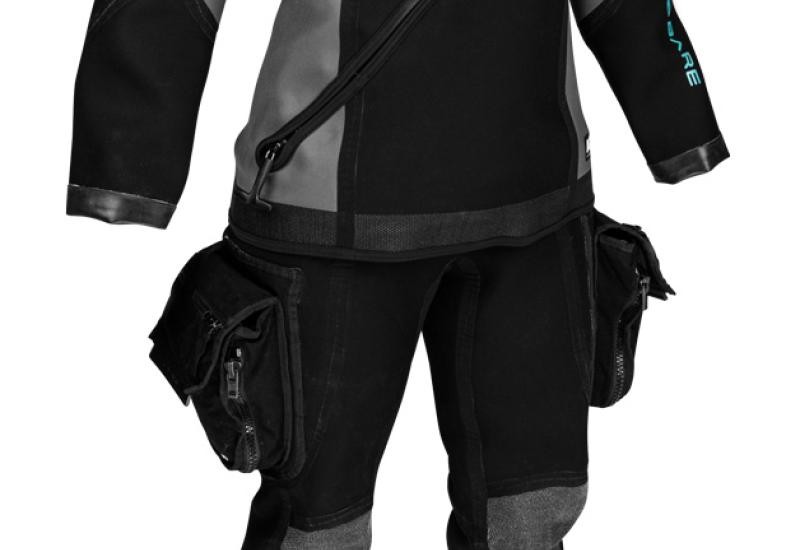
Bare has turned up the durability dial on its Trilam Pro Dry by incorporating a commercial-grade fabric made of a high-tenacity nylon/butyl/polyester trilaminate stitched with two-needle felledseam construction and reinforced in all critical-wear areas. The company obviously has confidence in this construction method because it’s offering a lifetime guarantee on seams and workmanship. The Trilam Pro Dry comes with a 2 mm smooth-skin warm collar that’s designed to seal with a dry hood over a 3 mm neoprene comfort-fit neck seal. Wrist seals are bottleneck latex, and for leg protection, Kevlar kneepads are backed with 1 mm neoprene to provide a little cushion.
Info: baresports.com

Katy Danca Galli
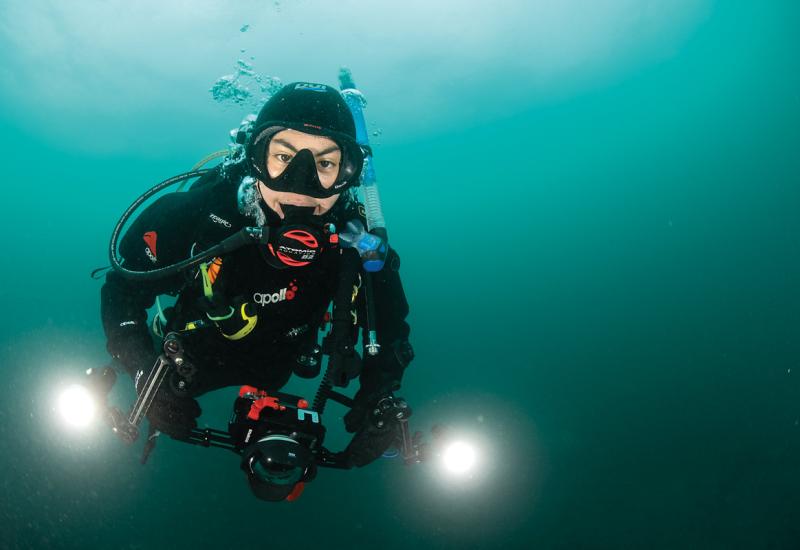
UK’s new Aqualite E-LED offers a choice of three different lamp heads to match the task at hand. If you’re looking to use the Aqualight as a dive light, there’s the 20-degree beam, which is the narrowest and brightest. Need a light source for some still photography or standard video work? Choose the 65-degree beam. And for wide-angle video, there’s the 90-degree beam. Four power settings provide the right illumination, whether you’re using it for fill or flood. That’s serious versatility. Power is supplied by a lithium-ion battery.
Info: underwaterkinetics.com

Katy Danca Galli
Measuring only 5 inches long and 2 inches in diameter, the rechargeable Vega is a bona fide multipurpose LED light. Designed for underwater video and still photography, for use as a focus light or as a backup dive light, the Vega packs a lot of punch — as in 2,000 lumens in a diffused, 70-degree beam. So much firepower coming from such a small casing makes us think, “Wow, this baby’s gonna get hot.” But according to Ikelite, the Vega’s Arctic Radiator Technology lets water pass through the body to transfer heat away from the LEDs, allowing it to burn cooler and brighter for longer.
Info: ikelite.com

Katy Danca Galli
This cool new torch opens the door to a new diving activity — fluorescent night diving. Shine the rechargeable Nightsea on certain critters and the 3000 Radiant Flux blue LED light will excite their biofluorescence, allowing you to see the underwater world in, literally, a whole new light. You get a choice of a powerful blue spotlight or a wide-angle flood. Or attach the included filter, and the blue light turns into a standard white light for use as a traditional dive torch. Both modes include a universal distress signal with enhanced burn times — just in case you need it.
Info: lightandmotion.com

Katy Danca Galli
One of the high points of our year is The DEMA Show, where we meander among booths and revel in shiny new gear. This year we noticed exciting trends in drysuits, fins, BCs and LED lights. In the gallery above you'll see the models that particularly caught our eye. We can't wait to take them into the water for some test dives.
Fins - Say Bye-bye to Splits?
Split fins appeared on the diving scene some 15 years ago. ScubaLab tested its first split in 1999 — the Apollo Bio-Fin — and it was an instant hit. In no time at all, more split fins were being brought to market than paddle fins, because when it came to kicking performance, most traditional paddle fins simply couldn’t keep up. Paddle-fin makers just hated hearing ScubaLab report this, so they put their R&D departments into high gear and emerged with some innovative fin designs now referred to as “modified” paddles. These fins were fast and responsive, and didn’t trash leg muscles — and divers ate them up. By the late 2000s, more modified paddle fins were coming onto the market than splits (this was also due in part to the complex licensing requirements that have dogged split fins from the start, plus caused them to be pricey). Fast-forward to 2013: Based on what we saw at DEMA, for the first time in more than a decade, not a single new or redesigned split fin is slated to be released this year. Not a one. While a number of high-performance split fins continue to maintain a firm grasp on the fin market (Apollo’s Bio-Fin Pro, Atomic Aquatics’ Split Fin and SCUBAPRO’s Twin Jet are three of the best), modified paddles are definitely in ascendance.

Katy Danca Galli
BCs - The Trend Toward Rec/Tec
Virtually everyone who has successfully made the transition from floundering beginner to seasoned recreational diver will at some point get the urge to take the adventure just a little bit further. This might mean jumping with both feet into technical diving; more likely, it will mean preparing yourself, when the opportunity arises, to maybe go a little deeper, stay a little longer, or carry more equipment. Let’s call it rec/tec diving — an experience more aggressive than typical recreational diving, but not as specialized or complex as full-on technical diving. Rec/tec divers are growing in number as they log more bottom time and start looking for new ways to keep their diving fresh, whether it be through photography, wreck penetration, or greater depths. Gear manufacturers are responding by building equipment better suited to a heavy-rec/light-tec style of diving — especially BCs. While simple and comfortable enough for recreational diving, rec/tec BCs are much more rugged than standard BCs, they provide lots of buoyant lift, and they offer large ballast pouches and cargo pockets, and heavy-duty D-rings — all good to have when it comes time to take it to the next level.

Katy Danca Galli
Drysuits - Can you say Bulletproof?
Experienced divers spend a lot of time in the water, shelling out big dollars for their gear, so they expect a lot from it. This is especially true when it comes to drysuits. After dropping from $1,500 to often more than $3,000 on a quality fabric suit, you want to know it will stand up to aggressive use —and, yeah, even abuse — dive after dive, well into the future. If what we saw on display at DEMA is any indication, drysuit manufacturers are definitely listening. Heavy-duty materials designed to withstand virtually anything short of a nuclear explosion are all the rage this year. And we’re not talking about simply laying on more Kevlar; on the contrary, the mission is to use materials that can withstand lacerations, abrasions and punctures better than anything currently on the market, while still being lightweight and stretchable. This seems like a daunting task, but a number of drysuit manufacturers have come up with some truly amazing high-tech materials: strong yet lightweight, flexible yet resistant to chemicals, all packed with convenience features and designed for easy maintenance.

Katy Danca Galli
LED Lights - Powerful, Versatile, Dependable
Multitasking — it’s the way of the modern world. And now it seems to have invaded the underwater world. A dive light is no longer necessarily just a dive light. The push today is to be multipurpose, and some of the models being released in 2013 have this in spades. Powerful enough to be used as a primary light for night diving, compact enough to be stowed in a BC pocket to be used as a backup light, with beams well suited for photographic applications — and an additional trick or two up the proverbial sleeve — you won’t find better examples of tomorrow’s dive lights today.