


We scuba divers love our toys. Meet any seasoned diver, and you’ll find a treasure trove of dive accessories clogging our closet space. Perhaps the first purchase we make after the essential dive gear is a dive light because, whether for night or deep diving, videography or even just looking for critters in holes, dive lights are universally useful. Nearly every long-term diver wants a specific light for a specific something. The selection of underwater lights—or torches—on the market today can be utterly blinding, with seemingly endless options for every purpose and from different manufacturers. We developed this guide to help illuminate the choices.
Properties of Light and Water
We have evolved to live in a dry world where we often take for granted the way visible light typically acts. For the purposes of this article, light has three properties that we are concerned with: intensity, color and direction. In the next section, we will discuss some use cases and how these properties can be combined to select the perfect light for you.
Color
Color is a pretty basic concept, but if you’ve ever accidentally cut yourself diving below 20 feet and bled green, you know that color isn’t always so straightforward underwater. You learned about light attenuation, or the concept that different colors will penetrate a water column more quickly than others, in your open water course. Red light famously disappears within a few feet of the surface, while blue or ultraviolet light can penetrate water for hundreds of feet.
Our brains are brilliant at compensating for this lack of color by normalizing what we see, whereas cameras lack this natural adaptation. That’s why photographers fuss about white balancing their cameras, and rebalance every time they change depth. However, white balancing can only do so much and won’t replace the red spectra once they are gone. One way to get lost colors back is to add artificial light in the form of video lights or strobes.
If you’ve ever flashed yourself in the eyes, it may seem like the light is a bright white when, in fact, our dive lights come in many different colors, which are denoted by the color temperature measured in Kelvin (K). This is similar to indoor lighting, which comes in cool (around 4000 K), warm (about 2500 K), or daylight-balanced tones (roughly 4600 to 6500 K). More Kelvin equals the more blue it will appear and thus the farther through the water it will penetrate.
Related Reading: Best Gifts of the Year for Scuba Divers
Light Intensity
Intensity can be measured in a few ways, but most commonly it is measured in lumens (lm) or the number of candles, or candelas, per square radian. Some companies use the term “lux” which is the number of lumens per square meter. In essence, lux and lumen are not directly interchangeable, but it’s important to remember that the higher the number, the more light produced. Even in clean water, light doesn’t travel nearly as far as it does in air, a characteristic that multiplies when any sand or sediment is suspended.
The short of it is that we need much brighter lights to make up the difference. Generally speaking, the more lumens a light has, the stronger the light—and the higher the cost.
Directionality and Beam Angle
Directionality means more than just where the light is coming from. In underwater lighting, it can also refer to the beam shape. Beam shape is a gradient and referred to in degrees. Narrow beams (approximately 15 degrees) cut through the water and project farther, while wider beams (greater than 100 degrees) cover more area in front of you, but don’t generally penetrate as far.
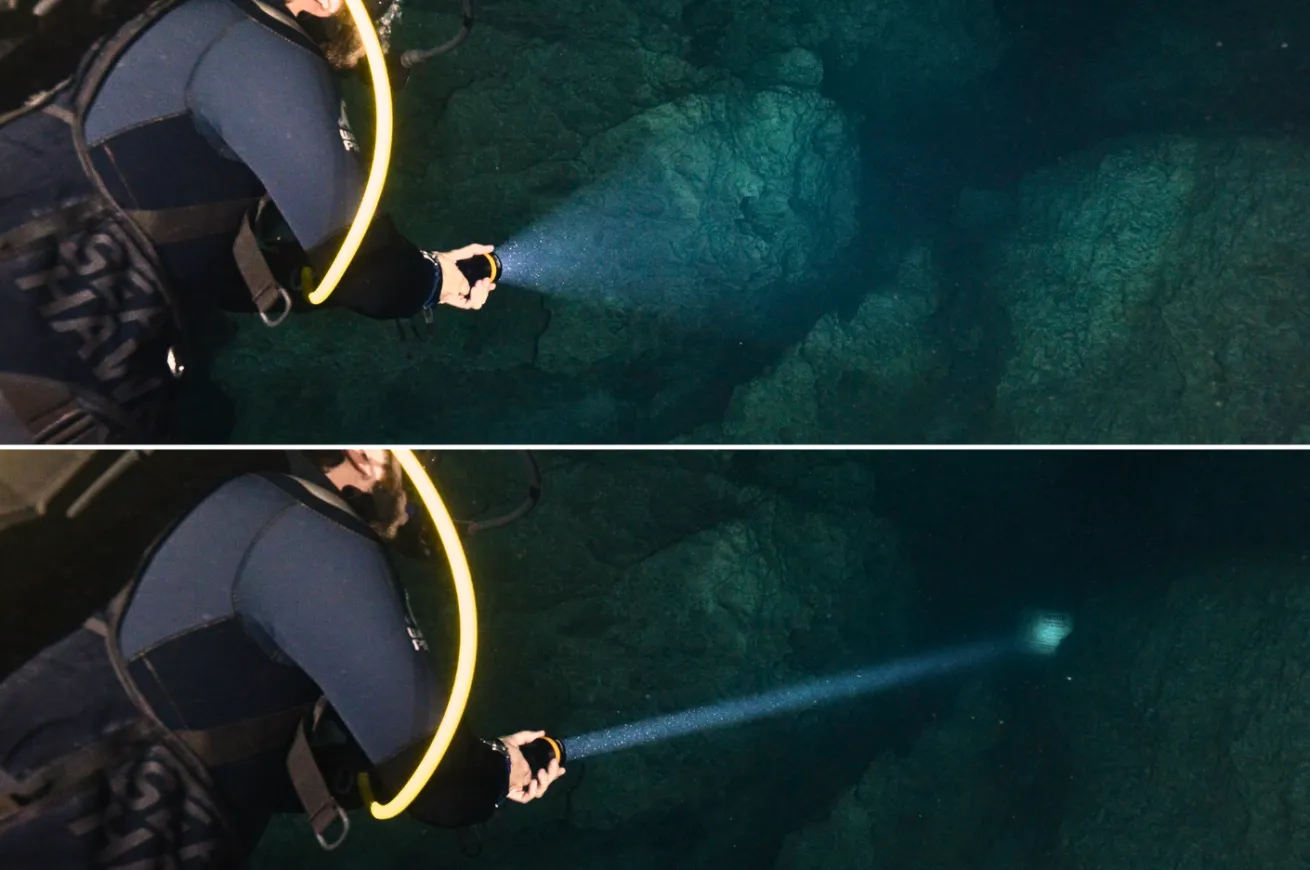
Kristin PaterakisThe top image shows a beam angle of 72 degrees, while the bottom image has a beam angle of 4 degrees and is better for penetrating through dark, murky environments. The OrcaTorch has the ability to adjust the beam angle on the fly.
Hybrid lights have a bright center beam and cast a wider halo. These can be the best of both worlds as they allow the user to see far while also seeing creatures near the beam. Beam shape is a factor of both lens/reflector shape and the pattern of LEDs in the lighthead. One of the advantages of LED technology is that it can cast a very even light, making videography much easier.
The Best Dive Light for You
Each of these properties plays into which light suits your needs. The best light for you depends on your budget and needs. Below are a few of the more common use cases and the properties you should look for in an underwater light.
Primary Recreational Dive Lights
Primary, or spotting lights, are general lights used as needed to spot creatures during night dives, illuminate wrecks or to simply see into holes. All three of these often have similar properties. They usually have a small form factor that attaches to your person, whether on a hand-mount or clipped to your BCD. I work a lot in blue water where dropped items sink quickly, so I’m a big fan of clips and wrist lanyards.
Spotting torches and primary lights with narrower beams are designed to pierce through darkness, without causing the high-beam-in-a-snowstorm effect one might get from a wider-angle light. Primary lights typically come in cooler temperatures, around 5000 to 6500 Kelvins.
We recommend a primary light with at least 1000 lumens, and a secondary light is always great to have on hand in case the primary light malfunctions or dies during the dive.
Editor’s Picks: SeaLife Sea Dragon Mini, Dive Rite FX40, OrcaTorch ZD710, Big Blue AL1300NP

Kristin Paterakis
Focus Dive Lights
Focus dive lights are used to illuminate a subject so your camera can achieve focus at night. They tend to be small and will mount somewhere on your camera. I’ve found relatively dim lights (<1500 lumens) to be sufficient on the reef at night, but for blackwater, the more light you can cast, the better your camera will focus. Focus lights tend to cast wide, even beams. If you are using a strobe, even a powerful focus light is usually too dim to show up in the final image. Focus lights are available in various color temperatures and colors, with red being a popular choice for reducing disturbance to marine life at night.
Editor’s Picks: BigBlue AL2900XWPB, SeaLife Sea Dragon Mini, Kraken NR-1000
Related Reading: A Look at Sherwood's 70-Year Legacy
Candice Landau
Underwater Video Lights
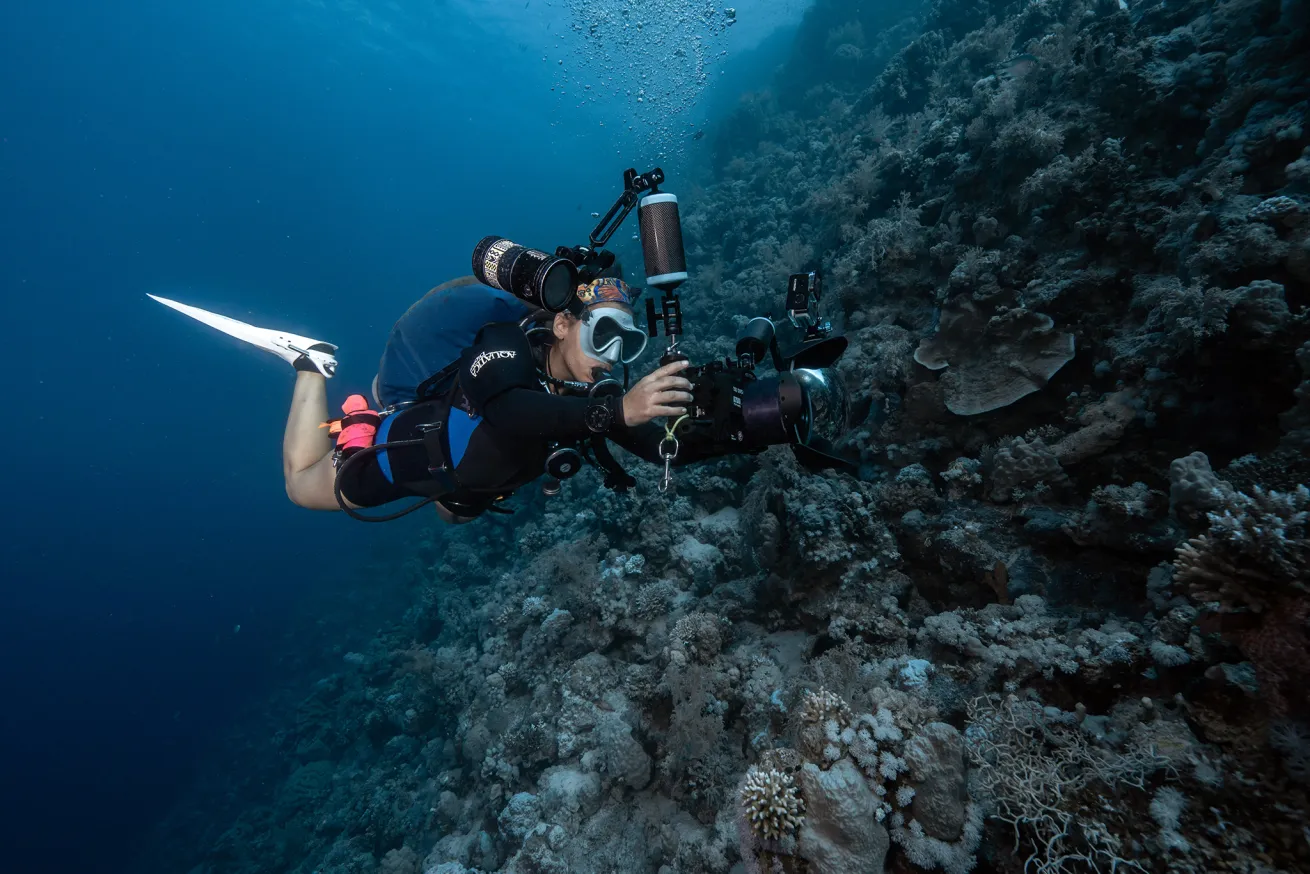
Videographers tend to have impeccable taste when it comes to lighting. They generally want a powerful, wide and even light, and ideally one that can be dimmed to accommodate for various conditions. You’ll often find them attached to a one-inch ball mount, but I’ve also seen assistants on professional shoots hold bigger lighting setups in hand or even set off-camera lights on tripods. In addition, lighting color is important in video, which is why some video lights have variable colors—they can adjust Kelvin temperature to create warmer or cooler tones.All of these options mean that video lighting costs can range from reasonable to eye-watering.
Editor’s Picks: SeaLife SeaDragon 3000 Colorboost, Kraken Hydra, DiveVolk SL 50, BigBlue Video/Tech Light

Technical Dive Lights
Videographers and technical divers both have exacting standards for lighting. The difference is that while videographers aim to produce a beautiful moving image, tec divers often rely on specialized lights—and a specific number of lights—for various environments. Tec divers may use their lights to explore deep reefs, illuminate caves or penetrate wrecks while remaining underwater for hours at a time, which means that both brightness and battery life are of utmost importance.
Canister lights offer the best option as they combine some of the brightest light heads on the market with external battery packs that can last over seven hours on a single charge.
Editor’s Picks: Dive Rite GX40, Halcyon Focus 2.0, Big Blue Canister or Big Blue TL3800P
Underwater Strobe Lights
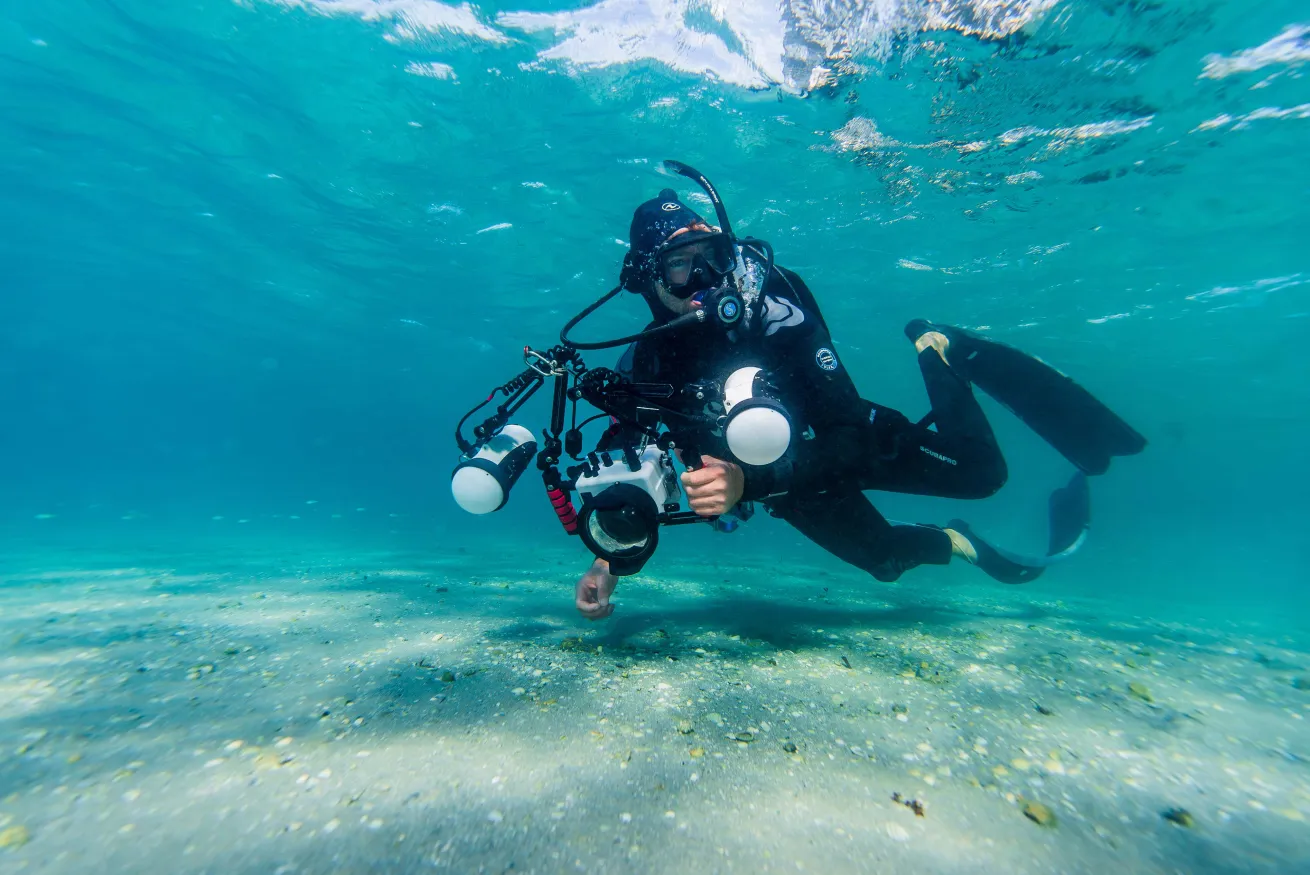
Strobes are specialized lights used for still photography that sync with a camera through electronic or optical connections. In daylight, they bring red colors to deeper subjects and light shadows. At night, they may provide all of the light available to the final photograph. Strobes throw a lot more light than any static light, and in a fraction of a second (1/800-1/1000 of a second), which photographers use to great effect. They can freeze a fast-moving subject in the frame, use it to show motion by combining flash and slow shutter speeds, or use a light-shaping device, such as a snoot, to bring focus to a subject.
It is worth the expense and time to learn how to effectively use a strobe if you want to take your photography to the next level.
A word of caution: Most starting photographers try using a static light on their subjects to save money on a strobe. Some have achieved minimal success, but generally, the lighting is off, and the artist has to make compromises in exposure to compensate for the diminished lighting.
Editor’s Picks: Ikelite Ecko Fiber, Ikelite DS232 Strobe + Video Light, Backscatter Atom
Dive Light Batteries
A final consideration in choosing a dive light is the type of battery the light uses. The options include lights with built-in batteries that are recharged through the light, removable proprietary batteries and normal battery sizes, each with unique pluses and minuses. Built-in batteries mean the lights don’t need to be disassembled to be charged, but the exposed charging ports are more prone to corrosion. Additionally, users can’t swap out new batteries for a full charge between dives. Removable proprietary batteries tend to last a long time and are common in powerful lights, but replacements from the manufacturer take time to ship—and are not commonly found in a dive shop, especially if diving in a remote destination. Additionally, these tend to be lithium which are more difficult to travel with. Normal battery sizes like AA are available in a pinch from any gas station or grocery store, but they are generally only available for smaller lights that don’t require much power. Regardless, it is always a good idea to carry backup batteries so you will always have a fresh set on hand for the next dive.
Final Thoughts Before You Buy
The properties of water, your needs and your budget will determine the right light for you. As you grow as a diver, you may accrue a few lights for various needs. I usually night dive with at least three lights, and each has a separate purpose.


