

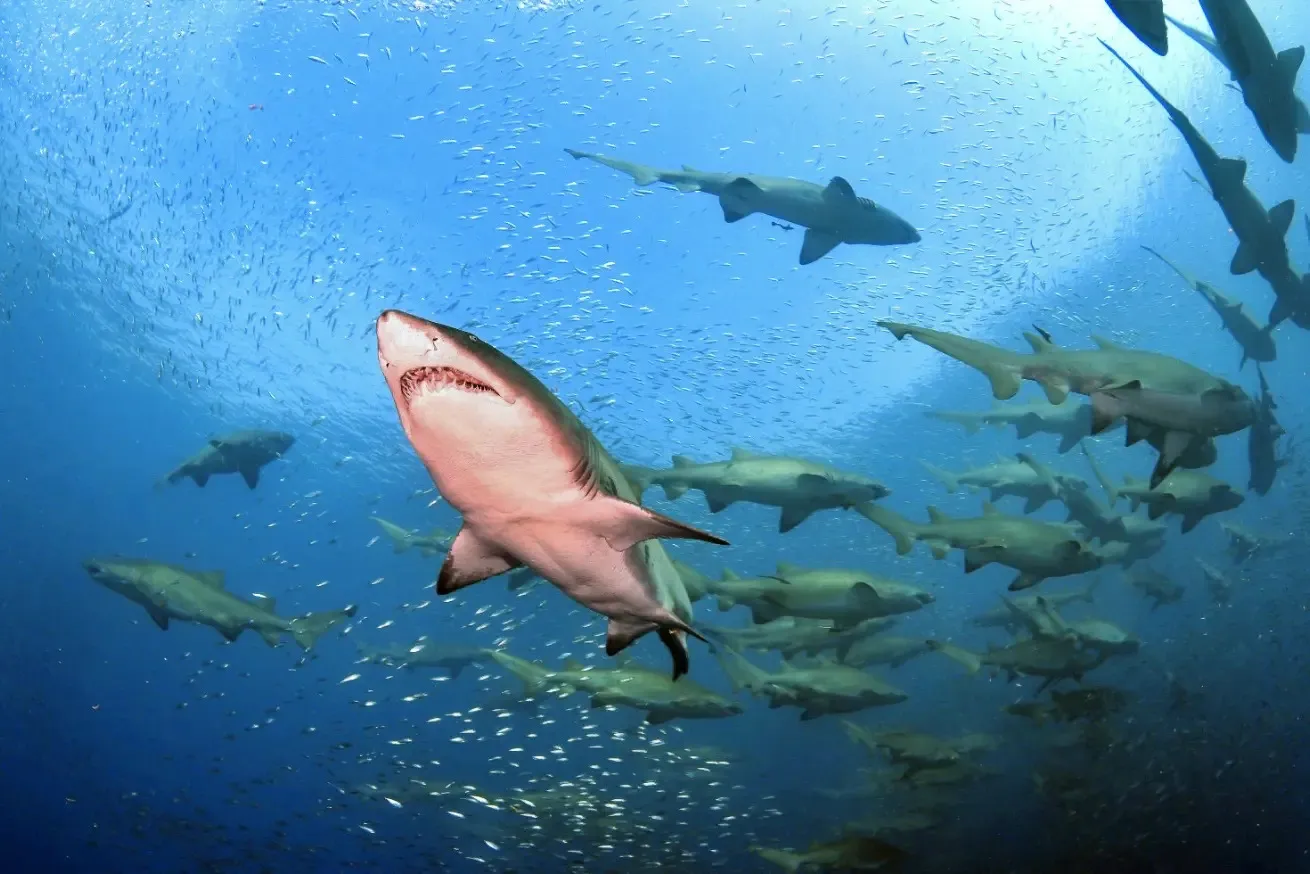
Courtesy of Olympus Dive CenterDespite their toothy grin, sand tiger sharks are remarkably docile, often gathering by the dozens around North Carolina's historic wrecks.
On the right summer day, the sand tigers stack up over Olympus Dive Center's offshore wrecks until the water itself seems to thicken. "Ten deep and a hundred wide" is how Bobby Purifoy describes the big aggregations—a hundred sharks layered midwater, so that when you follow the anchor line down, the school parts around you like starlings giving way to a hawk. "You just go right down through them," he says. Those days turn on weather and timing, but when one lands, Purifoy says, "It's just magic."
More often, the sharks are scattered across the wrecks, mouths open, in no hurry, a few slipping inside to circle a cabin like fish in an aquarium. Either way, they're nothing like their television reputation. "We don't bait the sharks. We never have," Purifoy says. "No chum, no bait buckets, none of it." Sand tigers are slow, heavy, faintly sleepy-seeming animals. "Spook one and it bolts with a crack like a bullwhip as its tail snaps. All you have to do is be still, and the sharks come right to you. Actually, they're kind of chicken." On a good day, count on seeing a couple over the shallow wrecks and a dozen on deeper wrecks. The hundred-shark shiver is, of course, the prize. Researchers at the North Carolina Aquarium ID each shark by the gold spots on its flanks, as individual as a fingerprint, and Olympus runs a citizen-science photo course so divers can join the research.
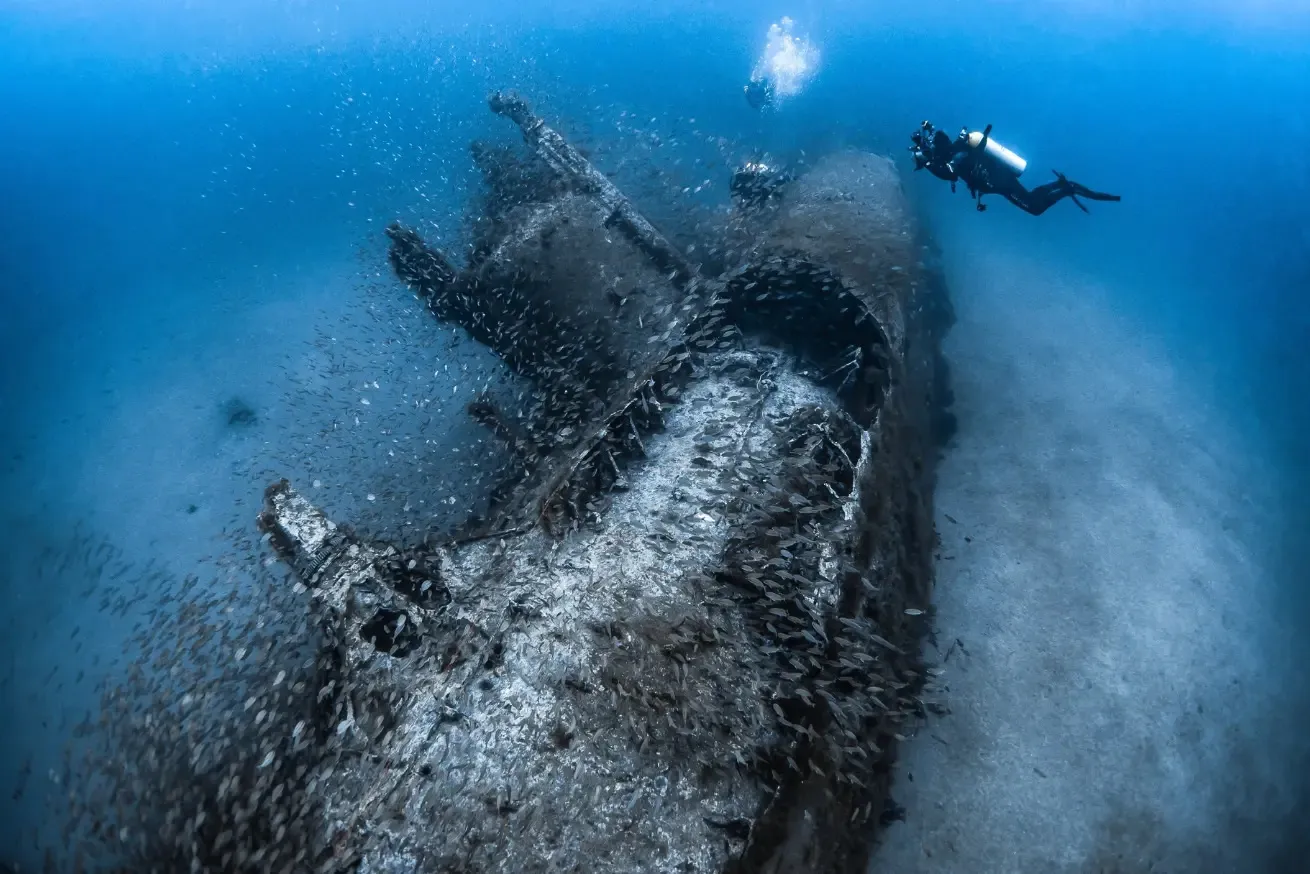
Courtesy of Olympus Dive CenterA diver explores the wreck of the U-352, a German U-boat sunk off North Carolina's coast during World War II and now blanketed in marine life.
The Graveyard of the Atlantic
The wrecks themselves—about 18 that are regularly dived—run from easy to more advanced. The shallow Indra and the James J. Francesconi tug sit in about 60 feet of water and are simple to dive. The one Purifoy can't talk about without lighting up is deeper and older: the U-352, a German U-boat sunk in 1942, about 26 miles offshore. His father searched for it for a decade, starting before his son was born, and the find all but launched the dive center. To Purifoy it's the most historic recreational wreck a diver can reach on an ordinary day. "I've been diving it since I was 12," he says, "and every time, it's still … God, that's awesome."
None of this, Purifoy makes clear, is light Caribbean diving. "It's a little more challenging here than in some places," he says, and he's honest about who thrives: divers comfortable with their gear and their computer, watching no-deco time on a flat profile with no reef to follow back up. Newer divers aren't shut out; shallow charters, dive guides for hire, and buoyancy and wreck courses build the skills. Holding it together is a crew of about 15 who've stayed for years and who drill the buoyancy that shark-covered multilevel wrecks demand.
The window for diving the "Galapagos of the East Coast" is open now. South winds from June into September pull the warm, clear Gulf Stream inshore, and the peak aggregation lands mid-July to mid-August. "Put it on the calendar," Purifoy says. "If you don't book it, you don't go." Why wait?
Book Your Dive or call (252) 726-9432 to learn more about diving The Graveyard of the Atlantic.


