


Francesca Page
Gliding into the blue, still sleepy-eyed, tunnel vision takes over and my mind drifts in the dark, moody water of the early morning light.
Ding! Ding! Ding!
The dive guide bangs on his tank, pointing with unmistakable excitement. The moment I have been dreaming of for years rises fast from the deep. There is no time to think. It’s here!
Straight out of a David Attenborough documentary, Mother Nature unveils a spectacle beyond anything money could buy. The bumphead parrotfish spawning show has begun.
Like fireworks, we’re surrounded by explosions of fish and new life. My mask leaks as I smile uncontrollably, trying to keep up with all the action. This is what it means to feel alive.

Francesca Page
Adrift in the Pacific
From the luxurious deck of the Black Pearl liveaboard, the days fall into a gentle rhythm: dive, eat, sleep, repeat. Dawn briefings blur into back-roll entries; surface intervals drift by under the hot, sticky tropical sun; and evenings are spent replaying encounters long after our last bubbles were made. With nothing to distract me, my world shrinks to the essentials: charging camera batteries, readying dive equipment, monitoring current direction and the quiet anticipation of what the next descent might bring.
Palau—a ring of islands born of fire—is a destination that needs little introduction in the diving world. Sitting on the edge of the Philippine Sea tectonic plate, this remote Pacific archipelago was forged through immense geological force. Millions of years ago, the vast Pacific plate slid beneath the smaller Philippine plate, triggering violent volcanic eruptions that formed a 100-mile-long volcanic ridge.
Today, we dive through the remnants of that ancient upheaval, exploring sunken volcanoes, sheer walls and limestone formations where Palau’s deep past is etched into the very rock beneath our fins.
The islands also lie at the meeting point of powerful ocean currents, creating one of the most biologically rich marine environments on Earth. It is a place where big animals thrive, reefs pulse with life and every dive holds the promise of something extraordinary.
.png)
If Palau is not already on your diving bucket list, this place, bursting with life, color and protected marine habitats, deserves strong consideration. With thrilling currents, shark and manta cleaning stations, healthy coral reefs, and scenery so stunning it almost doesn’t feel real, Palau doesn’t disappoint!
Click here to follow Francesca's travel log to Palau.
Worth the Wait
It took three long days of travel to reach this remote corner of the world. My partner, Liam, who joined me on this trip with the energy of an excitable puppy, spent much of the journey telling me how one of his earliest childhood memories was a poster of Palau on his bedroom wall. Visiting had always been a dream of his.
As our plane begins its descent and Palau reveals itself for the first time, my eyes struggle to process the flood of color, a vivid explosion of turquoise blues and emerald greens. Below us, limestone islands rise from impossibly clear water, dense jungle spilling down to the sea. Even from above, life feels abundant here.

Francesca PagePalau’s vibrant reefs showcase a diverse range of corals and fish life.
I look at Liam, our smiles stretched from ear to ear, and we both break into a small, uncontainable happy dance in our seats, pointing out of the window. “That looks like it would be a great dive spot! Oh, I bet there’s a manta there!” Our imaginations are already off to the races as excitement builds for the week of diving ahead.
Before entering Palau, every visitor is asked to sign a pledge, neatly stamped into their passport, promising to “preserve and protect your beautiful and unique island home.” It ends with a simple yet powerful line: “The only footprints I shall leave are those that will wash away.”
It’s the first country I’ve visited where conservation begins the moment you arrive. Palau is a global leader in marine protection. It has one of the largest marine protected areas in the world, and 80 percent of its waters are fully protected from fishing and other destructive activities. This leaves the ocean remarkably pristine and supports an economy built on tourism, diving and snorkeling. The remaining waters are reserved for traditional, small-scale local fishing, a balance that allows both nature and culture to thrive.
Related Reading: Palau Diving Meets Luxury on the Four Seasons Explorer
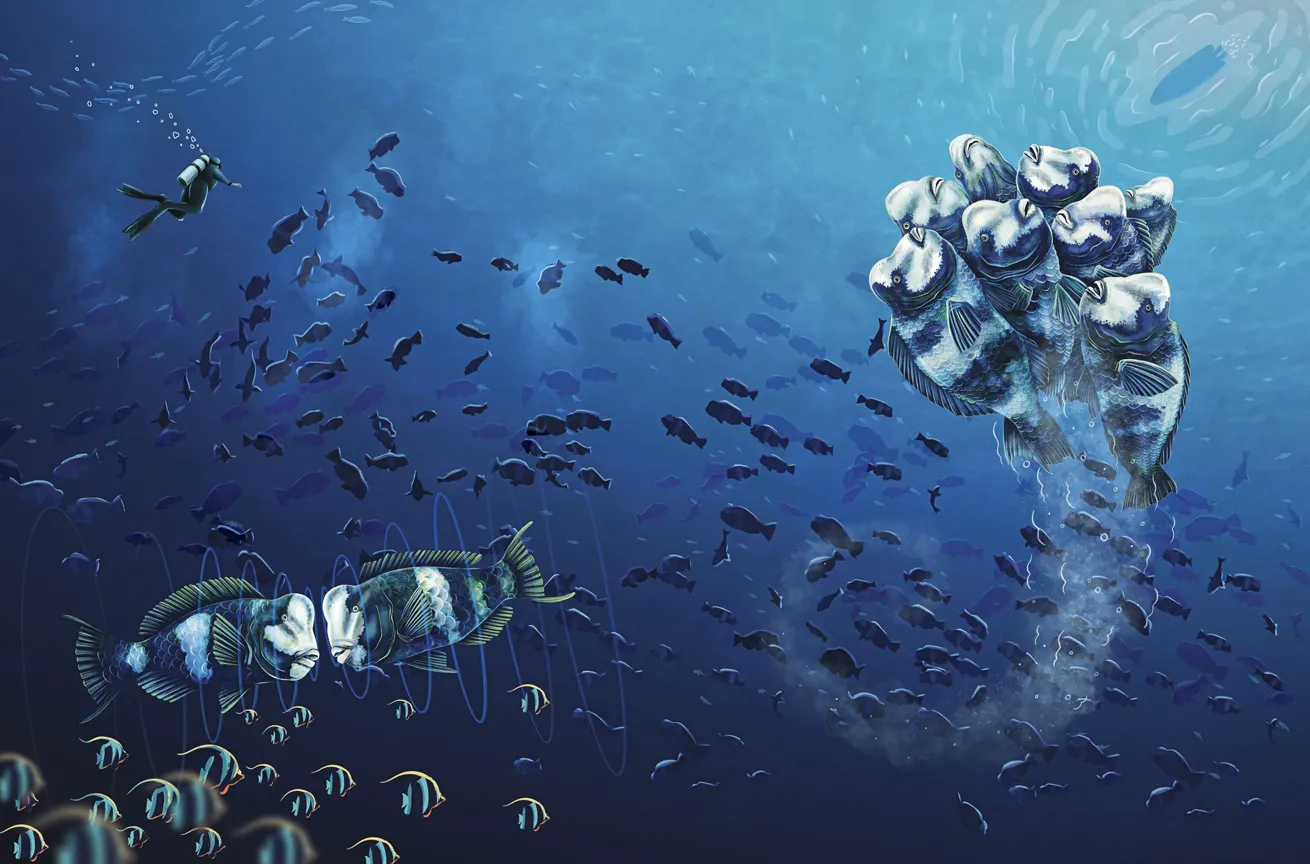
Francesca PageAn aggregation of bumphead parrotfish rockets upward from the depths. The fishes’ white faces indicate they are ready to mate.
Diving With Spawning Bumphead Parrotfish
Jet lag hangs over me like a fog as we sit down for our first meal on board. My partner and I are pleasantly surprised by the care the chef has taken to accommodate our plant-based diet. Every day of our trip offered thoughtful, nourishing meals that left us fueled for the diving ahead.
Then Jefry, the cruise director, walks into the dining room. I assume we’re about to get a gentle introduction. Instead, he grins and says, “So, who’s ready to do the bumphead parrotfish spawning dive tomorrow morning?”
He explains that plans have shifted: With the new moon in two days, 6 a.m. tomorrow is our best chance to witness it. My hand shoots up far too quickly, like I’m back at school. The room laughs. My next thought is immediate and practical: I need to get my camera ready, and I need to get some good sleep.
Every new moon, thousands of bump-head parrotfish gather in Palau’s Rock Islands for a mass spawning event, the largest of its kind anywhere in the world. Timing is everything. The fish spawn on an outgoing tide, giving their fertilized eggs the best possible chance to drift into open water, away from waiting predators.
The next morning, we descend into the dark blue, leaving the bustling shallow reef behind and heading straight for open water. We settle between 60 and a hundred feet, suspended in the blue, waiting.
Then, out of the haze below, they rise. Like a herd of buffalo emerging from the mist, thousands of bumphead parrotfish materialize from the sandy bottom, moving as one in perfect synchrony. They surge upward, and suddenly, poof! Silent explosions ripple through the water as clouds of gametes burst around us, again and again.
What fascinates me most is the way their bodies transform, as if they are putting on costumes for the show. By day, they are emerald green, but now they fade to blue-gray, a stark white stripe slicing down their bodies, faces paling as they prepare to spawn. I’ve long been drawn to animal migrations, and having witnessed cuttlefish mating events in South Australia, the same phenomenon always strikes me—creatures quite literally shapeshifting for the act of creating new life.
It’s moments like these, hovering in complete awe, that fuel my love for scuba diving. In less than 45 minutes, it’s over, Mother Nature in full command, her timing guided by the moon, the tide and millennia of instinct. This is what a protected ocean looks like, and it leaves that fire in my belly burning brighter, reminding me why marine protected areas are so important.
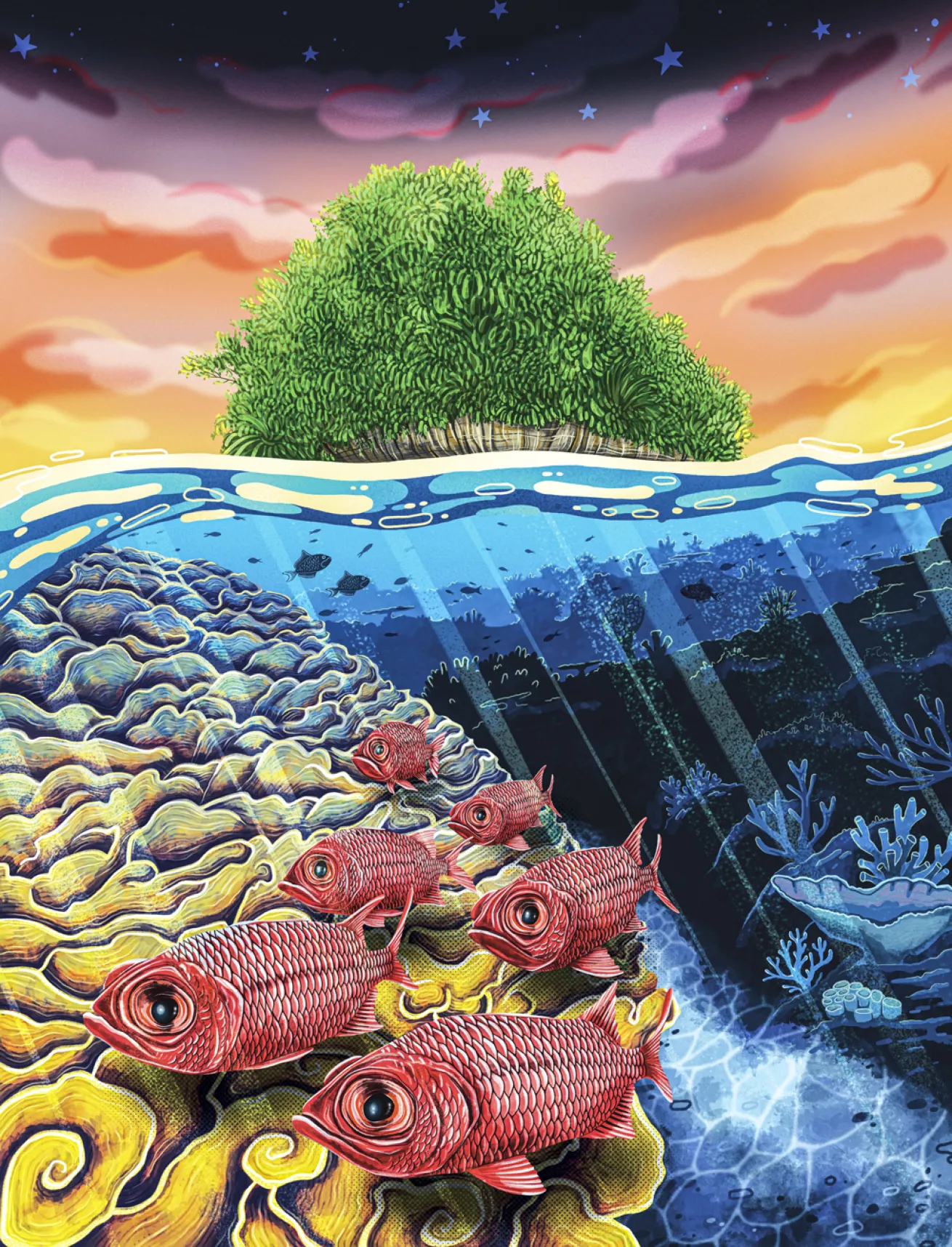
Francesca Page
Strong Current, Schools of Fish and Patches of Cabbage Coral
The dive site Ulong Channel quickly becomes one of my favorites. We hook into the reef wall, bodies horizontal, feeling like superheroes as the current rushes past. Water flows over our faces, bubbles flying diagonally over our shoulders, and for a moment, it feels like flying.
I look up to see five gray reef sharks gliding effortlessly against the current. For 10 minutes, we watch them cruise along the wall, seemingly unbothered by the current. Around us, schools of barracuda and jacks swirl like a murmuration of starlings, folding and twirling through shafts of light against the rich blue backdrop.
I glance at our guide, Joddy, and he gives us the signal. It’s time to move on. One… two… three… We release from the reef together, launching backward into the channel. A kaleidoscope of pinks, purples and blues blurs beneath us as the current sweeps us over the reef to a white sandy bottom channel. Late-afternoon light kisses the reef, casting silhouettes of groupers and distant schools of fish. We dodge territorial triggerfish, darting unpredictably to protect their circular rubble nests.
The true highlight awaits at the end of the channel: a gigantic yellow Montipora, or cabbage coral, the second-largest patch in the world. It’s impossible to take in fully without a dive buddy for scale. Blotcheye soldier-fish hover over its shelves, eyes staring, markings so precise it looks as though each scale was drawn by hand.
The dive feels like a roller coaster. During our safety stop, I signal to my partner with a flurry of gestures: “That was epic!” Giggles turn into bubbles, timed with the safety stop beeps of our dive computers. We surface, and I pull out my regulator, shouting to Joddy with excitement, “Can we do that again?”
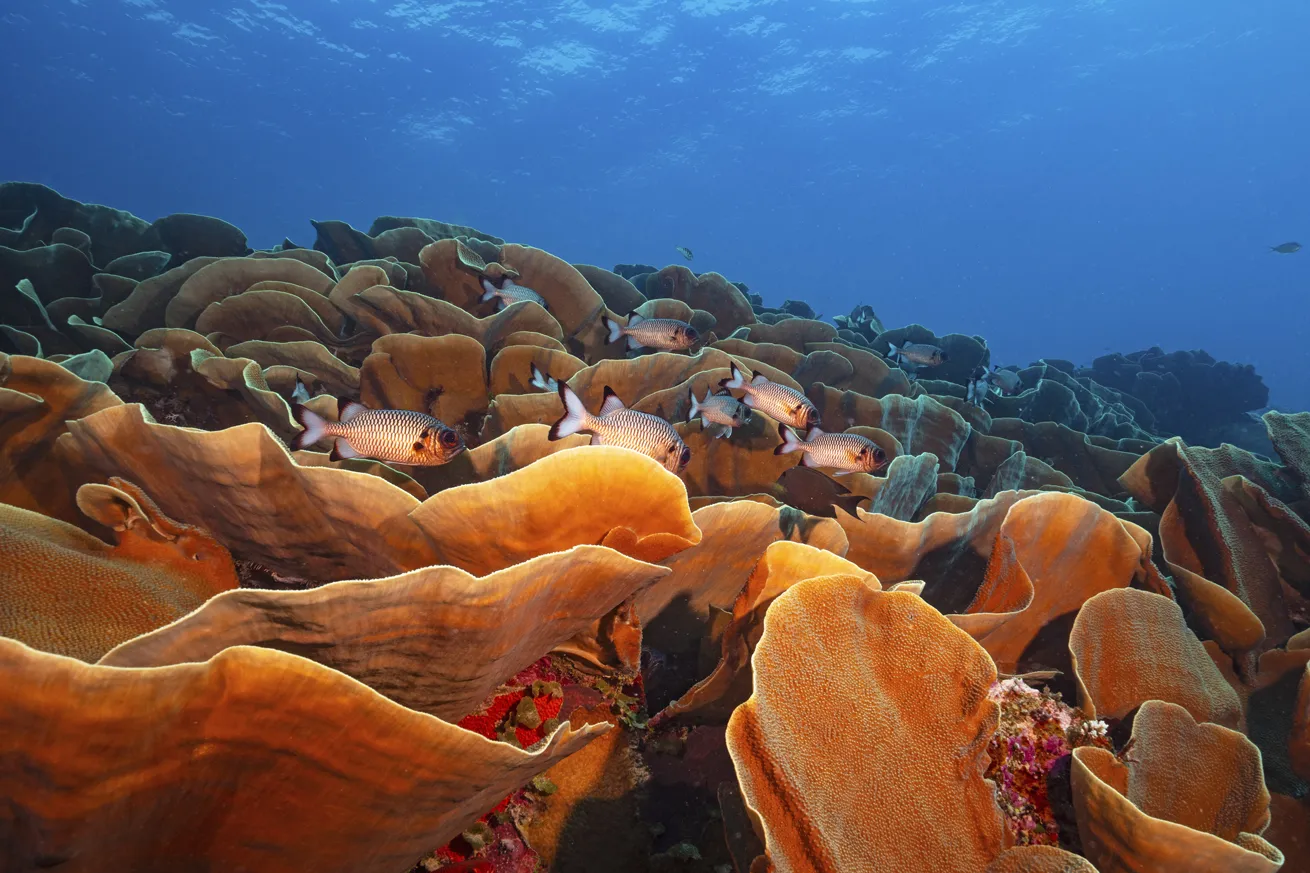
Francesca PageA massive patch of cabbage coral at Ulong Channel.
Tangled Up in Blue
A famous Palau dive site, just south of the iconic Blue Corner, is so good we did it twice. The dive begins with a descent into a deep-blue crack in the reef, dropping 30 feet before being spat out into a cathedral-like cave, vast and mesmerizing. Sleepy whitetip reef sharks rest beneath rocks, while pink sea fans carpet the ceiling and edges like delicate curtains, revealing the bustling coral city beyond.
At 80 feet, we exit the blue hole, letting the gentle current carry us toward Blue Corner. Here, the reef cascades over the plateau like a coral waterfall. Soft pastels and an array of hard and soft coral species create a kaleidoscopic landscape.
As we drift shallower, the reef becomes a riot of life. Schools of shimmering fish swirl around us. I’m suddenly engulfed by tiny blue triggerfish, sending me into a trance. I glance at my dive group, also surrounded by fish that I imagine to be sirens of the reef, whispering sweet nothings into our bubbles and luring us to stay for just a little longer.
Related Reading: How to Dive Palau's Blue Corner
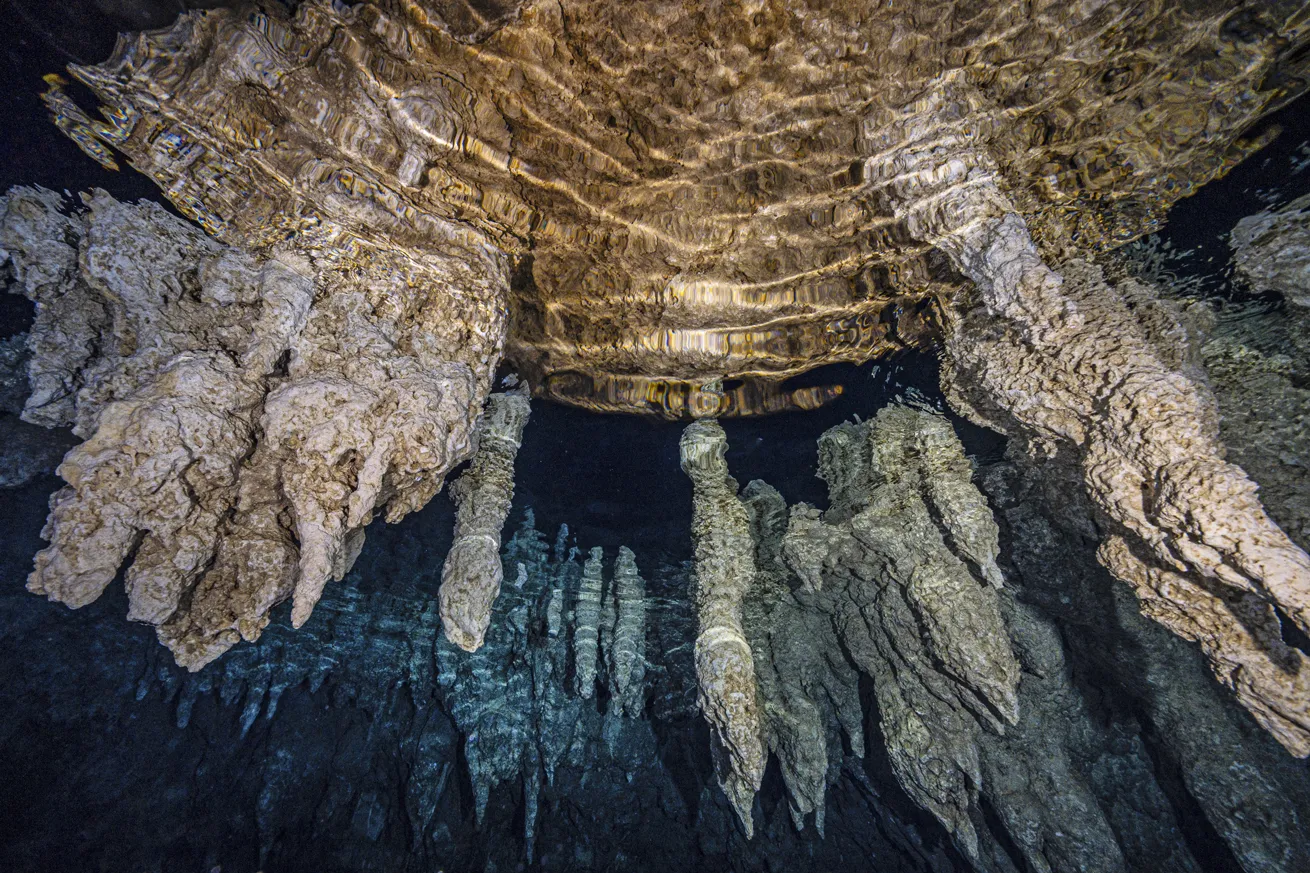
Francesca PageStalactites hang from the ceiling at Chandelier Cave.
Cave of Wonders
On the final day of diving, I realize the best has been saved for last. Nestled in Malakal Harbor, a breathtaking series of partially submerged chambers lies tucked beneath the tangled rainforest, mere feet from the bustle of Koror, Palau’s largest city. The Chandelier Cave entrance, just 12 feet below the surface, is a dive that will take your breath away.
Inside, towering stalactites hang like frozen chandeliers, mirrored by stalagmites rising from the floor. Each chamber feels like diving into a cathedral carved by time, shaped by rain and the slow, patient work of Palau’s unique geology. Long ago, the cavern was open to the sky. Over millennia, these glittering mineral formations grew into the marvels we see today. As the oceans rose after the last ice age, the entrance vanished beneath the waves, leaving a labyrinth of water-filled chambers, each holding pockets of air.
As we journey through the caverns and natural light grows dim, we flick on our torches. The cavern reveals itself, with shimmering architecture that feels almost otherworldly, a sanctuary where time stands still. My favorite chamber is the second, the largest and most impressive. Surfacing into its air pocket, we shine our torches toward the reflective ceiling and the entire cavern illuminates, as if someone has flipped a switch. From here, you can explore narrow cracks in the rock, getting close enough to admire Palau’s ancient geology. This dive became a personal highlight of the trip.
After each dive, we’re welcomed back on board by smiling faces, cold drinks and handmade sweet treats, a much-needed sugar hit before the next plunge. I retreat to the top deck, stretching out beneath a sky heavy with heat, watching Palau’s rainforest-choked islands drift by. Sketchbook in hand, I try to capture fragments of the week, not just what I’ve seen, but how it made me feel. My mind hums with inspiration.
It’s weeks like this that make me feel alive and remind me why I fell in love with scuba diving in the first place. Reflecting on our time here, what stays with me most is the sheer abundance of life: reefs thick with movement, predators cruising with confidence, ecosystems quietly doing what they’ve done for millennia. As I begin the long journey home, there’s comfort in knowing that beneath the surface here in Palau, life is still thriving, protected, resilient and extraordinary.
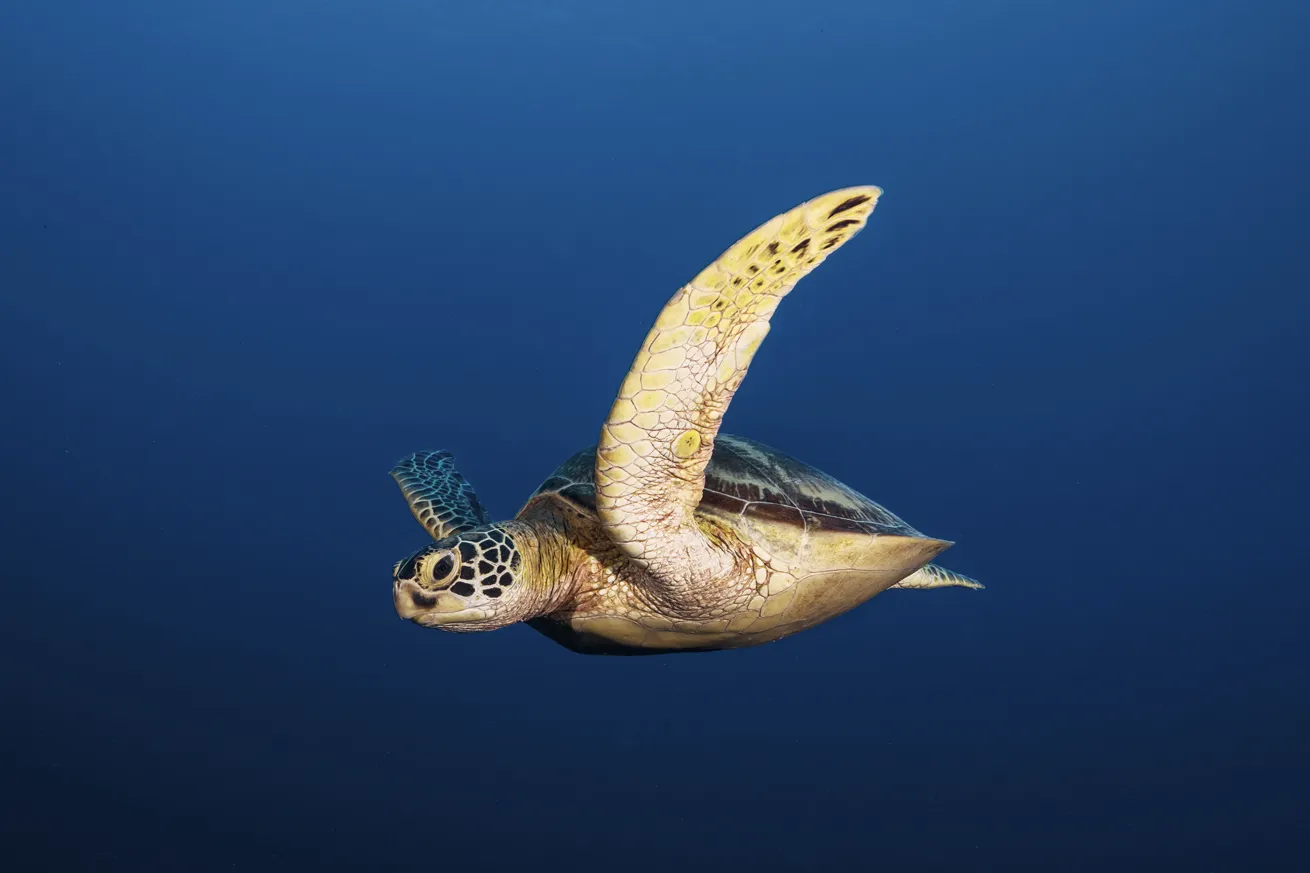
Francesca PageA green sea turtle swims in Palau’s open ocean.
Need to Know Diving Visayas, Philippines
When to Go The best time to visit Palau is during the dry season from November to April.
Conditions Water temperatures typically range from 82°F–86°F. Current can be expected at certain sites.
Itinerary 8 days / 7 nights
Diving Equipment If you’d rather save on baggage weight, full dive gear or individual items, such as wetsuits, are available to rent on board Black Pearl. The crew handles everything—setting up, refilling tanks and rinsing your gear—all guests need to do is place their tank on the tender. Wetsuits and cameras are rinsed separately, with large freshwater tanks and showers on the dive deck.
Travel Tips There are no taxis in Palau, so it’s essential to book your transfer before arriving, either through your hotel or Pearl Fleet. Be sure to bring cash in USD, as most places on the island, including hotels, restaurants and tourist excursions, prefer cash payments. If needed, your driver can usually stop at a local ATM en route to your final destination.

Francesca Page
About the Black Pearl Liveaboard
Year Built 2019
Length 160 Feet
Maximum Guests 24
Tenders 2
Staterooms/Beds Black Pearl's 12 cabins are cozy, modern and thoughtfully designed, each with a spacious en suite bathroom and plenty of storage. Twin double beds and air-conditioned interiors make for exceptionally comfy nights, some of the best sleep I’ve ever had on a liveaboard. It’s a slice of luxury, sailing through paradise.
Amenities The yacht is equipped for both adventure and downtime, with a dedicated camera table and charging station on the dive deck, indoor and outdoor lounges, free Wi-Fi, Jacuzzi, spa with an onboard personal masseuse, and air-conditioned interiors. An outdoor bar, kayaks and stand-up paddleboards invite slow afternoons on the water, while generous sun decks offer endless places to stretch out, unwind and soak up the sunshine.
Food/Drink Meals are served buffet style, offering a generous spread of international dishes, from Italian and Asian to American and Western cuisine. Dietary requirements are thoughtfully catered to, with plenty of vegan, vegetarian and gluten-free options available. Just be sure to inform the liveaboard in advance so the crew can prepare for your arrival. Complimentary snacks are available throughout the day, along with a selection of tea and coffee. Alcohol, wines and soft drinks are offered at an additional cost.


