

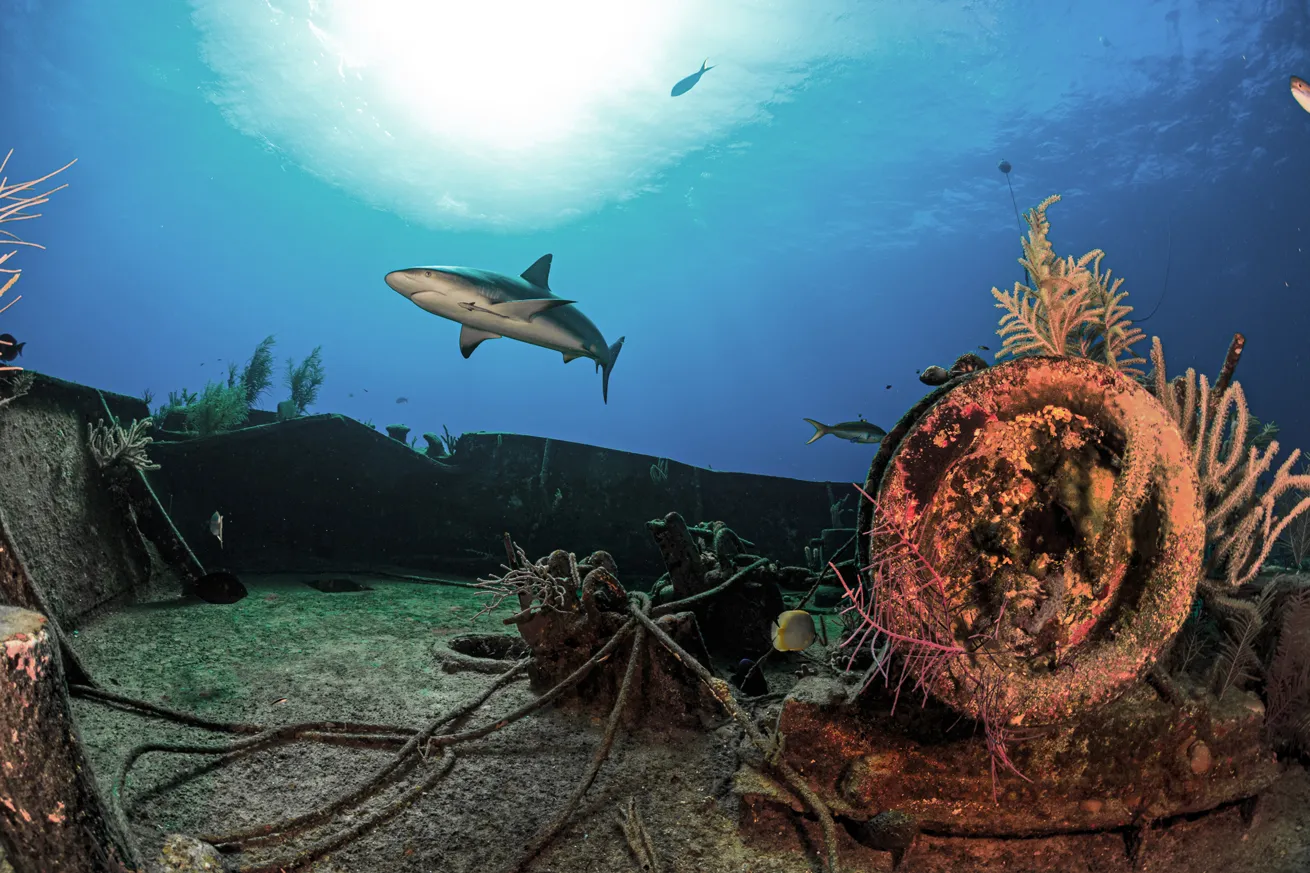
Shutterstock/Nicolasvoisin44Caribbean reef shark sightings are practically guaranteed when you dive in the Bahamas.
Diving With Sharks in the Bahamas
It’s common for first-timers to be unprepared for all the adrenaline of a Bahamas shark dive.
“The big shock is, ‘Oh my gosh, there are sharks everywhere,’” says Travis Cove, general manager at Stuart Cove’s Dive Bahamas in Nassau.
He’s talking about the Caribbean reef sharks that regularly show up at a handful of dive sites, including the Ray of Hope wreck.
On the dedicated shark dives, the first dive is an exploratory tour of the site for folks to acclimate to the environment—and the fins cutting through the water.
“With the second dive, they can appreciate the experience a little more,” says Cove, referring to the fact that when nerves calm, vision widens. Divers can be more present to the wonders surrounding them.
Simply put, you notice more.
The sharks vary in size, with juveniles spanning 3 to 4 feet and the adults clocking in at 9 feet. Females may have scars from past mating seasons.
Granted, the reason the dive is so popular is also why it can be hard to identify individual sharks. On any given day, anywhere from 10 to 30 Caribbean reef sharks appear.
“Guaranteed, you’ll get 10 to 15—the rest are a perk if you do see more,” says Cove.
“Really though, it’s better at 20 [or under],” he adds. “When you get to 30, you can’t see as well because there are so many.”
Related Reading: Unexpected Adventure in the Bahamas
Need to Know Diving in the Bahamas
When to Go Year-round. The best visibility is in October and November, a draw for film crews looking to book underwater shoots.
Water Temps Summer temps climb to 88 degrees; winter can dip as low as 78.
Don’t Miss The Ray of Hope gives divers the chance to experience shark action on a wreck. The wreck offers swim-throughs awash with light, making for ample photography opportunities.
Contact Stuart Cove’s (stuartcove.com)
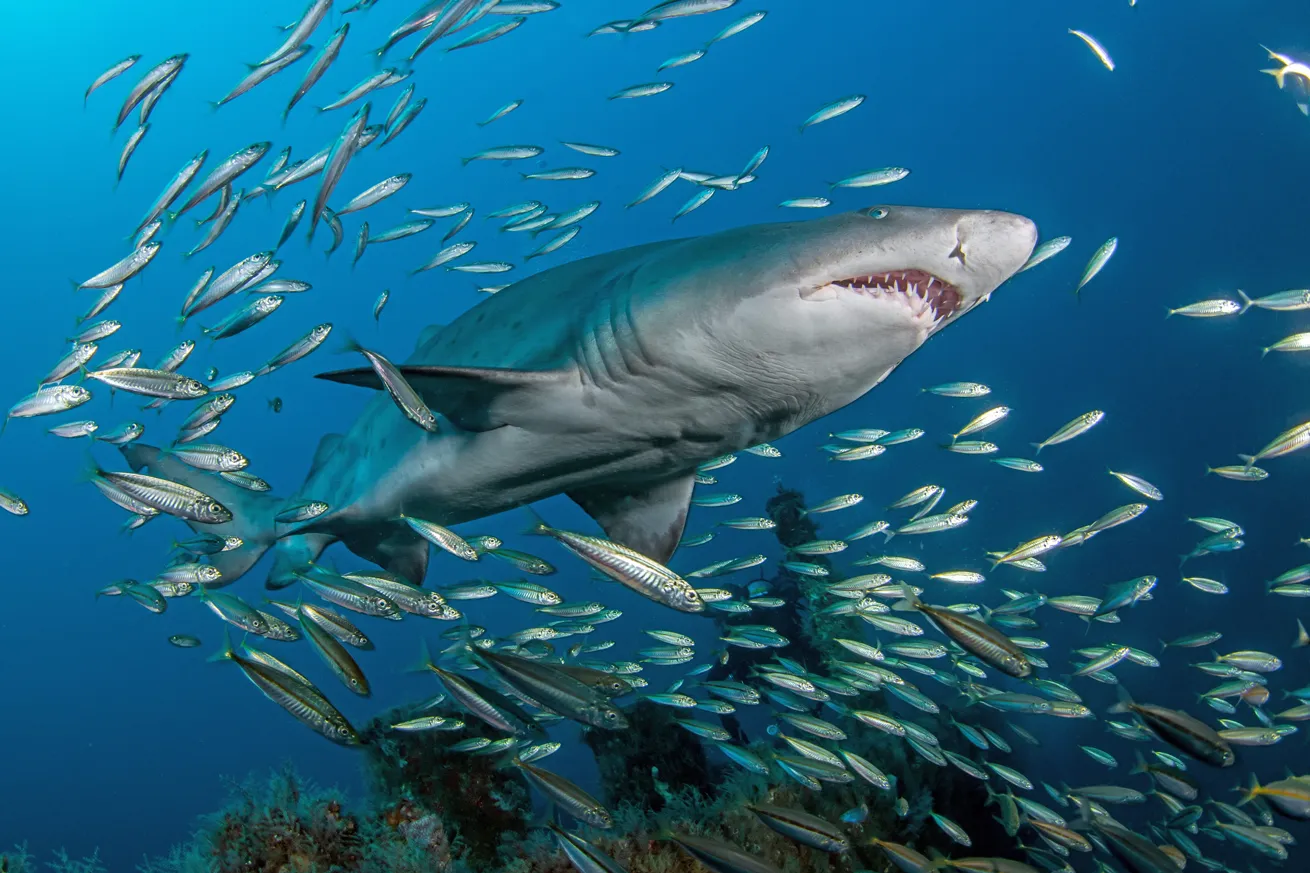
Shutterstock/Tomas KotoucConservation efforts have resulted in a boom in North Carolina’s sand tiger population.
Diving With Sharks in North Carolina
The only folks not pleased with the success of the last three decades of conservation work off the North Carolina coast are fishermen. Sharks are appearing in record numbers, which means their hauls of yellowfin tuna and other prize catches are often snatched before they reach the boat.
For divers, this means that drop-ins on such wrecks as the Caribsea, the Atlas and the Papoose bring not only a greater number of sand tiger sharks but also better odds of seeing other species. Most recently, it’s sandbar sharks in the mix, along with the sand tigers, which have been a staple in the area for years. “We used to go years and not see the sandbar sharks,” says Bobby Purifoy, owner of Olympus Dive Center in Morehead City. “We now see them pretty much every day.”
The two species are easy to tell apart, and they behave differently. Sand tigers swim slowly with their mouths open and teeth exposed.
“Sandbar sharks swim quickly in more of a searching pattern, and this shark has one tall dorsal fin—almost abnormally tall for its size,” says Purifoy.
The sharks also interact with divers in their own ways.
“The sand tiger doesn’t seem to know you’re there, whereas the sandbar is much more curious, and will come right up and check you out,” says Purifoy.
One of the best wrecks to see both sharks is the 436-foot Ario tanker. Torpedoed in 1942, it has had more than 80 years to accumulate marine growth, attracting ample spadefish and amberjack.
“The spadefish are very slow swimming, making really easy targets for the sharks,” says Purifoy.
With such a steady food supply, the sharks stay close by. They’re actively on the hunt, and lucky divers will even witness the sharks chomp down on their next meal.
Related Reading: How Do I Dive Safely With Sharks?
Need to Know Diving in North Carolina
When to Go The dive season off Morehead City extends May through October, plus weekends in April and November.
Water Temps Late summer sees water temperatures of 76 to 80 degrees. At the start of the dive season, water temps can be in the high 60s to low 70s. Call the week before you travel to get an updated report.
Don’t Miss The 328-foot Indra wreck is another top pick for spotting sharks. In May 2025, divers often encountered five or more sandbar sharks as well as a handful of sand tigers.
Contact Olympus Diving (olympusdiving.com)
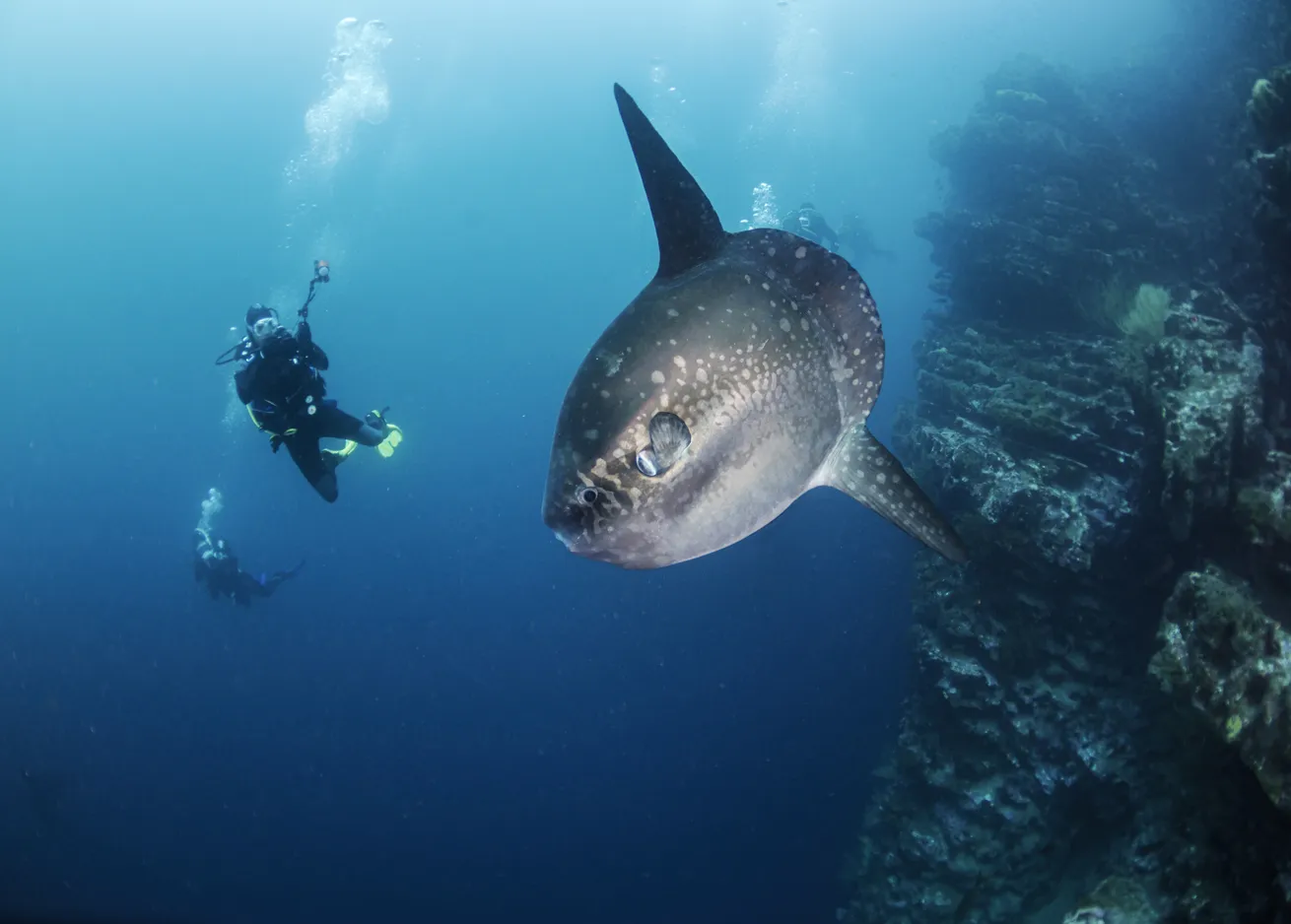
Shutterstock/WildestanimalOcean sunfish are notoriously shy, but with a little patience, they often will approach divers, like this one did at Punta Vicente Roca, a dive site in the Galapagos.
Diving With Sunfish in the Galapagos
Schooling hammerheads and giant mantas are the most famous underwater attractions of Ecuador’s Galapagos Islands, but it might just be a relative of the trunkfish that gives guests the biggest jaw-dropping moments.
Sightings of ocean sunfish—wide and flat with cartoonish eyes—are so rare that most divers don’t expect to ever encounter them.
“People really want to see this bizarre animal, but they have no idea that they can see them in the Galapagos,” says Jenny Waack, founder of Galapagos Shark Diving, which offers liveaboard trips where guests dive alongside researchers.
Head to the western side of the island of Isabela, and there you’ll find cleaning stations where this up-to-10-foot animal gathers year-round. The fish is famously shy, which means divers need to practice the utmost restraint, letting the sunfish come to them, should they choose—which they often do. Last year, Waack and her divers mixed with a school, with 10 sunfish swimming right through the group.
“A lot of people mention the sunfish as a trip highlight because it’s something they never expected to see—it’s quite magical,” she says.
Of course, the expected encounters can be just as life-changing.
This past year was exceptional for hammerheads, with schools of 500 seen on dives. Perhaps emboldened by being in such large schools, they came in even closer to divers.
“They were streaming right overhead, not bothered by our bubbles,” says Waack. “There were so many hammerheads, you couldn’t see through to the whale sharks. It was like, ‘Could you move out of the way?’”
Related Reading: Diving to Protect the Galapagos
Need to Know Diving Galapagos
When to Go From June to November, divers have the best chances for encounters with the biggest schools of hammerheads.
Water Temps The Humboldt Current keeps temperatures between 60 and 75 degrees.
Don’t Miss The dive site Punta Vicente Roca is famous for ocean sunfish, as well as sea lions and flightless cormorants.
Contact Galapagos Shark Diving (galapagossharkdiving.com)
Readers Choice Awards 2025
This year we surveyed 8,566 readers on their favorite destinations, resorts, operators and liveaboards, awarding their top picks across a variety of categories. Our Readers Choice travel feature highlights the first-place destinations in each global region and offers a taste of what makes each a reader favorite.
Click here to see all Readers Choice award-winning resorts, operators and liveaboards.


