

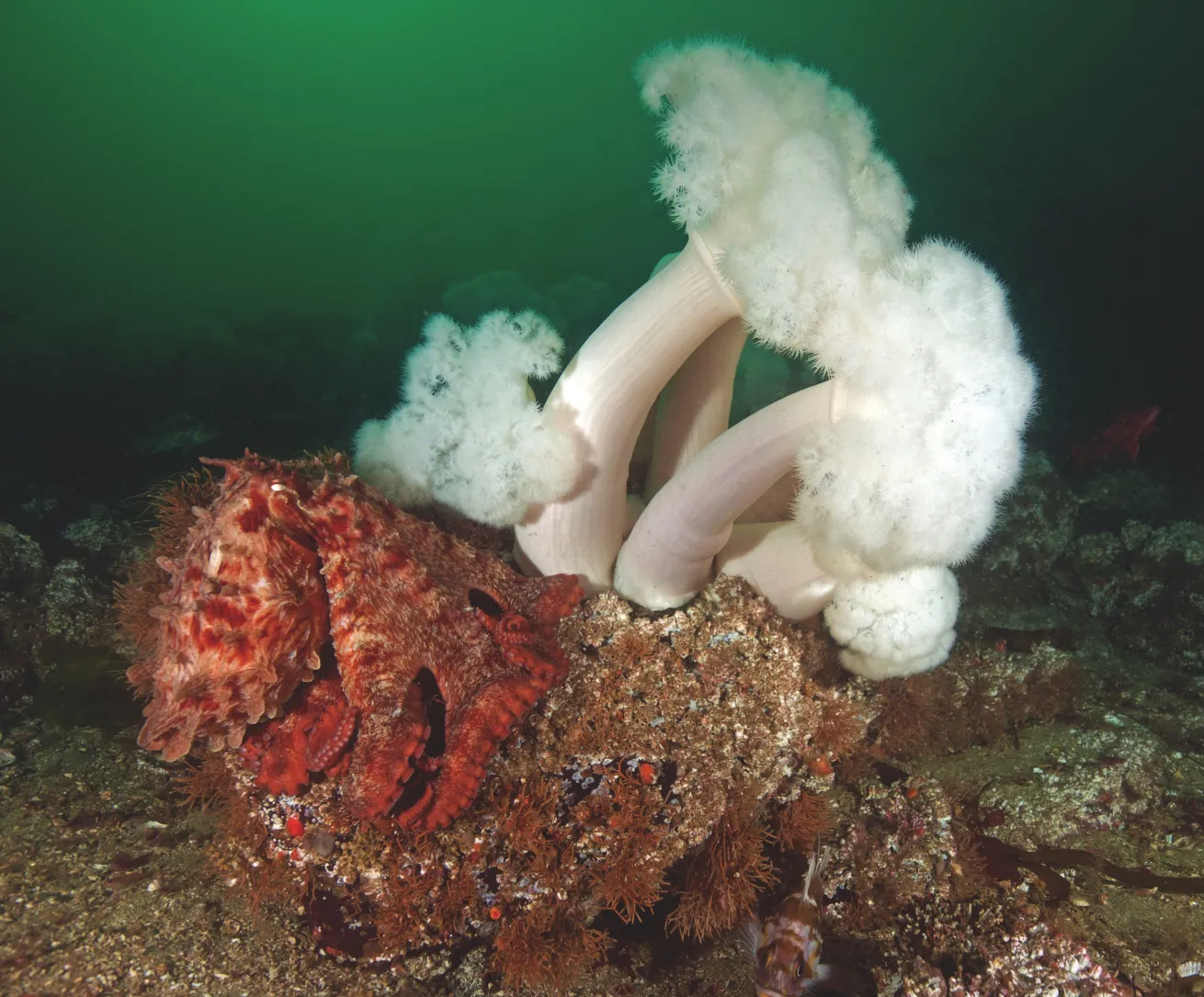
Shutterstock/Philip GarnerA giant Pacific octopus poses beside a plumose anemone in British Columbia.
British Columbia
The combination of exotic cold-water species along with wrecks and walls of colorful invertebrates makes British Columbia a top destination for underwater shooters.
“Everybody loves the giant Pacific octopus and the wolf eels,” says Cody Tyson-Pearce, instructor and general manager at Rowand’s Reef Scuba Shop in Vancouver.
GPOs leave a lasting impression on divers, starting with their size. At up to 14 feet long, they easily fill the camera frame. Their dappled, rose-colored skin changes colors as they hover over substrates of varying shades. Most of all, this species is known to be playful with divers—especially photographers. They’re curious, perhaps drawn to their reflections in a housing dome, which gives shooters ample opportunity to snap just the right shot.
Also significantly larger than their warm-water counterparts, wolf eels grow up to 8 feet long. Their Muppet-like faces and overly wrinkled, mottled gray skin hold a certain appeal. Like the GPO, these freakish but gentle fish are known to approach divers, mugging for the camera.
Both can be found at shore-diving sites, including the walls of Whytecliff Park in West Vancouver and Porteau Cove at the north side of the city.
But there’s more to British Columbia than just oddball species.
Several artificial reefs dial up the diversity, giving divers the chance to shoot wide-angle.
“Most of the wrecks around Vancouver Island are covered in stuff—they’re quite dirty, so much so that it makes it hard to tell it’s a wreck,” says Tyson-Pearce of many of the downed vessels.
The HMCS Annapolis is the most notable exception. Sunk in 2015, it’s still relatively new and largely intact.
“It’s obvious that you’re looking at a 100-meter warship,” he says.
The 366-foot destroyer escort sits between 35 and 105 feet of water and offers its bridge, hallways, helicopter deck and hangar deck as ideal spots for photos.
The Annapolis is one of the area’s most requested sites: It’s the chance to dive a wreck and potentially see wolf eels and giant Pacific octopuses—knocking multiple animals off the must-see list with just one dive.
Related Reading: Why Do Octopuses Change Color? How It Works and Why They Do It
Need to Know Diving British Columbia
When to Go Winter months bring the best visibility.
Water Temps Expect between 45 and 55 degrees.
Don’t Miss Kelvin Grove, a shore-dive site in Lions Bay, is a top spot for finding nudibranchs, including the giant red dendronotid. It’s a good place to see dogfish, six-gill sharks and, in the summer, other small shark species.
Contact rowandsreef.com
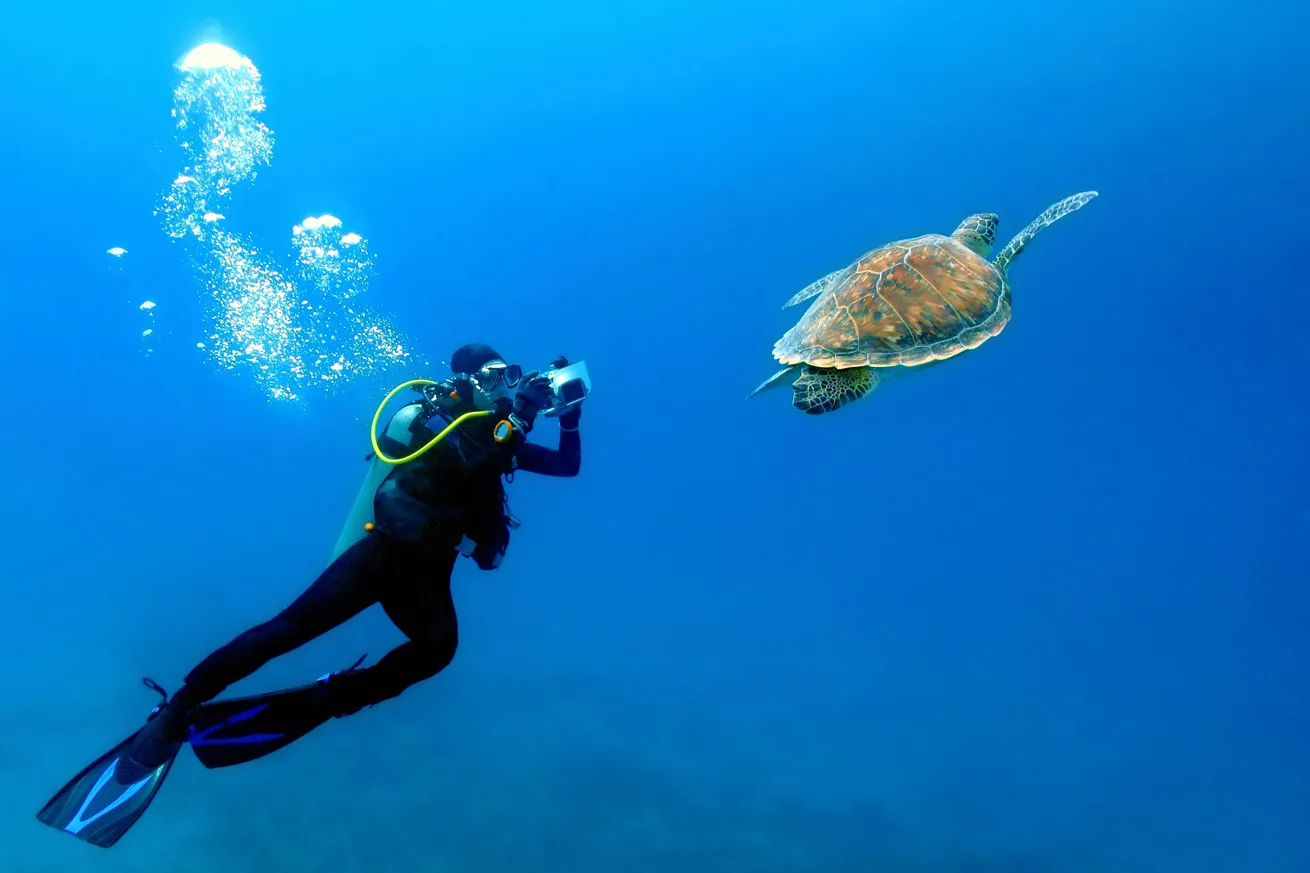
Shutterstock/Blue-Sea.CzGreen sea turtles are abundant in Bonaire, particularly in proximity to seagrass.
Bonaire
Bonaire is the Caribbean dive destination where underwater shooters can become more adept at spotting critters, all while taking advantage of sunny days and clear visibility to take epic macro and wide-angle shots. For most divers, camera in hand or not, the biggest prize is a seahorse.
“Of course, all dive sites on Bonaire have seahorses,” says Tommy Pera, divemaster and underwater photo instructor with Buddy Dive Resort.
But for the best odds, head north to sites such as 1000 Steps.
“The shallow area is just inundated with soft corals—they love it,” says Pera. “Plus, green turtles love the seagrass.” Both are found at this iconic dive site that starts at the water’s edge, just yards from the long staircase that leads from the parking lot to the beach and gives this site its name. (Don’t worry; there are only 72 steps to contend with.)
Another top site for seahorse spotting is Jeff Davis Memorial, also in the north. At these sites—or any Bonaire site—a diver’s best luck for seeing seahorses is in the shallows, no more than 25 feet deep.
Stay shallow and take advantage of ambient light photography. “One of my favorite things is taking photos of elk-horn corals in 8 feet with a fisheye lens,” says Pera. “Shoot up to get the rays of sun—you also get these reflections, and the elkhorn pops so beautifully.”
Related Reading: The Organization Helping to Protect Seahorses, Sea Dragons and Pipefish
Need to Know Diving Bonaire
When to Go April to November brings the flattest seas and visibility from 80 to 100 feet. This is also considered the low season, so flights and accommodations may be cheaper.
Water Temps Quite warm, ranging from 87 degrees in summer to 82 degrees in winter.
Don’t Miss Head to the Something Special dive site for lettuce sea slugs, seahorses, frogfish, tiny slender filefish and octopus. “You have the chance to see it all on one dive,” says Pera.
Contact buddydive.com
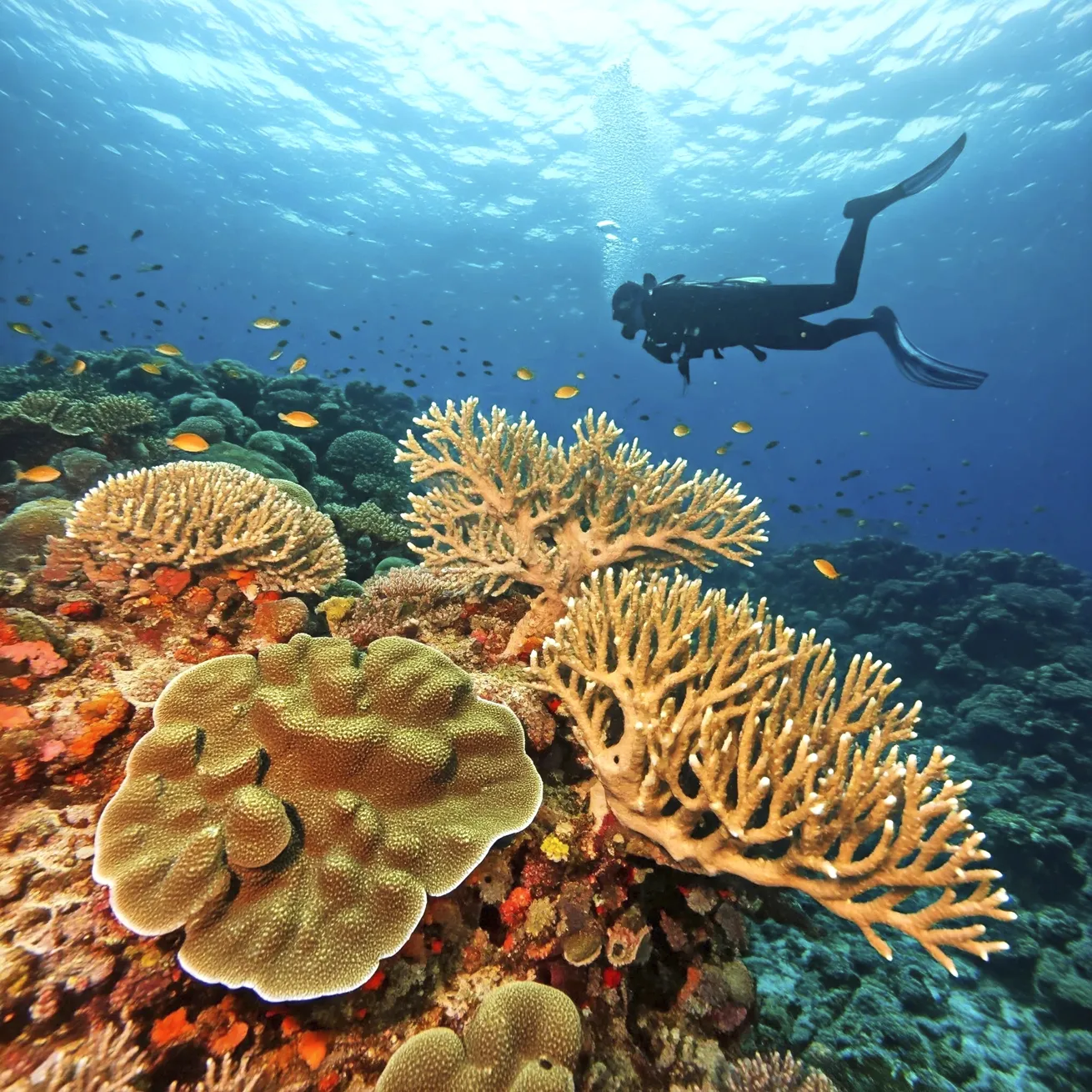
Shutterstock/Ahmad Gazali AlwiA diver hovers close to a pair of thriving staghorn corals. Indonesia’s healthy reef conditions help nurture the biodiversity this region is best known for.
Indonesia
With more than 17,500 islands, Indonesia shines for its abundance of hidden pockets—miles and miles of reefs far from development or the pressures of cities. These remote areas serve up pristine corals and seemingly every critter in the book.
So it is with Wakatobi Dive Resort in Southeast Sulawesi, known for having its own protected park spanning 5,370 square miles—90 percent of which is ocean.
“No other operators or day-trippers have access to our reef system,” says Bailey Anderson, marketing manager at Wakatobi. “This means fewer divers, less impact and verifiably healthier reef conditions in comparison to nonprotected areas in the same region.”
For photographers in particular, this means more critter encounters and fewer divers to contend with at any site.
Divers get more time to linger and enjoy the finds highlighted by the guides.
At sites such as Malabea West, it’s easy to miss out on appreciating the wide-angle reef scene as a whole, given how many critters tuck into the sand and the folds of the reef. Guides excel at finding the small stuff, which, in a single dive, might include two different species of pygmy seahorse, several nudibranchs, a porcelain crab filter feeding on a carpet anemone and a pair of fire dart fish.
Of course, this entire country is one where a wide-angle lens will be put to good use. At Wakatobi, it’s sites such as Roma where shooters will want to go wide.
“This site has a stunning colony of rose corals—they are truly spectacular and a fan-favorite,” says Anderson.
Related Reading: Ultimate Diving Guide to Raja Ampat’s Magical Misool Resort
Need to Know Diving Indonesia
When to Go March through November offers the best visibility and calmest seas.
Water Temps Expect around 86 degrees in October and down to 78 degrees by August.
Don’t Miss “The house reef is incredibly spectacular—on one dive, it is not uncommon to see five turtles,” says Anderson.
Contact wakatobi.com
Readers Choice Awards 2025
This year we surveyed 8,566 readers on their favorite destinations, resorts, operators and liveaboards, awarding their top picks across a variety of categories. Our Readers Choice travel feature highlights the first-place destinations in each global region and offers a taste of what makes each a reader favorite.
Click here to see all Readers Choice award-winning resorts, operators and liveaboards.


