

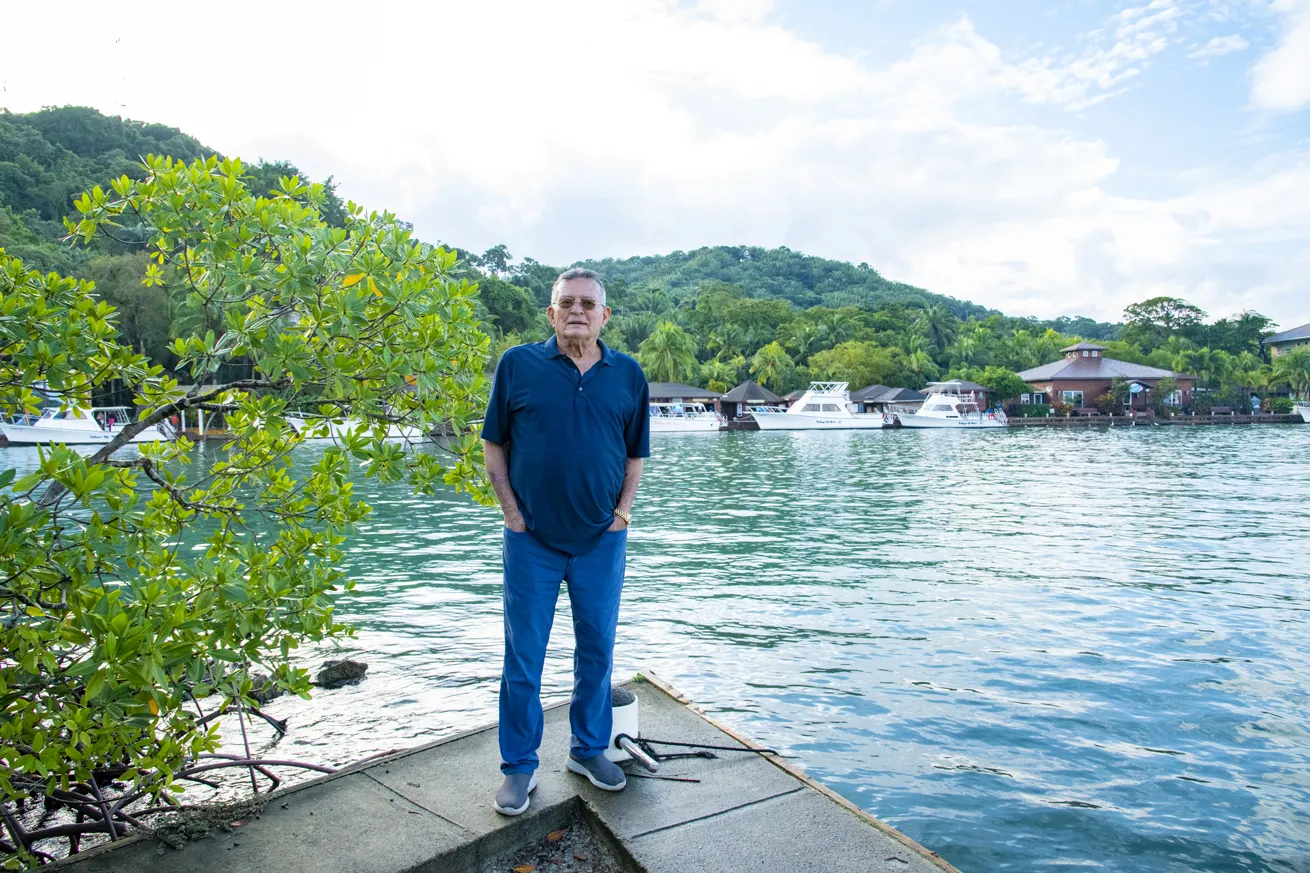
For more than 50 years, Julio Galindo Sr. has worked to bring tourism to Roatan while maintaining its natural splendor.
It began with a simple but radical idea: to create an intimate retreat that revealed Roatan, Honduras, to the world as it truly is—welcoming, wild and largely untouched. More than five decades later, that vision has become Anthony’s Key Resort, one of the Caribbean’s most enduring and beloved destinations shaped by the legacy of its founder, Julio Galindo Sr., known affectionately as Don Julio.
Born in Roatan in 1944, Galindo grew up in a time before scuba tanks and dive computers. Weekends were spent swimming after chores were finished. When Anthony’s Key was founded in 1968 by Galindo and his wife, Cheryl, it began modestly as an 18-unit retreat off the northwestern coast of the island with prime access to the Mesoamerican Barrier Reef. Back then, Roatan was still largely unknown, and tourism was a gamble.
“WE MUST UNDERSTAND THAT PEOPLE WORK HARD ALL YEAR TO GET ONE WEEK OFF. SO WE HAVE TO ... GO OVER THEIR EXPECTATIONS.”
—Julio Galindo Sr.
Galindo learned to dive alongside some of the best in the industry, mentored by pioneering figures like Lloyd Davidson and Peter Hughes, who introduced him to a new way of experiencing the ocean. To bring business to Anthony’s Key, Galindo visited various dive shops in the United States.
A turning point came when an airline partner donated 50 free tickets, allowing Galindo to invite dive professionals en masse to Roatan. The strategy worked, cementing Anthony’s Key as a diver’s haven.“I invited the whole diving industry to Roatan,” he says. “That was the exposure we needed.”
Related Reading: An Unforgettable Dive: The Reef that Transformed Me
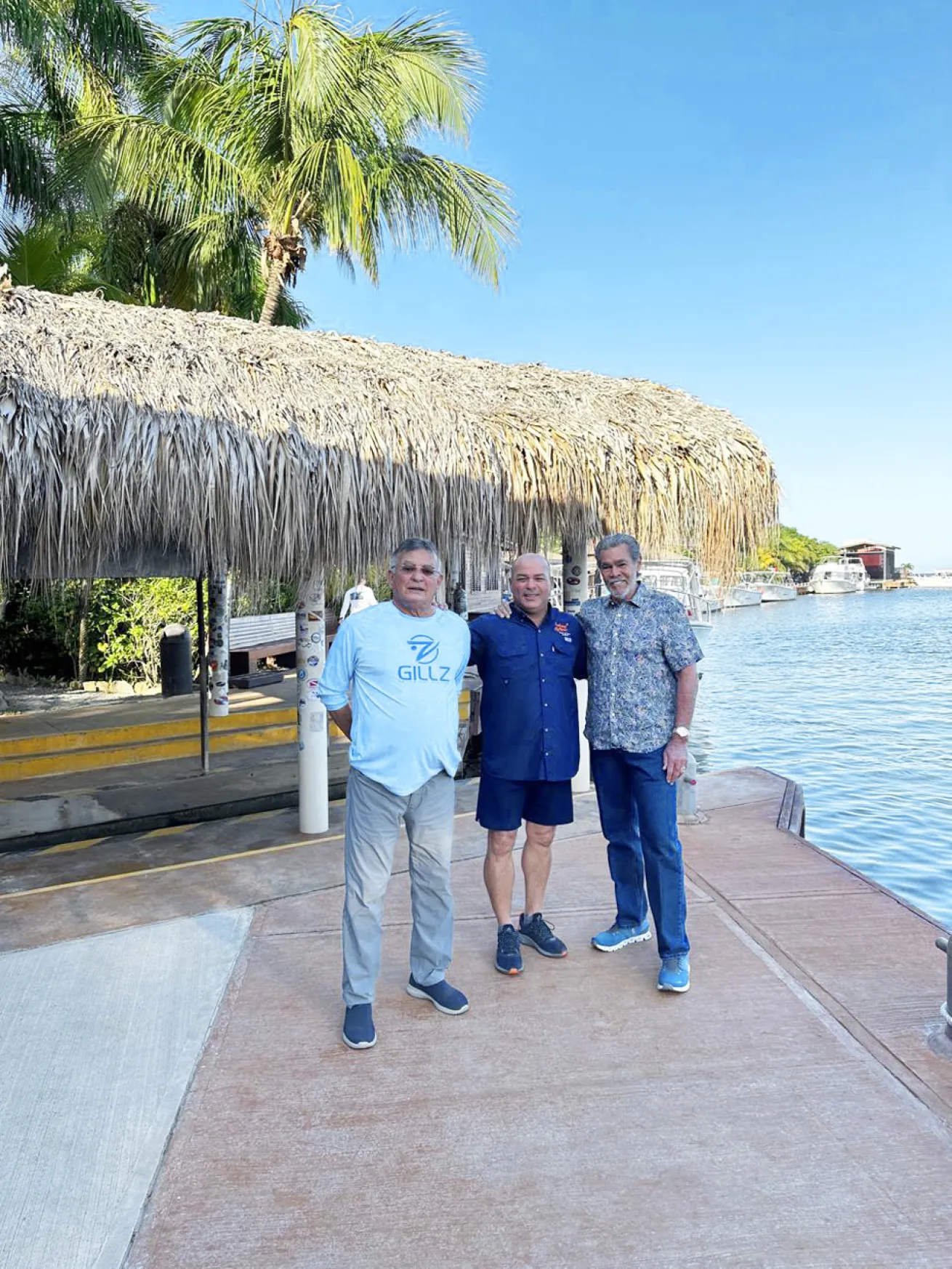
Galindo stands with his son Samir (middle) and dive legend Peter Hughes (right).
During the 1980s, Galindo bought out his partners, ensuring the resort remained family run as it expanded thoughtfully, adding activities, accommodations and a spa. Today, Anthony’s Key spans an 11-acre private island with 61 wooden bungalows tucked along the turquoise water and lush hillsides.
Named a 2026 Best Overall Resort in the Caribbean/Atlantic region in Scuba Diving’s Readers Choice survey, Anthony’s Key continues to stand out for its value, authenticity and sense of place. Yet its greatest distinction may be continuity: a resort still guided by the family that built it and by a founder who believed that paradise is best preserved by sharing it carefully.
Q: Our readers named Anthony’s Key one of the top 10 Best Overall resorts in the Caribbean/Atlantic region. What’s your secret to success?
A: Diving here is easy. We’re located on the northwest side of Roatan. Roatan is long and slim, but we’re lucky to have a reef that surrounds us completely. Everybody says we run a well-oiled machine, but nature’s been great to us. We’re always like five to 10 minutes from a dive site. We have a nice little harbor.
Q: Your guests also rave about the quality of your staff.
A: The key is to surpass people’s expectations. Our guests travel all over the world, but have never found friendlier people than those we have. The biggest asset we have is our help. I also make sure we have great infrastructure. We live in an area where if something breaks, I can’t go around the corner and buy it. So I provide my own energy. I do my own water. I have my own dry dock. We have some of the best boats. We must understand that people work hard all year to get one week off. So we have to provide the service and go over their expectations. No excuses. I learned that very early.
Q: You’ve served as mayor of Roatan. What made you decide to become active in the community’s politics?
A: We live on an island, so our resources are very fragile and limited. There are different challenges you face, like providing enough jobs and schools. We have to make sure that we don’t overpopulate the island. I was also concerned about the environment. I wanted to make sure that we were respecting it the way it should be.
Q: Looking back, what makes you proudest about your career?
A: A lot of the people on Roatan—not only because of me, but thanks to our employees—they’ve learned that they can make a lot more money protecting grouper than taking them home and cooking them. Through the Roatan Institute of Marine Sciences, we offer tours to school kids so they can learn about marine science. I’m proud to know that we’re in a position where we can help.
Q: Scuba diving is relatively new, and Anthony’s Key has been there pretty much since the beginning. How has the industry changed since you started?
A: You don’t see young people diving as much. I would say that 80 percent of our divers are people who are over 50. What is the reason behind it? Is it too expensive for people to do? Is it that some people try it and think they’ve seen it all, so they quit? I think that as an industry, that is our challenge. The more people we get into it, the better off we’re going to be.
Related Reading: Dive Industry Innovator: Margo Peyton
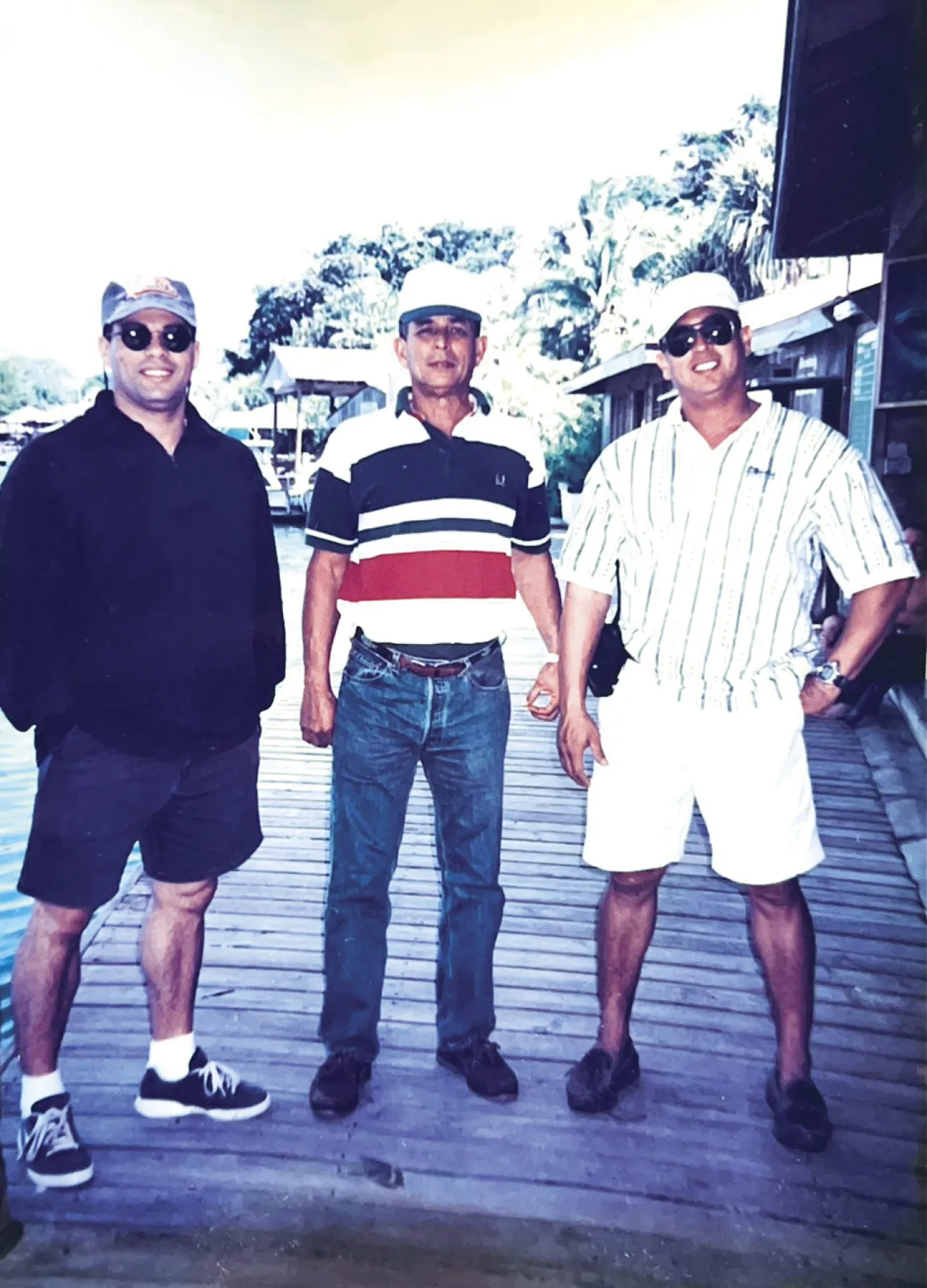
An older photograph of Galindo and his two sons on the dock at Anthony’s Key Resort.
Milestone Moment
From the earliest days, Galindo understood that sustainable tourism relied on healthy marine ecosystems. That led him to help establish the Roatan Institute of Marine Sciences (RIMS) in 1989 to fund research, education and on-the-ground conservation while keeping the island as pristine as possible.
Today, RIMS hosts roughly 30 schools a year whose students and faculty contribute to long-term monitoring and research. Their work has deepened scientific understanding of Roatan’s marine environment while training new marine scientists. “Our greatest asset is our reef,” he says. “With their help, we can get a better understanding of what we have out there and what we have to do to take care of it.”
Galindo also helped spearhead the creation of the Roatan Marine Park, hiring former poachers as wardens, creating local buy-in. When fishing pressure and poaching increased outside protected areas, Galindo expanded, gaining government recognition and support from the navy along the way. His vision helped transform Roatan into a premier dive destination with more than 35 sites—and a model for conservation-led development in the Caribbean.
Even as Roatan has become a major cruise destination, welcoming more than 2 million passengers a year, Galindo has emphasized balance: managing visitor flow, protecting the reef and ensuring tourism benefits the community. “When we first started Anthony’s Key, I would go to the States and people would ask, ‘Where are you from? Roatan? Where is that?’ You couldn’t pay for the kind of exposure we have now.”


