

Francesca Page
My bubbles tickle the belly of a manta ray gliding gracefully above as its vast wings dance through the water. I float beneath it in awe, my eyes fixed on this gentle giant. It’s an unforgettable encounter in Indonesia’s Komodo National Park, where I’m surrounded by a vortex of the ocean’s most majestic creatures.
Known for having the largest brain-to-body ratios of any fish, manta rays are awe-inspiring, curious, intelligent and increasingly rare. Today, magical moments like the one I experienced in Komodo face the threat of disappearing entirely.
Related Reading: 10 Amazing Facts About Manta Rays
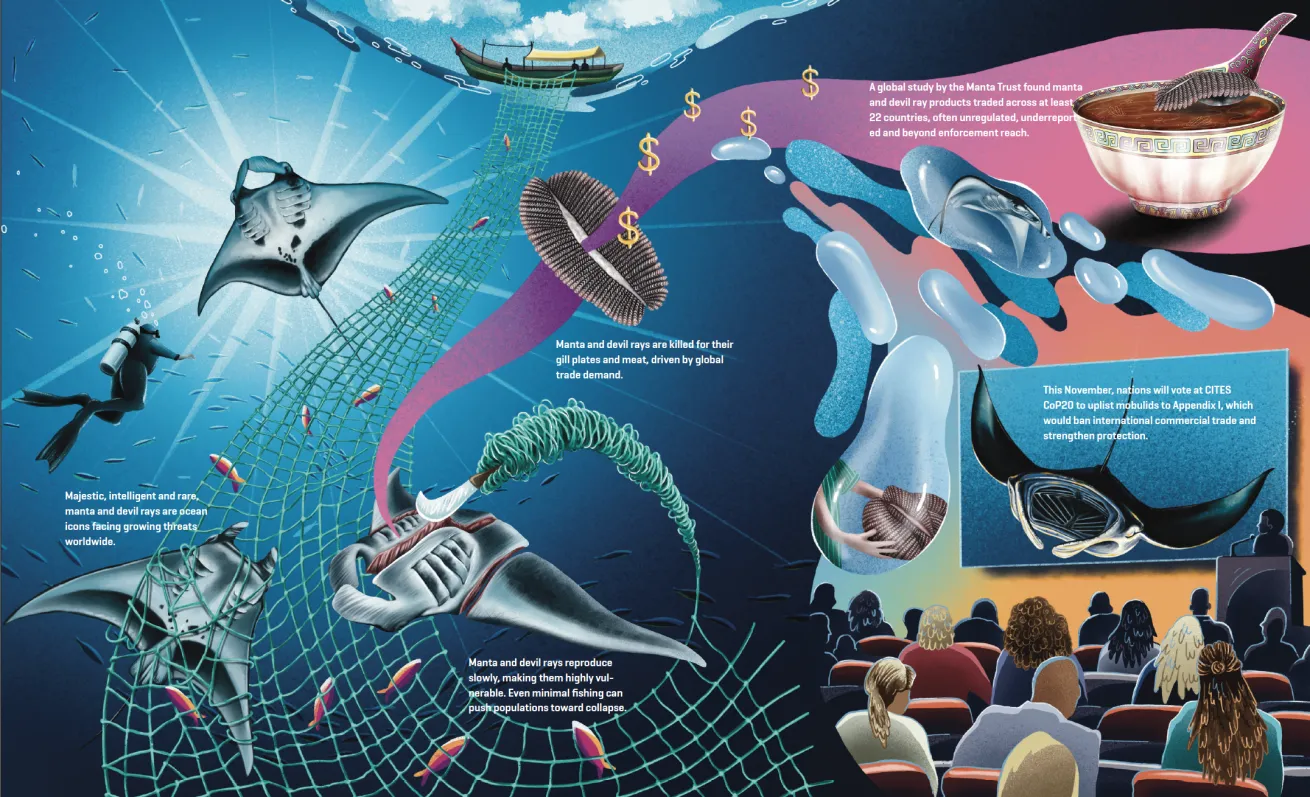
Despite being listed under Appendix II of the Convention on International Trade in Endangered Species of Wild Fauna and Flora (CITES), which tightly controls trade of species that are not necessarily threatened with extinction, manta and devil ray populations continue to plummet. All nine known mobulid species are now threatened; seven are endangered. In some regions, numbers have dropped by over 90 percent.
“Manta and devil rays are among the most iconic and revered marine species, yet they remain incredibly vulnerable to overfishing,” says Dr. Guy Stevens, chief executive and co-founder of the Manta Trust. “After over a decade of global protections under CITES Appendix II, it is disheartening to see unsustainable international trade in these species not only continuing but increasing. Stronger action is urgently needed to protect them.”
The main driver is overfishing, fueled by demand for mobulid gill plates, sold for their purported medicinal effects in parts of Asia and used in a soup known as peng yu sai. The meat is consumed locally and traded internationally, often unreported.
On the crimson-stained concrete floors of a fishing market in East Java, Indonesia, the cost becomes heartbreakingly real. The bodies of these graceful giants lie in silence.
“This isn’t just about conservation, it’s about survival,” says Muhammad G. Salim (Egin), who leads the Mobula Project Indonesia, an affiliate of the Manta Trust. “As fish stocks decline, shark and ray meat has become one of the most affordable protein sources in coastal communities. People rely on it out of necessity. Without viable alternatives, conservation efforts will continue to meet resistance.”
In response, the project launched the Sustainable Seafood Network last year, aiming to cut targeted shark fishing in Muncar, East Java, by 50 percent by connecting local fishers directly with eco-conscious hotels and restaurants.
A recent global study led by the Manta Trust found that international trade in manta and devil ray products involves at least 22 countries. “Once manta and devil rays are landed, their meat becomes nearly impossible to identify by species, making current trade controls extremely difficult to enforce,” says Dr. Marta D. Palacios, lead author of the publication.
“Mobulids reproduce extremely slowly,” Stevens explains. “They take around a decade to reach maturity and give birth to just one pup every few years.” This means that even low levels of fishing can have devastating, long-term impacts.
But there is hope. In November, governments will vote at CITES CoP20 on whether to uplist all manta and devil rays to Appendix I, the highest level of international protection. If passed, the move would ban all commercial international trade in mobulid products.
“Appendix I is reserved for species at the greatest risk of extinction,” says Jasmine Corbett, media and communications manager at the Manta Trust. “Uplisting mobulids would close the loopholes that allow exports under so-called ‘sustainable’ quotas.”
“Our research shows that current protections simply aren’t enough to counter the ongoing threats facing mobulids,” adds Palacios.
The uplisting proposal, led by Ecuador and supported by a coalition of governments and NGOs, is grounded in science. It offers a clear, enforceable path forward and builds on the most comprehensive global analysis to date.
The Manta Trust is working tirelessly to turn the tide, and it’s not alone. Ahead of the critical vote, the organization has launched the #SaveTheMantas campaign to rally global support.
Related Reading: How to Photograph Tide Pool Split-Shots
“An Appendix I listing won’t solve every challenge. Local enforcement, providing alternative livelihoods and reducing demand will all remain critical,” says Corbett. “But it’s a vital and urgent step, one that could finally give mobulids a real fighting chance.”
As divers, we’ve witnessed their magic firsthand. Now, we can be a part of ensuring that future generations can float beneath those wings, feel that awe, and know a world where manta rays still soar.


