


Courtesy Ba’alche Proyecto AzulBa’alche Proyecto Azul aims to generate valuable data for the management and conservation of bull sharks in Mexico.
For Mayan communities, storytelling is a way of preserving traditions. The practice has helped the ancient culture and its teachings and beliefs persist through millennia. Now, a woman-led organization is using storytelling photography to further conservation for one of the Mayans’ sacred animals—sharks.
Ba’alche Proyecto Azul (“ba’alche” means animal in the Mayan language) was created to tell the story of the ocean and its creatures through a community-driven catalog, with the goal of protecting local bull sharks.
Along with promoting environmental awareness and responsibility among locals, the project aims to generate valuable data for the management and conservation of bull sharks that visit the area every winter.
Using Photography to Identify Sharks
Photography is the project’s main tool. By analyzing fin shapes, scars and unique coloration patterns, individual sharks can be identified and named from a photo. This allows for easier collection of scientific data.
The sharks are named as individuals, and the images of divers enjoying encounters with these amazing animals start transforming the relationship between the local community and its sharks.
One of Ba’alche’s founders, Cecilia Gutiérrez Navarro, began working with sharks while finishing university as a divemaster. Inspired by her grandfather, a conservationist who carefully documented wildlife observations by hand, she started making lists of her shark encounters after every dive.
Around the same time, another professional diver, Candy López, was independently collecting photo-identification data. When they compared notes, they realized they were documenting the same individuals. That moment marked the beginning of the project.
Today, Ba’alche is led by four women and relies on citizen science. Divers, tourists, guides, fishermen and captains all contribute data and photographs to the project’s library. Images must show both sides of the shark and be uploaded with a dive log that indicates whether the encounter occurred during an attraction or observation dive. All information is incorporated into a growing database for analysis.
Related Reading: What’s the Deal With Shark Teeth?
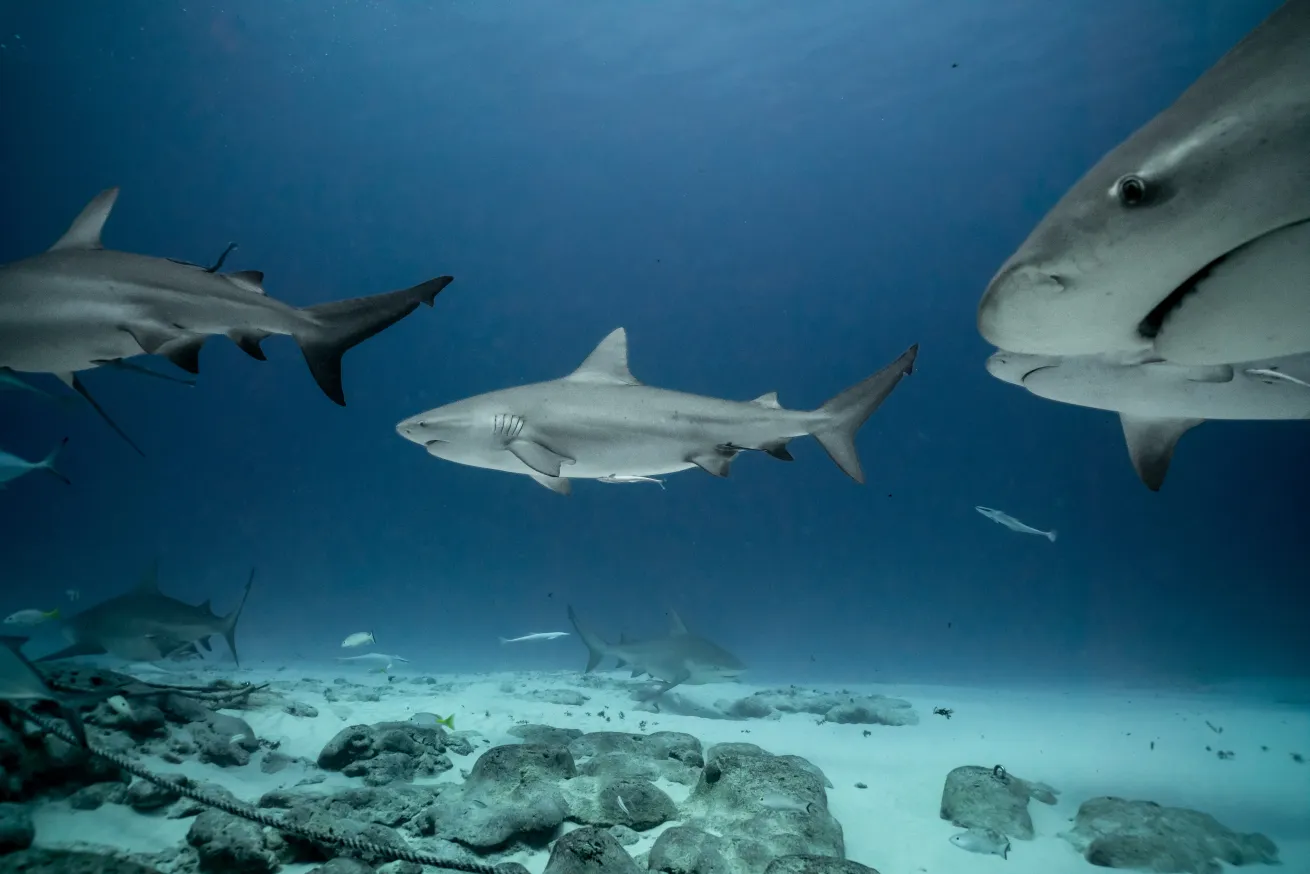
Denisse SotomayorPregnant bull sharks swim together in Mexico.
Dive With Las Gordas and Support Conservation
When water temperatures drop in the Mexican Caribbean from November to March, dozens of pregnant bull sharks arrive in Playa del Carmen during the final stage of gestation and visibly gain weight as their pregnancy progresses. Locally, they are affectionately known as Las Gordas because of their big size. In Latin America, “gorda (literally “chubby”) is commonly used as a term of endearment.
This is when Ba’alche collects most of its data, photographing Las Gordas on dives in the Caribe Mexicano Biosphere Reserve.

Because dives take place inside the reserve, the activity is strictly regulated. There are two methods to ensure bull shark encounters: attraction and feeding. Ba’alche promotes ethical baiting practices and prefers using only attraction rather than feeding. Self-regulation and cooperation between tourism operators, scientists and authorities have proven essential to the activity’s success.
Divers descend along a fixed line and position themselves side by side on the seafloor, allowing safe and controlled viewing of the attraction event. Each dive lasts 30 minutes, and bottom time is kept to a strict 25 minutes. The depth is around 82 feet (25 meters) and there are sometimes strong currents, so divers must hold advanced certifications and ensure proper weighting.

Denisse SotomayorCecilia Gutiérrez Navarro, co-founder of Baalche Proyecto Azul, doing bull shark photo-ID
Bull Shark Behavior
Each shark displays distinct personality traits, explains Gutiérrez Navarro: “Ana, who has come for over 12 years and is one of the easiest individuals to identify, has a straight cut on her left pelvic fin and a darker colouration. When she arrives, divers and other sharks immediately notice her commanding presence. She has a very strong character.”
Other individuals—like Alpha, whose right pectoral fin curves upward without affecting her swimming ability and Michigan, who lacks the lower lobe of her tail yet swims perfectly—are powerful examples of shark resilience.
Although sightings in Mexico and the Caribbean occur in the ocean, bull sharks are known for their ability to adapt to freshwater. They have been observed in the Amazon and even in the delta of the Mississippi River. Females are larger than males and can exceed 10 feet (3 meters) in length.
Females’ gestation periods last around 10 to 12 months, and they give birth to between one and 15 pups, which are born ready to hunt. Although it has not been proven, researchers believe the bull sharks Ba’alche observes give birth in nearby coastal lagoons of the Riviera Maya.
Related Reading: Readers Choice: World's Best Places to Go Scuba Diving in 2025
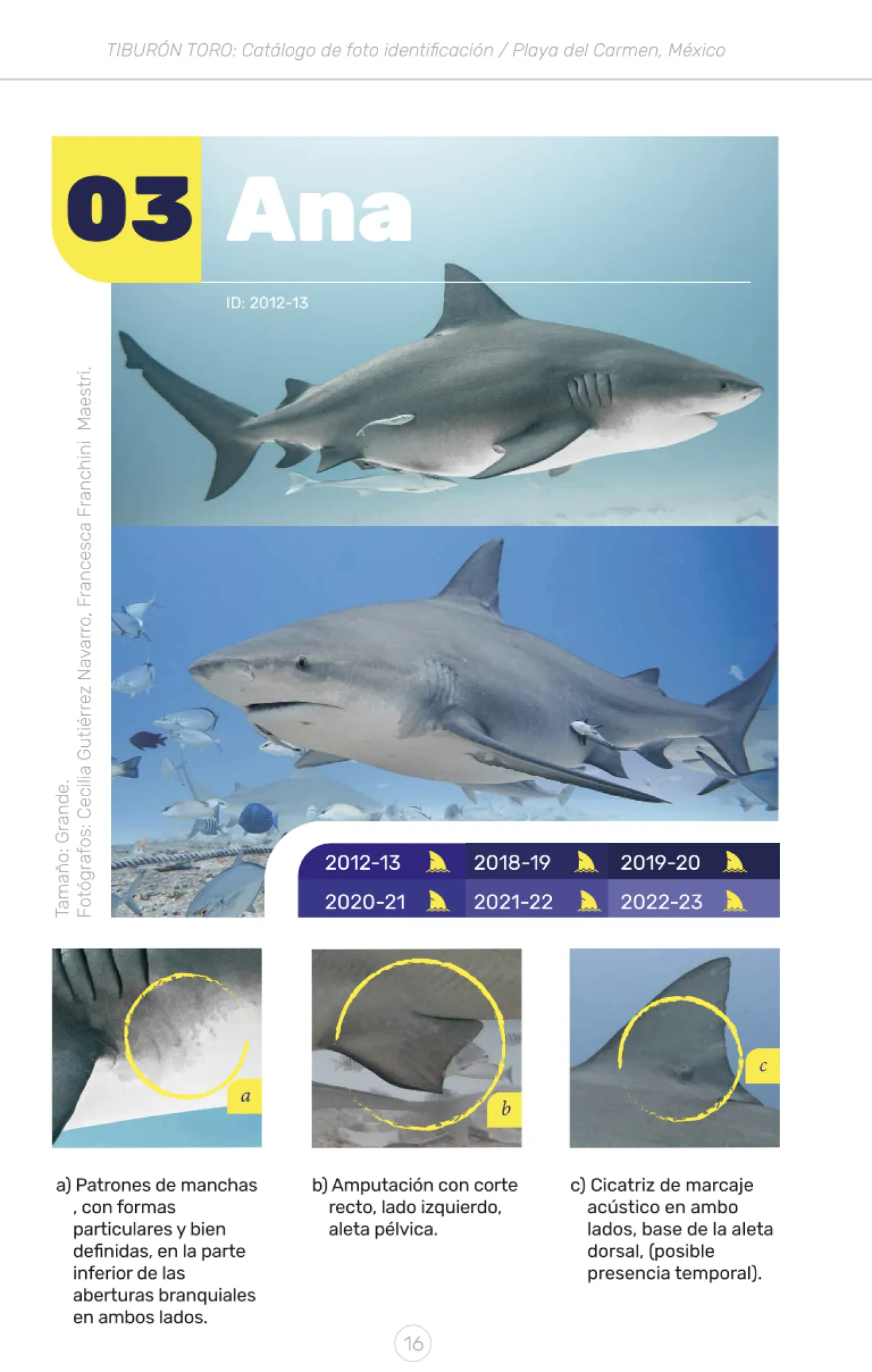
Example of the shark catalog, featuring "Ana."
Results and Impact
One of Ba’alche Proyecto Azul's most significant achievements has been changing officials’ perceptions of sharks. For years, authorities avoided discussing their presence out of fear it would discourage tourism—one of the most important sources of income for Playa del Carmen. The project’s focus on demystifying sharks, teaching safe interaction practices and reducing risk through knowledge rather than fear helped shift that narrative toward coexistence and education.
The municipality of Playa del Carmen and Ba’alche have even worked together to embrace Ana, one of the oldest bull sharks visiting the area, as part of the city’s visual identity. Now, her silhouette can be found outside local markets on storefront signs, and this year, she became the main attraction of the city’s carnival, one of its most important cultural celebrations, appearing as a giant inflatable. was the main attraction for the carnival. Furthermore, tourism authorities are using bull sharks to proudly promote the destination.
Sharks play an important ecological role for the ocean, maintaining the overall health of the ecosystem. These bull sharks also play a major economic role for Playa del Carmen. From November to March, an estimated 25,000 to 30,000 visitors travel specifically to scuba dive with them, typically staying two to three days. The activity supports roughly 1,600 local livelihoods directly, with significant indirect economic benefits.

Denisse SotomayorThe Baalche team attracting bull sharks in the Mexican Caribbean.
“During the winter, we spend a lot of hours underwater doing photo identification, but despite the excitement of diving, the hard work happens behind a computer,” Gutiérrez Navarro explains—they spend countless hours organizing and analyzing thousands of pictures and data.
Giving information back to the community remains central to the project. With support from the international nonprofit MarAlliance, the team produced a waterproof printed ID catalog that dive operators can use underwater, ensuring knowledge flows back to those who help collect it. To date, 43 individual sharks meet the project’s identification protocol, with 25 frequently observed.
For Gutiérrez Navarro, the project is ultimately about changing how people see sharks.
“The purpose of this catalog is to get to know our sharks and recognise them as part of our community,” she says. “We have been on these coasts for hundreds of years, but they have been in this sea for millions of years. It is time to leave behind our old paradigms and learn to coexist with them.”
Related Reading: Finding Family-Friendly Diving in Fij

Denisse SotomayorPerspective from the safety stop at the dive site.
Need to Know
Citizen science dives can be booked through Dive Mike at www.divemike.com.
Best time of year to go November to March.
View the full catalog of Las Gordas here.
Learn more about Project Ba’alche at https://baalche.com/pages/projecto-azul.


