

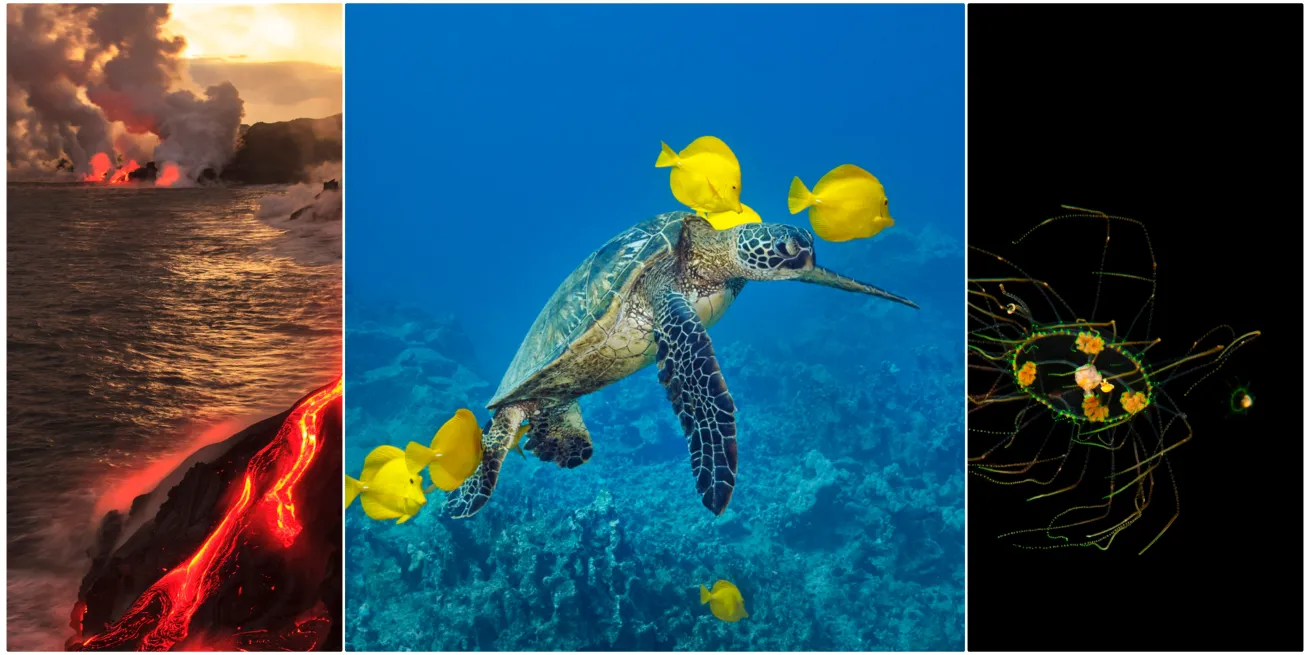
Brandon Cole; Andrew Raak; David FleethamLeft: The Island of Hawaii’s landscape, both above and below the water, is forged by lava; Center: Green sea turtles are a hallmark of any Hawaii dive trip; Right: Blackwater dives yield unique critters like this medusa jellyfish.
The Hawaiian islands are some of the most isolated landmasses on Earth. They are located 2,500 miles from Los Angeles, and the nearest substantial island, the uninhabited Johnston Atoll, is 700 miles away. When it comes to diving, isolation brings big advantages, starting with fish. These reefs are home to the planet’s highest concentration of endemic species—about 25 percent of Hawaii’s marine animals can’t be found anywhere else. The Big Island in particular has a unique draw: It’s the only place on the planet where just about every night, divers and snorkelers can swim with reef mantas—anywhere from one or two, up to a record 45! Then, consider that Hawaii was forged by fire. The Big Island, with almost 300 miles of coastline, serves up a buffet of unique experiences, from lava-formed tunnels that cut through the underwater landscape to jaw-droppingly large underwater canyons. Add in an endless parade of green sea turtles, along with dolphins, seals and whales, and the result is an experience not to be missed.
Related Reading: Dive Deeper on a Thoughtfully Curated Trip for Adventurous Divers
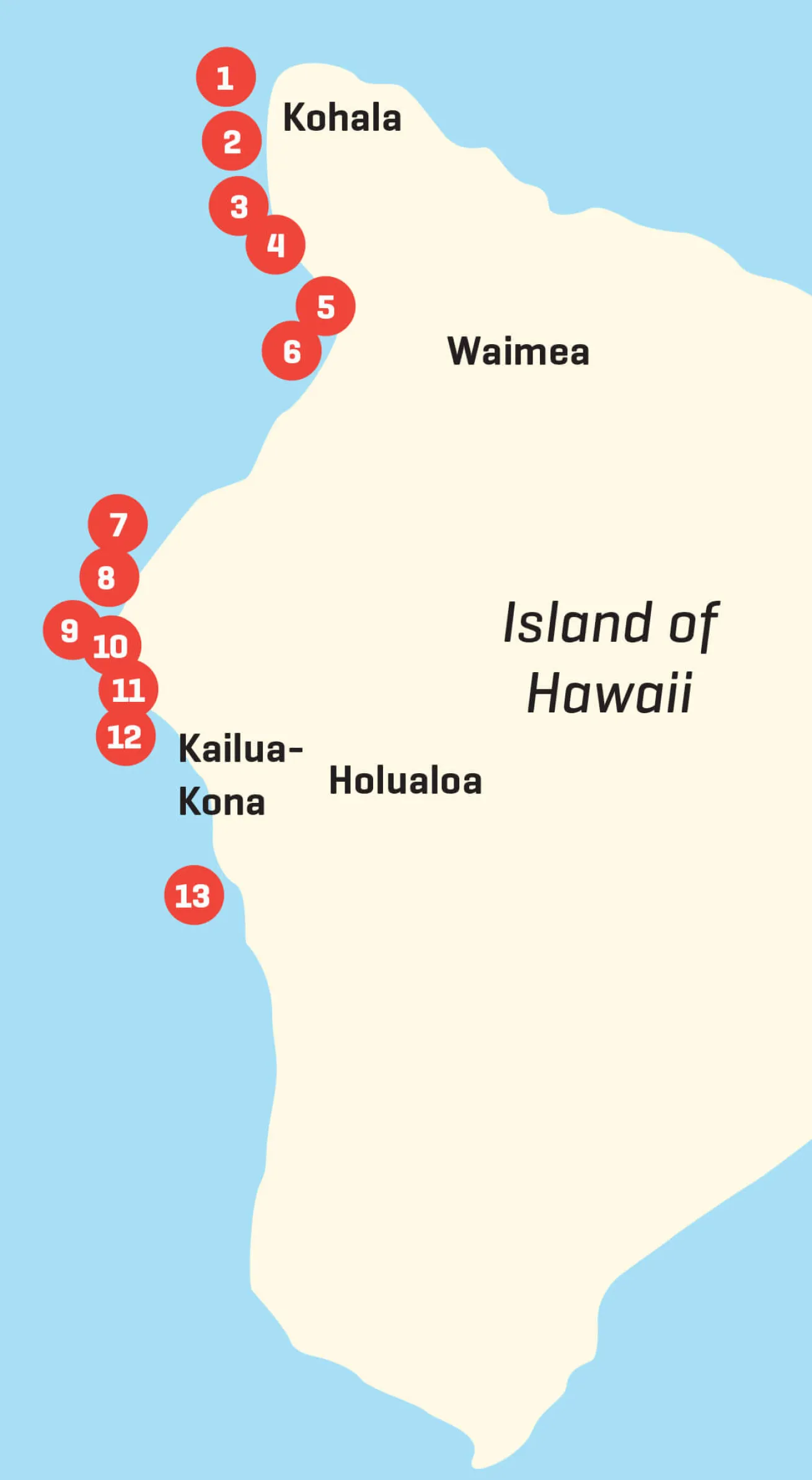
Dive Sites
1. Mahukona
2. Black Point Caves
3. Kei Kei Caverns
4. Frog Rock
5. Mauna Kea Beach Hotel
6. Paniau
7. Keahole Wash Rock
8. Makako Bay
9. Golden Arches
10. Pyramid Pinnacles
11. Kaloko Arches
12. Naia
13. Keauhou Bay
Big Island At A Glance
Number of Dive Sites: More than 100
Viz: 75 to 125 feet
Water Temps: Mid-70s to low 80s
What to Wear: 3mm or 5 mm wetsuit
Operators:
Jack’s Diving Locker jacksdivinglocker.com
Kona Honu Divers konahonudivers.com
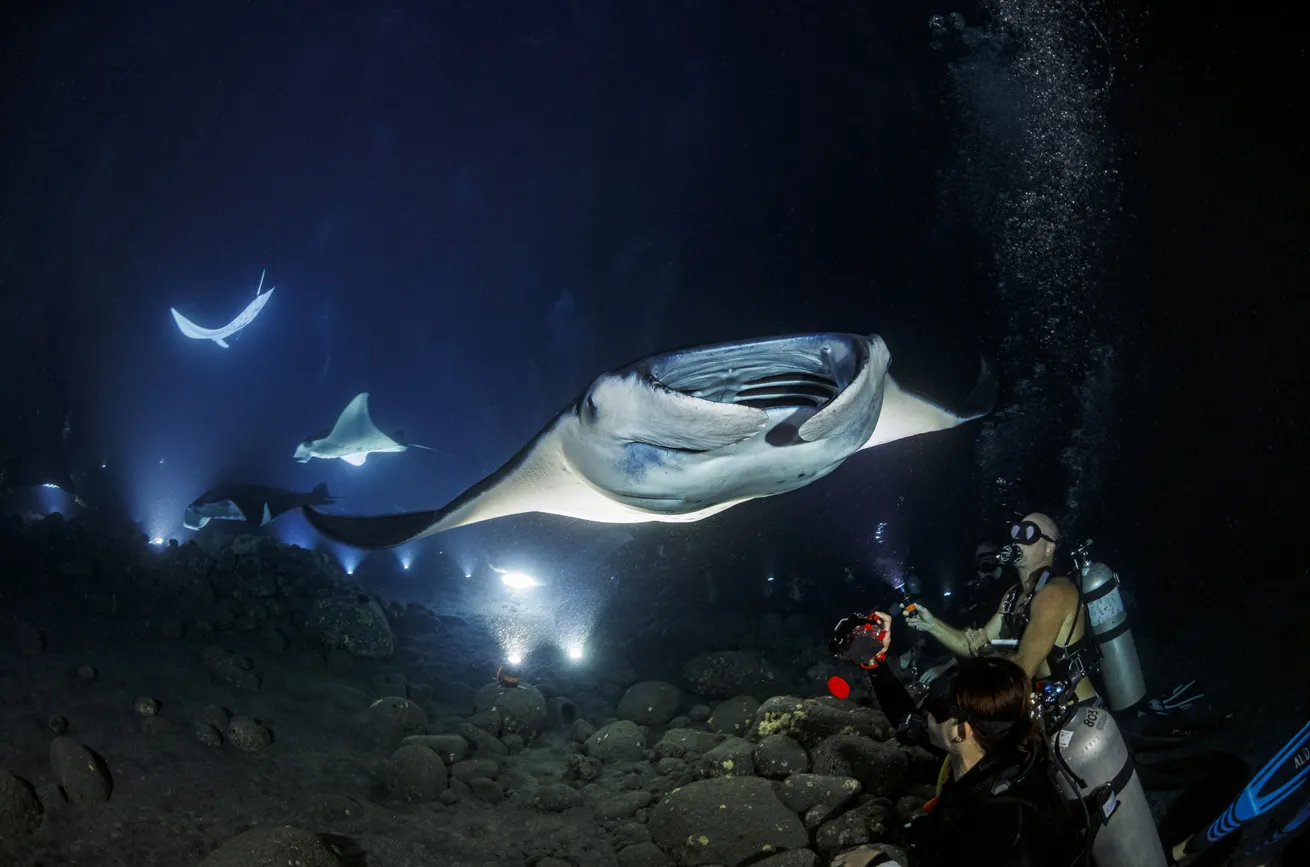
Brandon ColeA group of divers witnesses the nighttime spectacle of manta rays swooping in to feed on plankton drawn to bright lights placed on the seafloor just off the coast of Kona.
Manta Dive
The Island of Hawaii is legendary for its reef manta ray night dive, and for good reason. It’s the only place on Earth where these animals gather roughly 80 to 90 percent of the time, according to Jack’s Diving Locker, one of the local operators guiding this dive experience four nights a week.
By comparison, a place like Manta Point in Indonesia also regularly draws in mantas—both oceanic and reef species—but the season is April to November, and the site requires a 45-minute fast-boat ride from Bali.
Here in Kona, the mantas regularly appear at three sites and even cavort in the shallows of the Outrigger Kona Resort, where nonswimmers can watch their flights while sipping cocktails.
But I’ve come for the dive, best experienced midtrip. You’ll want to give yourself a day or two to acclimatize to the water and your gear, but avoid waiting until your last night in the rare event the mantas don’t show.
We’ve done the afternoon dive at Makako Bay to become familiar with the environs. Keller Laros, a PADI Master Scuba Diver Trainer with Jack’s Diving Locker, briefed us on what to expect— and what to avoid to encourage the best possible encounters.
He’s given us loads of info about the mantas, and the directions were pretty simple: “Stay on the bottom to give the mantas room to maneuver, shine your lights up and out of other divers’ eyes, and try not to exhale when a baby swims overhead, as baby mantas are frightened of bubbles.”
Now here we are, kneeling on the rubble. Jack’s is the second boat at this site, with the first boat’s lights already drawing in several mantas. By the time we settle, it isn’t more than two or three minutes before the first manta comes cruising in. Before it can even circle back, several more come powering in. Divers’ lights shine bright on their bellies, creating a gorgeous contrast of bright white against blue-black water. Then they flip, showing the blacks of their backs as they loop and dive-bomb back toward the lights.
The dive is an adventure, sure, but it’s really art. The mantas can’t help but swoop straight into and through the spotlight of the “campfire,” the lights that Jack’s places to draw in the plankton and thus the filter-feeders.
Related Reading: New Study: Male Mantas Practice Courtship Without Females
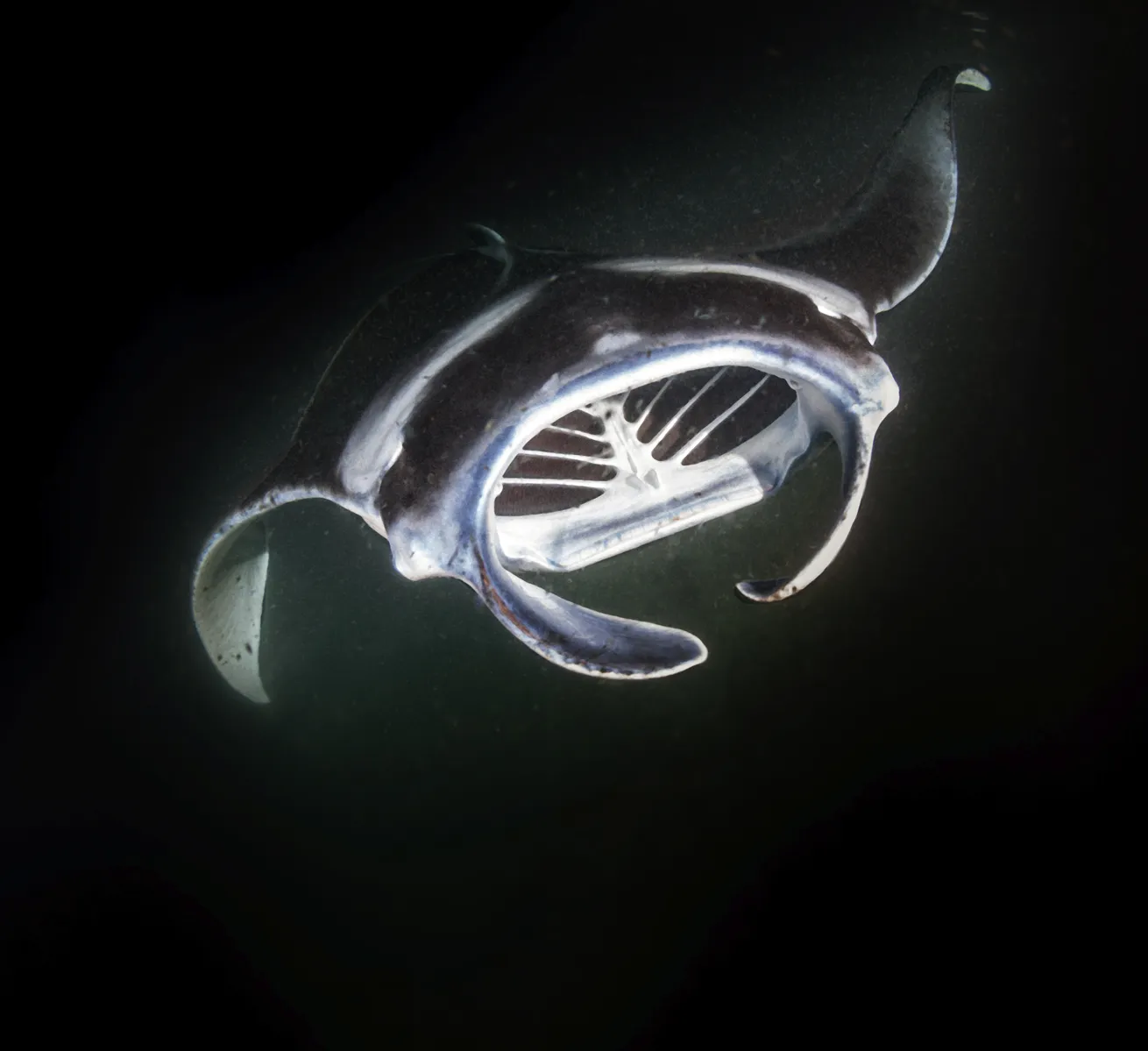
Olga Torrey
With the darkness of the water and the bright lights shining up, it’s hard to make eye contact with the mantas. Still, it’s not hard to feel swept up in the motion of it all. It’s mesmerizing. It’s alien. Strangest of all, perhaps, is that most of the players are regulars on this stage.
“Mantas have high site fidelity on the Hawaiian islands,” says Laros. “The mantas of the Big Island don’t often cross deep water—they don’t go to Maui.”
Most mantas will stay on Kona for 30 years or so, maybe longer. In addition to their avoidance of deep water, they’ve also got incentive to stay put. As of 2009, it’s illegal to kill or capture this animal in Hawaii.
“They’re super comfortable with people,” says Laros. “They have no reason to flee from people because people have been really nice to them.”
It makes sense then that so many mantas show up night after night. They’ve been doing so for years—they know the drill. They have the biggest brains of any fish species, so it tracks that they can make informed decisions.
In return, the dive guides, who can identify individual mantas by the black and gray spot patterns on their bellies, have learned who’s who. Tonight, Big Bertha is in the mix, and she’s been coming to these dives for 40 years.
“They’re not just fish,” says Laros, sharing that he feels a connection to the mantas he sees again and again. “I’ve known Bertha 30 years—longer than I’ve known many of my friends.”
Related Reading: A Land-and-Sea Tour of Hawaii's Big Island
More to Explore
The Manta Learning Center at the Outrigger offers educational talks and interactive exhibits that teach about the animal’s habits and ideal environments—and it’s free. To learn even more, certified divers can take the Manta Ray Diver course, a distinctive specialty created by Laros that focuses on the biology, behavior and conservation of manta rays—specifically Kona’s population.
Where to Eat
For a view of mantas while staying dry, head to Duke’s Kona restaurant at the Outrigger Kona Resort. Merriman’s in Waimea is considered one of the island’s best restaurants, serving wok-charred ahi and curried fish made with macadamia nuts, along with farm-to-table vegetarian and vegan dishes.
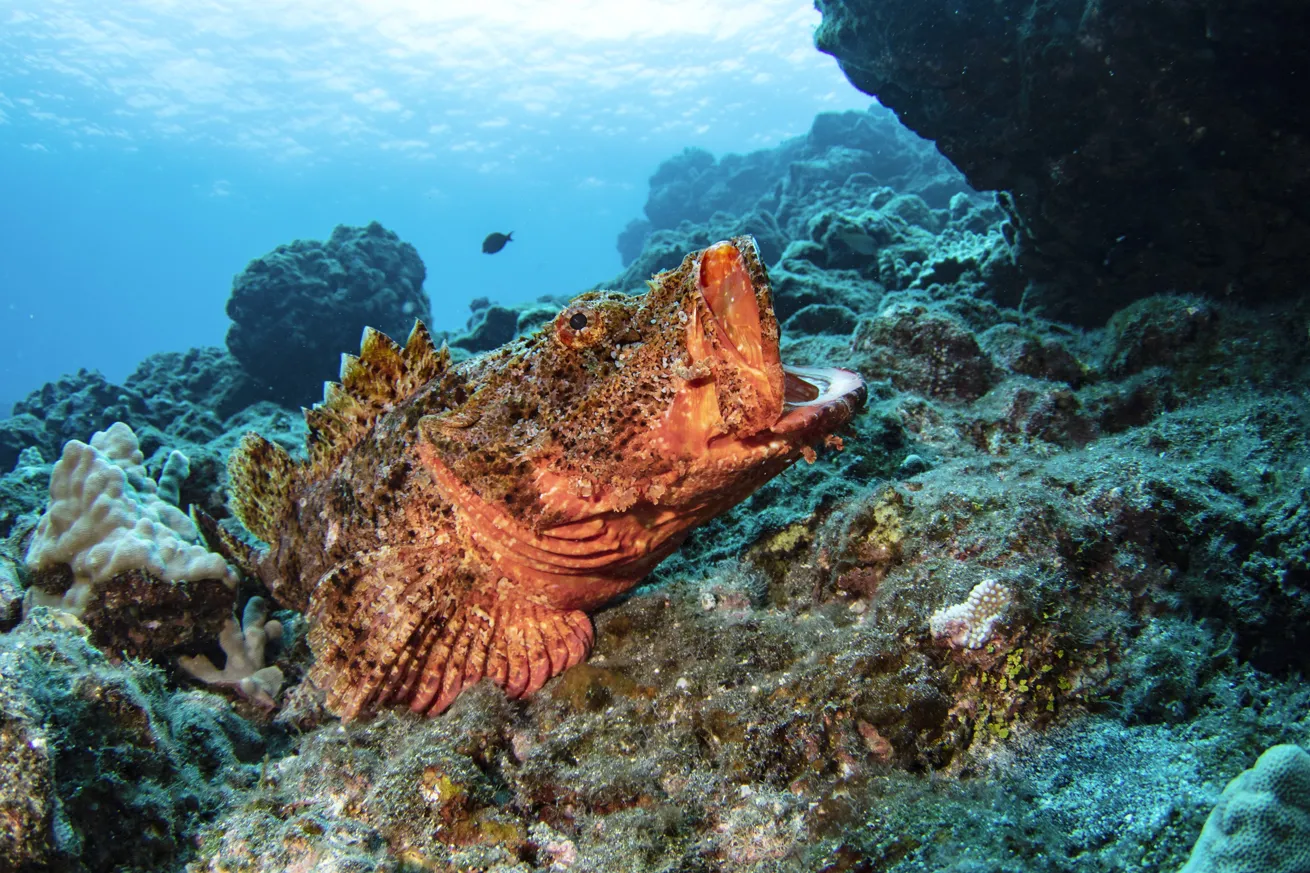
Jeffrey MilisenA titan scorpionfish (Scorpaenopsis cacopsis), endemic to Hawaii.
Lava Reef Diving
The reef disappears from view. I’ve just been swallowed up by the darkness—by choice—and my eyes need a moment to adjust.
The Big Island is the youngest of Hawaii’s five isles, but in the past several hundred years, the flowing hands of molten rock have shaped and stretched this landmass. Veins of red-hot lava poured down the coast, the gently sloping reef and the steep drop-offs. The outer surface of these lava rivers cooled first, forming caves, caverns and—in cases such as the dive site Kei Kei Caverns on the northwestern Kohala peninsula, where we are right now—lots of tunnels.
I’m here with a small dive group led by James Kregness, a PADI Master Scuba Diver Trainer with Kohala Divers, a PADI Five Star Dive Center located nearby.
Moments ago, he had briefed us about these tunnels, where entering is entirely optional. He explained the sizes of the tunnels and that within the first big open cavern, we’d possibly find a few sleeping whitetip sharks—as well as a hole in the floor we could drop into, one at a time.
It’s a bit like being inside a covered waterslide, but I’m moving nowhere near as fast. Much slower, in fact. These walls are splattered with sponge life, and inching forward among it all are nudibranchs, including the sphinx nudi, white and black with electric blue along the edges.
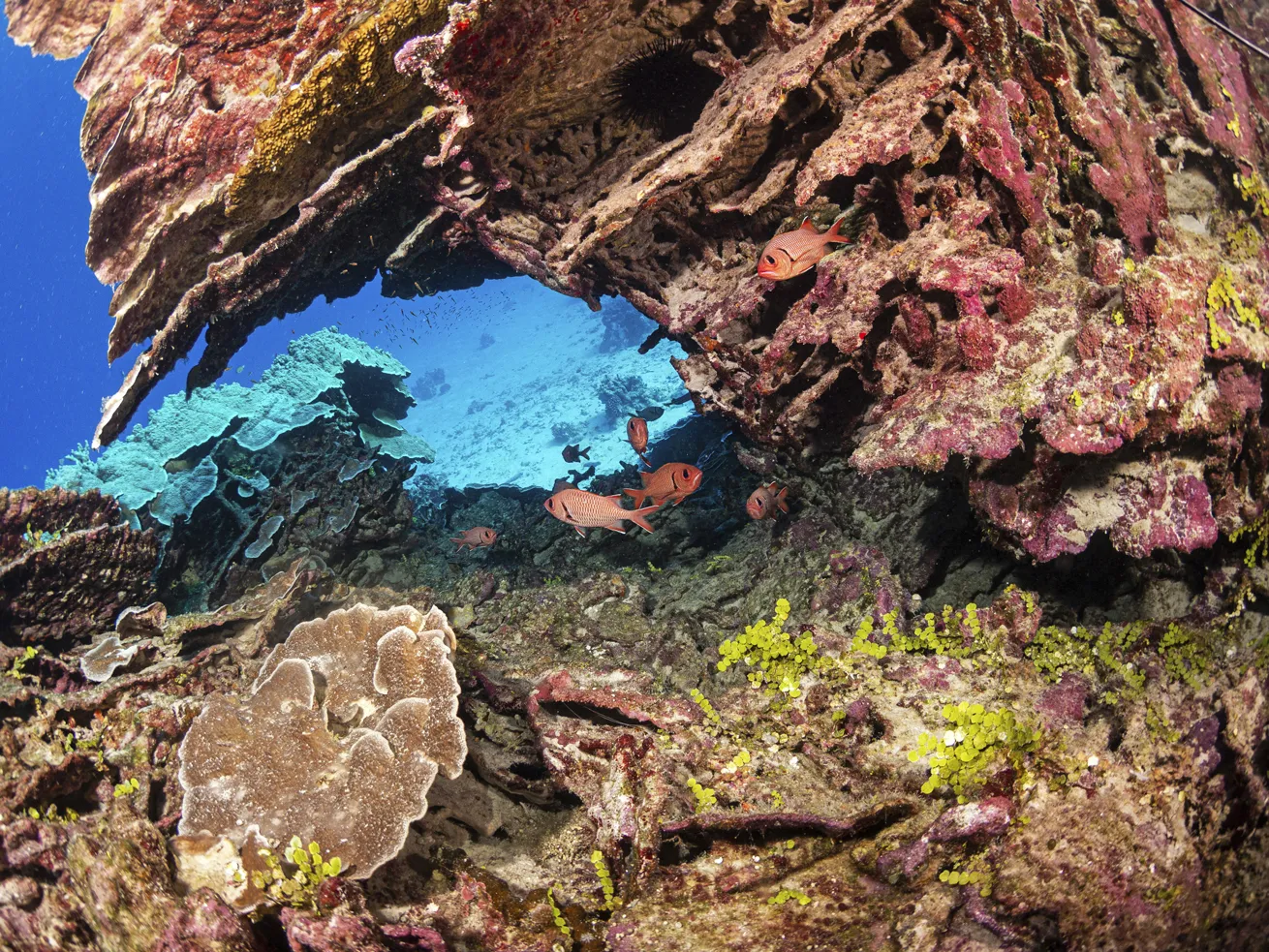
Olga TorreyLava tubes created by molten rock flowing into the sea make for interesting underwater features.
Then, there in the water column is another nudibranch. “That’s the ‘second diver’ nudibranch,” Kregness explains later. “He doesn’t have a good sticking mechanism, so the first diver’s bubbles dislodge this guy on the roof, and he starts falling.” In the ID books, it’s better known as the gold lace nudibranch.
Also in the tunnel is a sculpted slipper lobster, unique for its bright-blue dots.
The lava tunnel spits us out into a huge cavern, then yet another swim-through. “For people who like it, they like that sense of mystery,” Kregness had said in the briefing. “People are thinking, What’s inside here? I’ve never done this before. It’s a little bit of the unknown.”
After we exit the unknown, we’re back amid the reef. These ridges of coral bloom with whites, purplish lobe corals, tan cauliflower corals and cream-color finger corals. But what’s more thrilling is the tornado of bluestripe snapper, swirling in a tight cluster.
Kregness hangs back, pausing as the diver in front of me slowly eases between the mass of fins. The school flows and flits in my direction, and soon I’m enveloped within. It’s a gorgeous, very Zen way to end the dive before we make our way to the second spot of the day.
Frog Rock is another favorite Kohala site for its two oversize lava-formed caverns. The most striking feature of the site is the cavern’s wall, a honeycomb of entrances, big enough for divers to enter. It’s the kind of site that— though I know we are far from the first to lay eyes on it—stirs up so much curiosity about what lies just on the other side.
Related Reading: The Ultimate Guide to Scuba Diving Maui
More to Explore
Spencer Beach Park offers calm waters and golden-sand beach. It’s also the start of the 3.5-mile Ala Kahakai National Historic Trail, with plaques that teach about the island’s history and culture. The drive to Hawi—pronounced havii—leads up the mountains and typically passes horses, sheep, pigs and other ranching land residents. Where the road ends, a hike begins, leading to a beautiful, quiet beach.
Where to Eat
Seafood Bar and Grill has a fun tiki-bar-like decor and dishes up a diverse menu, including coconut shrimp and seafood quesadillas, all at affordable rates. A splurge option is Cipriano’s, serving Italian and Peruvian cuisines, including ceviche, Kona lobster puttanesca and a Peruvian pork belly sandwich.
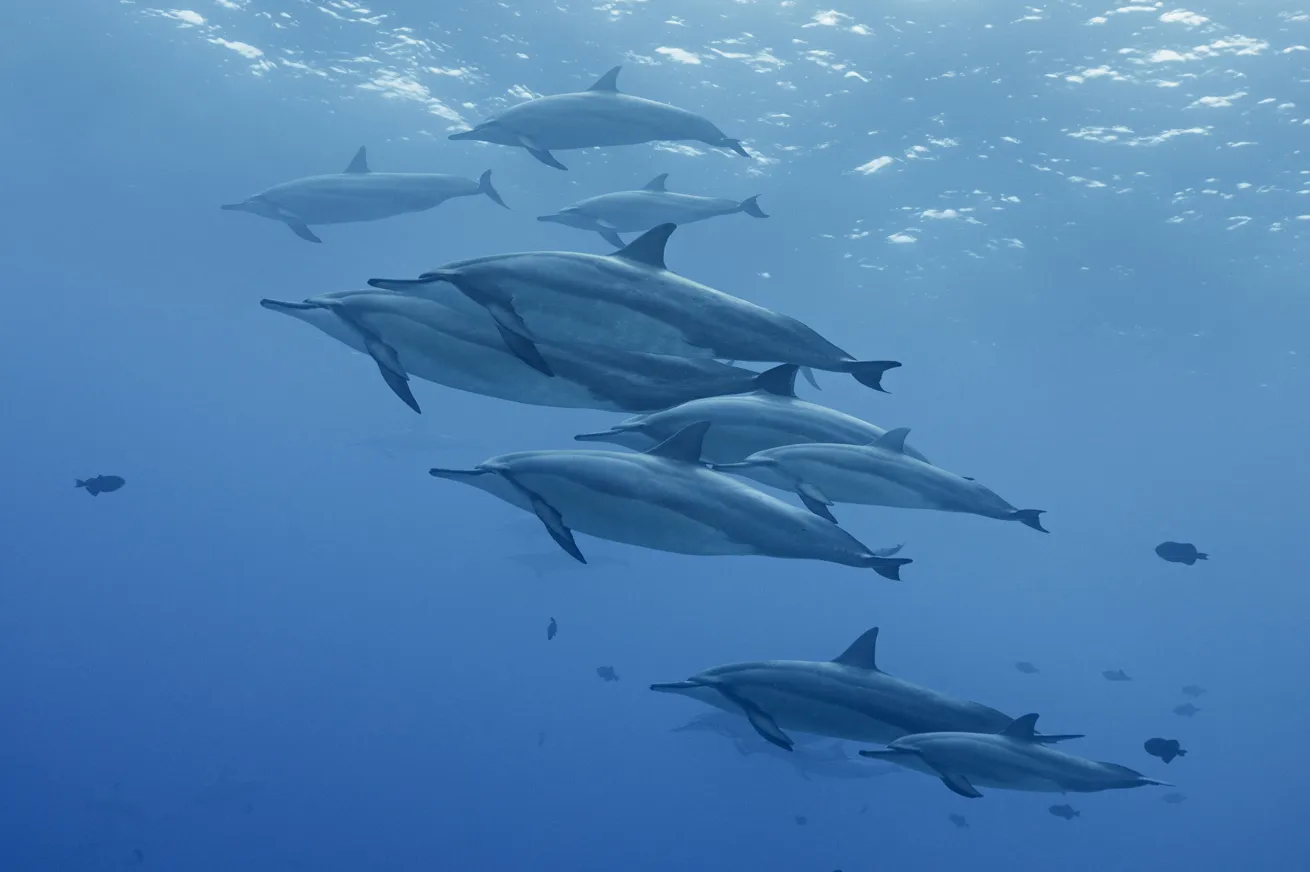
Brandon ColeA pod of spinner dolphins cruises in the blue.
Boat Dives
The hourlong boat ride south from Kona to the long-range dive sites visited by Kona Honu Divers is almost worth the ticket alone. Signs of development fade from view as we pass shore-diving sites such as Red Hill. It’s a tour that shows a side of the Big Island most tourists won’t see. Soon the shoreline becomes ragged, burnt-black crust.
“We are really going far out there—not to uncharted waters but definitely off the map,” says Jeff Milisen, a divemaster with Kona Honu Divers.
Along the way, we see more than our share of spinner and bottlenose dolphins. I’m told it’s not uncommon to see pilot whales and, in winter, humpback whales too. The occasional whale shark and even a manta have made appearances.
Then we see it: a break in the rock that signals we have arrived at Au Au Canyon. We drop in, taking a moment to acclimate to this dive site—it’s like nothing I’ve seen before.
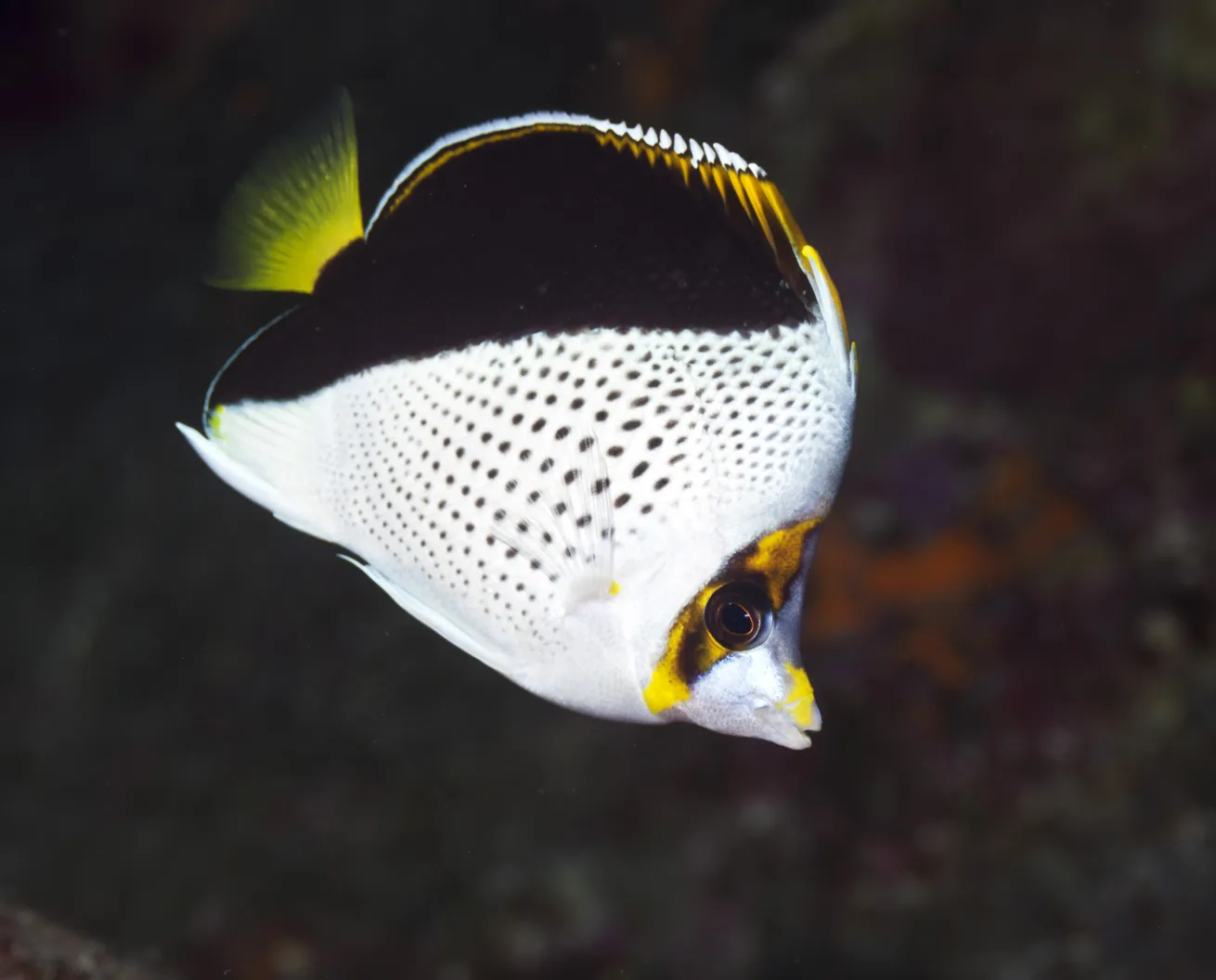
Jeffrey MilisenA Tinker’s butterflyfish.
The Big Island has no continental shelf buffering the reefs from the abyss. That means deep water charges right up against the shoreline. The drop-offs are abrupt, bottoming out thousands of feet below.
Before us is an amphitheater of a canyon. In the briefing, Milisen had prepared us that we wouldn’t be able to see the other side of this massive gap.
He starts leading us along the south wall, which is crawling with nudibranchs. This underwater cliff is riddled with holes, many with eyes peering out—a spiny lobster, a whitemouth moray, a longnose hawkfish .
Milisen then starts leading us on “the jump” to the other wall of this canyon and keeps going, several kicks out into pure blue nothingness.
In his briefing, he had told us about this spot. “When you look down, you’ll see pinnacles and cuts in the reef, just at the edge of visibility—and the deep just beckons you here,” he said.
The visibility is stellar today, enough to see the pinnacles. Any diver would feel the pull to explore something new and deep, where untold pelagics await. But we’re here to dive a plan, which does not include going off into the unknown.
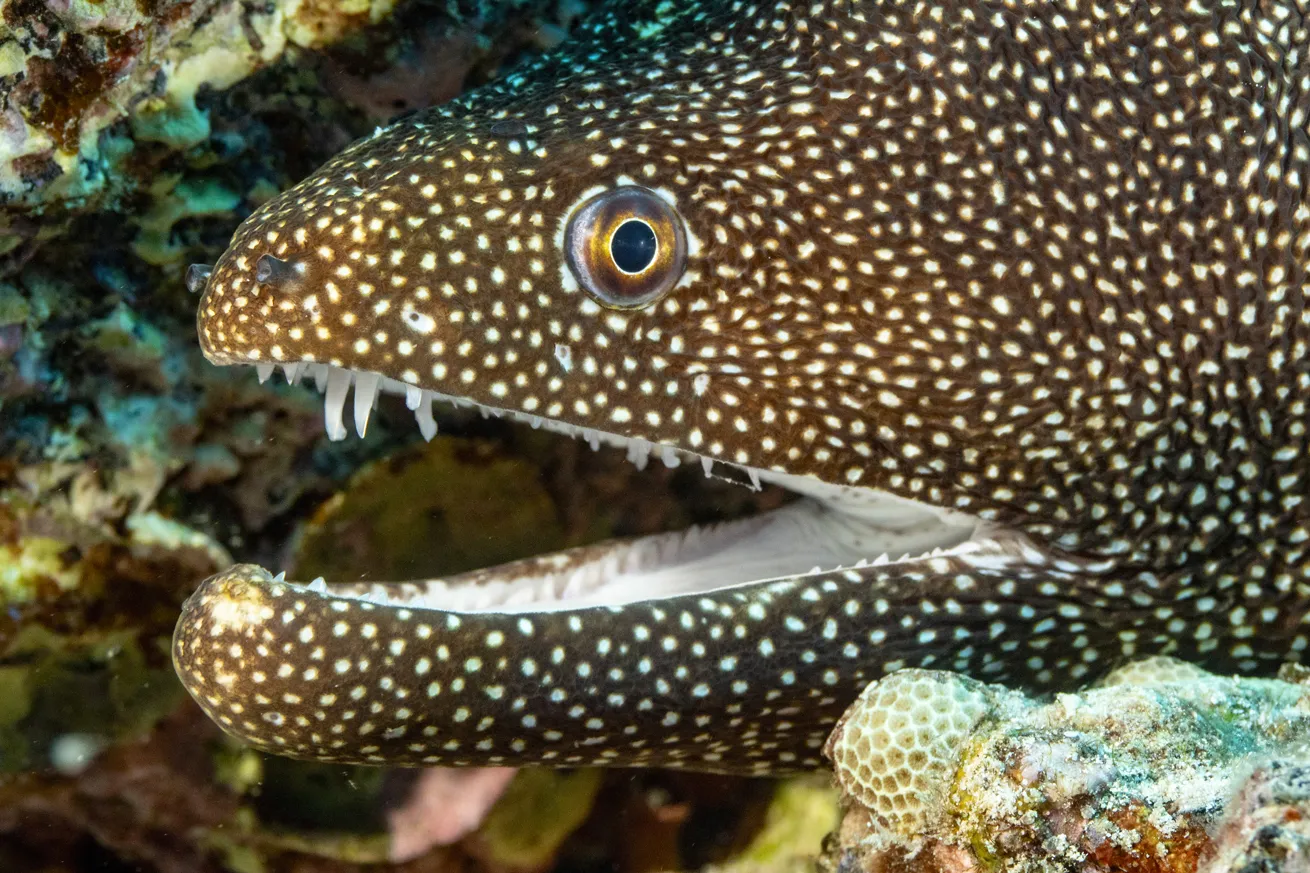
Jeffrey MilisenA whitemouth moray pokes out from a crevice.
I realize I’ve been caught in a daze. When I look up, I’m at the rear of the dive group, following Milisen and the group as he now takes us parallel to shore, past giant boulders to another wall.
This wall has outcroppings and chunks missing, creating a series of overhangs.
There, like pops of big yellow confetti scattering about, are Tinker’s butter-flyfish—with a David Bowie Ziggy Stardust–like face painted with a slash of yellow across its eye. Its body is equal parts black and white, giving even more contrast to the tail, pure yellow.
Milisen had told us that this fish dwells in the deep, typically at 200 feet.
“Tinkers are very friendly and will swim right up to you,” he said. “If you see those, you know you’re in a special place.”
The Tinker’s butterflyfish are a treat no doubt, but even before we laid eyes on them, I already knew we were taking in something amazing—something you couldn’t dive anywhere else.
More to Explore
If you enjoy cruising the Pacific to encounter big stuff, spend a day with See Through Sea for a blue-water safari. You’ll get to snorkel with whatever Capt. Dylan Currier finds that day, be it mahi mahi, ahi or marlin. “You want to go with someone who has a good set of eyes, and Dylan has been doing this many years,” says Milisen.
Where to Eat
Head to Izakaya Shiono for fantastic sushi and some of the best tonkatsu. Sticking with the Japanese theme, don’t miss Teshima’s Restaurant, a fusion of Japanese and Hawaiian flavors. Milisen recommends the deep sea trio: ahi sashimi, fried ahi, and tempura shrimp and vegetables, served with rice and tea and miso. “It’s simple but fresh.”
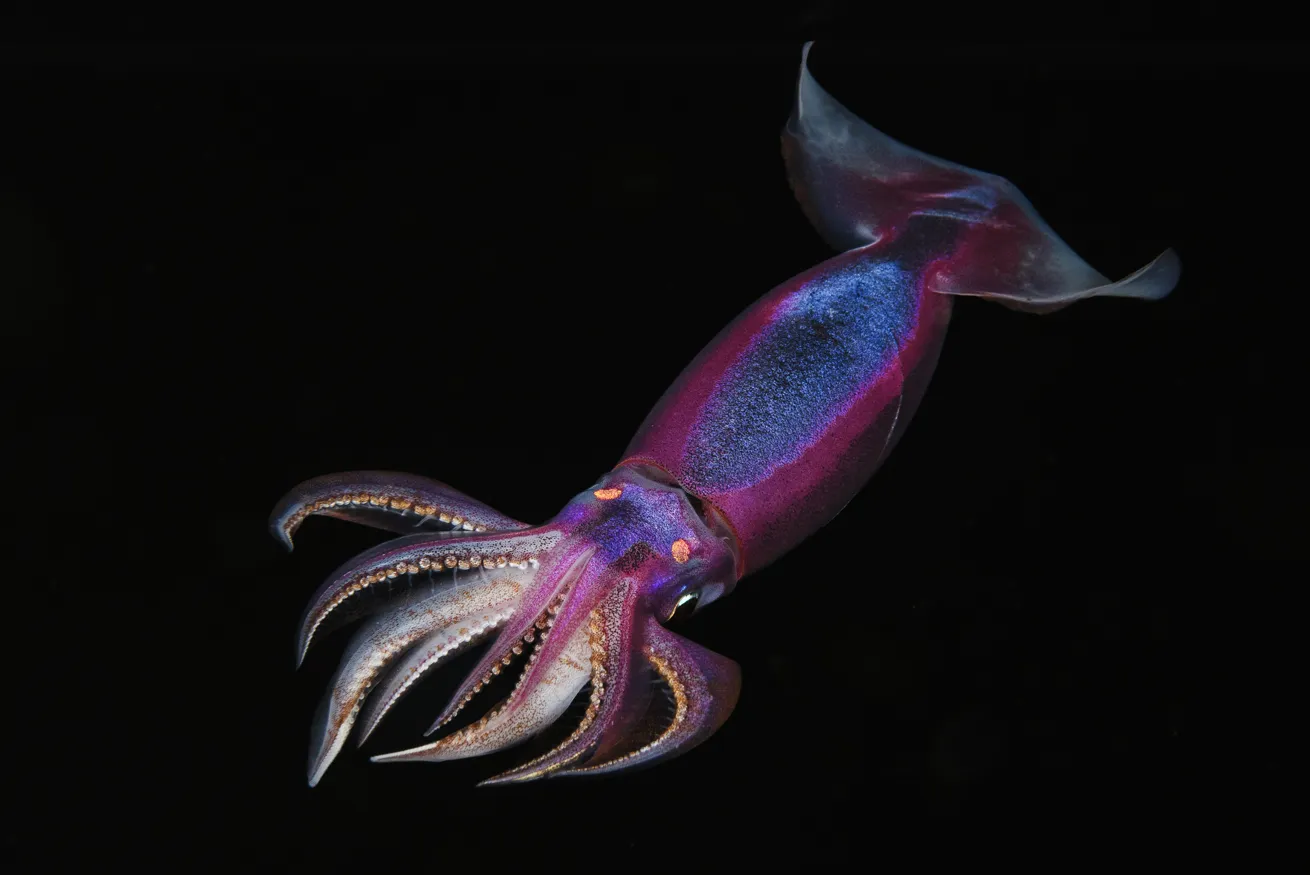
Brandon ColeA purpleback flying squid.
Pelagic Magic/Blackwater Night Dive
As my fin tips touch the edge of the swim platform and I’m moments from jumping into black water, I can’t tell if I’m excited or scared. We’re here under the night sky, in a boat rocking ever so gently in the waves, with the bottom some 3,000 feet below. Hawaii’s waters regularly see tiger sharks and oceanic whitetips, which adds to my nerves, but really, I’ve just never before been diving in the open ocean well past sunset. I breathe in and remember that excitement and fear are really just the same emotion.
Before I giant-stride, I recall the words Jeff Leicher, PADI Master Scuba Diver Trainer with Jack’s Diving Locker, had shared during the briefing moments ago: “Your body thinks you’re going to die, but you’re not. In 10 seconds, 98 percent of that nervousness is gone.”
He promises that after fear comes fascination. “We are not capable of being scared and fascinated at the same time,” he said.
David FleethamRanging in size from a couple of centimeters to 8 inches long in the case of the squid.
I jump. The fizz of bubbles dissipates, and I’m surrounded by darkness. There are six of us tethered to the boat, with a guide swimming between us, making sure everything stays copacetic.
My light is on. At first, I don’t know where to look. It takes a moment to slow my breathing and reorient to the fact that all the action—or most of it, anyway—will happen 6 to 12 inches from my face.
That’s when I see the first salp.
It’d be easy to miss if we weren’t here specifically to lay eyes on these tiny, translucent wonders.
Related Reading: Best Dive Lights for Every Diver: A Complete Buyer’s Guide
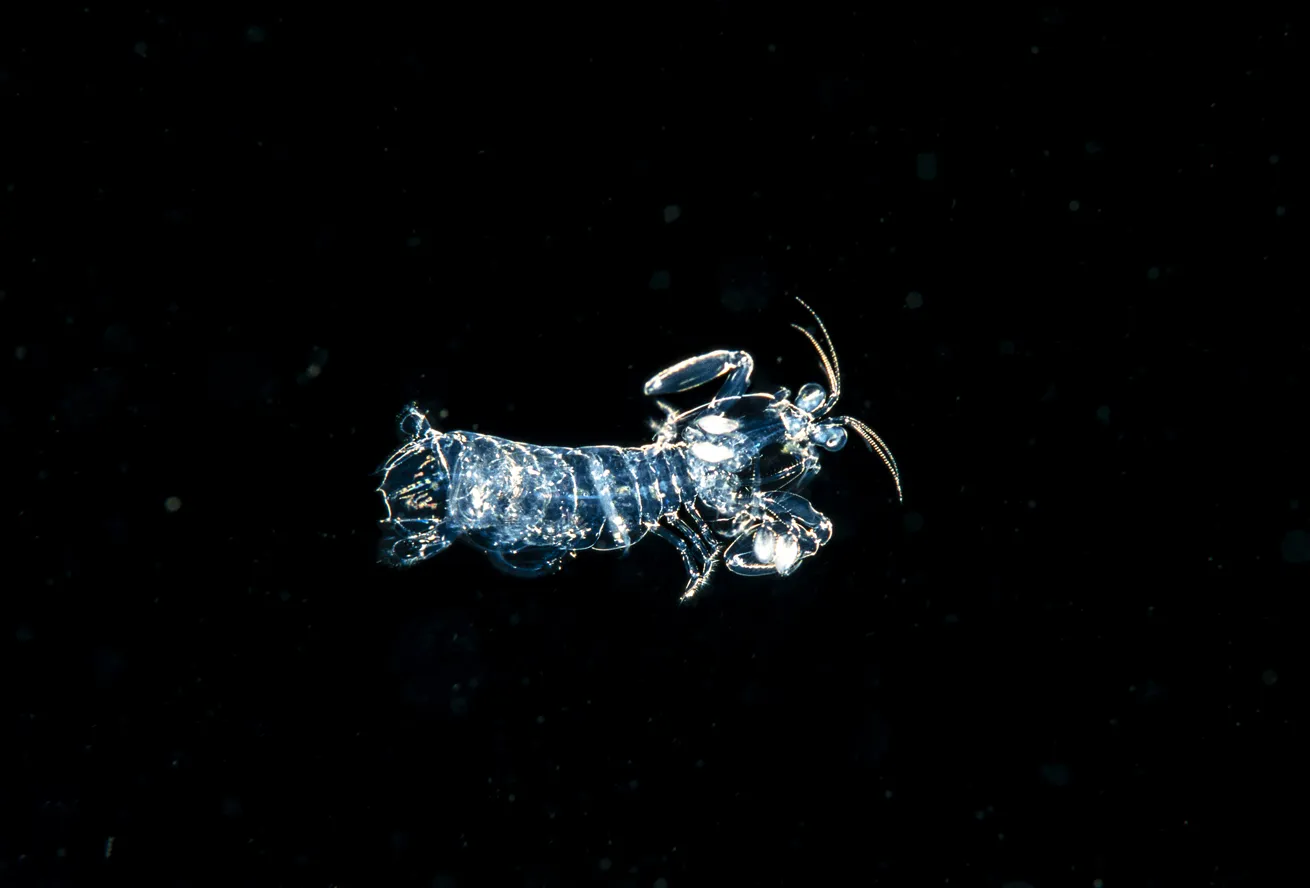
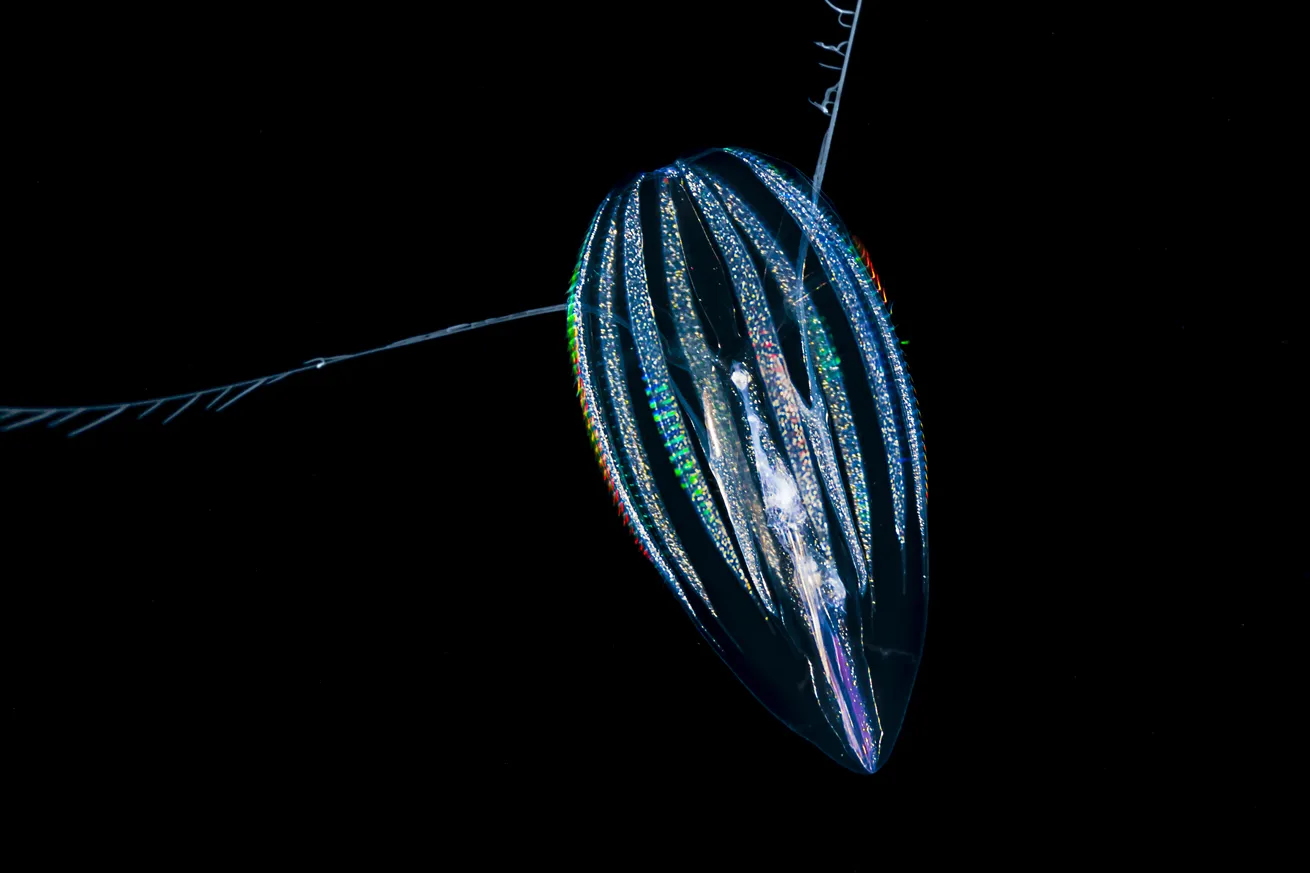
David FleethamLarval-stage shortnose mantis shrimp and comb jelly.
This salp is nothing but a garland of small rectangles, with teeny tiny orange tennis balls on the end of each component. It appears that the water is causing the undulations in this chain of organisms, yet somehow it must be able to locomote, as it makes a nightly pilgrimage 650 feet up to the surface.
A few moments later, in flows the light show. A comb jelly rises to the surface. It’s a clear tulip, with flashing twinkle lights on its perimeter and rainbow lights pulsing at its core. Its mouth, wide and round, yawns open and shut, inhaling plankton.
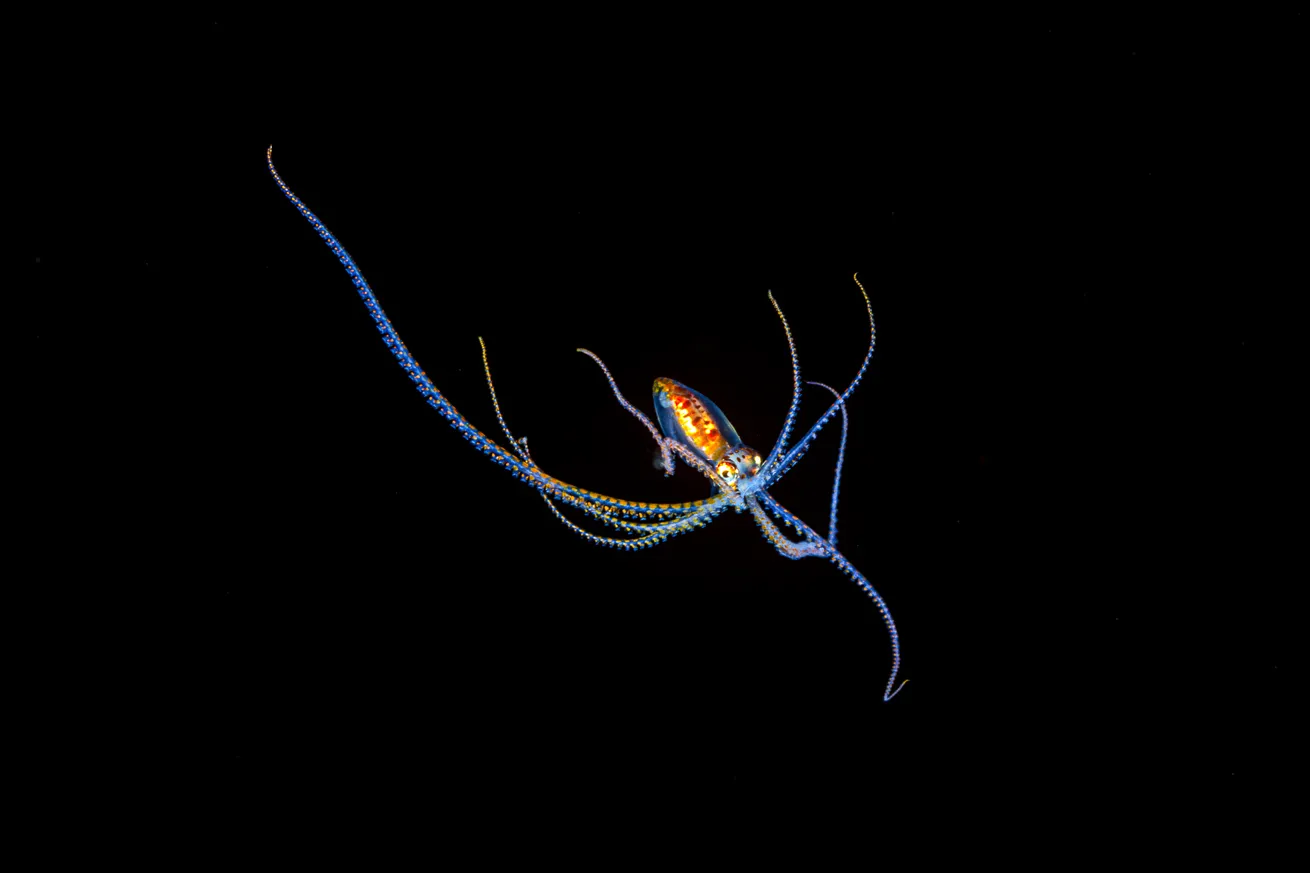
David FleethamLarval-stage longarm octopus.
I don’t have to move much during the dive—in fact, Jack’s deploys a sea anchor to limit the boat’s drift. Instead, the deep-sea critters come and go all on their own.
A few squids dance by. Perhaps the trippiest find of the night is a larval eel, a translucent ribbon that carves endless S-patterns. Most of what I see is unidentifiable to me in the moment—a tiny paragliding wing, a peapod with a propeller of sorts, and a fuzzy pink sock emitting light. One could photograph and look up every species, but it’s also pure joy to simply watch the world’s tiniest light parade slowly swoosh by.
Back on the boat, banter and joking turn to psychedelics. “I definitely have ’60s flashbacks when I’m down there,” jokes Leicher. He then shares that Grateful Dead front man Jerry Garcia used to dive with the shop long before Pelagic Magic became a regular offering. “It’s a shame we didn’t have this back then,” says Leicher. “He would have wanted to do this every night.”
Where to Eat
Eat a late lunch at Harbor House Restaurant before the night dive. Try the clam chowder or calamari. Laverne’s Sports Bar, named for one of the tiger sharks that lives outside the harbor, is often open late, dishing up burgers and pizza. Both Leicher and Laros recommend Umeke’s Fish Market Bar and Grill, known for poke bowls.
More to Explore
Head to the artist community of Holualoa Village, 1,500 feet above sea level, on a nondiving day to tour studios selling local, handmade paintings, sculpture, woodwork, pottery and photography. The Courtyard by Marriott King Kamehameha’s Kona Beach Hotel has a new Epcot-like flying-ride experience called Flight of Aloha.


