


Courtesy Simon Hilbourne.Reef mantas glide in formation during a mating train at Rasfari, Maldives, offering divers a glimpse into one of the ocean’s most elusive rituals.
Witnessing manta ray courtship on a dive is akin to finding the golden ticket in a Wonka Bar. Few get lucky enough to experience it, but if you get the chance, you will remember it forever.
In a manta ray “courtship train,” as many as 30 males line up head-to-tail behind a female manta, twisting, spiraling and turning around her in perfect synchrony as she swims at high speeds. The trains run hot and cold, reaching periods of explosive speed and energy before slowing again into a graceful procession led by the female.
At a first glance, it may look like the female is trying to escape her pursuers. But in fact, the train is a way for her to assess her potential suitors; she is testing the males before she makes her choice.
For Dr. Michelle Carpenter, a manta and devil ray (mobulid) behavioral ecologist and principal collaborator for the Manta Trust, observing manta ray courtship was when she truly grasped how complex and interactive these animals are.
“My first time was in Komodo National Park, Indonesia,” Carpenter says. “I turned around underwater, and a female manta was inches from my face, followed by three males. I watched them dance together for an hour. It was magical.”

Courtesy Guy StevensReef mantas participate in a courtship procession at a known aggregation site in the Maldives.
These encounters, captivating to witness, are windows into one of the ocean’s most elusive processes. For decades, divers and scientists have known little about where, when and how these mysterious creatures reproduce. Until recently, the behaviors of many mobulid species remained largely undocumented.
Related Reading: 10 Amazing Facts About Manta Rays
“I had encountered shortfin devil ray mating in Aliwal Shoal, South Africa, where I’m based most of the time,” Carpenter says. She published a paper on the sightingand was soon contacted by Dr. Guy Stevens, co-founder and chief executive of the Manta Trust.
“[Stevens] reached out saying he had some unpublished shortfin devil ray sightings,” Carpenter says. “We started wondering: How much data on mating might already exist around the world that we just didn’t have access to? So we reached out to scientists, divers and the public to collect as many observations as possible across species, to compare and contrast behaviors.”
Carpenter’s curiosity, combined with contributions from divers and researchers worldwide, culminated in a recently published global study documenting 87 courtship events across eight mobulid species. Among the most surprising revelations? Male manta rays practice what researchers call “pseudo-courtship”—a sophisticated rehearsal of courtship moves with other males.
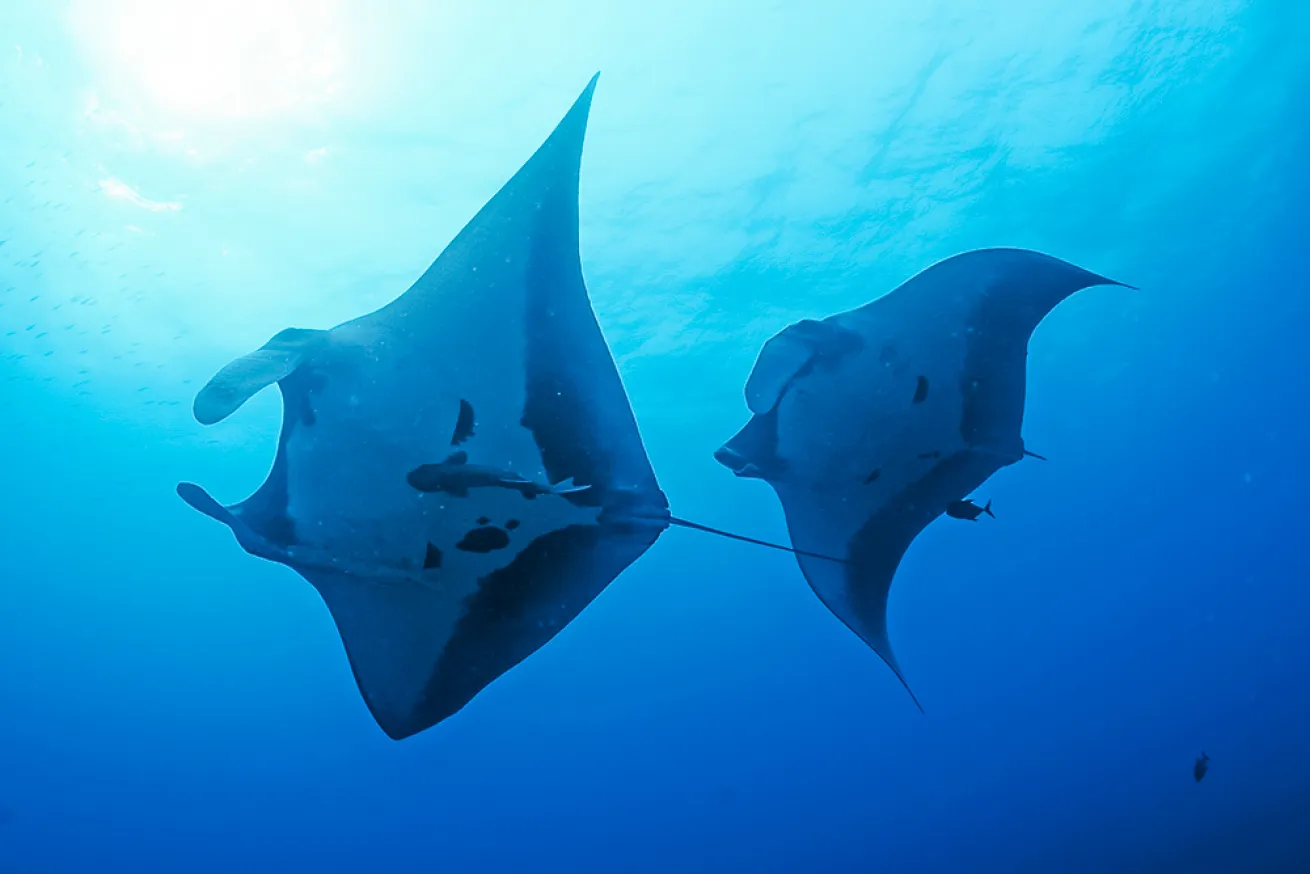
Courtesy Guy Stevens.Two oceanic manta rays engage in pseudo-courtship in Mexican waters—a rare glimpse of males practicing complex mating choreography together.
Practice Makes Perfect
One of the study’s most striking findings is male-to-male pseudo-courtship. Observed in four species—reef manta ray (Mobula alfredi), oceanic manta ray (Mobula birostris), Atlantic manta ray (Mobula yarae) and captive Atlantic pygmy devil ray (Mobula hypostoma)—this behavior involves males performing the first three stages of courtship (initiation, endurance and evasion) with each other instead of a female.
“It’s one of my favorite findings,” Carpenter says. “Male-to-male, or ‘pseudo’ courtship… our best hypothesis is that it’s practice—honing the skills needed to impress females.”
During these rehearsals, males align, follow and mimic each other’s movements in intricate trains, sometimes spiraling together in an acrobatic display. In essence, they’re rehearsing the complex choreography of real courtship: learning how to stay close to a female, respond to her evasive maneuvers, and execute rapid, precise turns.

Courtesy Conor Mulvenna.Male-to-male pseudo-courtship, like this display between two reef mantas, helps individuals hone the endurance and agility needed for real mating trains.
“For so long, when we saw a mating train, we’d assume the leader was a female,” Carpenter says. “Now we know that’s not always true. It shows how complex and social these animals are.”
Related Reading: Manta Rays Are Smarter Than You Think
This behavior mirrors what researchers have documented in other socially intelligent species, like manakin birds in Central and South America and Mozambique tilapia fish, where males practice mating displays in communal leks (aggregations for mating rituals). For mantas, cleaning stations may serve a similar function, providing a safe stage to sharpen social and reproductive skills.
Breaking Down the Dance
Mobulid courtship and mating follows a complex seven-stage sequence. “The easiest stage to recognize is ‘endurance’—the mating train,” Carpenter explains. “You’ll see a lead manta ray, often followed by several others copying its every move. They twist, turn and dance around. It’s truly incredible to watch.”
This is followed by “evasion,” where the female swims at high speeds, unpredictably, with males hurriedly mimicking her movements to maintain contact. This stage is the most energetic and visually dramatic, and you occasionally see the female using her powerful pectoral fins to deter the hopeful males.

Courtesy Guy Stevens.A female reef manta leads pursuing males through sharp turns in the “evasion” stage—a high-speed test of agility and stamina.
Carpenter emphasizes the species-specific variations: “Each species adds its own twist. The Munk’s pygmy devil ray forms beautiful vortex patterns during mating, while others, like the spinetail devil ray, move in slow motion. Each ritual is fascinating.”
When she is ready to mate, the female slows and allows the suitor to position himself on her back. Then the male performs something quite fascinating. He grasps onto her left pectoral fin with his mouth and spirals himself beneath her, so they are belly to belly, ready to mate. After hours of endurance, the act of mating itself is brief and usually over in under two minutes. The mantas then separate, unlikely to see one another again.
Using the Science
Understanding courtship isn’t just academic; it’s a tool for protecting these giants.
Mobulids are slow to mature, giving birth to just a single pup after gestation periods ranging from 10 to 15 months. Some species reproduce as infrequently as once every seven years. Coupled with fishing pressures and habitat threats, these reproductive traits make mobulids highly vulnerable.
“Aggregation sites—for feeding, cleaning or mating—are crucial areas to protect,” Carpenter says. “Feeding and cleaning keep individuals alive, but reproduction keeps the species alive. So, protecting mating areas is vital to their survival.”
Related Reading: Stranded Manta Ray in Florida Unlocks Discovery of a Third Species
Sightings of courtship behaviors offer critical clues to understanding where and how these animals mate, allowing conservationists to identify and safeguard hotspots essential for population recovery.
“Some species mate in predictable spots like cleaning stations, which are easier to manage, while others mate offshore—even in shipping channels—which is much harder to protect. So understanding where and when these behaviors happen is essential,” Carpenter says.
How Divers Have Helped
Citizen science played a crucial role in this study. Divers and the public contributed videos and observations from around the globe, filling research gaps. Carpenter underscores this: “You don’t need a degree to contribute to research or conservation. Public participation massively helped advance the science.”
Yet some mysteries remain. Mating rituals of certain species, like the longhorned pygmy devil ray (Mobula eregoodoo), are almost completely undocumented.
“This study shows how much we still don’t know,” Carpenter says. “Every new observation helps fill in the story—and every diver can be part of that story.”
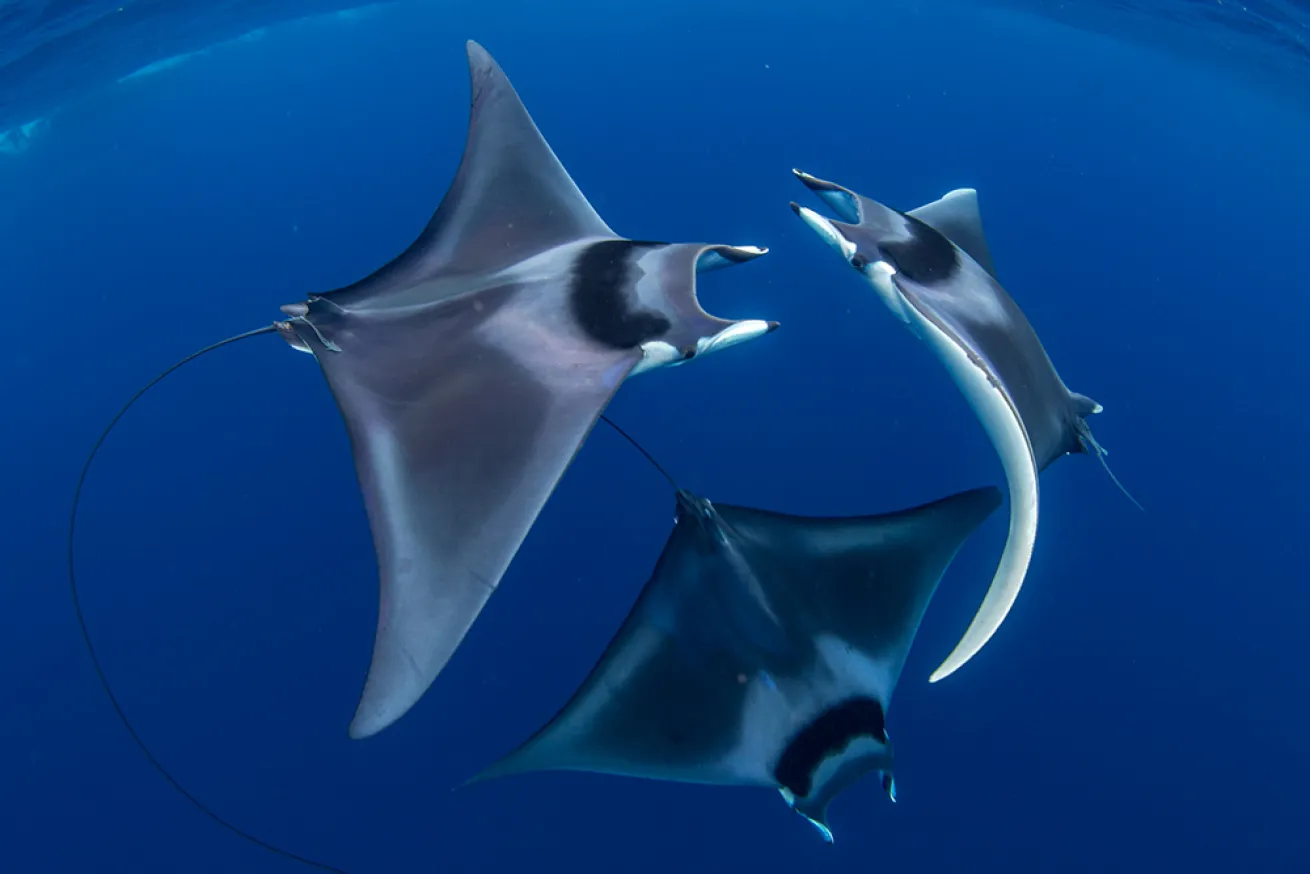
Courtesy Duncan MurrellA spinetail devil ray courtship sequence captured in the Philippines. These ritualized chases allow females to assess their suitors’ strength and stamina.
Witnessing mobulid courtship in the wild is rare, and even brief encounters leave lasting impressions. Watching males spiral and twist in synchronized choreography, practicing skills that ensure the next generation, reminds us of both the intelligence and vulnerability of these giants.
For divers, patience is key. Seasonal peaks and known aggregation sites improve chances of witnessing mating trains, but luck and persistence are part of the thrill. Each encounter is a window into a hidden world, offering a story that science alone cannot fully capture.
“It’s amazing how these complex, intelligent creatures still hold so many mysteries,” Carpenter says. “The public has played a huge role in piecing together their story. Hopefully this study inspires more people to look, record and share what they see.”