

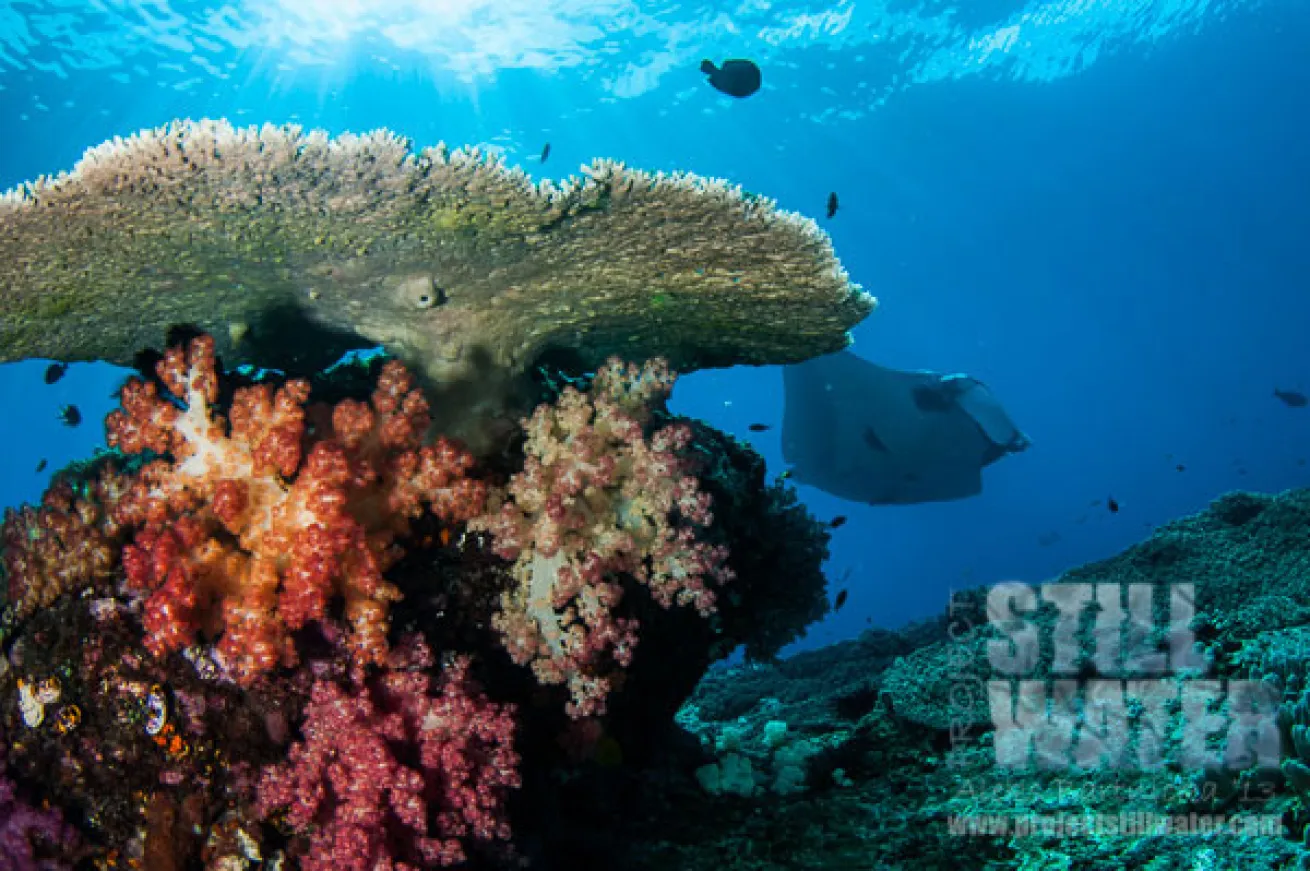
Aleks BartnickaMagic Mountain is not only a beautiful dive site, full of creatures and stunning corals. It's also a cleaning station and a premier manta spot.
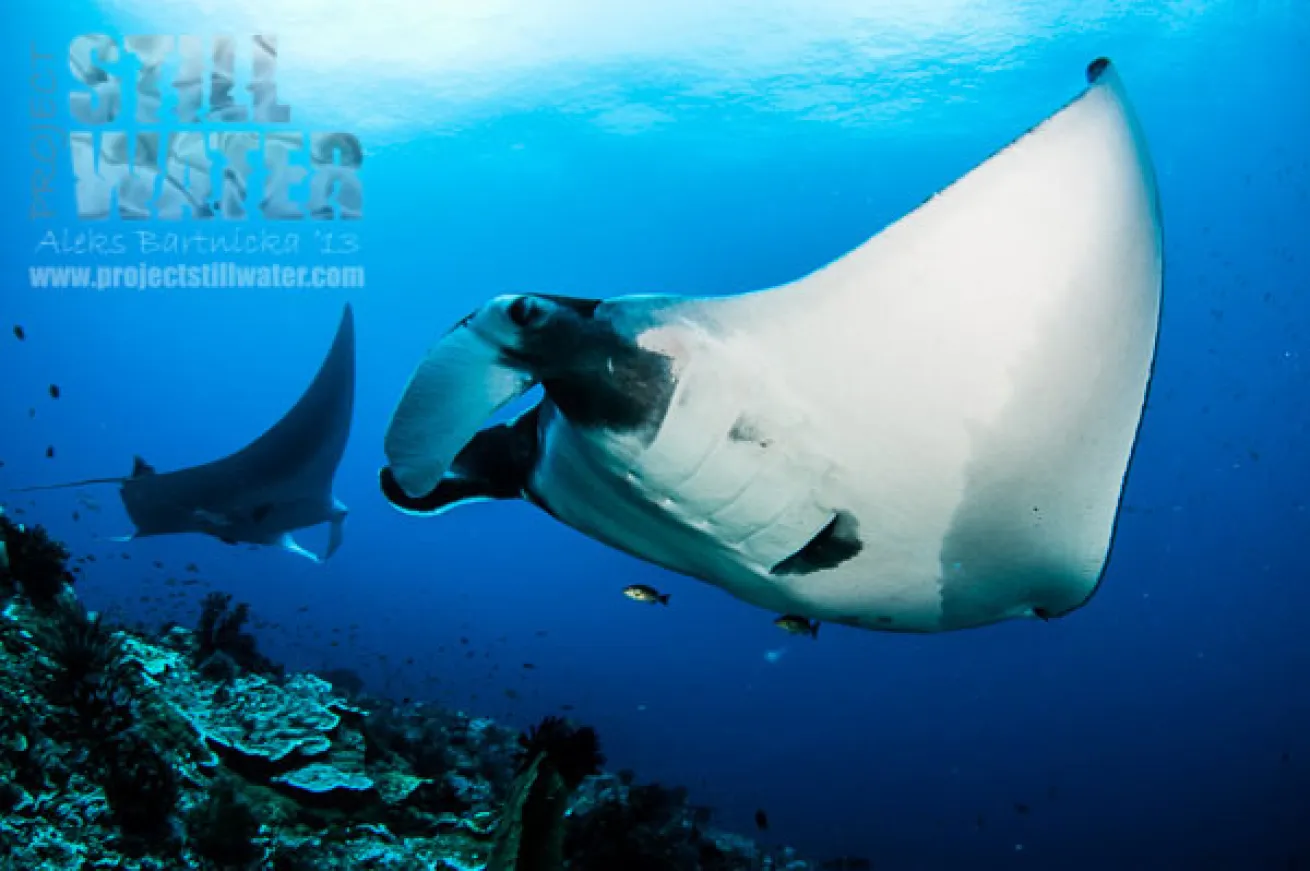
Aleks BartnickaOceanic mantas share the cleaning station with reef mantas. Magic Mountain is one of the rare sites around the world where this happens.
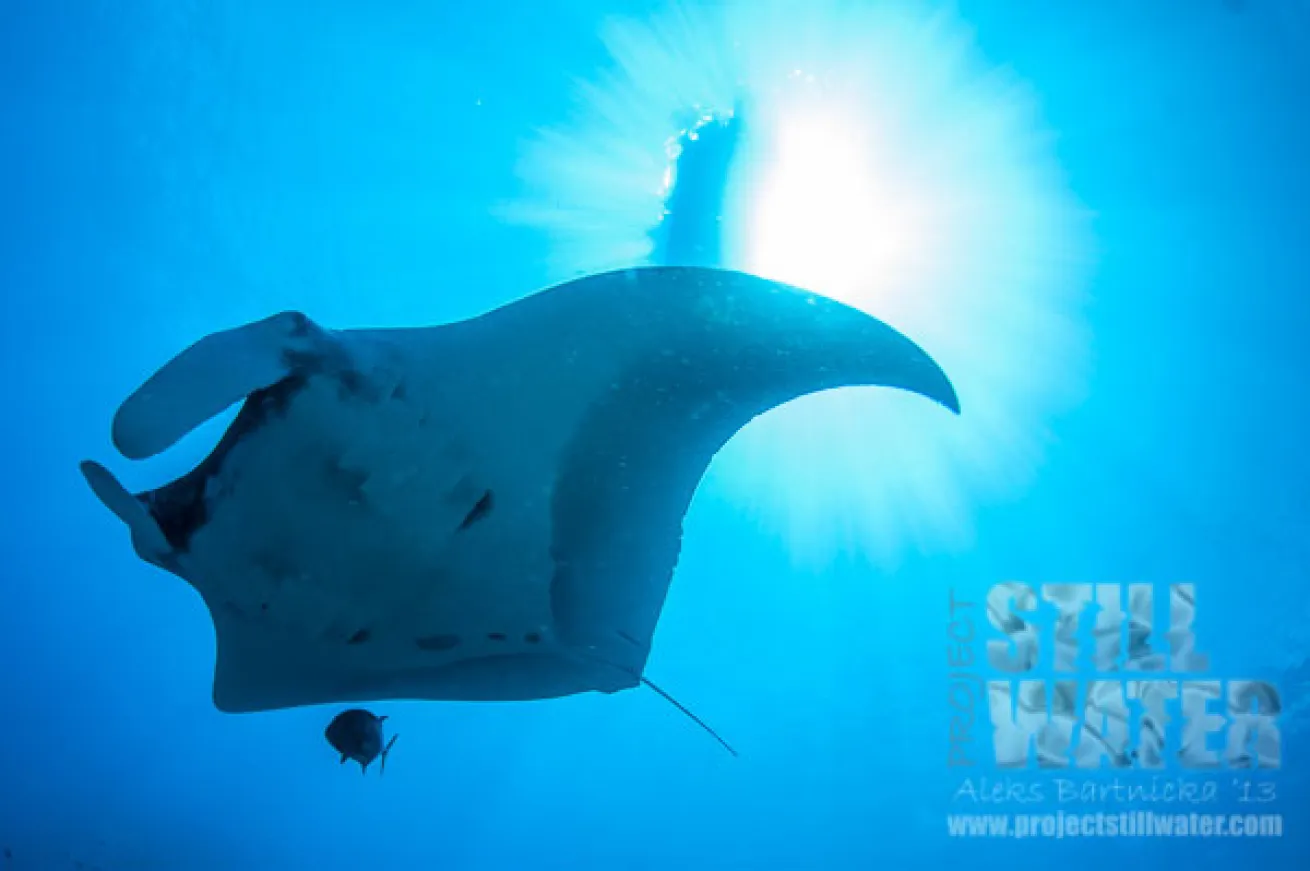
Aleks BartnickaOn good days, you might see the mantas as soon as you jump in the water; they will be cruising right under the boat.
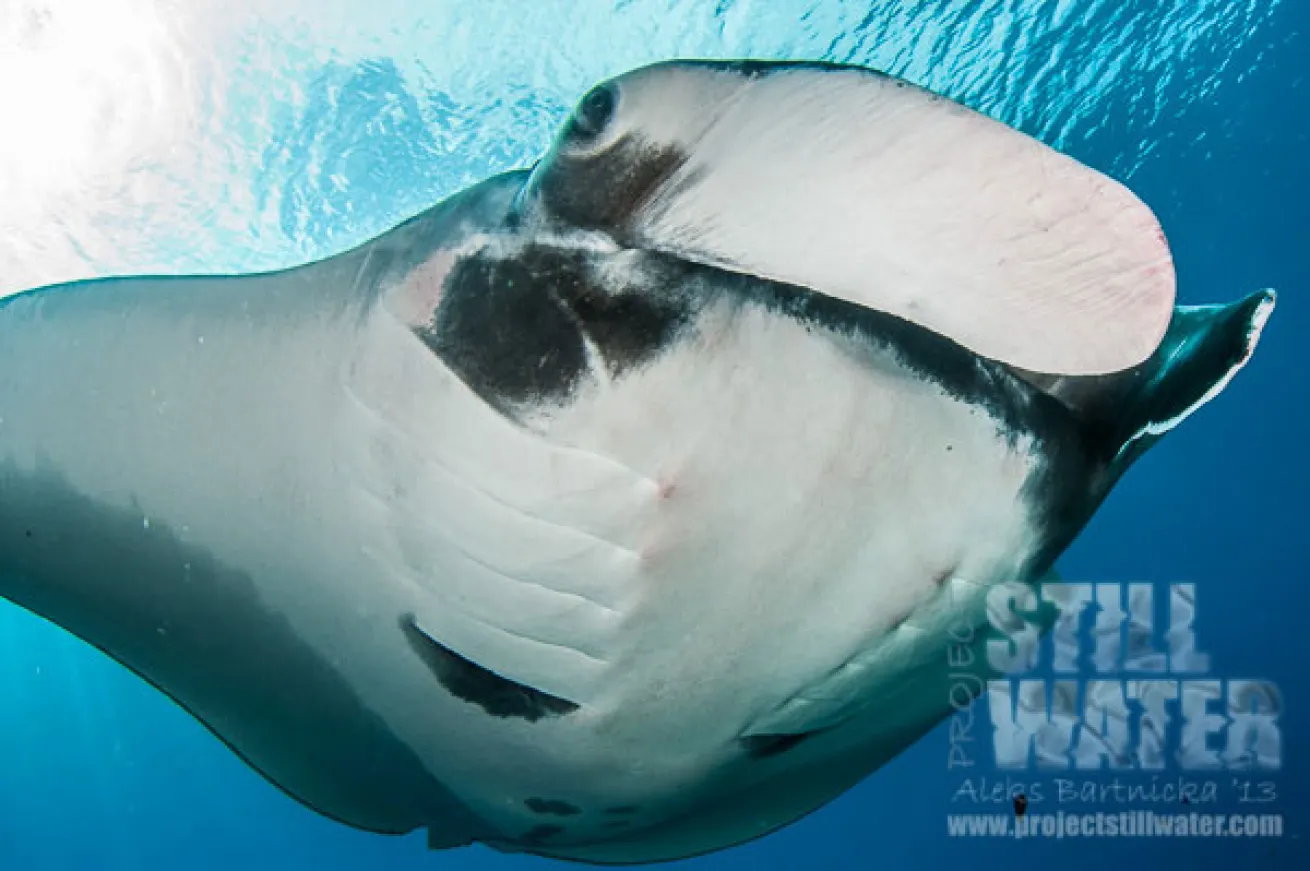
Aleks BartnickaIf you're patient and remain still, the curious manta can get very close. Those are the moments you might want to put the camera down and just revel in the encounter.
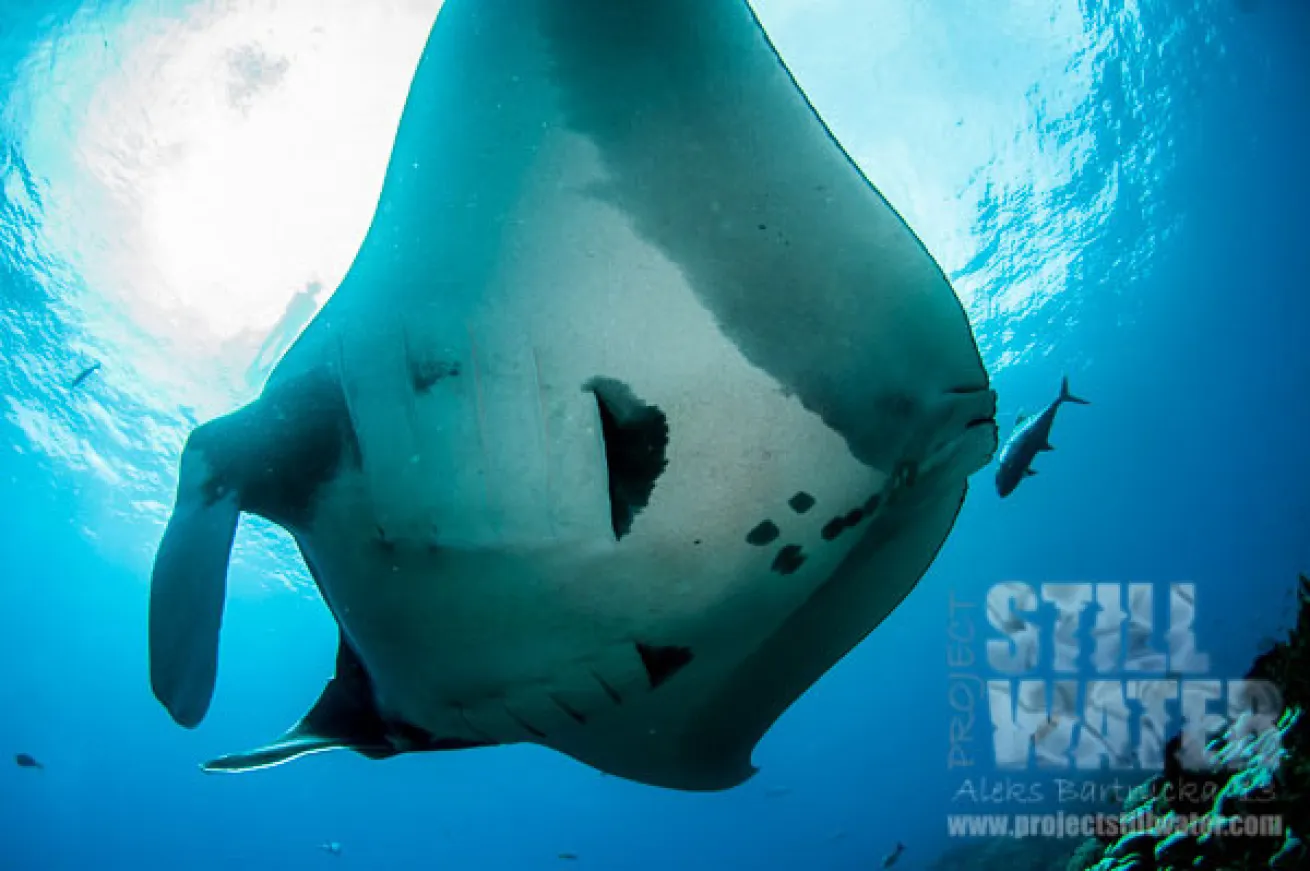
Aleks BartnickaA good id photo will clearly show the patterns on the underside of a manta, in this case an oceanic with black "spills" form the last gill opening, and a distinctive set of black spots, "the fingerprint." You can also see the gender, female, the lack of damage on the fins and lack of tail.
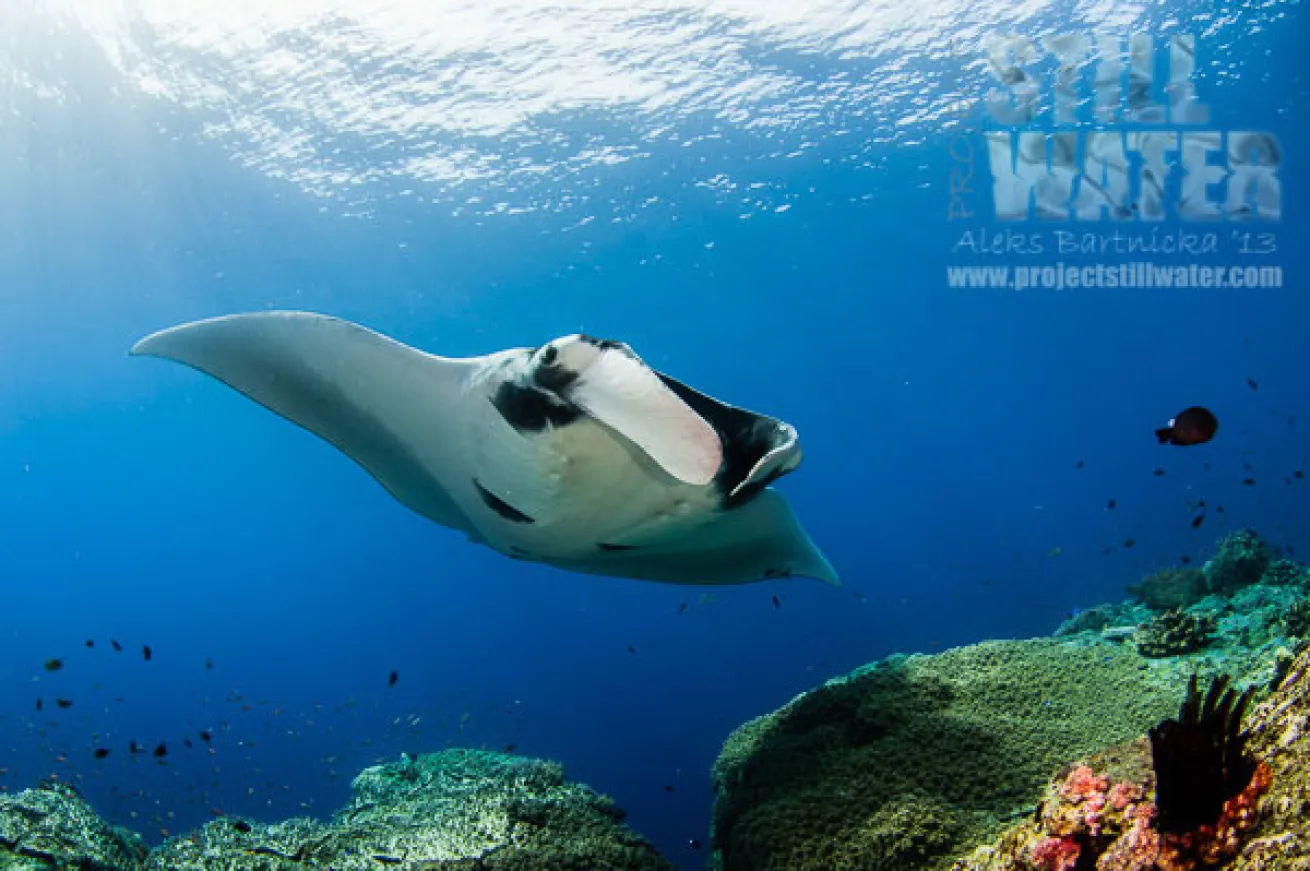
Aleks BartnickaLack of a tail is yet another mark of an individual manta that will be noted in the database for faster identification.
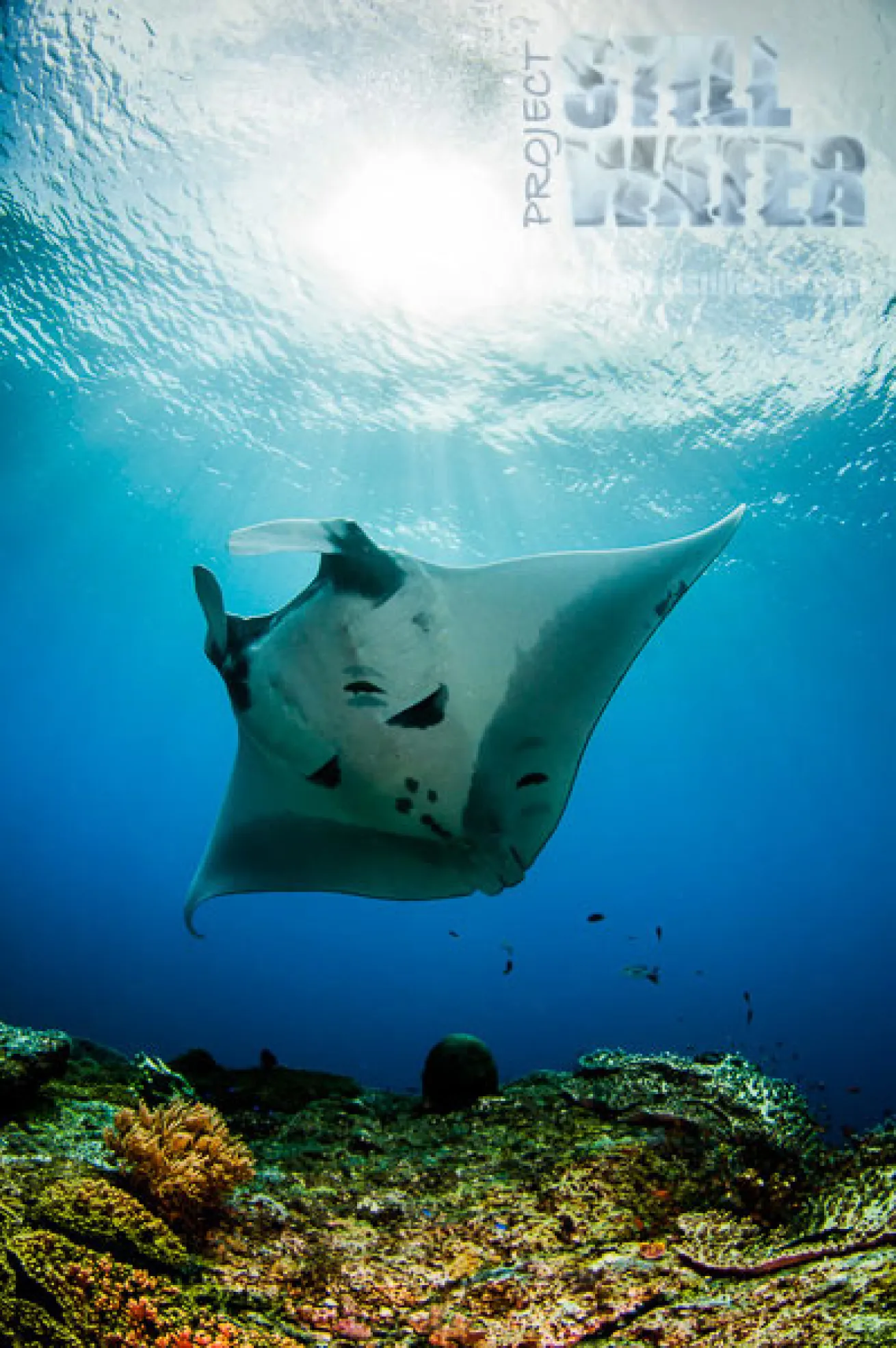
Aleks BartnickaBeautiful oceanic manta on Magic Mountain. All species of mantas are in dire need of protection.
The water is warm and clear. We are surrounded by blue, hovering over a deep ridge… waiting. Rays of sun are shimmering around us, lighting up schools of blue and yellow fusiliers and golden spadefish. A wobbegong shark rests under a ledge and an eel pokes its head out of a nearby hole. There’s a stonefish on a pile of coral rubble. But we are oblivious to all those wonders. They are not what we are waiting to see.
We’re diving on Magic Mountain, Misool’s premier manta ray cleaning station. This is one of the few rare sites worldwide, where both oceanic (giant) mantas (manta birostris) and reef mantas (manta alfredi) can be seen together. If we’re lucky, we’re in for a real treat.
As we’re starting to run out of no deco time, a shadow appears in the blue. It gets closer and we’re able to distinguish the white and black coloration and the telltale winged shape. Our patience paid off: an oceanic manta emerges from the deep.
Respectful of the creature we stay out of the way and let the manta come in to the station, where tiny (especially by comparison!) cleaning wrasse do their job, removing parasites and dead skin. If we stayed on top of the ridge, the manta would most likely move on, but since we keep our distance, it comes around again and again.
The next thing we know, a second manta appears and they take turns getting cleaned. They are curious of us as much as we are curious of them and they make slow passes right over our heads, giving us many photo opportunities.
They say that looking into a gorilla’s eyes changes your life. For us, divers, that must be the case with mantas. Their eyes are not empty black holes, but they show intelligence, study you with all gentleness and curiosity. This intelligence is supported by the highest brain-to-body ratio amongst the ray family. They are incredibly beautiful.
As a small manta with no tail passes over me for the third time, so close I could almost reach out and touch it, I have to put my camera down and just revel in the moment. It’s looking into my eyes, right into my soul. This encounter is one of the most exhilarating experiences I can remember.
As we make our way towards shallower water to start our safety stop, another manta, this time a reef, passes by. We find ourselves pushing our air limits to spend another minute with this amazing creature, but the manta soon disappears into the blue. Where did it come from and where is it going?
Mantas are a mystery. These most graceful ocean inhabitants have many secrets and a handful of researchers around the world have so far only scratched the surface trying to uncover them.
How does one decide to devote their time to studying these animals?
I wasn’t the only one affected by a close encounter with a manta. Calvin Beale, the founder of Misool Manta Project, currently based out of Misool Eco Resort (www.misoolecoresort.com), remembers his first manta encounter like it has just happened.
“I was working in the Seychelles for a research organization, as a boat driver and divemaster. After free diving to retrieve a diver’s snorkel I was coming back to the surface and out of nowhere this creature came towards me.” After realizing what it was he alerted other divers and then continued to swim on the surface. The manta followed him, even turned its belly up as it was looking at him.
“After a minute or what seemed hours, it turned back and started to slowly drift down in circles and figures of eight until it disappeared into the depths below me. I will never forget those eyes looking up at me.”
After moving to Indonesia Calvin worked in Flores as a divemaster and visited Komodo National Park almost every day. The Park is located between two of world’s largest manta ray fisheries: Lombok and Lamakera, and what he witnessed there was an eye opener.
“Every day we saw the lack of protection and conservation of these species: boats long-lining, fishermen in the reefs and liveaboards dropping anchor on the manta cleaning site.”
The Park regulations were poor at best so he used his background working for conservation based companies and set up his first Manta Project. Its main purpose was to create an ID database and an awareness program for the guests.
When the opportunity to work at Misool Eco Resort presented itself he was thrilled.
“The willingness of the Raja Ampat government to create the first Shark and Manta Sanctuary in the Coral Triangle, thanks to the work of the Misool Eco Resort and a few strong-minded individuals, made it a perfect place to base a study which would show the Indonesian government how important and profitable these creatures are to the country’s tourism industry.”
For the divers it may be all about the beauty and grace of mantas, but governments look for income. So how profitable are the rays? The main argument to convince the authorities to introduce a ban on manta fishing is the huge difference in their value: a dead manta may be worth US $300-500; a live manta can bring over a million dollars in its lifetime, not only to dive companies, but all the supporting businesses like restaurants and hotels.
It would take 2000 mantas fished out to bring the same revenue from killing the creatures. Unfortunately there aren’t even that many mantas left. So far, known populations have 200-400 animals, and as research shows, with the mantas birth rate of 1 every 5 years, those are not sustainable by any margin.
Thanks to Raja Ampat sanctuary, Calvin gets a chance to study mantas in a special place.
Magic Mountain, being one of those rare sites where both species meet, makes Misool, and Misool Eco Resort nearby, a perfect hub for the research. “We have a large population of reef mantas which regularly come back to be cleaned at the site and also we see relatively high numbers of oceanic mantas returning over a period of time.”
The research consists of a few things.
First, there’s the photo identification database. Every manta has a distinct pattern of spots on its underside that can be used like fingerprints – to tell individuals apart. Photos of the belly taken by divers are compared to those already in the database and if no match is found they are described and added. Each file contains the gender, size, tail length, any scarring, damage to cephalic fins (the bits in front of the mouth), shark bites and coloration (black or chevron).
The mantas are compared between databases from different regions. So far, no reef mantas have been known to travel between southern and northern Raja Ampat and populations separated by only 200km of sea are not using the same cleaning stations. This shows that the scope of their travels is limited, unlike oceanic mantas that travel long distances.
To track the mantas whereabouts Calvin uses two types of tags: the acoustic and the satellite tags. If you’re wondering if they hurt the manta, don’t worry, the rays show no discomfort. As a matter of fact, they don’t seem to be aware of the accessories at all. The process of attaching a tag lasts a split second, as the manta is swimming by.
The acoustic tags are efficient only on reef mantas that don’t travel far and often come back to the same spots – these tags require receivers installed in strategic locations on the reefs which collect “pings” from the tags attached to mantas. Even though they can’t be used for real time tracking, since the memory card has to be retrieved from the receiver and downloaded, they provide invaluable information about what the mantas have been up to in a period of time and if they travel in any specific patterns.
The satellite tags are used to collect information about the oceanic mantas. The tag is programmed to stay on the manta for a set period of time and store data about temperature of the water, the depth and, most importantly, the location. This usually takes from 3-6 months and then the tag pops up to the surface and transmits its contents through the satellite until the battery dies. What the tag sends through is analyzed and studied.
Due to high costs, so far three satellite tags have been deployed. Two popped up, although one emerged early for unknown reasons, the other one didn’t send all the data due to a faulty battery. The third tag never transmitted, even though it’s now past two months since it was due. The tags can be retrieved and plugged into a laptop to get all the recording, but finding them is nearly impossible, since they are only a couple inches long and it’s a huge ocean out there. The location of one of the tags was narrowed down to a small bay, thanks to the signal it kept sending to the satellite. Unfortunately Calvin had to rely on friends from a liveaboard to look for it. Upon closer inspection the bay turned out to be full of debris and despite numerous volunteers combing through it, the tag, with the battery now dead, was never found.
The data that was retrieved through the satellite showed that oceanic mantas can travel up to 350 miles away from Magic Mountain, covering up to 1550 miles between visits, but they don’t leave Indonesia. This means that the population is locally contained: information crucial to conservation – if the population gets fished out, it will not be replenished from outside sources. And speaking of numbers, if that happens, it would only bring about $80,000 in revenue; nowhere close to the million a live manta can generate.
The reef mantas stay close to home, but why do oceanic mantas travel?
“Previously it was thought that the oceanic manta rays would be migrating large distances following chlorophyll blooms and feeding in those rich areas. The satellite tag data combined with chlorophyll data shows no correlation between the manta tracks and chlorophyll level, indicating a different food source for these mantas.”
What that food source might be and why mantas travel remains a mystery.
As the technology develops and better equipment is available, the data recorded will provide more information. Thanks to generous donations from the resort guests as well as conservation organizations ten more tags are on order.
The third part of the research studies genetics and feeding. In order to understand the gene flow, Calvin performs a biopsy. Using a special spear tip, he will cut a tiny piece of skin with the underlying blubber the size of a pencil eraser. The process lasts a second, is less painful than a remora bite and is largely ignored by mantas. The acquired sample is sent to a lab for processing. So far the results only confirmed what the satellite data showed: the populations are separate and contained.
Conservation and protection are on the agenda, but it’s not all about the research.
“Every manta encounter, whether it’s just seconds or hours long, is magic. My favorite have to be large female oceanic mantas, the oceanic mantas have such beautiful markings and the females tend to spend longer periods cleaning.” Go figure!
There are numerous locations around the world where divers can encounter manta rays on a regular basis, but knowing where those hot spots are is merely the tip of the iceberg of knowledge.
“It takes years of studies to get conclusive data. You can’t base your theories on results from one satellite tag from one manta in one area.”
The research has much more at stake than just learning about the manta ways. The rays are in dire need of protection. Because of little knowledge about their habits, it’s very hard to establish sustainable practices in order to ensure the species survival.
So far the research shows that manta populations are confined and territorial and all fishing practices are causing a rapid, potentially irreversible population decline.
Calvin’s study of Mantas of Misool provides the insight needed for scientifically backed control over fishing areas. Misool Manta Project “aims to create blanket protection for all manta and mobula species across Indonesia and Asia.”
How can you help?
Send in your photos of mantas from around Indonesia, with time, date and location, whether it’s Bali, Komodo, Raja Ampat, or any other area.
“What we need is a photo of the belly of the manta, as this shows the unique pattern of spots.”
If you have photos of Indonesian mantas and would like to get involved in conservation, send your photos to [email protected]
Aleksandra Bartnicka has traveled the world as an underwater photographer. Originally from Warsaw, Poland, Aleks has lived and worked on Palau and is the former photo pro aboard the Aqua Cat in the Bahamas. To see more of her work and read her blog, visit Project Stillwater.


