

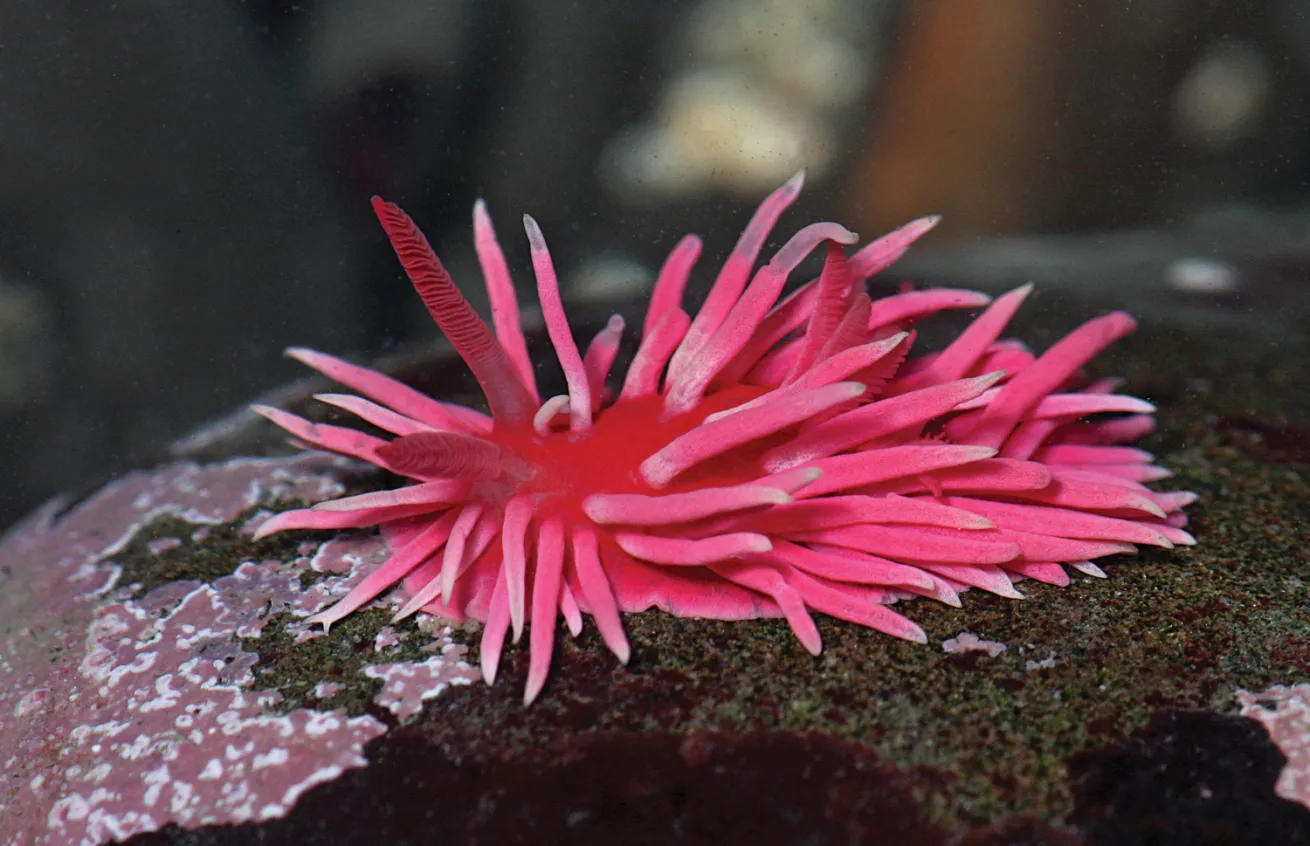
Ron WolfHopkins Sea Slug
Although the Hopkins’ rose nudibranch is striking, its presence on the northern California coast is not necessarily a good sign.
A pink sea slug moving north off California’s coast indicates rising ocean temps.
Researchers tracking a sea slug — Hopkins’ rose nudibranch — that has invaded most of the northern California coast say that it’s an indication of warming seas: and a bad sign for marine life.
“We can’t ignore that warming seas mean less food for seabirds, and adverse impacts for all marine ecosystems,” says Dr. Terry Gosliner, California Academy of Sciences curator of invertebrate zoology and geology.
The lipstick-pink sea slugs — Okenia rosacea — are named after Timothy Hopkins, a railroad executive who helped establish Hopkins Marine Station. Gosliner esti- mates their life span is about a year. “They get their coloring from feeding on a pink bryozoan, or moss animal, that is found under rocks,” says Gosliner.
Hundreds of the sea slugs have been spotted farther north than usual. And they have company. “Another nudibranch, the Spanish shawl, Flabellina iodinea, has been making its way from southern California into northern waters,” says Gosliner.
This is not good news for an already stressed ecosystem. “The Cassin’s auklet seabird has been dying in record numbers, and emaciated California sea lion pups have been coming to shore,” says Gosliner. “Both are starving as a result of low nutrients in the warmer waters.”
The last time these nudibranchs were found this far north was during an El Niño more than 16 years ago. While there is no El Niño now, the National Oceanic and Atmospheric Administration says northern California ocean waters are 3°F to 5°F above the long-term average.
“We’re seeing this exact cocktail of climate conditions in California right now,” says Gosliner. “We are tracking the trends to find out exactly what the shift means and how it might impact marine life.”


