

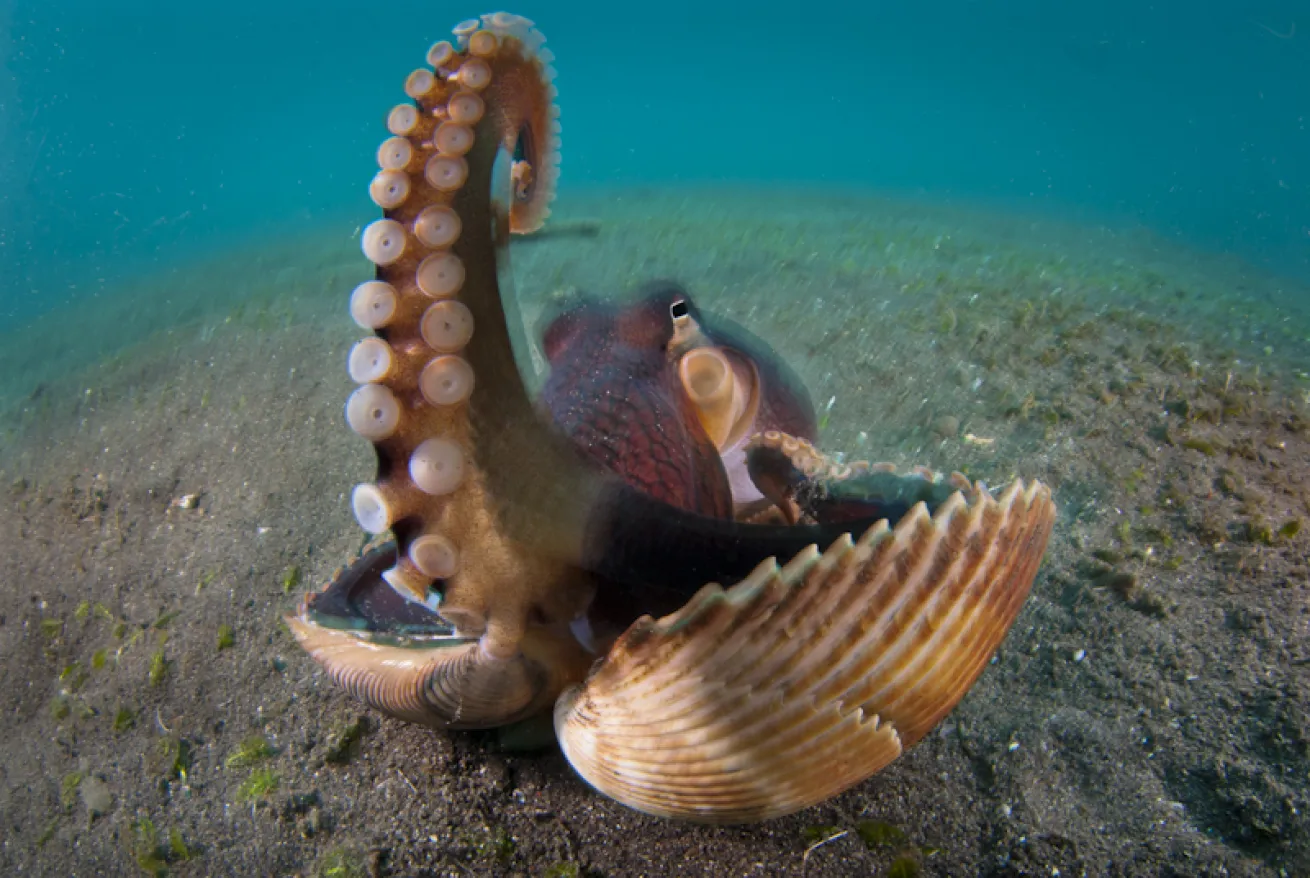
Christian Loader/Scubazoo
Cephalopods are a class of marine molluscs that include what we commonly know as octopus, squid, cuttlefish and nautilus – of which there are around 800 species found throughout the world's oceans. These highly intelligent invertebrates are a favourite among many divers and photographers. The ability of all cephalopods (especially octopus and cuttlefish) to rapidly change colours and patterns in milliseconds for signalling or camouflage never ceases to amaze those who observe them. Many smaller species are highly-prized finds for divers in tropical waters, such as the photogenic Blue-Ringed, Wonderpus, and Mimic Octopuses, and Flamboyant Cuttlefish for example, and these rare gems are often at the top of many photographer's wish lists.
Here are some useful tips for shooting these wonderful creatures:
Equipment
Macro lenses such as 60mm, 100mm, or 105mm are commonly used since many species are very small and often found on the seabed in sandy habitats, such as 'muck diving' locations like Lembeh Strait in Indonesia for example. A close-up diopter 'wet lens' is a useful piece of kit for shooting minute species such as Pygmy Squid, or juvenile cuttlefish. Macro lenses are also the optimal choice for shooting squid, such as Reef Squid as they hover mid-water – they can be very skittish during the day, but are attracted to divers lights at night allowing for some nice portrait shots. A 60mm macro lens is the most suitable for capturing behaviour, but may require you to get closer to the subject which then increases the chances of spooking the animal. A 100mm or 105mm macro lens allows you to shoot from slightly further away, however shooting through more water (possibly in bad viz) presents its own problems.
Wide-angle lenses are great for shooting larger species like a Reef Octopus, or large cuttlefish and squid, and particularly suitable for capturing the subject in its environment. A fisheye zoom lens such as the Tokina 10-17mm or Canon 8-15mm, is even more versatile and allows for tighter wide-angle compositions. Fisheye lenses such as this are perfect for 'close-focus wide-angle' shots of both large and small species that allow you to get very close to them, giving a unique perspective.
Shooting cephalopods typically requires the use of strobes to provide artificial light. Under natural light, octopus, cuttlefish and squid can look very dull in their dull surroundings, whereas strobe lighting makes elaborate colours and patterns stand out in many species (a great example being the Flamboyant Cuttlefish), resulting in a much more pleasing image. The use of a snoot, side-lighting, or backlighting can also help to make the subject stand out and give an image more impact.
Settings
When shooting macro, you can use a low f-stop with a shallow depth-of-field to isolate the subject from a distracting background, or for close-up portraits focusing on the eye and using part of the subject as the background – which produces nice, soft background 'bokeh' (blur).
Divers love cephalopods because they very often show interesting behaviors, and when shooting any kind of behavior such as feeding or mating for example, it's advisable to use a higher f-stop for a greater depth-of-field, as well as a fast shutter speed to capture the action.
Shooting with a wide-angle lens, you may need to use a slower shutter speed to brighten the background water, whereas this is usually not an issue when shooting macro with sandy/reef backgrounds. You can also use a slow shutter speed (eg. 1/20s) with a high f-stop (eg. f16) and strobes on a high power to capture movement, such as a large cuttlefish swimming over the reef, to make for a more interesting image.
Habitats & Behavior
Having an experienced dive guide is often essential when trying to find certain species of cephalopods, especially small, elusive species like the Blue-Ringed Octopus, or the 'Holy Grail' of macro critters, the Hairy Octopus! Larger octopus such as the Reef Octopus (aka Day Octopus) can usually be found hiding in the same crevice on a reef, and although sometimes very shy during the day, at dawn and dusk they can be observed hunting around the reef or seabed. Some species of octopus like to make homes out of all kinds of trash on the seabed, so be sure to have a look inside tin cans, bottles etc. The wonderfully inquisitive Coconut Octopus is a perfect example, and uses coconut shells, clam shells, and all kinds of other items it finds to use as a protective 'mobile home' – I've found Coconut Octopus inside/under almost everything from a plastic detergent bag, to a banana skin, or even a coffee mug! Mimic Octopus inhabit only sandy areas, and are remarkable for their ever-changing forms which some believe mimic different animals to confuse predators – forms resembling a flounder, lionfish, jellyfish, or sea snake. Octopus catch their (mostly crustacean) prey by 'tenting' -– enveloping a small rock or patch of the seabed, with their body and webbed-like arms trapping the prey within. Be aware of flashing, color-changing displays as it could be a sign that another individual is close by (possibly a potential mate, or a rival), and may signal oncoming courtship, mating, or a fighting. On the other hand, it could also be a warning for you to back off if it feels threatened.
Small cuttlefish species such as Crinoid, Papuan, or juvenile Broadclub, may be perfectly camouflaged as dead leaves, or blend in amongst feather stars, soft corals, sponges and seagrass. The impressive Flamboyant Cuttlefish are active during the day and can be found 'walking', rather than swimming, on sandy and rubble seabeds. When disturbed they display elaborate colors, and are commonly seen hunting and feeding on small crustaceans during the day. This species will often lay its eggs inside old coconut shells, under wooden logs, inside tin cans, bottles etc. – with a lot of luck, or by going back to these spots regularly, you could be very lucky to witness and photograph tiny colorful juveniles hatching from their eggs. As with octopus, colorful, flashing displays could be signals to other individuals and an indicator of courtship, mating, or fighting – so look around for others, and be prepared to shoot such behaviors quickly!
Reef Squid are easily seen on night dives – shine your torch up into the water column occasionally and they may be attracted to you. Reef Squid are also often seen laying eggs in the same spots regularly, such as mooring lines, or sunken tree roots for example, and usually at a particular time of the day. Many seabed-dwelling cephalopods can be found in the same spot on a dive site, so try and remember these spots so you can go back and shoot them again if need be. Small iridescent Bobtail Squid hide buried in the seabed during the day, and are only seen when they become active at night. When disturbed or threatened they'll bury themselves again, lastly using 2 protruding arms to cover the remaining parts of their bodies with sand and rubble, which is very interesting to observe.
Photographer Etiquette
In sandy muck diving locations, your guide may spot the eyes of a Mimic Octopus or a Wonderpus peeking out of its burrow long before you do, and may get you and your dive group to stop and hang back to avoid spooking it. With experience, some guides carefully use a long metal pointer stick to stir up sand in front of the octopus, mimicking a burrowing crab, which can entice the octopus out from its burrow allowing you and others to see it and take photos. These two species being slightly larger (arm span up to 50cm) mean it's possible for more than one person to shoot them at the same time and achieve decent images (unlike two photographers trying to shoot the same tiny Blue Ring!), and when they're on the move many different angles and compositions are possible. Be respectful, and don't harass cephalopods – when any cephalopod is threatened suddenly, it releases a jet of ink as it swims away, and large cuttlefish such as Broadclub Cuttlefish may sometimes stay still while slowly expelling a huge, thick cloud of ink in which it simply disappears. If a cephalopod appears stressed then back off for a few minutes before attempting to move in again for more shots, and use this time to review your images and adjust camera settings. When shooting any cephalopod which is on the move in a sandy habitat, swim using frog kicks to avoid kicking up sand. Never poke or antagonize a cephalopod with a pointer stick in an attempt to 'make it do something' just because you're getting impatient – the important rule for shooting cephalopods is to simply _have a lot of patience!_Cephalopods are highly interactive and intelligent creatures compared to some other types of marine animal, and with a patient approach you'll be delighted with some natural behavior.
Aside from the impressive 'big stuff' that draws the most attention from divers, when it comes down to the smaller creatures of the reef, cephalopods reign supreme in my opinion. I learn more about them and their behavior every time I observe one on a dive, (which I don't think I could say about a frogfish for example, which sometimes just do absolutely nothing!). As a result, shooting them becomes easier and more enjoyable every time. I hope these general tips can help and guide you, whether you're shooting a huge Humboldt Squid, or the tiniest Hairy Octopus – if so, then lucky you!
Get inspired! Check out this Photo Gallery: Octopus, Cuttlefish and Squid.
Christian Loader (31, UK) is a full-time professional photographer for Scubazoo Images (www.scubazoo.com). He has worked extensively throughout SE Asia as an underwater videographer and photographer for Scubazoo since 2007, and lives in Kota Kinabalu, Sabah, Malaysian Borneo.


