

SHUTTERSTOCK/CASEY FREDETTE MEDIA
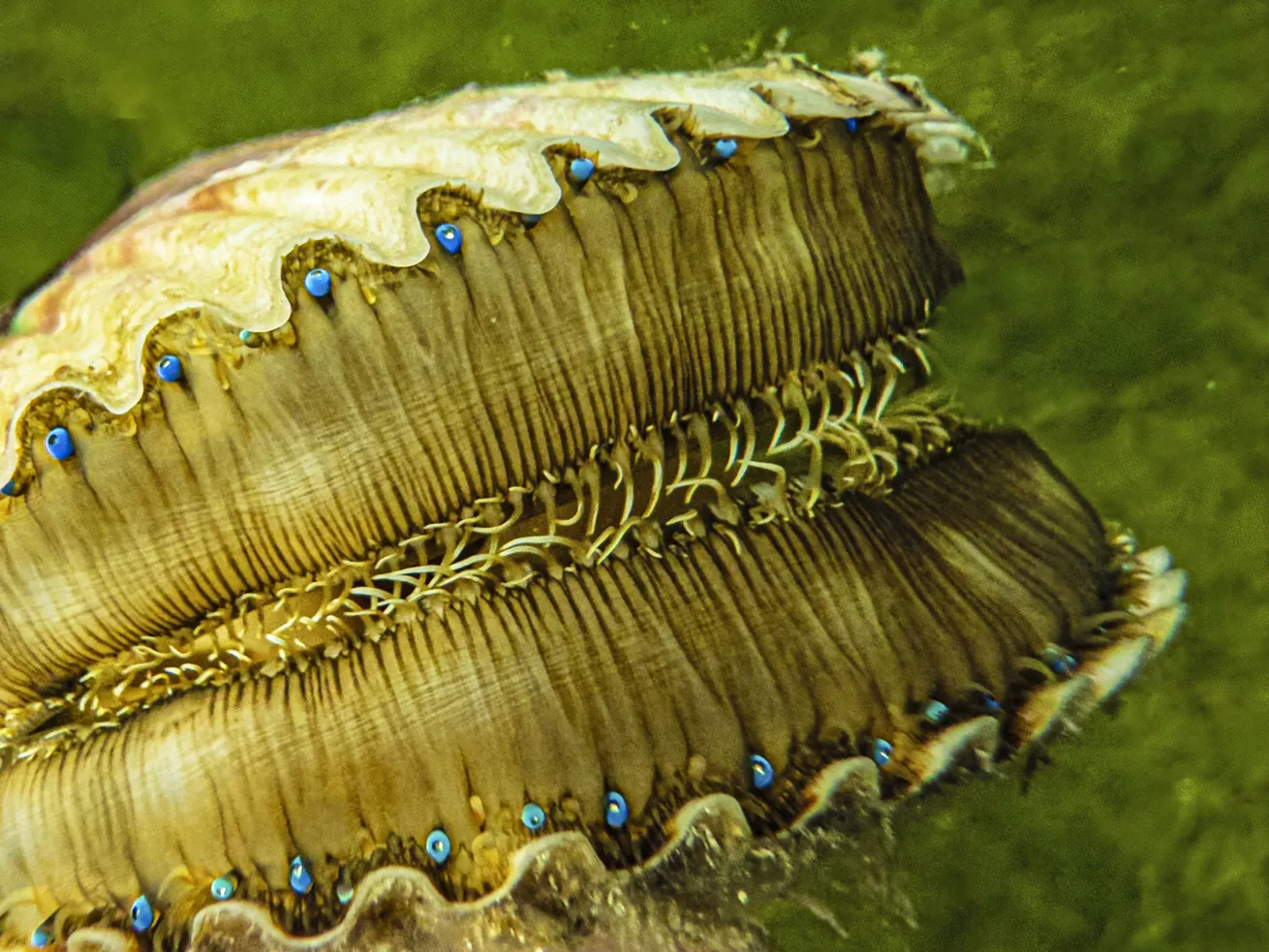
Ever seen a scallop propelling itself through the water? I have, and it looks ridiculous—a bit like a set of swimming dentures edged with electric-blue eyes.
Most divers only take notice when one decides to show off its unique clap-and-swim escape technique, marveling for a second, then moving on. They’re just simple mollusks, right? Decorative. Briefly entertaining. Not especially mysterious.
Dan Speiser would disagree.
Suprisingly Sophisticated Eyes
“Scallops know where you are,” says Speiser, a professor in the Department of Biological Sciences at the University of South Carolina. For decades, researchers have recognized that scallop eyes can resolve images, not just detect light and dark.
Speiser notes that their tiny mirror-based eyes have “surprisingly sophisticated” optics. More recently, his lab found that scallops also appear able to do more than detect objects. “[They] behave like they know the locations of objects relative to their own bodies. For example, scallops will follow moving visual cues with the sensory tentacles that are interspersed with their eyes.”
Related Reading: Largemouth Bass Hunting Behavior: The Little-Known Reef
If you approach a scallop carefully enough that it doesn’t close, Speiser suggests trying to see whether it will follow movement with its tentacles. The tentacles, interspersed among its eyes, are a visible clue that the animal is receiving information and responding to what it perceives. Though his lab has yet to test if scallops can distinguish between threats and nonthreats, he does believe “scallops make meaningful distinctions between the animals they’re interacting with—and vision plays a role in it.”
For such a common animal, there’s still so much we don’t know. “We don’t have a good understanding of the visual cues that cause scallops to swim away in alarm,” Speiser says—an uncertainty that makes divers useful observers. “Pay attention to what is happening around scallops when they decide to take off.” Was it your light? A shadow? A nearby fish? Perhaps your observations will influence the next study.
How Scallop Vision Works
Scallops are intriguing partly because their visual system seems absurd. They have dozens of eyes on their shell margin, with overlapping fields of view, yet they don’t behave like they’re seeing the same object repeated over and over. Instead, Speiser says, “scallops are somehow taking dozens of separate, overlapping images and making something coherent out of them,” which means the real mystery is not just that scallops have so many eyes, but the picture they’re building.
Related Reading: Cooperative Hunting: How Eels and Grouper Partner on Prey

Speiser’s early-career experiments led him to think scallops might be responding in a simpler, more reflexive way. Later work changed his opinion. In more recent experiments, he and doctoral student Dan Chappell found that when a visual stimulus rotated around a scallop, its eyes and tentacles followed in a coordinated wave, showing us that it really does see.
And scallops do all of this without a centralized brain. They have ganglia and a nerve center called the visceral ganglion, and Speiser suspects that the latter is where something important is happening.
Are Scallops Intelligent?
So should we call this intelligence? He’s open to that, arguing that if we’re willing to say insects demonstrate intelligence, it’s fair to use the word for scallops. The point is to stay open to queries that once might have sounded absurd: Do scallops learn from experience? Communicate with each other? Navigate using landmarks? “I don’t think we have answers to any of these questions yet,” he says, “but I don’t think any of them are preposterous to ask.”
What Speiser most wants people to understand is simple: “Even animals as seemingly simple as scallops are curious about the world around them.” The next time you hover over one on a dive, remember you’re not just looking at a shell with eyes. You’re looking at an animal that’s also looking at you.


