

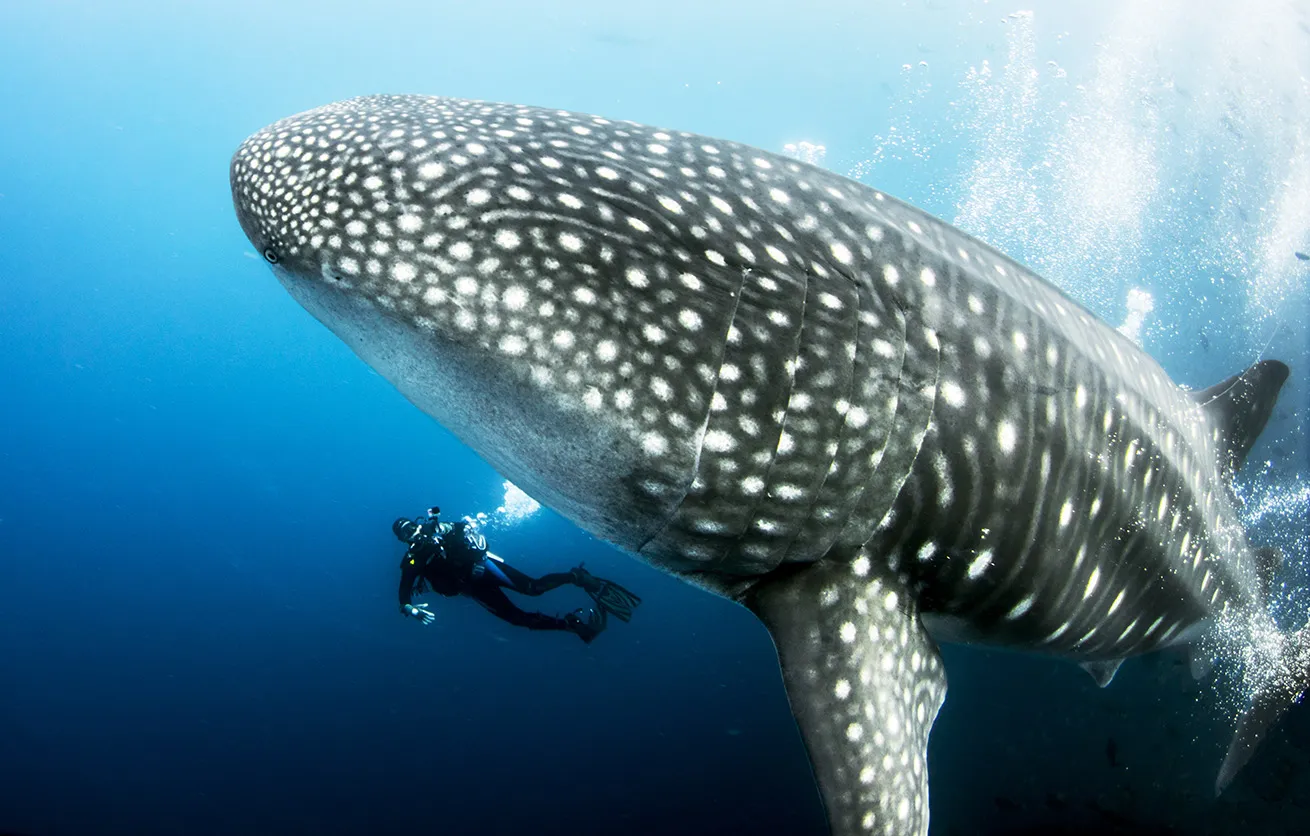
Shutterstock/Lindsey Lu
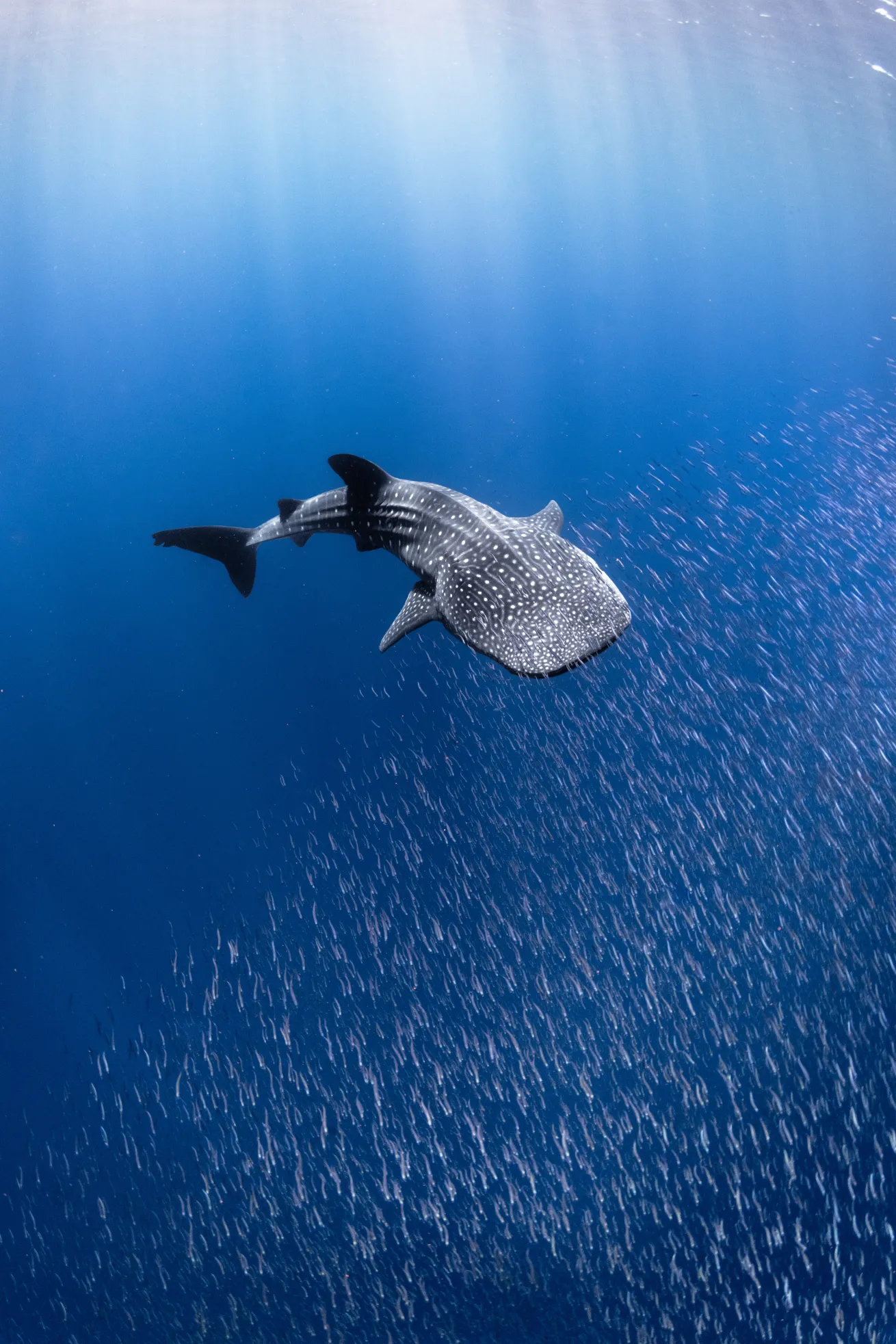
Diving with whale sharks means encountering the largest fish in the ocean. Yet these spotted giants aren’t predators, and despite their name, they aren’t whales. Instead, they are gentle, filter-feeding sharks that glide effortlessly through warm waters, feeding on some of the smallest organisms in the sea.
The contrast is what makes diving with whale sharks so unforgettable: immense size paired with calm, seemingly slow-motion swimming behavior that draws divers back again and again. Yet, their popularity means choosing sustainable locations and operators to ensure the survival and safety of these endangered animals.
10 Amazing Facts About Whale Sharks
- They are the largest fish on Earth, typically reaching lengths of up to 40 feet and weighing 20 tons, with the largest recorded individual measuring an astonishing 61.7 feet!
- Despite their immense size, whale sharks aren’t predators but gentle filter feeders, swimming through the water as they scoop up plankton, like fish eggs, crustaceans and small fish.
- Each whale shark has a unique spot pattern, like a fingerprint, which scientists use to track and study individuals.
- Scientists estimate whale sharks can live up to 130 years based on new research.
- Their mouths can be over 4 feet wide, yet they feed on tiny prey.
- They migrate thousands of miles annually following plankton blooms.
- Whale sharks can dive to depths over 6,000 feet.
- Scientists still know surprisingly little about their breeding and birthing behavior.
- The whale shark is ovoviparous, meaning the female produces eggs that hatch while inside her (up to 300), and then are released in a steady stream over a certain period.
- They are closely related to nurse sharks, wobbegongs and zebra sharks, which are all types of carpet sharks. However, unlike their cousins, they don’t hang out on the seafloor.
Where Do Whale Sharks Live?
Whale sharks live in tropical and warm temperate oceans worldwide, including the Atlantic, Pacific and Indian Oceans, and are often found in regions with seasonal plankton blooms or fish spawning events. Most whale sharks live in the Indo-Pacific (about 75 percent), with the rest in the Atlantic (about 25 percent).
Although they are primarily pelagic and roam the open ocean, they regularly gather in coastal areas, along reefs, and near seamounts where food is concentrated, especially the teenage males.
Overall, they spend much of their time feeding near the surface but are also capable of diving into deep offshore waters when needed.
Related Reading: St Helena Dive Guide: Caves, Wrecks and Whale Shark Encounters
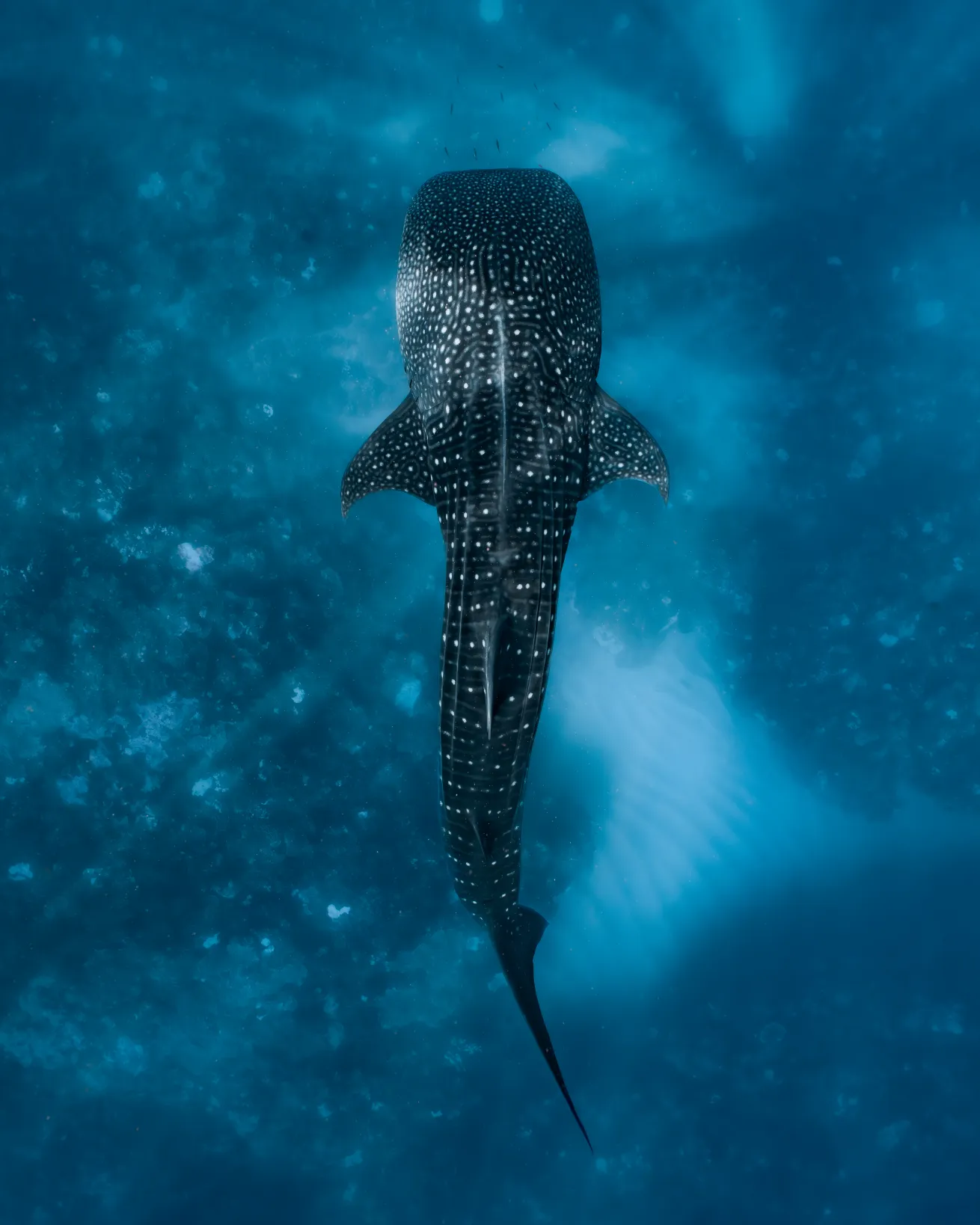
Ocean Image Bank/Noemi MerzResponsible tourism matters: choose operators that follow whale shark conservation guidelines.
Where and When to Dive and Swim With Whale Sharks Responsibly
Galapagos Islands, Ecuador
The Galápagos Islands are one of the most scientifically important places to dive with whale sharks, especially at the remote Wolf and Darwin Islands. Here, large, often pregnant females are frequently seen. It’s one of the only places to scuba dive with whale sharks consistently — and particularly massive ones at that!
Diving here is heavily regulated, and some operators offer citizen-science trips where divers can contribute to ongoing whale shark research, such as those offered by Galapagos Shark Diving, founded by a group of whale shark scientists.
Best time to visit: June to November
Dive type: Diving only on multi-day liveaboard trips, departing from Santa Cruz or San Cristobal islands, and set by the Galapagos National Park administration. Dives at Darwin and Wolf typically require advanced certification and comfort diving in strong currents.
Ningaloo Reef, Australia
Drawn by the annual spawning of more than 200 species of coral, whale sharks gather at Ningaloo Reef, one of the best and most sustainable places in the world to see them. Plus, if you’re lucky, you might also see a humpback whale or manta ray.
Encounters here are tightly managed, with regulations enforced by the Department of Biodiversity, Conservation and Attractions to ensure sustainable interactions, including minimum distance rules, small swimmer group limits, no flash photography, snorkel-only access and strict time limits per vessel.
Best time to visit: March to September, with peak season around April, May and June.
Dive type: Full day, snorkel trips
Isla Mujeres, Revillagigedo Islands and La Paz, Mexico
On Mexico's Caribbean coast, Isla Mujeres and on its Pacific Coast, La Paz, are two of the world’s top destinations for whale shark encounters, where large seasonal aggregations gather to feed in nutrient-rich waters filled with lots of food.
Tourism has surged since the early 2000s, and while regulations exist, studies have found frequent violations of whale shark tourism rules in Mexico, even with fewer boats than allowed. Operators are typically required to complete training and brief guests on guidelines, but the key is choosing those who actively enforce the rules rather than just explain them (see below for info on choosing an ethical operator.)
Best time to visit: May to September (Isla Mujeres), November to February (La Paz)
Dive type: Snorkeling only (diving with whale sharks is not allowed).
Additionally, about 250 miles off Mexico’s Pacific Coast, the Revillagigedo Islands offer another opportunity to dive with whale sharks.
Best time to visit: April to June and November to December
Dive type: Liveaboard only and remote (takes over a day to reach them!) leaving from Cabo San Lucas. Scuba diving with advances and often enriched air (nitrox) certifications, due to strong currents, deep sites and wall dives.
South Ari Atoll, Maldives
While whale sharks can be found throughout the Maldives, South Ari Atoll stands out as the only known year-round aggregation site of its kind in the world. Research by the Maldives Whale Shark Research Programme monitors the population (and tourism) and thinks the area acts as a secondary nursery for juvenile males, thanks to ideal conditions for feeding. It has one of the highest re-sighting rates in the world, but once the sharks hit about 30 years old, it’s time to move on.
Best time to visit: Year-round, but best, August-November.
Dive type: Both diving and snorkeling. Sharks are spotted at deeper sites for divers and near the surface for snorkelers.
Other places in Maldives to encounter whale sharks include Hanifaru Bay, May-September, which is generally considered ethical due to regulations within the UNESCO Biosphere Reserve.
Donsol Bay, Philippines
Widely regarded as one of the best places in the Philippines to see whale sharks, Donsol Bay provides a safe gathering place where they naturally feed. The program here, supported by the World Wildlife Fund, emphasizes conservation and strictly prohibits feeding or baiting practices seen in other areas of the country.
Best time to visit: November to June (Peak season: February to April)
Dive type: Snorkeling only, scuba diving not permitted.
More Destinations to Dive and Swim With Whale Sharks
Another top spot for whale sharks is Gladden Spit and Silk Cayes Marine Reserve in Belize. From March through June, around the full moon, whale sharks gather here to feed during snapper spawning events, drawing snorkelers for rare, close encounters as mutton, cubera and dog snapper release eggs into the water.
Similar to South Ari Atoll, Utila, Honduras, is a year-round location for whale sharks. While not as reliable as other places, it is certainly a possibility. They are more frequent in spring months and early autumn.
Related Reading: In Living Color: Diving the Philippines Visayas Islands
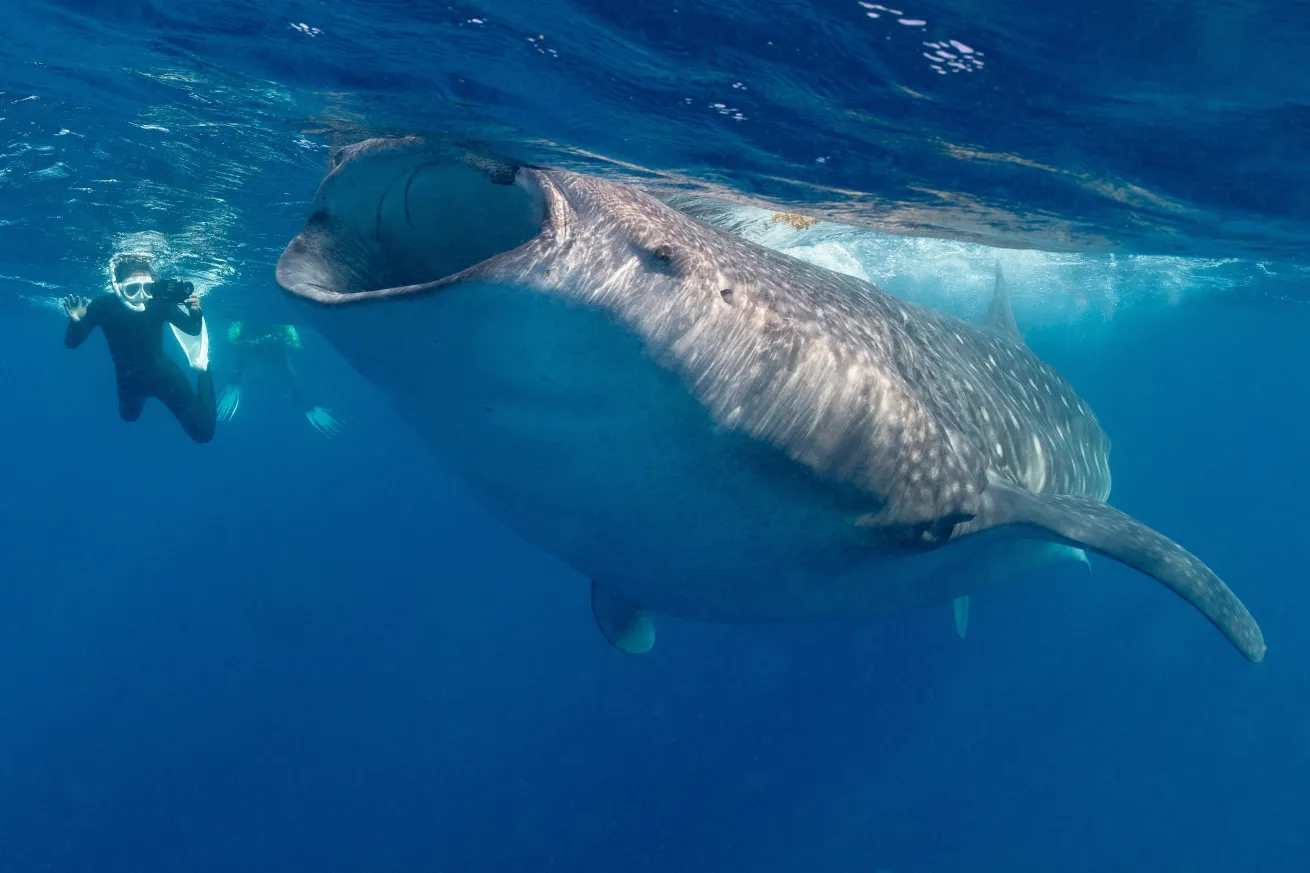
Shutterstock/subphotoDespite being the largest fish in the sea, whale sharks are gentle giants that filter feed on small organisms.
What Do Whale Sharks Eat?
Whale sharks mostly eat plankton, such as krill, fish eggs and small schooling fish—through filter feeding, a technique in which they swim with their mouths open to sieve prey through specialized gill rakers.
In some areas, they also exhibit vertical feeding, positioning head-up in the water column to gulp dense patches of plankton, and while they are one of only three filter-feeding sharks (alongside basking and megamouth sharks), they have around 3,000 small teeth arranged in rows in their mouths that they don’t use.
Whale Shark Conservation Status
Whale sharks are classified as endangered on the International Union for Conservation of Nature Red List due to significant global population declines over the past century. They face ongoing threats from accidental capture in commercial fishing nets, vessel strikes that can cause serious injury or death, and continued fishing pressure in some regions where their meat is consumed locally and fins may enter international trade.
In 2014, a three-year investigation revealed that hundreds of whale sharks were being illegally killed each year in China. Earlier, a legal fishery in Taiwan harvested around 800 whale sharks between 1995 and 2008 before it was shut down under international pressure.
Scientists estimate the global population of whale sharks has declined by about 50 to 79 percent, based on fewer large adults, lower catch rates in fisheries, and fewer sightings over time.
Ocean Image Bank/Dani Escayola
How to Dive with Whale Sharks Ethically
Diving with whale sharks is an unforgettable experience, but it’s essential to keep encounters safe and respectful for the animals, especially as the number of people wanting to swim with these giant fish has increased. Always maintain a minimum distance of about 10 feet from the body and 20 feet from the tail, and never touch, ride or attempt to redirect a whale shark.
Enter the water calmly and avoid splashing or sudden movements, which can stress the animal. Do not block their path or surround them with swimmers, and limit your time if multiple people are present. When photographing, avoid excessive flash and give the shark space to approach naturally.
Also, many places exist to dive with whale sharks. Do your research and choose locations and operators that follow established wildlife guidelines to ensure these encounters remain sustainable, helping protect whale sharks while allowing future divers to experience them responsibly. Avoid places with weaker regulation or inconsistent enforcement.
For instance, places like Oslob in the Philippines and parts of Indonesia, such as Cenderawasih Bay, are known for feeding the sharks year-round, which alters their natural behavior, including migratory patterns. Tofo Beach in Mozambique and parts of Tanzania may experience crowding or limited oversight depending on the operator.
Key guidelines to look for:
- No touching: Never touch or harass whale sharks
- Limited numbers: Small groups of swimmers and controlled boat traffic
- Educated guides: Operators who teach shark behavior and conservation
- Safe distances: Clear rules for both swimmers and boats
- Eco-friendly practices: Reduced plastic use and support for conservation efforts
- No chumming or feeding: Ethical operators never bait or feed whale sharks
Related Reading: This Course Helps Divers Save Sharks
Upload Your Whale Shark Photos and Contribute to Science
If you encounter a whale shark in the wild, you can help scientists track and study it while learning more about the individual you saw. If possible, photograph the area of white spots behind the gills on the shark’s left side and upload the images to the Wildbook for Whale Sharks, along with details like location, depth, and date.
If you want to learn more about whale sharks, visit these organizations:
Whale Shark and Oceanic Research Center
Maldives Whale Shark Research Programme
The Australian Institute of Marine Science


