

Tanya G. Burnett
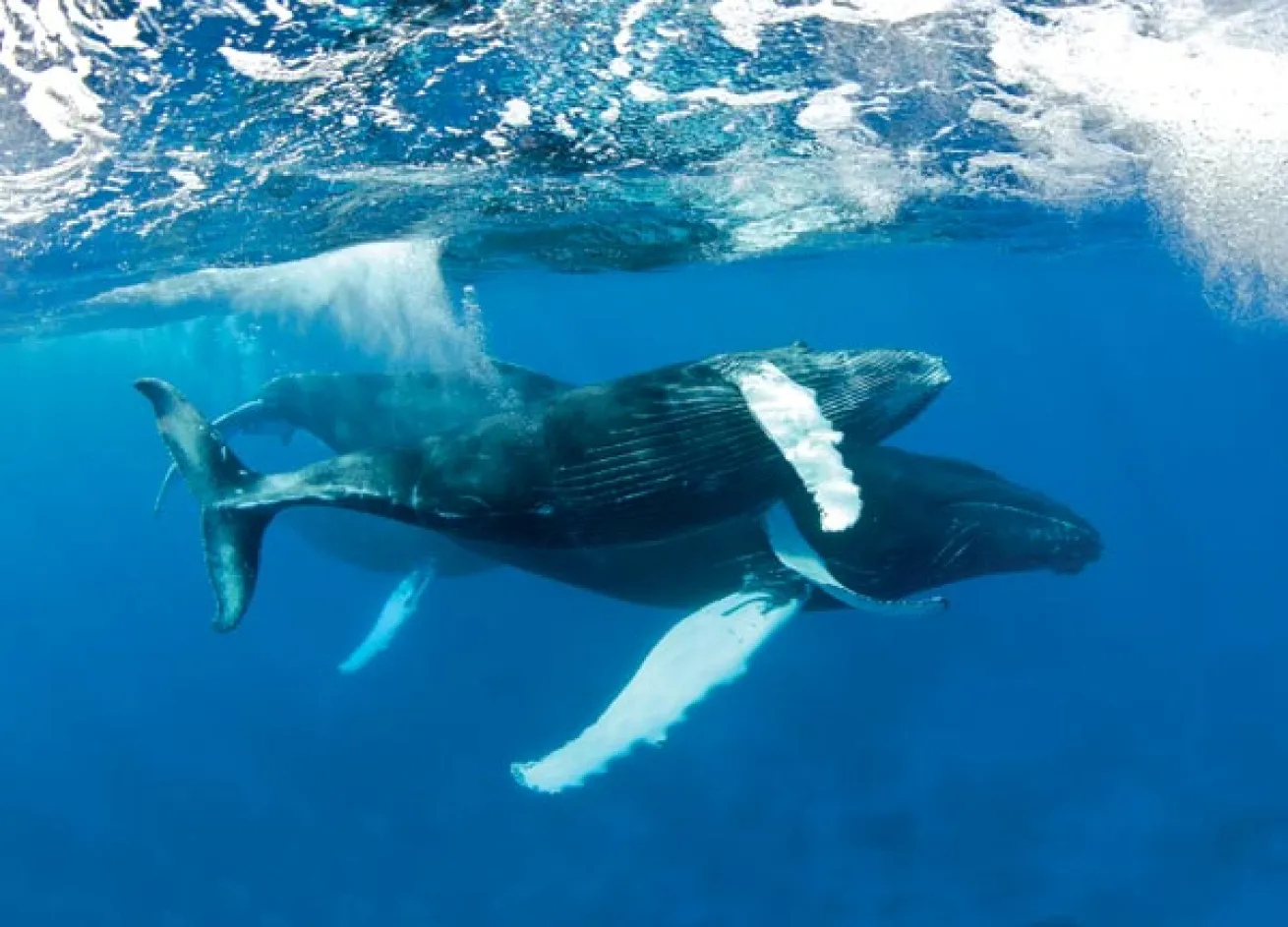
She was the world’s first supermodel — fashion’s first million-dollar face — a fearless adventurer in business and pleasure. But Women Divers Hall of Famer Lauren Hutton, 67, met her match on the Dominican Republic’s Silver Banks. “She’s the size and weight of a freight train, and moves with such ease, pure sexy grace,” Hutton says of her close-up with a mother humpback whale. “You felt emotion through the water, watching mother and calves continually in touch, playing, nuzzling.”
Hutton and a group of women divers joined photographer and Sport Diver contributor Tanya G. Burnett to travel with Conscious Breath Adventures (www.consciousbreathadventures.com) aboard the Dancer Fleet's Sun Dancer II, one of very few vessels — along with Aggressor Fleet's Turks & Caicos Aggressor II — permitted into the marine sanctuary 70 miles off the DR. There, the women had the rare experience of swimming with humpbacks via a technique in which swimmers float on the surface and let the whales come to them. Following this unique encounter, we spoke with Hutton about the humpback experience and her longtime passion for diving.
SD: This was your first time in the water with humpbacks. What was the most surprising thing about the experience?
LH: Nothing I had read or seen before prepared me for the flood of emotion I felt while watching the delicate choreography of a pair of “dancers” (male and female humpback mating behavior). And the boisterous antics of a rowdy group of male humpbacks launching hundreds of tons of testosterone-fueled cetacean muscle in breathtaking competitive displays is an experience that inspires awe in ways that few can imagine.
SD: During your humpback encounter, you swam on the surface of the water and let the whales come to you. What was that like, and did you get close enough to feel a connection or a sense of two-way communication?
LH: Not every whale sought me out, but when they did, I definitely felt the connection. No doubt about it, when a mammal of this stature takes note of your presence, you know you’ve been looked at! I soon noticed that even when whales were sleeping or facing away from us, they were always supremely aware of our presence and carefully maintained their positioning.
SD: When and where did you start diving?
LH: I started diving in 1965 off the Island of Cozumel. It was just a sleepy island back then, and we could slip into the water anywhere to see enormous groupers and stampedes of fish life.
SD: What’s your favorite place to dive?
LH: There is so much amazement to be found in the ocean that my favorites are too many to list. Perhaps the places that stand out the most are for truly unique encounters and circumstances that pushed my comfort zone in a memorable way. These are the thrilling moments that add serious juice to my life! I was fortunate enough to dive off Bougainville Island in Papua New Guinea in 1982. Everything about the diving was wild. Absolutely untouched, full on naturally tribal wild! Another spot close to my heart was introduced by Dan Ruth of Fiji Aggressor in the late ‘90s on a site called Namena Reef. It had spectacularly beautiful soft corals punctuated by the electricity of ever-present sharks.
SD: What’s your most memorable dive?
LH: Sometimes dives are memorable for what might have happened, but didn’t. Case in point: I became lost in the wreck of the USS Coolidge in Vanuatu. This shipwreck is akin to a skyscraper lying on its side with windows and doors leading in all directions. Or the time I got trapped in the cockpit of a Japanese Zero in Truk Lagoon. In each instance, a level head and great dive buddies provided good outcomes, but you grow a little wiser and more respectful with each adventure. One of my favorite dive buddies, Tanya Burnett, keeps introducing me to new places and discoveries. With each new experience, I am changed and become more than I was before.
SD: You’ve long worked on wildlife conservation causes, what advice would you give divers who want to protect the environment?
LH: There are so many great organizations out there doing important work in countless arenas. Find a cause that “speaks to you” and jump in at whatever level is feasible and rewarding to you. I have always supported that amazing apex predator, the Great White Shark. It’s a fascinating and important species, and we still know so little about them. The shark-finning trade has decimated the numbers of almost all varieties of sharks worldwide, and we are clearly at a critical turning point to save these great animals.
I am equally fond of those other great giants of the sea – the whales. Starting in 1999 I participated with the Whaleman Foundation and IFAW in protecting the Grey Whales Breeding area in San Ignacio Bay in Mexico. During my time with the Humpbacks on the Silver Banks I spent time with Jeff Pantukhoff of the Whaleman Foundation, and I look forward to supporting more of their efforts. We all benefit from passionate people getting involved in protecting our extraordinary marine environment.
SD: Diving is still a pretty male-dominated activity; do you see ways women divers can encourage other women to try scuba?
LH: Plan a trip with your girlfriends. Show them that the ocean is not a scary place by getting their face beneath the surface with a little snorkeling or resort dive experience. Sometimes getting pressure and performance out of the picture is all it takes for the diving bug to take hold.


