

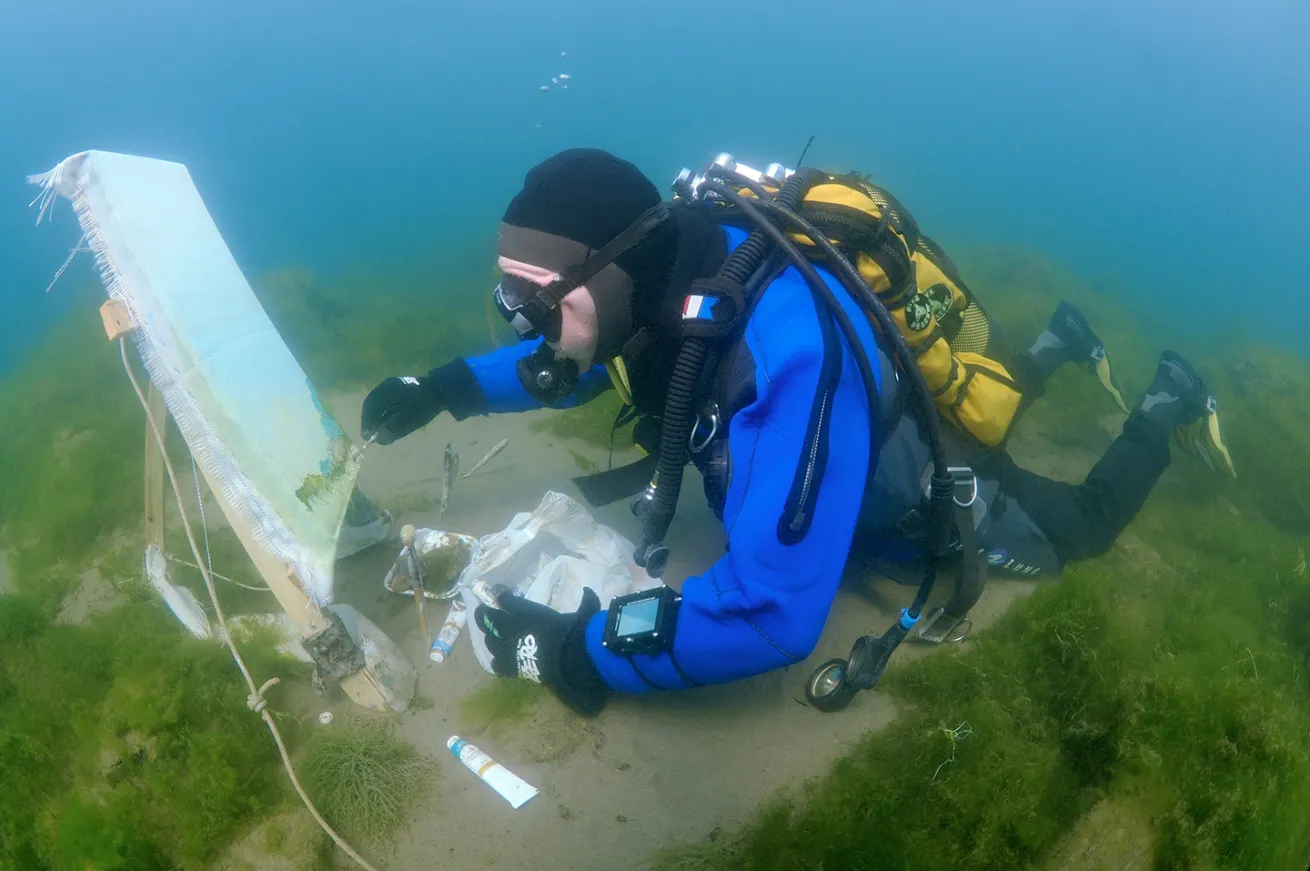
Andrey NekrasovArtist Yuriy Alekseev at work in his underwater Lake Baikal studio.
Lake Baikal’s water is cold, even in the summer, but that doesn’t deter a Russian painter from using the world’s deepest lake as his studio and his subject matter. A rift lake in Listvyanka, Siberia, Baikal is also a UNESCO World Heritage Site that’s home to more than 1,700 species of animals and plants. Inspired by the lake’s beauty and diversity, Russian artist Yuriy Alekseev began hauling canvases and paints to various shallow locations on the lake’s bottom.
“I was impressed by one place in the Olkhon island region, where you can see a rock going vertically down for almost 800 meters,” he recalls. “When you see it, your breath is taken away. It was natural for me to want to draw what I saw underwater.”
At first, Alekseev painted scenes from memory at his studio in his home village of Baikalsk, but says he missed the inspiration and energy that he got while diving the lake. So, in 2011, he fashioned a weighted underwater easel, and brought a canvas and oil paints underwater.
There are challenges to working in water where the temps are generally between 33 and 53 degrees F. Ordinary oil paints make the perfect medium because they don’t dissolve in water, but Alekseev has to use palette knives to apply the paint. “The biggest difficulty is that you must work wearing thick gloves, and that makes it difficult to squeeze paint out of a tube,” he says. “The paint becomes stiffer in very cold water. Besides that, your perception or reality is affected — everything seems to be bigger underwater, and the way the light is filtered changes your perception of colors.” And then there’s the time constraint — Alekseev completes all his paintings while underwater, usually spending between 60 and 90 minutes from setup to his finishing strokes with the knife.
Alekseev’s first underwater painting still hangs in his studio, “an unpretentious, not-very-big painting in the corner,” says underwater photographer Andrey Nekrasov, who dived with the artist to record him at work. “It stands out next to all his paintings,” says Nekrasov. “It stands out next to everything I’ve ever seen before.”


