

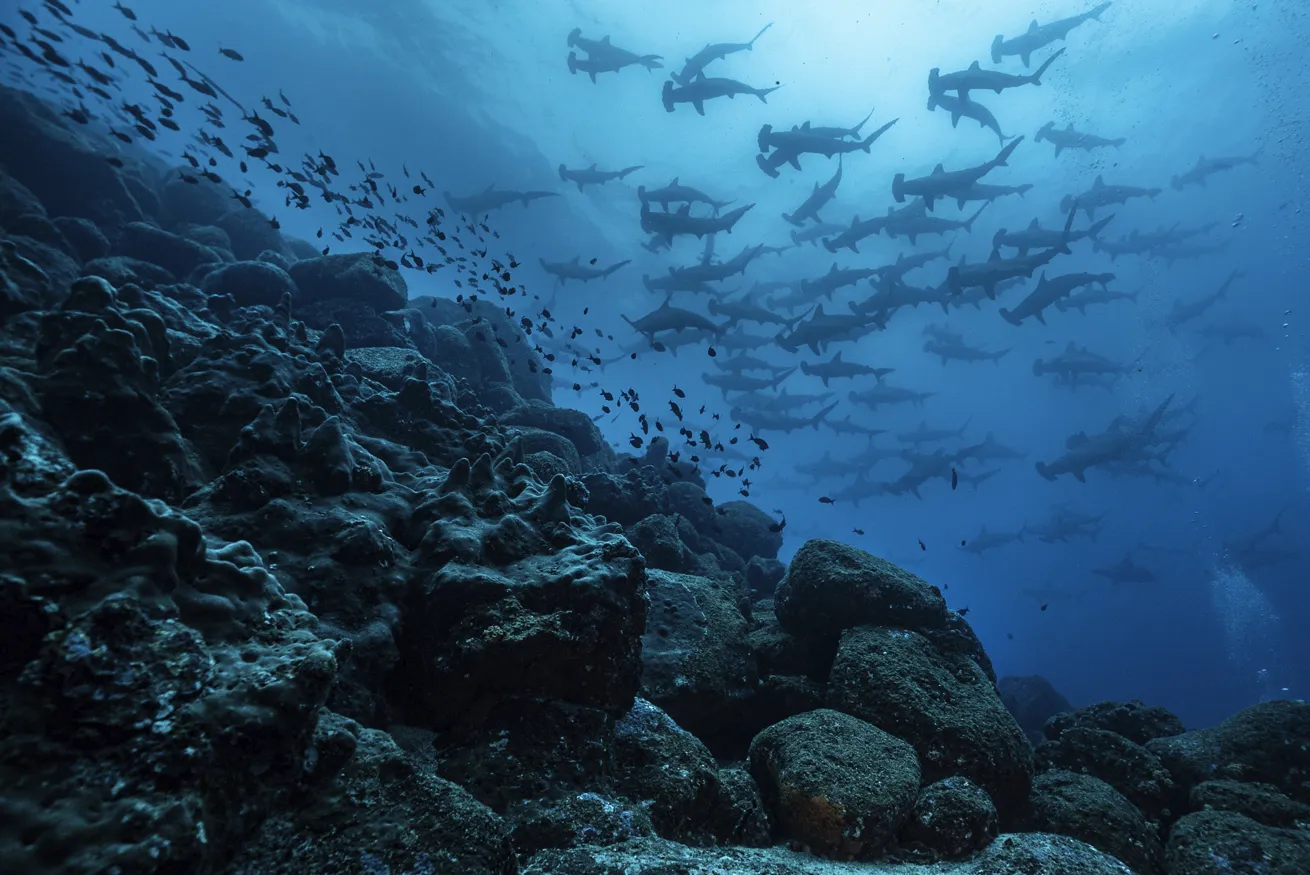
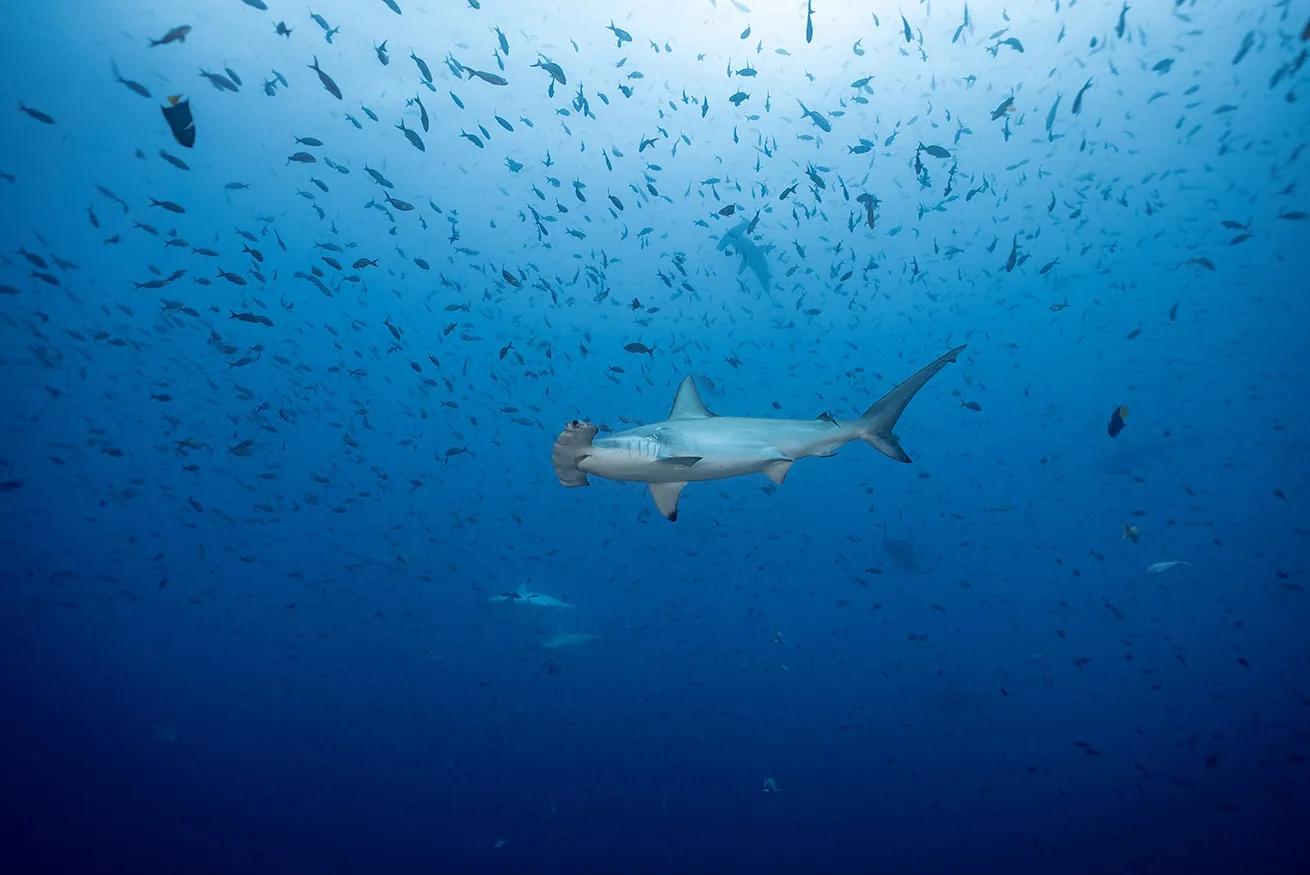
Kristin PaterakisA school of hammerhead sharks numbering in the hundreds swims overhead at Wolf Island.
I stroll Charles Darwin Avenue, the smell of the daily fishermen’s catch mingles with the street food grilling. Kids gather under an awning, creating crafts as their parents drink cool beverages and music radiates from the surrounding stores, art galleries and restaurants. A sea lion scurries up—faster than I ever imagined one could move on land—displacing the previous occupants of a bench to claim her resting place for the evening. I, too, return to my lodging, leaving the crowds of local friends, tourists and honeymooners for the solitude of my bed.
While some divers come to the Galápagos Islands feeling anxious about the cold water, strong currents or sharks, I fall asleep with a different type of anxiety. I am traveling to my bucket-list destination—alone.
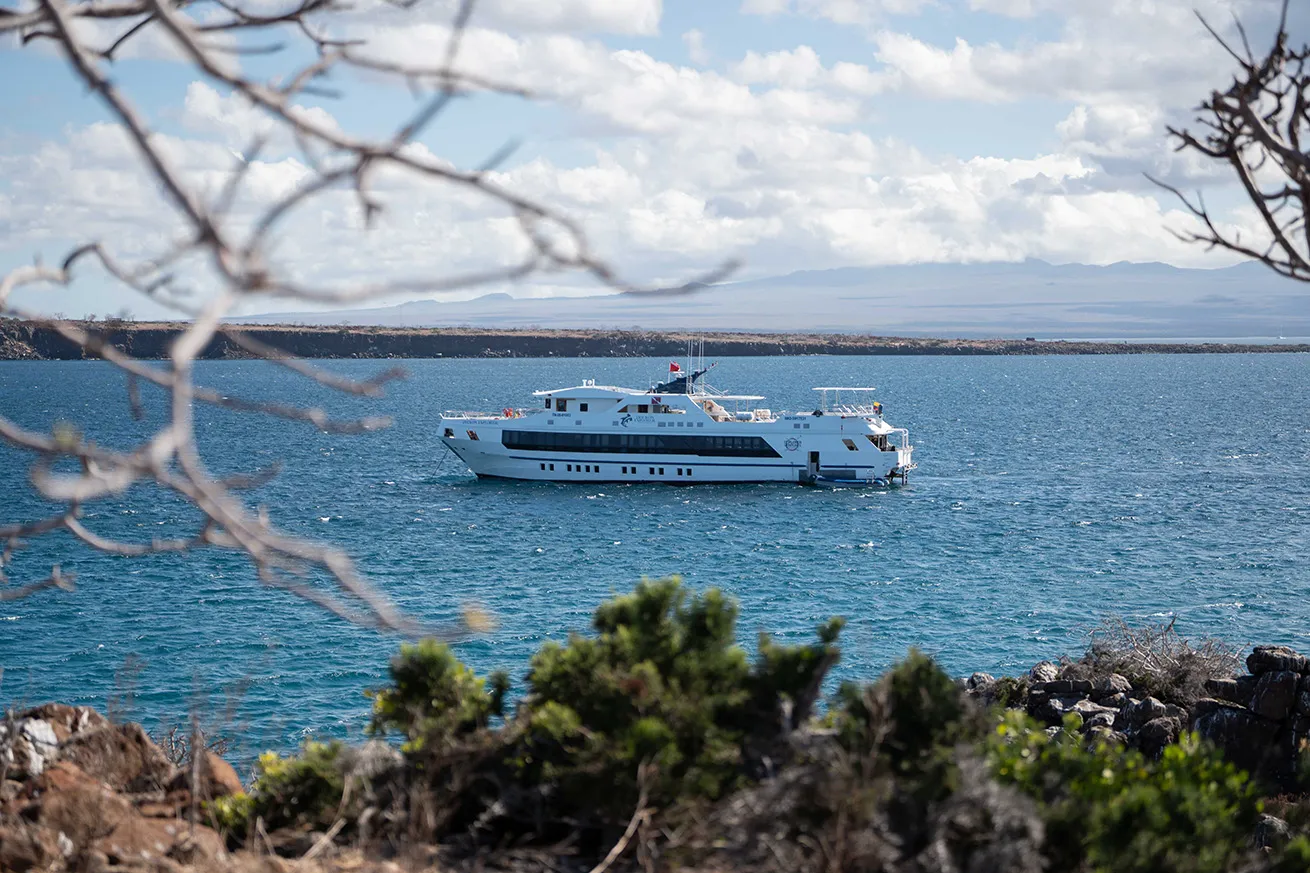
Kristin PaterakisThe Tiburon Explorer liveaboard.
A Lonely Heart’s Guide to Liveaboard Diving
After an evening in Puerto Ayora, the most populous town in the Galápagos, I hand over my bags of dive and camera gear and hop onto a separate dinghy. Three couples surround me. A hand on the knee. An arm drawing a loved one near. And me, party of one. We motor toward the vessel on which we will be spending the next seven days—Tiburon Explorer, one of two Explorer Ventures liveaboards operating in Galápagos.
I smile at a couple across from me, imagining what it would be like to experience this trip with someone I love, someone with whom I’ll reminisce in 40 years when our garage is no longer filled with dive gear.
It’s fine. I’m here to dive—it doesn't matter if I have someone to share that experience with, I try to convince myself. As I board the 125-foot-long Tiburon Explorer, a smiling crewmember hands over a welcome drink and I meet the rest of the 12 divers. Thankfully, there are two other solo travelers. I begin to relax now that I am here. We will all be sharing this experience together, though I have no idea yet just how meaningfully.
Related Reading: Guide to Land-Based Diving in Santa Cruz, Galapagos
Awaken to the Moment
I wake up the first morning aboard and turn to pet my dog, Zoe, only to remember she isn’t here. It’s early, and I’m not usually one to rise before the sun. A familiar ambient-electronic sound drifts from a speaker in the ceiling: “Awake” by Tycho, one of my favorite tracks. A smile creeps in, and I sway to the music.
On other liveaboards, I’m used to a bell or an unpleasant bang on the door—Tiburon Explorer surprises me as the song completes and the soothing voice of Israel, one of our dive guides, delivers a sort of morning affirmation—a ritual I’ll grow to look forward to each morning.
“Good morning, dear divers. It’s time to wake up; it’s time to dive. You are not just visiting Galápagos, you are becoming part of them. Out here, the world feels simpler, older and wonderfully alive.”
Jack Johnson’s relaxing melody “Better Together” plays next. I laugh to myself at the irony, then leave the comfort of my king-size bed to join the other divers on deck.
Our two dive guides are in opposite attire—Oscar dons a thick neoprene drysuit, and Israel is in a shirt and swim shorts. I slip on my 5 mm hood and the surrounding noises instantly muffle. I’m alone again with my thoughts and nervous excitement. We cruise a quick distance to the dive site and, on the count of three, back-roll into the frigid 63-degree water. Israel curses himself for his exposure suit selection— if you want to know how unpredictable conditions in Galápagos can be, this is your proof.
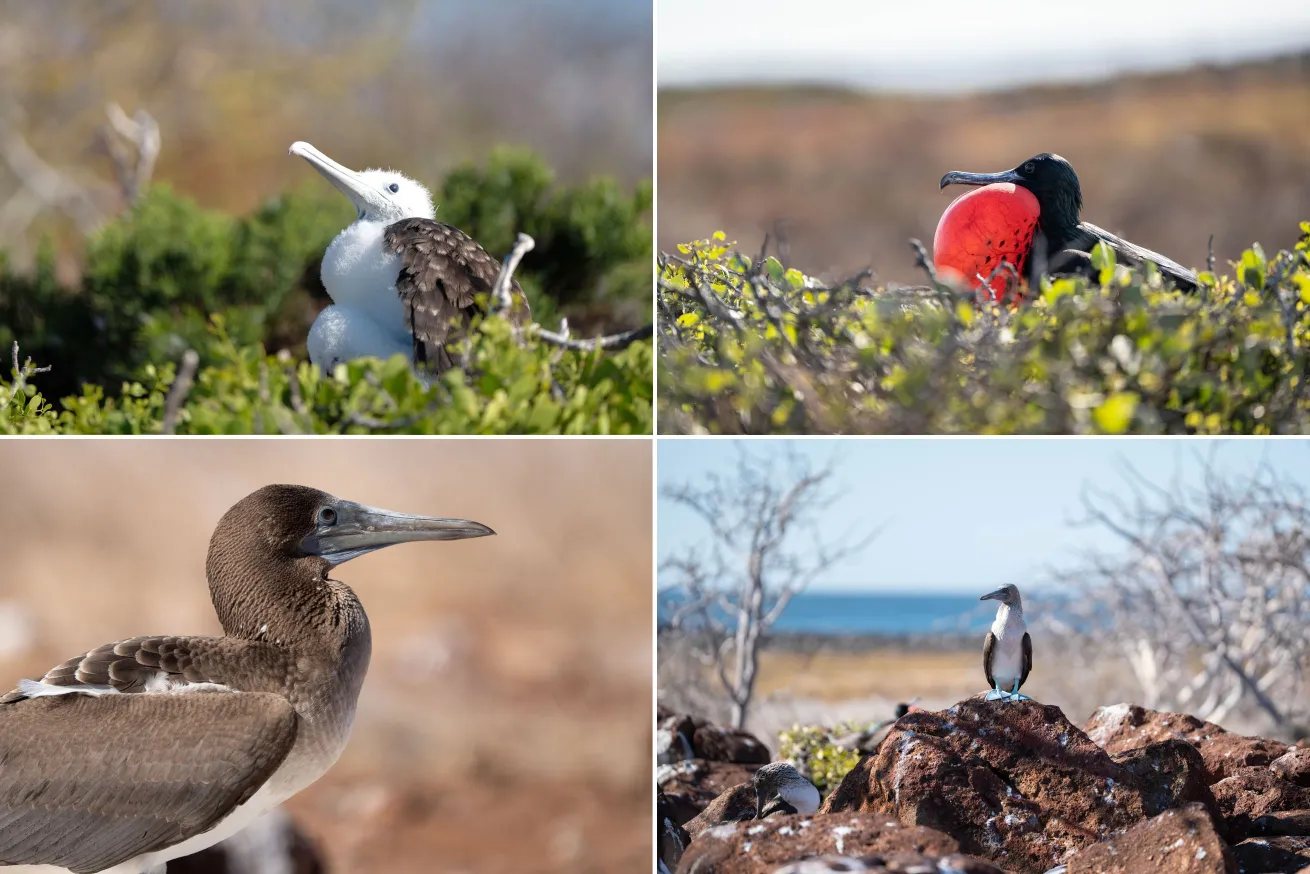
Kristin PaterakisBirds of the Galápagos. Top: magnificent frigate bird chick and adult. Bottom: blue footed booby juvenile and adult.
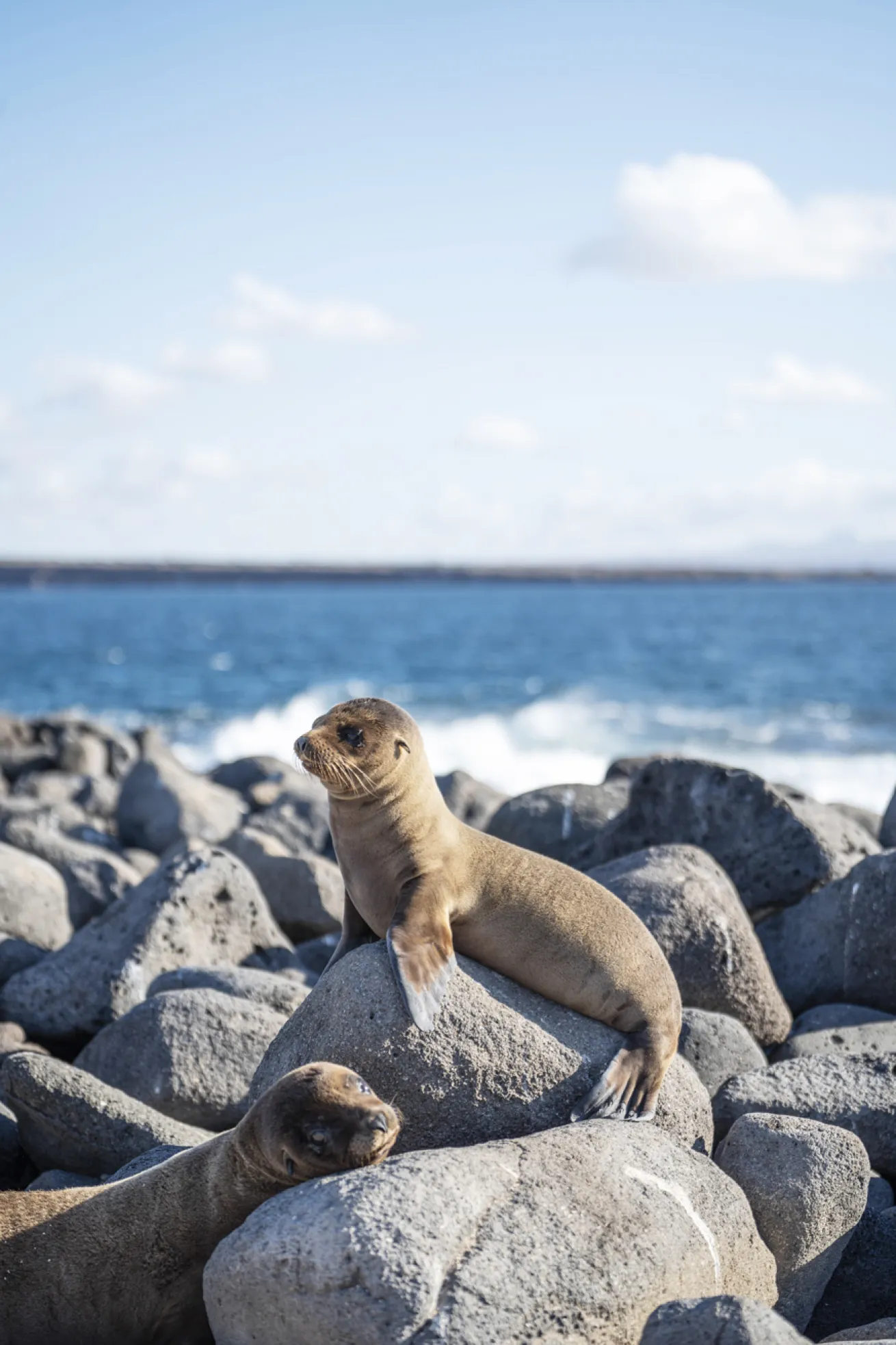
Kristin PaterakisSea lion pups at North Seymour Island.
A Taste of Galápagos
Our first dives at Mosquera give us a taste of what Galápagos has to offer. During our first dives, we witness a few passing scalloped hammerheads, mobula and eagle rays, whitetip and blacktip sharks, turtles and macro wonders like seahorses and hundreds of blue-striped nudibranchs.
North Seymour Island: A Birder's Paradise
The afternoon is spent touring North Seymour Island, a birder’s paradise that is also home to more than 2,500 land iguanas. The animals here are so unbothered by humans that our guide has to remind us to keep our distance.
Only recently entering my bird era, I find myself genuinely captivated by the iconic blue-footed boobies, whose youngest chicks have barely a hint of blue in their feet yet. Even more striking are the baby magnificent frigate birds that look absurdly like little snowmen, a contrast to the adult male’s vibrant crimson throat pouch, inflated like a balloon to attract a mate. If only finding my dive romance was that easy—eligible bachelors puffing their brightly colored BCDs and showing off their skills.
Our walk past the dwarf palo santo trees, among the nesting birds, and through the sea purslane field takes us toward a volcanic shore dotted by charcoal-colored marine iguanas. We come across a lonely sea lion apart from the rest of the colony, exiled by a rival male. The baby sea lions, basking in the sun, unbothered by the competition, steal my heart.
Related Reading: Standout Stay: Galapagos Sky Liveaboard
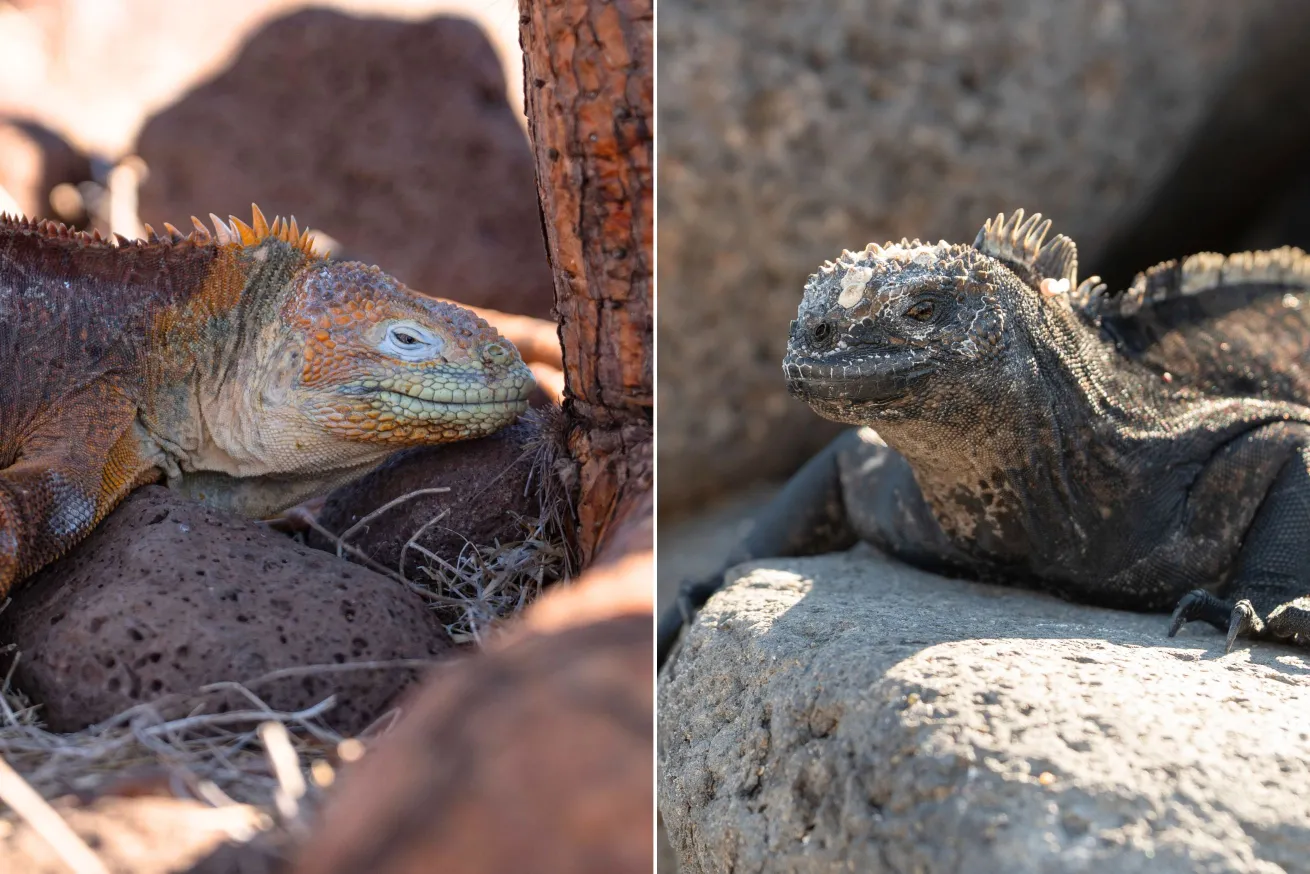
Kristin PaterakisWhile they share similarities, the marine iguana (right) evolved to swim and feed underwater, unlike the land iguana (left).
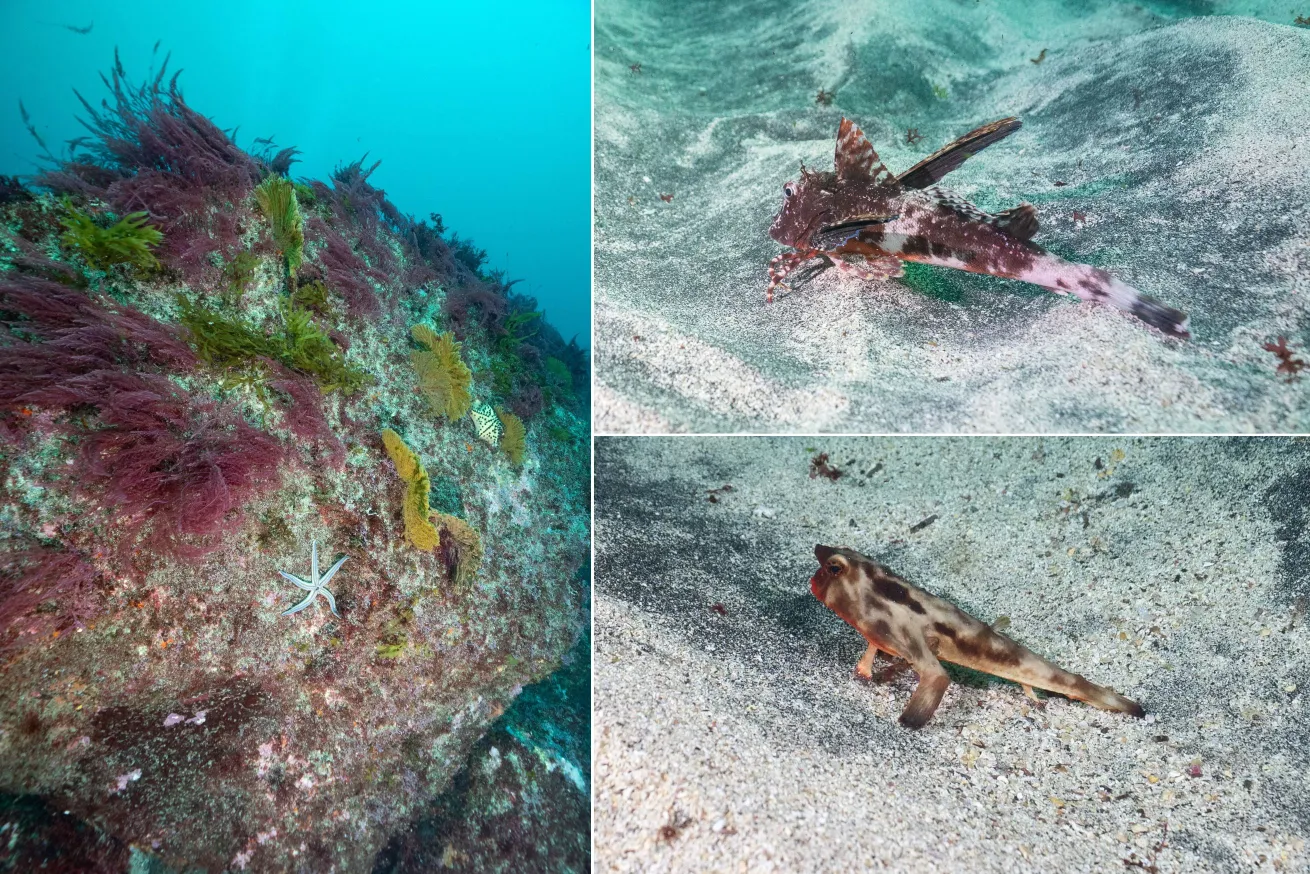
Kristin PaterakisDiving Fernandina Island, Galápagos, delivers rich hues, cold-water marine life, and muck diving for endemic Galápagos sea robins and the red-lipped batfish.
Diving Fernandina and Isabela Islands
The emerald water off Fernandina and Isabela islands, streaked with deep purples, pinks and greens from soft coral and algae-encrusted rock, reminds me instantly of diving off the coast of Peru. Rightfully so, as both feel the cold, nutrient-rich upwellings of the Humboldt Current. We descend into the dark, hazy depths in search of sea robins—an extraordinary-looking fish with legs that crawl along the sandy bottom—and the endemic red-lipped batfish, perhaps also looking for its mate under the sea.
While the benthic diving is enough to make me wish I brought my macro lens, we fin to the open water for the next attraction. An animal I was OK with never seeing—its odd-shaped body and lumpy skin always gave me the heebie-jeebies—appears in the distance. I float in awe as the bumphead sunfish (Mola alexandrini) glides in a captivatingly smooth movement while butterflyfish and Moorish idols clean it.
Later, curious to learn more about the mola, I do an online search to see if it is also a solitary animal and discover it listed in an article titled “7 Marine Animals That Are as Single as You Feel.” Is this awkward, unattractive behemoth my spirit animal?
"I WAS NOT READY FOR A 3-FOOT-LONG LIZARD TO SLAM AGAINST MY CAMERA’S DOME, THEN HIT ME ON THE HEAD."
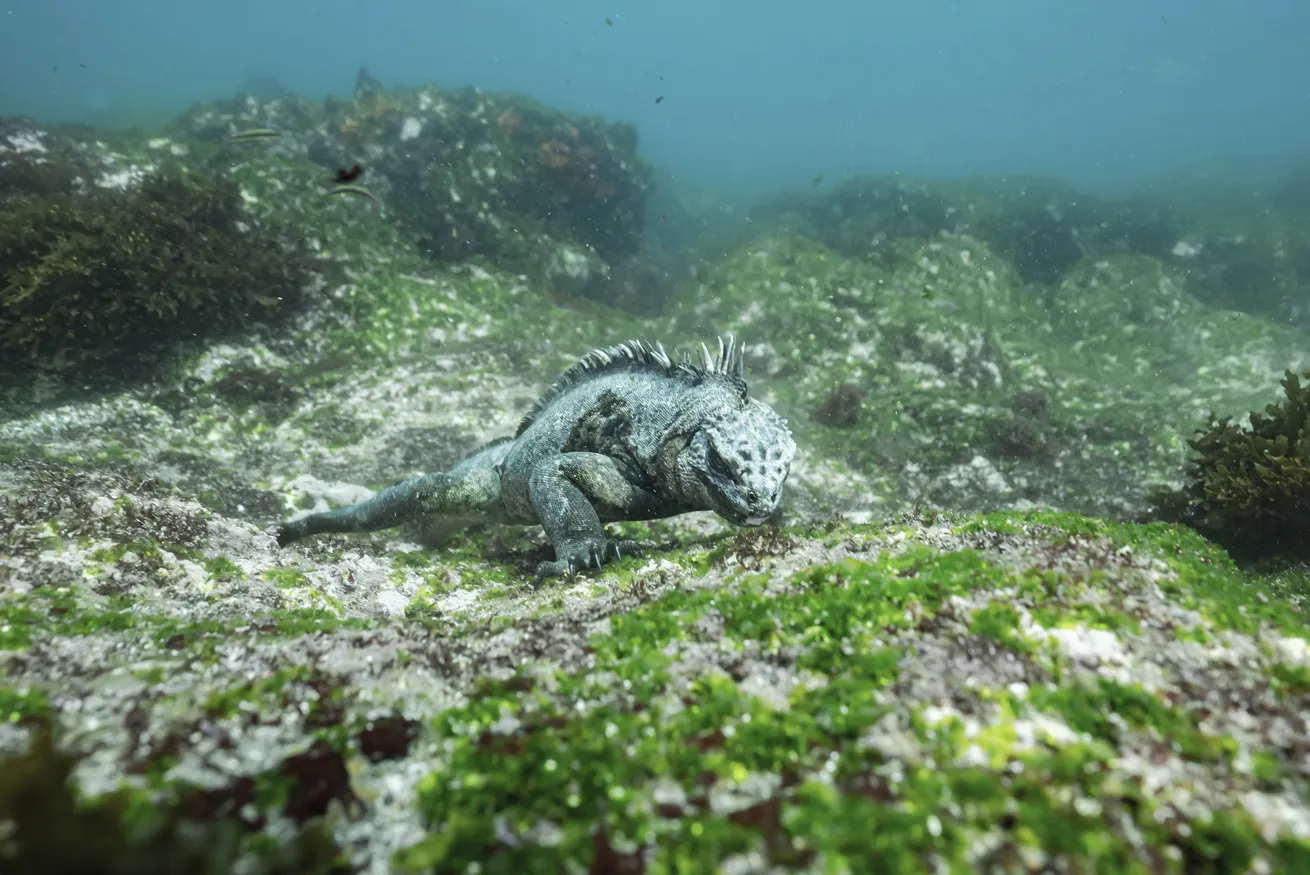
Kristin PaterakisA marine iguana, endemic to Galápagos, munches some algae
The “IMPS Of Darkness”
Despite the guides’ warning of rough conditions and strong surge at shallow Cabo Douglas, I was not ready for a 3-foot-long lizard to slam against my camera’s dome, then hit me on the head. I squeal as I try to get out of the way of any more iguana-bombs, quickly mumble an apology through my reg and swim on.
Having lived for over a decade in Florida, where these reptiles are more of a nuisance than a sight of wonder, Darwin’s description of marine iguanas as “imps of darkness” always seemed fitting. But something shifts when I finally see this smaller version of Godzilla swiftly swimming with its rudder-like tail. Its dark skin, evolved to absorb heat from the volcanic rock, and snot- and salt-encrusted face become endearing.
Tips For Traveling Solo
Traveling solo can be intimidating, especially if you’re an introvert like me. But the flow of liveaboard life—dive, eat, sleep, repeat—offers a unique way to be as social or solitary as you desire. Having a daily structure removes the need to worry about where to go, whom to go with or whether it’s safe to do so alone. It also provides space to get to know other guests at your own pace.
Still nervous? Here are some tips that have worked for me:
Say Cheese! Offer to take photos of fellow guests. Many don’t get to see themselves alongside a school of hammerhead sharks.
Schedule Alone Time Download a book or two for your trip. I chose one on the natural history of Galapagos, as well as a light-reading fictional story—ironically, about someone falling in love on a Galapagos cruise.
Bring Something to Share One guest brought a nice bottle of scotch that, paired with his belly-laugh humor, made him a favorite among the group. Other ideas include snacks from home.
Switch It Up Even if you go with a group or bond with one person the first day, sit with someone new each meal. You may find an unexpected connection. And don’t forget to chat with the boat staff.
Take a Risk No one else knows you, so when the last evening comes around, and you are forced to take part in dressing up as a marine iguana and crawling around the dock, don’t hold back.
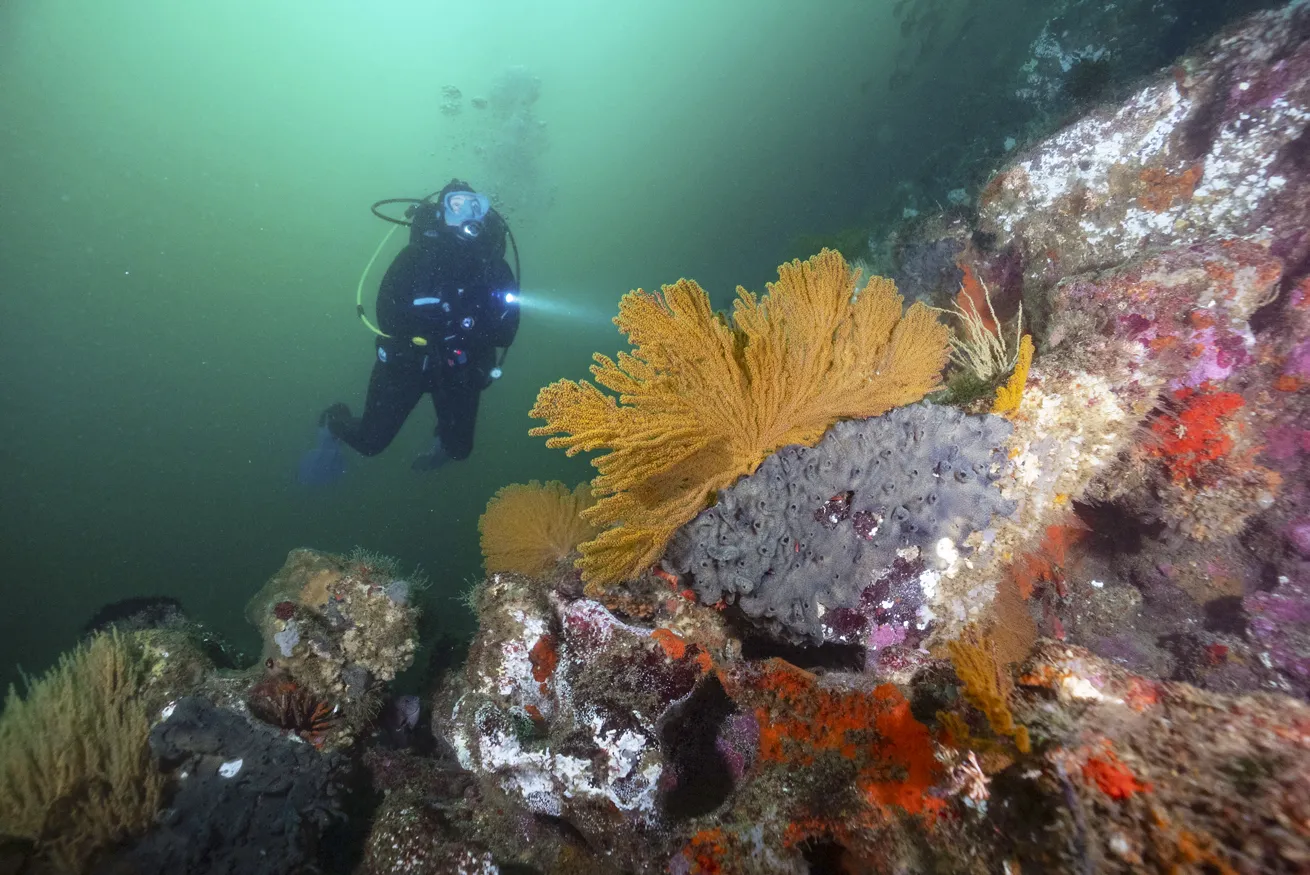
Kristin PaterakisThe author’s dive buddy, Laura, searches for molas and Galápagos bullhead sharks at Punta Vicente Rock
Mo’ Plankton, Mo’ Mola
At nearby Punta Vicente Rock, conditions are even rougher—reminding me to never set expectations based on what you see online. Visibility hovers between 20 and 50 feet, and before I can adjust my camera settings, a friendly sea lion spins by, quickly leaving in a trail of bubbles. We shiver as we head to deeper water, where we encounter another mola. This time it comes close enough for us to see the pigmented spots and distinctive bumped head and smooth clavus that identify the alexandrini species.
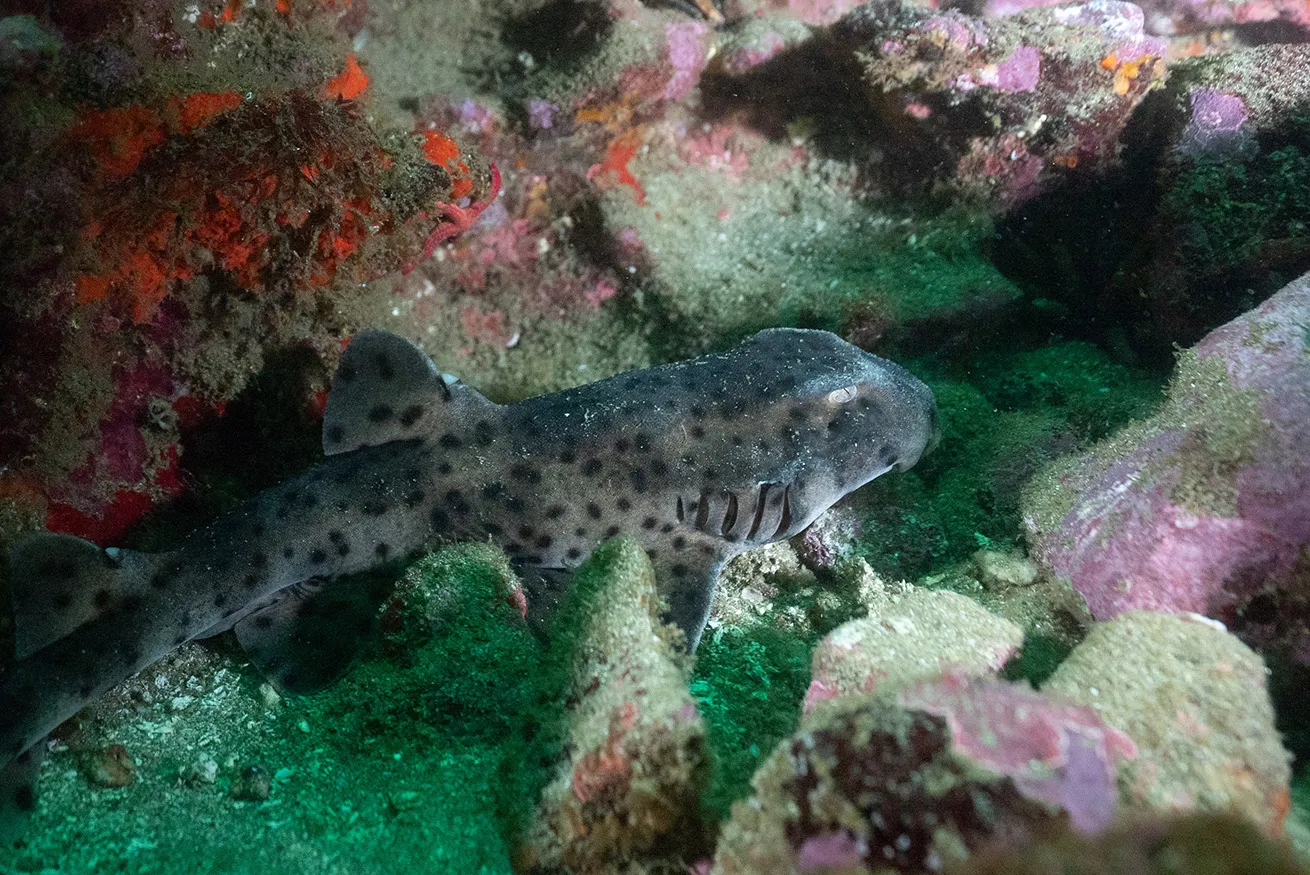
Kristin PaterakisGalápagos bullhead shark in the crevices of the volcanic rock.
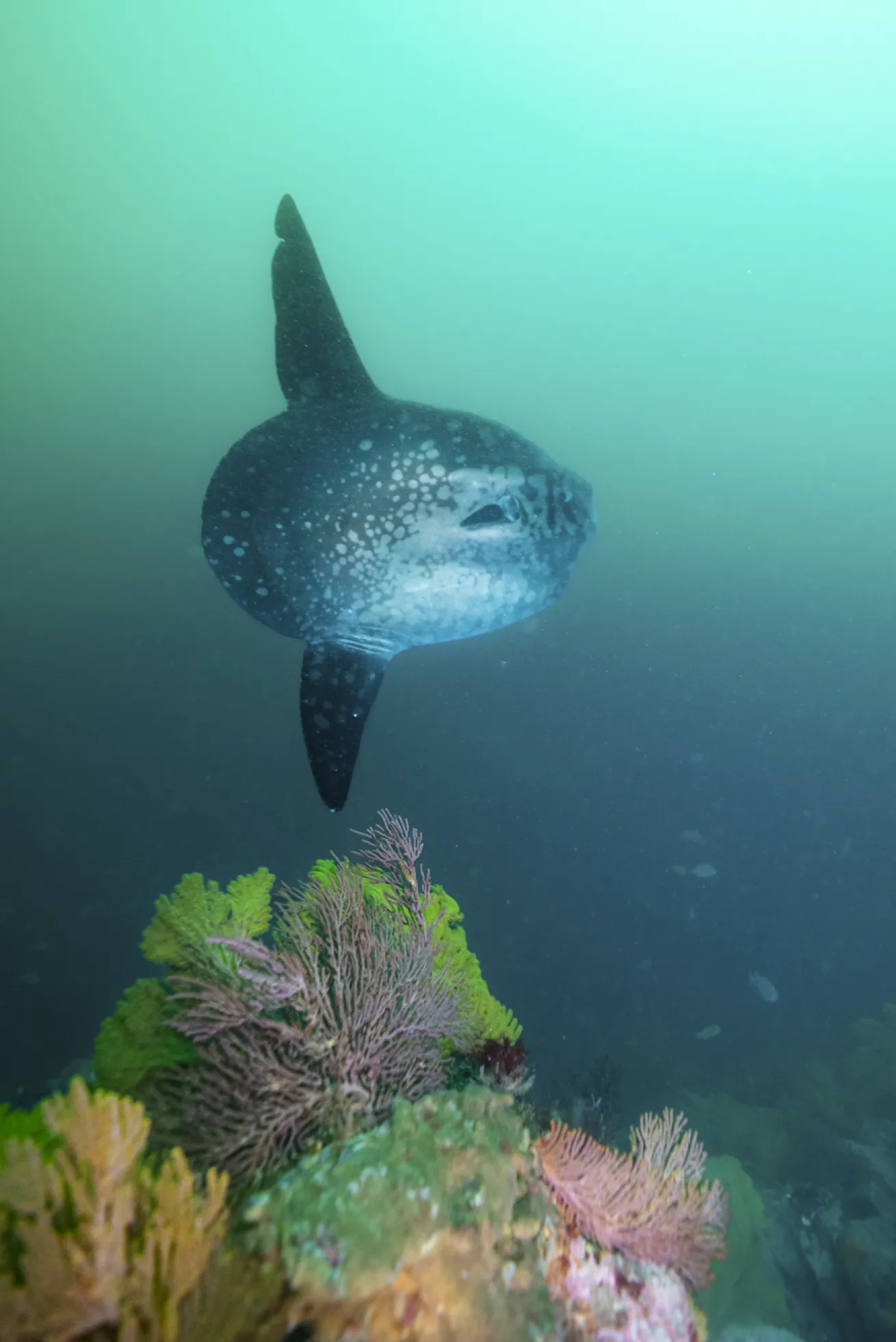
Kristin PaterakisMola alexandrini at Punta Vicente Rock.
Now with a “never miss a dive” attitude I lacked when I first started liveaboard diving, I am one of two divers to opt for a second dive in these murky conditions, along with Laura, a British marine biologist living in California. While we don’t find more mola, and visibility makes it feel as dark as a night dive, we become quick friends over our excitement of spotting more than a dozen Galápagos bullhead sharks. We observe the small, spotted elasmobranchs, with milky-iridescent gold eyes and little snouts like catfish, looking so cozy in the crevices of the volcanic rock.
We surface and do a short tour of the island, straining our eyes to see penguins, boobies and hundreds of marine iguanas from a safe distance. I’m bitter that my camera is locked in the housing with a wide-angle lens but smiling with excitement as I’ve made a new lifelong dive and animal-loving buddy.
Related Reading: How to Photograph Camouflaged Animals Underwater
Kristin Paterakis
The Main Attraction: Diving With Hammerhead Sharks
“Three… Two… One… Zero point zero!”
Packed shoulder-to-shoulder, we celebrate crossing the equator—zero degrees latitude—like it’s New Year’s Eve as we head northwest to Darwin and Wolf islands, world-renowned for schooling hammerheads and the highest biomass of sharks in the world.
Hammerheads are addictive—once you glimpse your first school of 30, you know there are even more beyond what the water column shows, and you want more. Closer. You curse the loud bubbles you exhale that cause them to turn away at the last second.
My late-January trip fell during the “off” season. Cold, strong currents from June through November bring plankton-rich water; in turn, sightings of whale sharks and larger schools of hammerheads are more common. I’m disappointed—but I tell myself it’s a reason to come back.
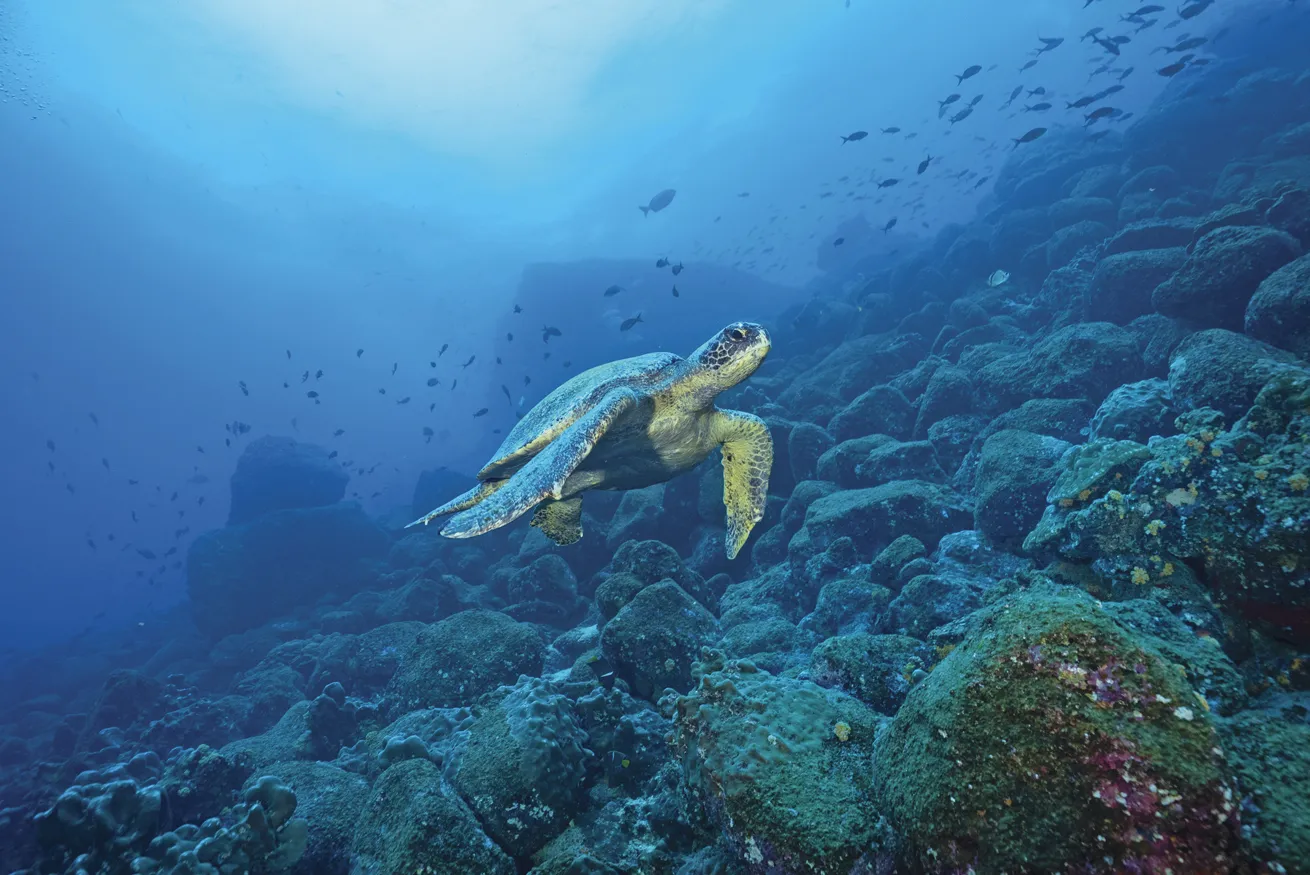
Kristin PaterakisA green sea turtle at Wolf Island.
By the time we reach Wolf Island, the group has become its own little community—I’ve convinced Giulietta, a scuba instructor and jazz singer from Italy, and her partner, Per, a former Danish soccer pro, to adopt me as their dive buddy.
The warm water and mild current push the hammerheads into the colder depths. I’ve just about given up, thinking maybe next dive we’ll get lucky, and turn my lens on a passing sea turtle. A yell from Israel abruptly interrupts my focus. I swivel my head to find him aggressively pointing up.
My regulator almost falls out of my mouth as I look up in awe—over 100 hammerheads are cruising overhead, backlit by the sun. On cue, Israel’s morning affirmations reverberate through my mind: “You are not here to chase sharks; you are here to witness them.”
I wish I could hold onto this moment forever, but it’s gone as quickly as it came.
My beating heart calms, and I enjoy the rest of the dive surrounded by fish as far as the eye can see. Mating scars on passing hammerheads, turtles swimming in pairs, the couples in my group blowing kisses—I take it all in and realize I haven’t felt the pang of loneliness in days.
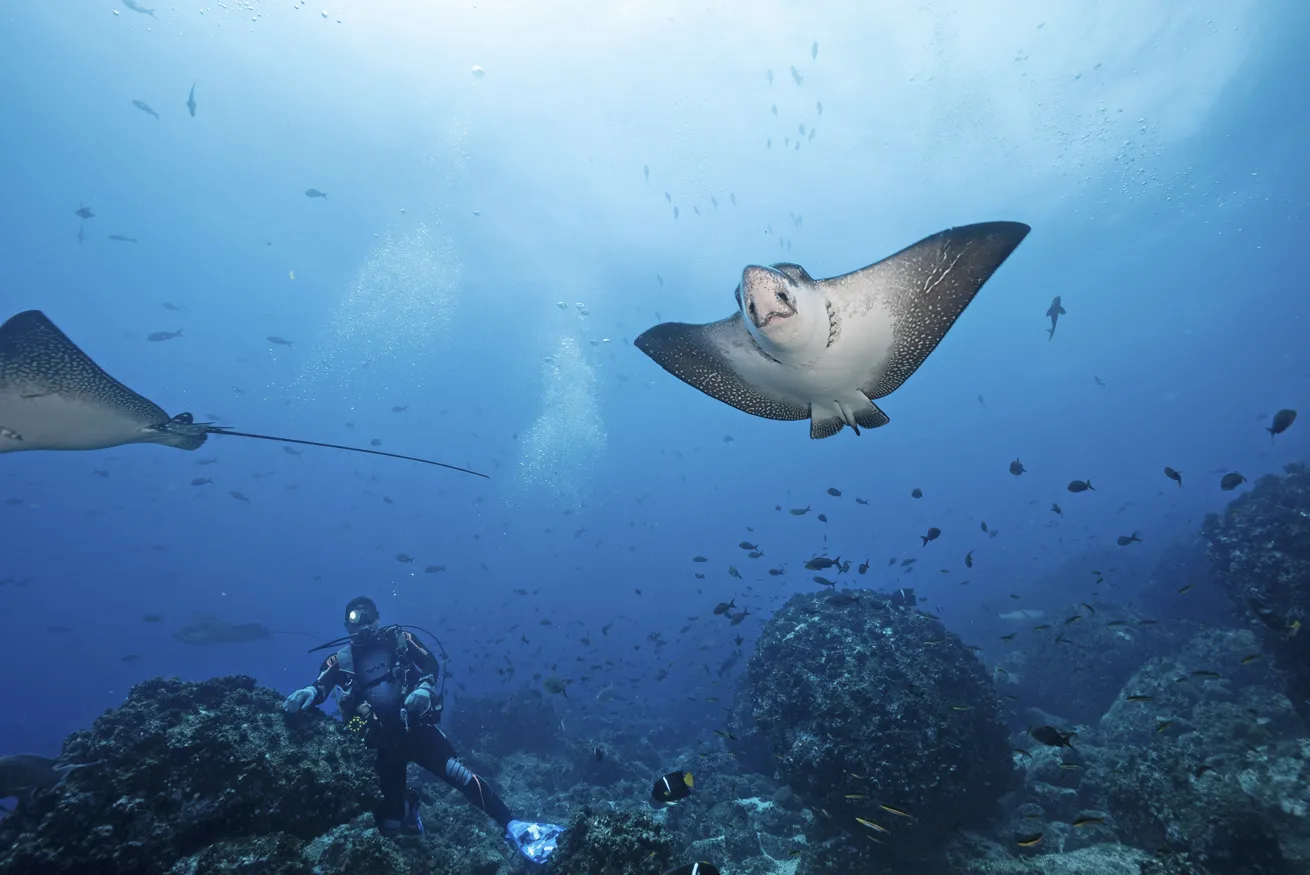
Kristin PaterakisAn eagle ray soars against the current.
Our final dives at Wolf Island offer a special experience through gardens of eels, fields of hard coral, dozens of Galápagos sharks and an unforgettable encounter with a school of eagle rays holding steady in the current.
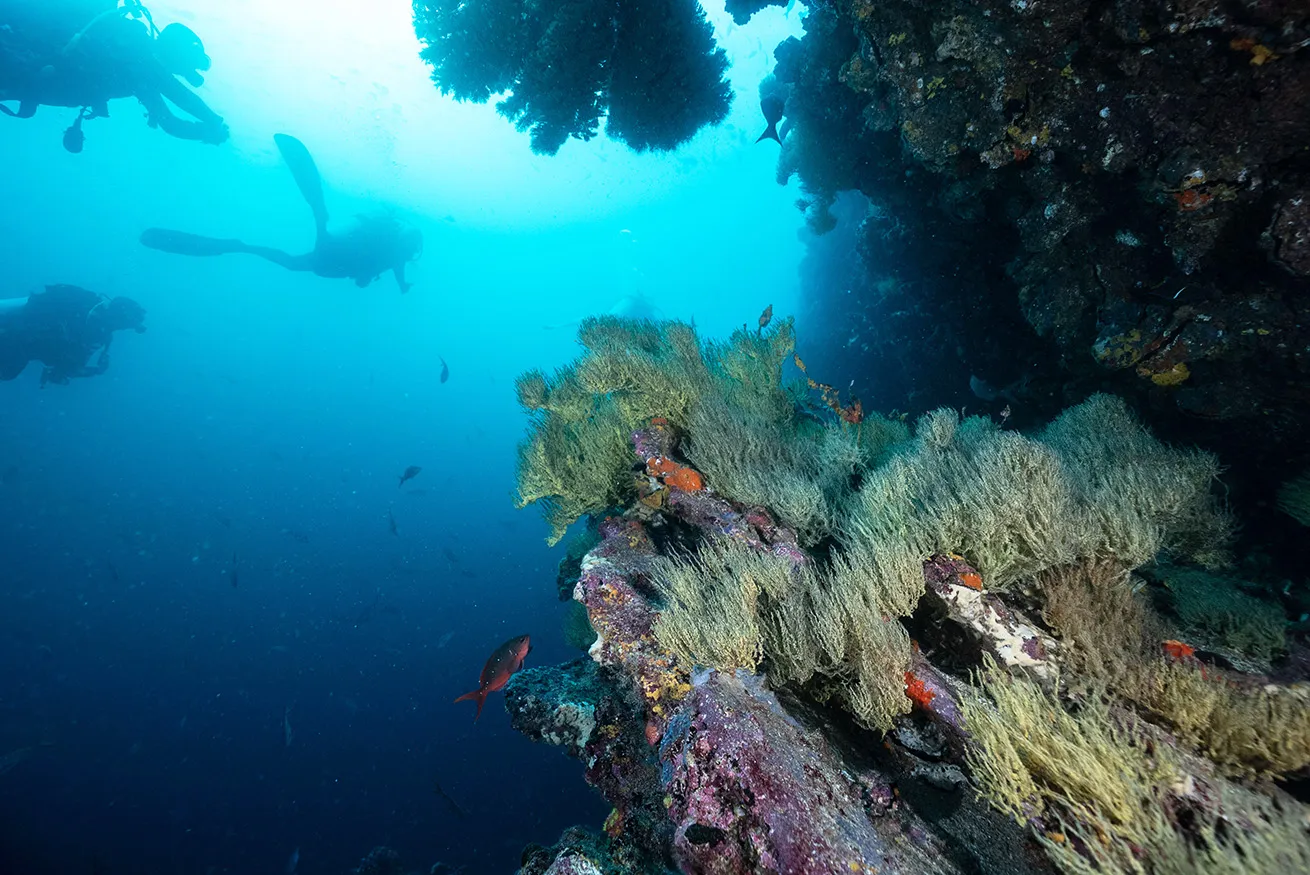
Kristin PatearkisCousin's Rock is a great site for spotting seahorses, eagle rays, black coral, stingrays and sharks resting in caves.
A Galápagos Goodbye At Cousins Rock
Eighteen hours later, we are back to cold water and low visibility, slowing down the pace of the past three days of high-adrenaline diving to the calm water surrounding Cousins Rock. After our guides point out a few seahorses, we ascend and swim through a forest of black coral. The misleading name identifies the black skeleton. However, the color of black coral depends on the living tissue. Some places it is orange; here it is a Granny Smith, almost glowing, green.
I still have 1,400 psi left in my tank when I see Oscar give the thumbs up—it’s time to go back to reality.
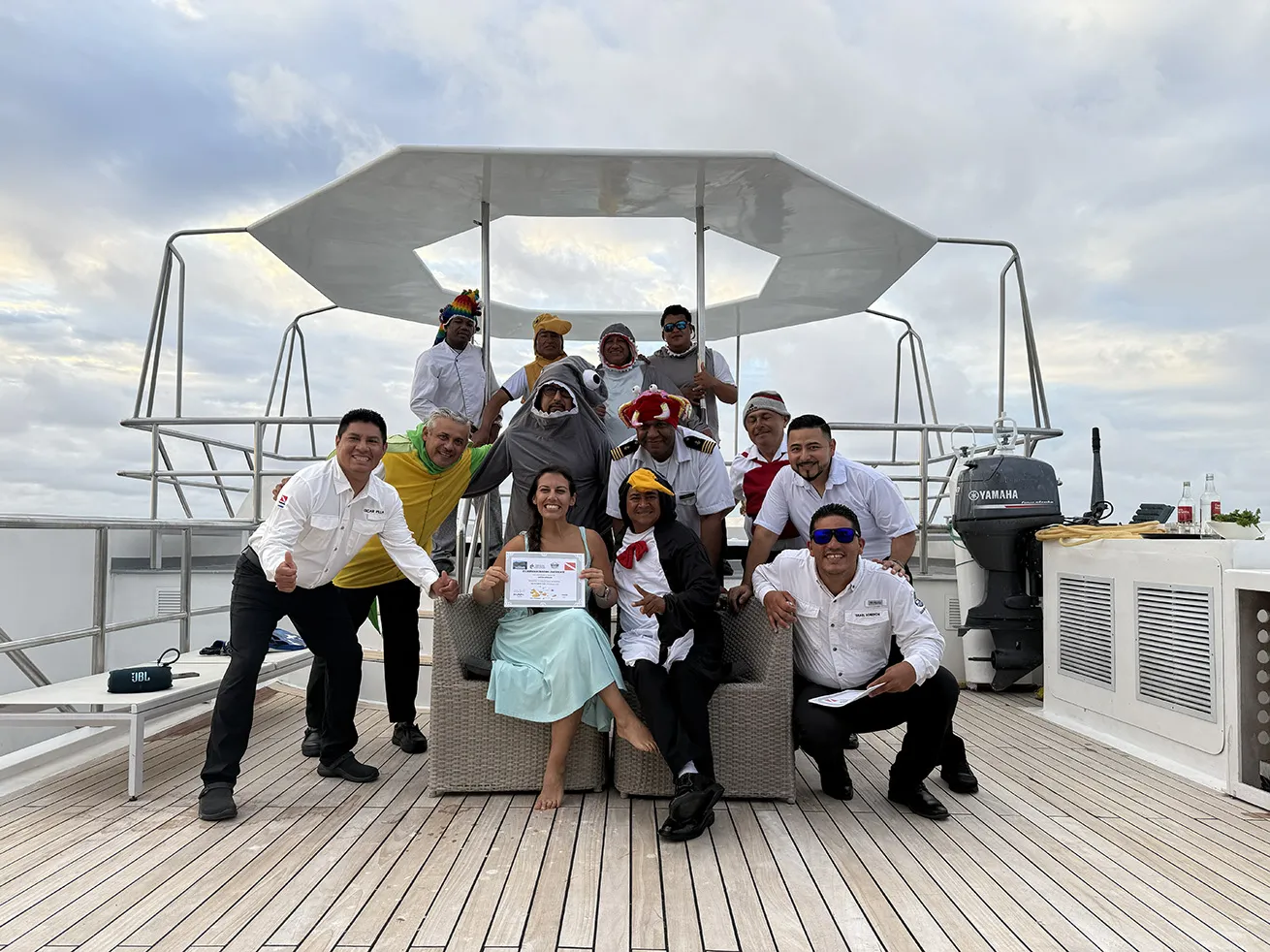
The author with the crew of Tiburon Explorer on the final night at sea.
New Friends and Memories to Share
Our final night after a day topside exploring Santa Cruz Island—crawling through a volcanic tunnel and coming face-to-face with giant tortoises—finds us back in Puerto Ayora. Just a week ago, I walked these streets, wistfully watching families and honeymooners from a distance. Now I share drinks, food and laughter with my new friends, leaving this experience a different person than when I arrived.
I no longer find marine iguanas and molas ugly. I have a new confidence for solo travel, and I promise myself I’ll come back for whale shark season.
I am already planning a visit to California to dive the kelp forests with Laura and a trip to an Italian jazz festival, to watch Giulietta perform.
And though I don’t fall asleep discussing the trip with a partner, I find other ways to share it. In this magazine and through videos I show my nephew, who now owns a wetsuit and scuba mask, ready to jump into the world I love.
As tempted as I am to cancel my flight and continue discovering this land of wonder, there’s one thing Galápagos doesn’t offer: my dog Zoe. I snuggle her face next to mine when we reunite, her ears pulled back and whiskers rubbing my cheek like a sea lion— and think that’s probably enough.
What to Expect Onboard the Tiburon Explorer
Year Built 2020
Length 125 Feet
Maximum Guests 16
Conservation
Green Fins member and PADI Eco Center
Staterooms/Beds
There are eight spacious staterooms. All staterooms feature large windows, full or king beds, a desk, and an en suite bathroom with luxury amenities. The lower deck staterooms feature a lounge area with a sofa.
Amenities
Tiburon Explorer has a spacious deck with charging cubbies, camera table and outdoor heaters, as well as a sun deck with a jacuzzi and lounging chairs for relaxing between dives and taking in the sunsets.
Food/Drink
Meals are served buffet style with made-to-order eggs at breakfast. Full bar and specialty drinks included. Gluten-free and plant-based dishes are available on request.
Galápagos Diving FAQ
When is the best time to go to the Galápagos?
Galápagos is a premier dive destination year-round. If you are keen to see whale sharks, the best time to go is the dry season, June through November, when the current is stronger and the water is colder—though it is never guaranteed.
What certifications or experience do I need to dive the Galápagos?
While not required, it is recommended that all divers have PADI Advanced Open Water Diver and Enriched Air Diver certifications as well as at least 100 logged dives.
What are the diving conditions like in the Galápagos?
Much of the diving is deep, with visibility and temperature varying between islands. The northernmost islands, Darwin and Wolf, are known for warmer water ranging from 75 to 80 degrees during the wet season and 72 to 75 degrees during the dry season. The westernmost dive sites have colder temperatures ranging from 60 to 75 degrees.
What type of dive gear do I need to bring to the Galápagos?
Bring gloves and a 5 or 7 mm wetsuit, with a 5 mm hood or hooded vest, to layer up on colder dives. Some opt for a drysuit, if they have prior experience and the proper training. Explorer Ventures offers rental 7 mm suits, which guests must reserve in advance. Everyone is given a marine rescue GPS, but you can bring your own.
How much does a liveaboard cost in the Galápagos?
A seven-night stay on Tiburon Explorer is $7,395 USD. A $200 park fee must be paid in cash when passing Galápagos customs. All food, snacks, drinks and alcoholic beverages on board are included. Bring tip money in cash (U.S. dollars welcome), as credit card tips are charged a 15 percent tax on top of bank fees.
What to bring on a Galápagos liveaboard?
Leave room in your luggage for souvenirs, including locally made artwork. Photographers looking to capture land excursions will find packing a long lens worthwhile.
How to get to the Galápagos?
It is suggested to get to Ecuador two to three days before your trip. Guests can fly through Guayaquil or Quito. Some opt to spend time on land in Galápagos before or after the trip.
What land excursions are included with the Tiburon Explorer?
Explorer Ventures includes a half day exploring North Seymour Island to view birds, sea lions and marine iguanas. The final day is spent visiting a giant turtle farm and shopping and dining in Puerto Ayora, Santa Cruz.
What liveaboard company do you recommend diving with in the Galápagos?
Explorer Ventures explorerventures.com


