

Walt Stearns
Ten Top Wreck Diversions off the Overseas Highway
Spiegel Grove
Overall Length: 510'0" Vessel Type: Landing-ship-dock liberty ship Year Sunk: June 10, 2002 Max. Depth: 130'0" Accessible From: Key Largo
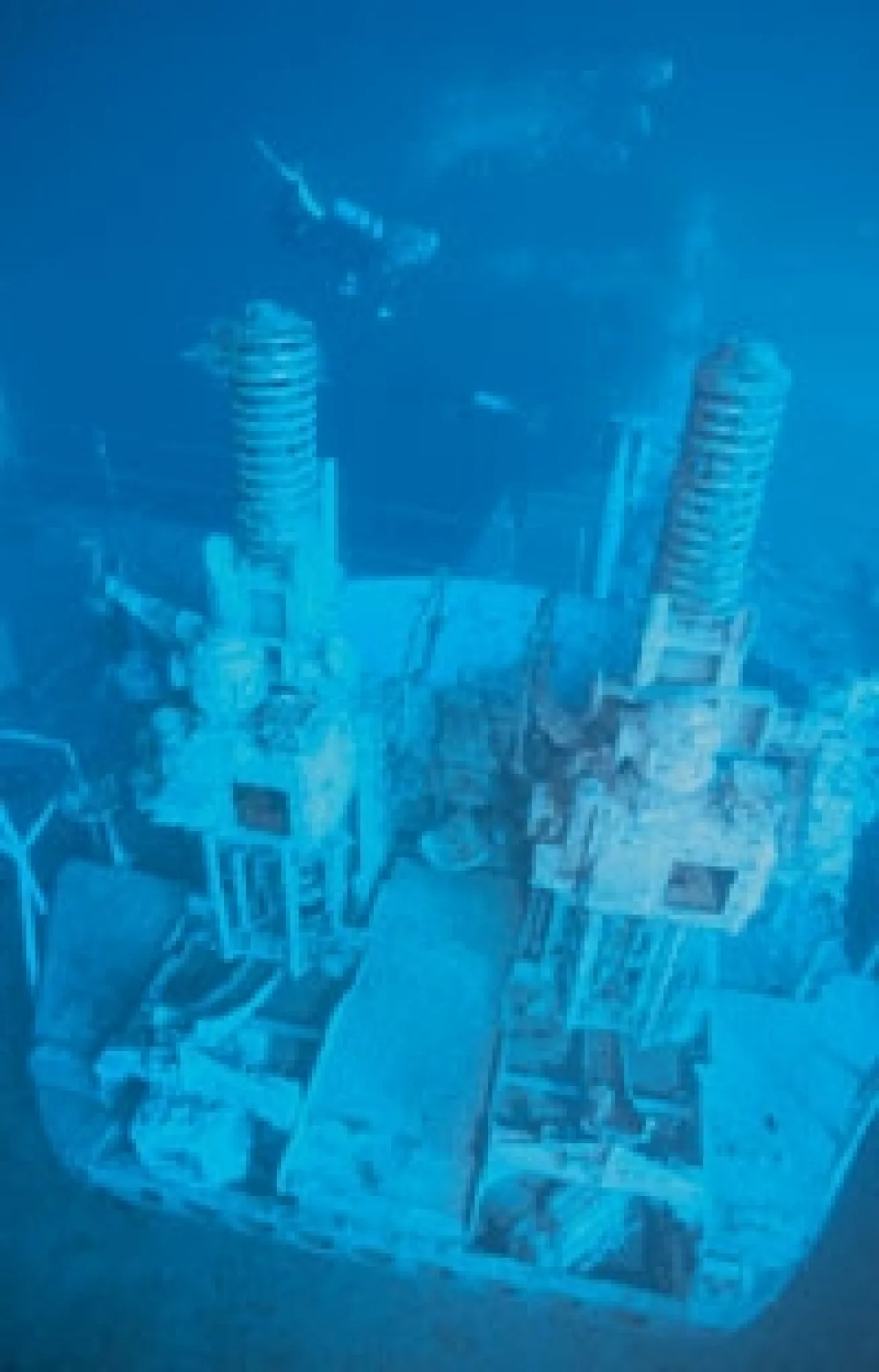
In addition to its initial claim to fame as the largest member of Florida's artificial reef fleet, the Spiegel Grove generated national attention following its sinking. On May 17, 2002, news stations across the country aired images of this massive liberty ship floating upside down, with its bow jutting high above the waves like a dead whale. It seemed an unsuitable end for eight years of hard work. Fortunately, the local dive community persevered, and some 30 days later, the hull was flipped by salvage tugs and came to rest on its side in 130 feet of water, with its underside facing into the prevailing currents. The Grove's 84-foot beam gives it more of the aspect of seamount than wreck, placing two-thirds of its 510-foot length within 50 feet of the surface, and creating a lee for divers touring the superstructure. Gone is the Spiegel Grove's battleship-gray paint. The ubiquitous military hue has succumbed to the process of "reefication" with a furry coat of algae, white and orange octocorals, and hydroids. In time, the Spiegel Grove's massive steel skeleton will develop a vibrant coat of sponge and coral communities. In the meantime, an abundance of fish have taken up residence in the many nooks and crannies. Although penetration is strongly discouraged by dive operators, there is nothing wrong with taking a short swim through the gaping maw of the well-deck ramp. Equally breathtaking are the ship's enormous twin screws, which also make an excellent photo op. In 2005, Hurricane Dennis moved the massive vessel so that it is now upright.
Benwood
Length Overall: 360'0" Vessel Type: Freighter Year Sunk: 1941 Depth Range: 50'0" Skill/Training Requirements: None Accessible From: Key Largo
The MV Benwood is a true hard-luck story. As was common practice among World War II freighters trying to escape detection from prowling German U-boats, the Benwood was running at night without lights. Just off Key Largo, it was inadvertently rammed by the Robert C. Tuttle, another merchant ship running dark. As a result of the accident, fires broke out on deck, alerting a German U-boat in the area. Not surprisingly, the 360-foot-long freighter was torpedoed. In its captain's subsequent attempt to save the ship's cargo by grounding it in the shallows, the Benwood struck a reef, sinking it in its tracks. Most of the Benwood's remains are spread over a wide area of reef with an average depth of 20 feet, with one section dropping to a maximum depth of 50 feet. These depths, plus the abundance of fish life, make it a great follow-up dive after the Spiegel Grove. The stern section of the ship is the most intact feature, forming an 18-foot profile in the water column. The rest of the way down, the ship's knees massive reinforced triangles of steel joined like the ribs of a titanic beast allow the vessel's outline to be easily discerned.
_ Bibb and Duane_
Length Overall: 327'0" Vessel Type: 327 Treasury Class U.S. Coast Guard cutter Year Sunk: Nov. 27, 1987 Max. Depth: Bibb 130'0", Duane 120'0" Accessible From: Central Key Largo to Tavernier
Although the arrival of the Spiegel Grove stole some of their thunder, the Bibb and Duane remain world-class wrecks and Florida Keys favorites. After their decommissioning, the Keys Association of Dive Operators was able to purchase both of these highly decorated cruisers for a dollar apiece. Sent to the bottom in 1987 fully intact — in 120 and 130 feet of water, respectively — off Molasses Reef, both wrecks have taken on a healthy, multicolored coat of encrusting sponges and corals. Of the two, the upright Duane is definitely the more popular. Vaulting upward some 60 feet from the 120-foot sand bottom, the old cutter hasn't lost its looks. If anything, it has aged beautifully with a blanket of orange cup corals extending all the way inside its forward bridge. One of the wreck's keener focal points is its towering crow's nest, which extends upward to a depth of 60 feet. On days when currents are strong, large numbers of barracuda use the tall structure like a windbreak, stacking up in large groups. Unlike the Duane, the Bibb is a more technically challenging wreck to dive. Instead of coming to rest upright on the bottom, the cutter rolled onto its starboard side, with two large propellers facing into the current in 130 feet. Given its less pronounced relief, greater depth and location closer to the Gulf Stream, more care and skill is called for to dive this incredible metal leviathan.
Eagle
Length Overall: 269' Vessel Type: Freighter Year Sunk: Dec. 19, 1985 Max. Depth: 110' Accessible From: Lower Key Largo, Tavernier and Islamorada
What this Holland-built freighter, originally named the Raila Dan, then renamed the Aron K, may lack in historical value, it makes up for in personality and color. When the Eagle was sent to the bottom, courtesy of Eagle Tire Corp. back in 1985, she landed with a sharp list to starboard in 110 feet of water. While the charges used to sink the vessel also blew several diver-friendly penetration holes in the hull, the added touches by Mother Nature deserve the most applause. Storm surge from Hurricane Georges in 1998 severed the hull cleanly in two, leaving a 20-foot gap between the massive bow and stern sections. Due to its placement on the boundary edge of the Gulf Stream, strong currents are rare, but there is ample coral and sponge growth, especially on the heavily encrusted forward cargo boom and aft crow's nest. Schools of baitfish swirl around the Eagle's superstructure and gaping cargo holds. In addition to various varieties of small baitfish, grunts and snappers, divers will routinely encounter bigger stuff such as schools of horse-eye jacks, spadefish, greater barracuda and a collection of grouper that often includes several large Goliaths. The wreck is often visited in the summer by 6- to 8-foot-long tarpon.
Thunderbolt
Length Overall: 188'0" Vessel Type: Cable layer Year Sunk: March 3, 1986 Max. Depth: 120'0" Accessible From: Marathon Key
Built in 1942, this 188-foot cable layer went by the name of USS Randolph. Later in its career, it was inducted into the U.S. Army for lightning research, hence its title and the strange circular structure on the bow, which resembles a giant steering wheel. Fused in place by 16 years on the bottom, the side-mounted, cable-laying wheel features both a lively level of growth and an affinity for attracting some beefy greater barracuda. Pay them little mind they don't eat much. The wreck is positioned upright and fully intact; penetration of the wheelhouse is simple with plenty of ambient light pouring in through doorways and windows. It is even possible to swim down the staircase amidships into the crew's quarters.
_ Adolphus Busch_
Length Overall: 210'0" Vessel Type: Freighter Year Sunk: Dec. 5, 1998 Max. Depth: 105'0" Accessible From: Big Pine Key to Little Torch Key
Like most freighters with a long service past, the Adolphus Busch underwent numerous name changes — London, Topsail Star, Windsor Trader and Ocean Alley — before being renamed after the beer magnate who helped fund its cleanup and sinking in the lower Keys. During its more active career, Adolphus Busch appeared in the 1957 film Fire Down Below, starring Jack Lemmon, Robert Mitchum and Rita Hayworth. With the exception of having its hatches and portholes stripped, everything else is intact on the Adolphus Busch. Clamped to the bottom by both bow and stern anchors, the 210-foot freighter carries a stately profile, sitting upright in the sand near Looe Key with its main deck at 90 feet overlooked by its 20-foot-tall aft wheelhouse. Until the sinking of the Vandenberg (another ship similar in size to the Spiegel Grove that was sunk in the Keys in 2009) is accomplished, the Busch was the_ _lower Keys' largest wreck in sport-diving depths. Furthermore, like most freighters built in the early 1950s, it is not likely to fall apart for many years to come. Since its placement in 1998, it has grown a healthy coat of marine life, which has attracted a plethora of fish life, including several robust 200- to 300-pound Goliath grouper.
Cayman Salvager
Length Overall: 187'0" Vessel Type: U.S. Coast Guard steel-hulled buoy tender Year Sunk: August 1985 Max. Depth: 90'0" Accessible From: Key West
Before the arrival of the Vandenberg, Cayman Salvager was the most publicized of the numerous wrecks within reach of Key West. Measuring 187 feet in length, the 1940s-era U.S. Coast Guard buoy tender, originally named the F.V. Hunt, was intended to be an artificial reef for sport fishermen. Like the Spiegel Grove, the Salvager sank prematurely while en route to its targeted depth of 300 feet. Today, it sits even-keel on an open white-sand bottom at a depth of 90 feet. With the exception of the superstructure, the vessel remains intact. Often, the Salvager is home to several Goliath grouper.
Joe's Tug
Length Overall: 65'0" Vessel Type: Steel tugboat Year Sunk: Jan. 21, 1989 Max. Depth: 60'0" Accessible From: Key West
Also eclipsed by the arrival of the Vandenberg, Joe's Tug remains a decent dive. As wreck stories go, Joe's Tug is a classic whodunit. Originally destined to sleep with the fishes off Miami, this 65-foot steel shrimp boat found its way, under rather mysterious circumstances, to the lower Keys where it was sunk six miles south of Stock Island near Key West. Some say a rum-soaked fisherman put it there as new honey hole; others say a local pirate had plans of making a drug run but failed. The wreck has pretty much disappeared, but it's still a good reef dive with lots of marine life in the vicinity. Visibility is usually good due to its location outside the reef.
_**General Hoyt Vandenberg
**_Length Overall: 524 feet, 10 inches Vessel Type: Missile Tracking Ship Year Sunk: May 27, 2009 Max. Depth: 140 feet Accessible From: Key West
The Gen. Hoyt S. Vandenberg is now an artificial reef in 140 feet of water seven miles off Key West. The Vandenberg, a former military troop transport and former missile-tracking ship, first saw duty as a U.S. Army troop transport named the Gen. Harry Taylor. It became the Gen. Hoyt S. Vandenberg in 1963 and tracked the U.S. space program's launches off Cape Canaveral. It also served in the Pacific monitoring U.S. defense missile test launches and eavesdropped on Russian missile launches during the Cold War. The large dish antennae were originally welded to the tops of their pyramid-like support towers, allowing access at a shallower depth, but they broke loose during the sinking and crews later attached them to the ship’s decks with heavy cable. Because of their central location, the tops of the support towers are good spots to get an overview of the ship and photograph the antennae.


