

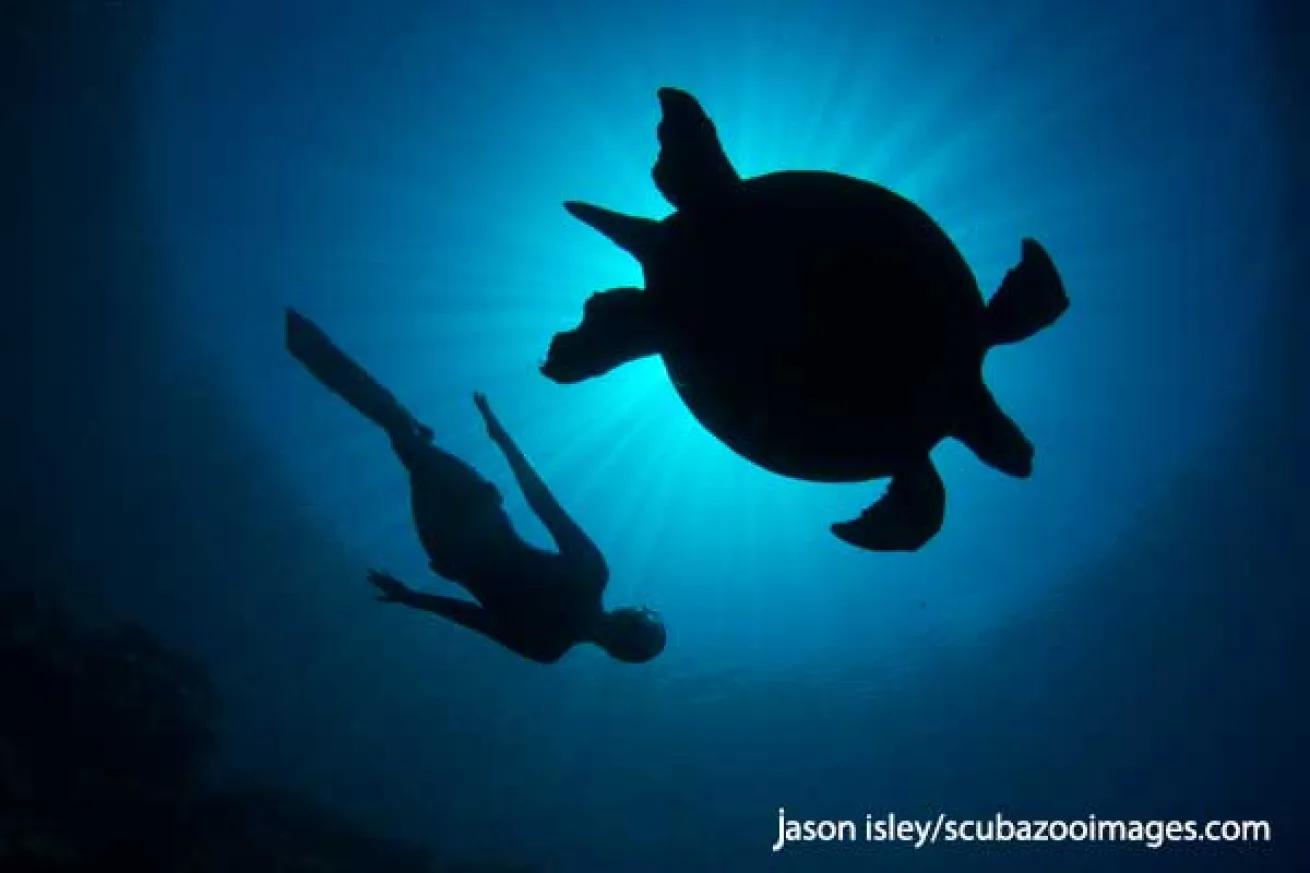
Sipadan, Malaysia
**Where do you live and how old are you?
**I live in Kota Kinabalu, Sabah, East Malaysia with my two dogs and I'm 43 years old.
**How long have you been diving? What made you want to learn to dive and where did you start?
**My first ever dive was a 'try-dive' in Greece in 1990 during a lads holiday, we didn't see anything and the water was actually very very cold. It was another five years before I completed my open water course in Cairns, Australia. I then completed all my training to divemaster level so that I could get a job as an underwater videographer for H2O Video run by Peter Mooney. I was completely hooked by the underwater world and for me capturing it with a camera was the perfect job.
**When did you start shooting underwater? Why did you start using a camera?
**Having worked for H2O Video in Cairns I then moved to Sipadan and helped create Scubazoo with Simon Christopher, we basically filmed guests diving around Sipadan on a daily basis. I lived on Sipadan and Layang Layang Island for roughly two years however I actually grew tired of filming guests every day and when one guest offered his NikonosV to me to play with I jumped at the chance. I had some experience with photography from when I was a teenager and the challenge of capturing one image underwater compared to the video recording was an instant addiction. I continued filming for broadcast jobs for another 10 years but in 2008 I decided to leave the filming to my colleagues and concentrate on the photography 100%.
**What was your first camera setup? What camera system do you use now?
**I used a Nikonos V for many many dives before Scubazoo invested in a Nikon F90X and Nexus housing, I loved the film days and the challenge of only having 36 frames per dive. I rejected the digital transformation for a long time but eventually came to my senses and we purchased some Nikon D200's and D2x's, now I mainly shoot with the Nikon D800 and D700 in Nauticam housings. We use Inon strobes, various glass ports and domes and plenty of gadgets created by my good friend Dave at Scubacam in Singapore.
**Underwater photographers seem to have an ability to look at the underwater world and know what sort of picture could be made, in a way that's not obvious to the non-photographer looking at the same site. Is that something you are born with or a learned trait?
**A good photographer can see a possible image, whether it be underwater or on land, having a good knowledge of the camera’s ability and the effect of light they know what can be created. The world of underwater photography has now become very saturated with hundreds of images that look the same, it is relatively easy to teach someone how to position the strobes, what settings to use and how to frame the image. But creating something different that stands out from the crowd is very difficult and in my opinion that type of creativity is something you are born with.
**Variable current and a fair amount of organic material in the water column seems common in this area, how would you advise budding photographers to learn to deal with each?
**Strong currents are difficult to deal with, if it’s an area where reef hooks can be used then they are very useful but they need to be long enough to ensure you are not laying on the reef. If the current is too strong then go with it and get the shot next time, no image is worth hugging the reef and damaging the corals.
Learning to avoid backscatter is a simple process, the positioning of strobes is so important or even shooting at very low aperture settings so you completely blur the background and create a boken effect.
**What is your most memorable underwater moment?
**This is one of the hardest questions to answer as I have been very very fortunate to swim with many amazing creatures like great whites, blue whales, salt water crocodiles and many many cryptic critters. However one encounter that will always stand out is the first time I had a humpback calf literally play with us. It was during a BBC shoot in Tonga, myself and cameraman Roger Munns were in the water with a mother and calf and the mother simply lifted her pectoral fin allowing the calf to swim to the surface alone, upon taking a breath of air it then proceeded to play tag with myself and Roger before heading back down to its mother. This continued for about half an hour before the mother decided enough was enough and they slowly moved out into deeper water.
**What type of photography do you prefer (wide-angle, macro, etc.)?
**I really enjoy macro photography and capturing behavior is clearly one of my main passions however capturing atmospheric wide-angle images is certainly more challenging and much more rewarding when it all comes together.
**Any scary or funny moments underwater?
**The scary moments are usually self inflicted, pushing the air for one more shot or staying in deco for a few minutes just in case something might happen. Being under a four and a half metre salt water crocodile certainly had my heart pumping a little faster than usual but most of the dangerous animal encounters all have strict risk assessments so they certainly aren't as dangerous as they may appear.
**Any awards or honors?
**I won a few shoot-outs many years ago and have been placed in the “Natures Best” competition a couple of times however we don't really enter competitions.
**Where have you been published?
**Many books, newspapers, magazines, etc. worldwide, Scubazoo have now published three books and authored two others so many images have appeared in those.
**What are you proudest of?
**Probably the self published books, completing our first book was a huge undertaking and we have now completed five large coffee table books, I'm very pleased to say each one has included a chapter about conservation, getting that message across is the most important part of what we do.
**Are there any underwater photographers you admire and why?
**My first inspiration was Michael Wong who published the very first Sipadan book, being based on Sipadan I could relate to those images and try to create similar shots. I then met Martin Edge on Sipadan and learned a lot from him, his underwater photography books are by far the best guides out there - I would strongly suggest to any new underwater photographer to get hold of a copy of his book.
The next one would have to be David Doubilet for his creativity, many of the “new” styles we see now are simply re-invented from what he was doing years ago.
Finally, Doug Perrine, he is out there shooting images and making a living from underwater photography without crazy gadgets and blogging about his endeavours, just gets on and does it!
What advice do you have for beginning photographers?
Don't give up your day job!
There aren't many people out there actually making a living purely from underwater photography, lots of underwater photographers make money from other jobs or are rich from previous jobs!
**Where are you going next?
**My photography is not limited to underwater, I shoot lots of terrestrial wildlife as well, in fact my next job is in the jungle of Borneo for three weeks shooting the “behind the scenes” images for a huge TV production and one of my heroes Sir David Attenborough.
For a gallery of Jason's work visit our Photo Spotlight: Jason Isley HERE.


