

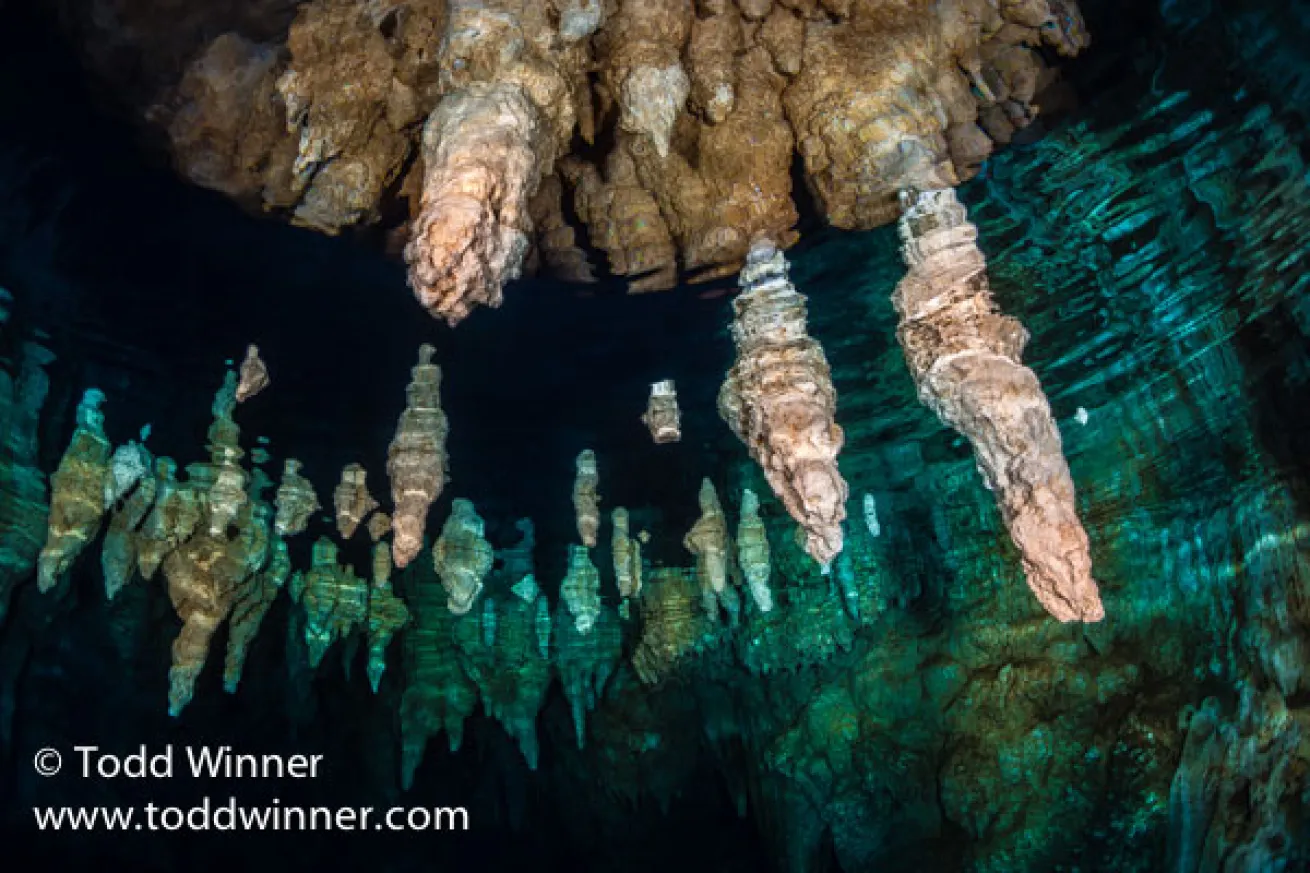
Underwater photography offers us so many unique opportunities that land photographers never get to experience. Just being neutrally buoyant allows us to position ourselves for shots that would be impossible on land. Light behaves quite differently underwater as well, and one of the best places to see some of these effects is near the surface. Reflections can create a perfectly mirrored image, and the arc at the top — Snell's window — gives us a small glimpse of what is above the water. This image from Palau's Chandelier Cave combines both to create a distinctive image.
Location
Chandelier Cave in Palau is a truly amazing place that offers the average recreational diver a brief look at what usually only cave divers get to see. Although Chandelier is technically a true cave, the interior has four large air chambers that allow divers to ascend, making it very safe for most. Once inside, divers are greeted by hundreds of stalactites hanging from the ceiling. These were created millions of years ago when the cave was above water. Many of the stalactites extend into the water and they seem to come in an endless variety of colors. One of the largest formations is in the first chamber and shimmers with reflections as you shine your light on its surface. It's no wonder the cave was named Chandelier.
The Reflection
Although you can see ambient light from the opening, there is no ambient light inside the cave to help with focusing. You will need a focusing light or the modeling lights on your strobes. Since there is no ambient light inside, our shutter speed does not really matter and auto modes are not going to know what to do in total darkness so set your camera exposure to manual. Set an aperture that is going to give you a lot of depth of field. I would start at around f/8 to f/11 on most wide-angle lenses. ISO can be set fairly low as long as you have powerful enough strobes to cover the area you would like to light. I would suggest an ISO around 200. Shutter speed does not really matter as long as no one shines a light into your camera or onto your subject. I would set it at around 1/100th of a sec. You can use TTL, but once you have your aperture set, it is very easy to adjust either your strobe power settings or your distance from the subject to achieve the proper exposure. To capture the reflection, get close to the surface and angle the camera until you see the reflection in the viewfinder. This happens at a camera angle of 42 degrees or less from the surface. The calmer the water, the more the reflection will look like a mirror. On this image, I also have a small Snell's window at the top of the image showing us some of the stalactites above the water. (In underwater photography, Snell’s window is portrayed as an arc or half-circle through which the sky is visible. The area around the circle is a reflection of the seascape, and as such is much darker than the sky.) These are being illuminated from the strobes under the surface. For this image, I used a Canon EOS 5D Mark III with an EF8-15mm f/4L Fisheye lens at 15mm and two Ikelite 160 strobes. ISO was set to 160, 1/80 sec at f/8.
Post Processing
I really wanted the detail and colors to pop on this image. In Lightroom, I balanced out the exposure, opening up the shadow so I could see more detail at the back of the cave and pulling down the highlights to keep detail on the foreground stalactites. Next, I added some clarity, which adds some overall sharpening and helps define all the little details in the rock. I also added vibrance to bring out the colors. When I set the white balance I was happy with either the surface portion of the image or the underwater portion but not both. In the end, I set the white balance to make the surface area look nice and then used the adjustment brush to paint in a temp and tint that warmed up the underwater portion.
Chandelier Cave is an incredible dive site for photographers. You can add a diver, model or slave strobes. The possibilities are almost endless! You don't have to wait until you are in Palau to shoot reflections, but Chandelier Cave is just full of picture-perfect opportunities if you happen to be there.
Todd Winner is a professional underwater photographer and cinematographer, PADI scuba instructor and owner of Winner Productions, a boutique post production facility catering to Hollywood's most elite cinematographers.Since taking up underwater photography in 1990, Todd Winner has won over 60 international underwater photo competitions. His images have been published in numerous magazines and online publications. His work has been featured in commercial advertising, museums and private galleries. To see more of Todd's work or join one of his underwater workshops, please visit www.toddwinner.com.


