

I spent the first 11 years of my life exploring Lake Michigan, its shores by foot and its waters by boat. When my family moved to Minnesota when I was 13, I was overjoyed to return to the silty ground of lake-land. It felt like coming home.
Now, at 34, I’ve become an amphibious creature once more, the top of my head bobbing above the surface of the Blue Grotto Dive Resort, a freshwater cavern in central Florida, the meditative cush-cushhhhh of my regulator allowing me to submerge myself in its aquamarine world.
As I surface, a softshell turtle wrinkles its snout at me from a few feet away. It surprises me by swimming closer.
“Her name’s Virgil!” a redheaded boy calls out from the dock, his freckles popping in the sun.
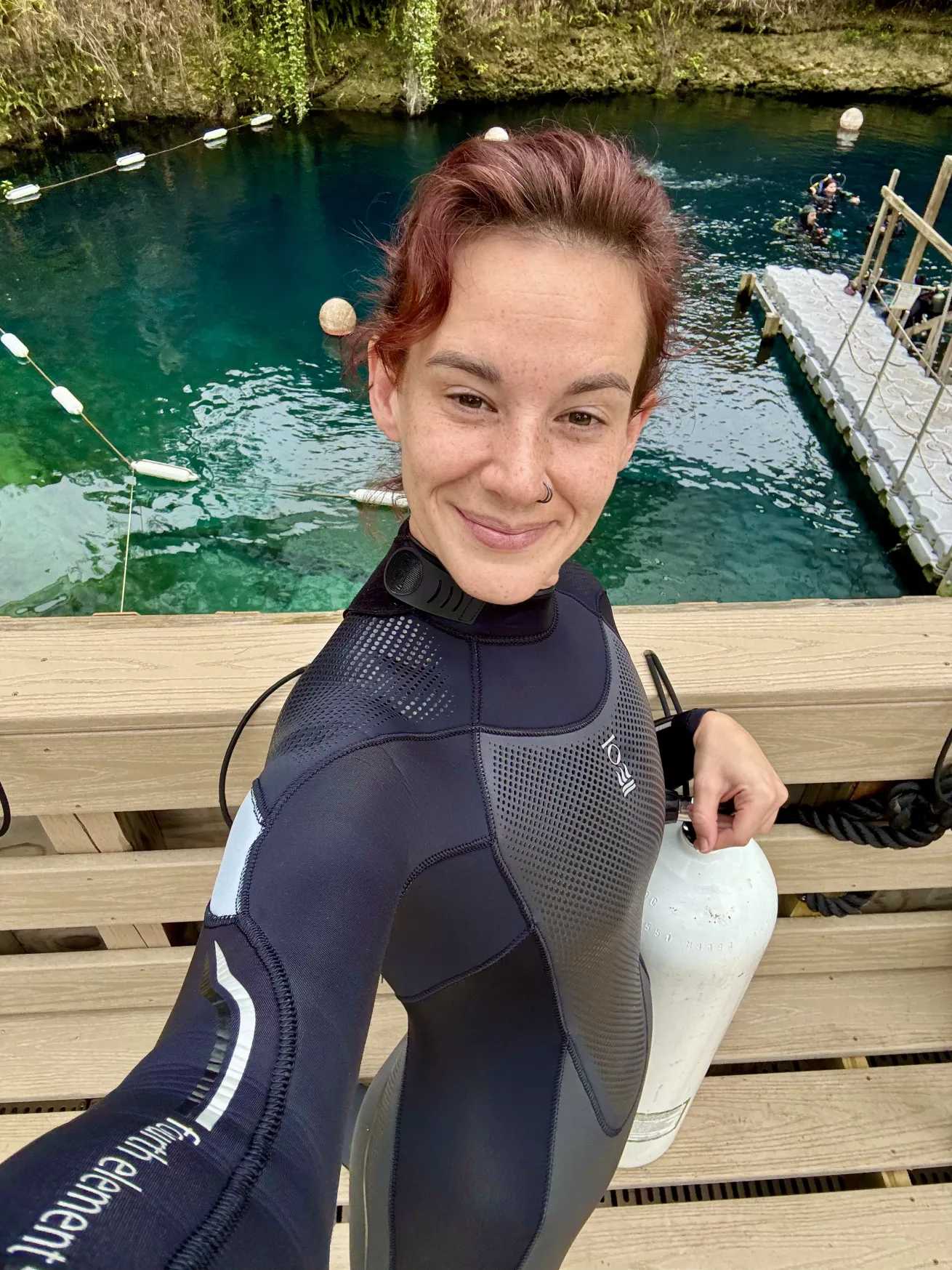
Savannah BrooksBrooks standing in wetsuit next to Blue Grotto sinkhole
Related Reading: Diving Florida’s Ginnie Springs
I have to laugh. Virgil, like the poet-guide of Dante’s Inferno. And then there’s me, so like Dante’s own character. I too am headed down, layer by thermoclimactic layer. And I too have been sloughing through my own personal hell: that of long COVID.
The Physical Toll of Long COVID
It’s December 2025. When I contracted the disease, in April 2022, I was working as a boxing instructor, teaching five classes a week and training in mixed martial arts. I could submit my MMA trainer, a 200-pound man, in under two minutes.
By May, I was restricted to a wheelchair any time I left my apartment. By year’s end, my weight had fallen from 145 pounds of pure muscle to 115 pounds barely clinging to my 5-foot-7 frame. Postural orthostatic tachycardia syndrome (POTS) and functional neurological disorder (FND) had ridden in on long COVID’s coattails, fully dysregulating my central nervous and cardiovascular systems.
These days, after nearly four years of physical therapy, I can walk up to two miles on a flat surface. I still can’t stand in one place for more than five minutes, though—not without the risk of, at best, losing consciousness and, at worst, having a seizure. Which means my wheelchair is still a constant companion.
My decision to get scuba certified was not one I took lightly. Even after my doctor gave me the green light, I knew the physical exertion of the sport outside of the water—carrying a full tank, say, or standing with my kit on my back—was still a risk, one I couldn’t take if I wanted to feel confident under the water. But I needn’t have worried. A dive team is just that, a team, and mine shouldered the weight that I couldn’t.
Related Reading: Can You Dive with Multiple Sclerosis?
Learning to Dive With a Chronic Illness
Virgil bumps her snout against my mask. She inspects my snorkel.
“That’s a good omen!” my certifying instructor, Logan Bueno, calls out. He’s with Mountains to Seas Adventures, located just outside of Asheville, North Carolina, where I live. “Softshells are usually super shy.”
Virgil turns, propelling herself toward the platform submerged below Logan, my dive buddy and me. The three of us take note of our surroundings, then take note of the time. Logan signs, descend.
My buddy and I sign back: Descend.
We decompress our BCDs. We let the water swallow us up.
We follow Virgil down.
Unlike Dante, though, this is where I find my heaven. Where I find my healing.
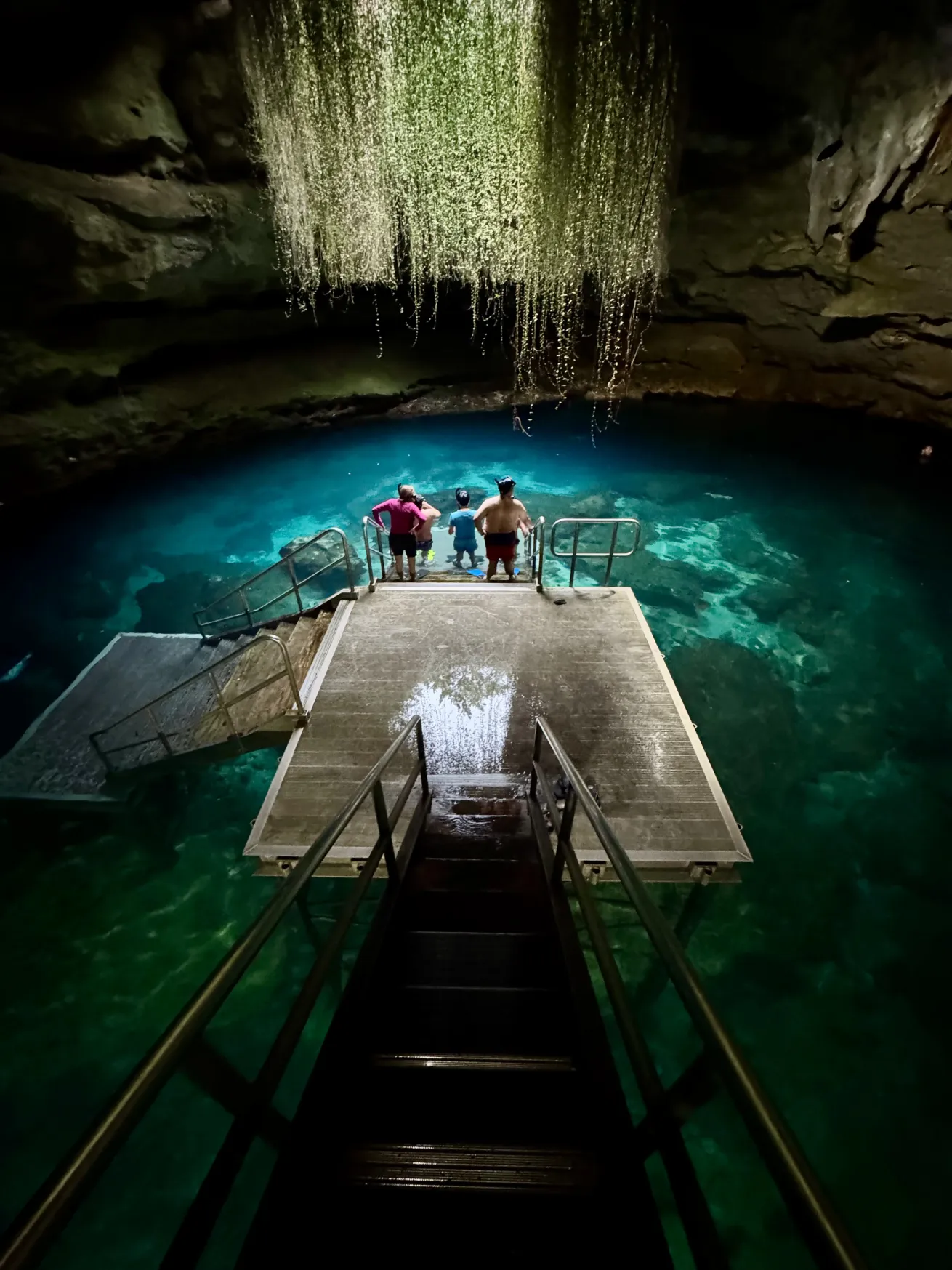
Savannah BrooksDevil's Den Prehistoric Spring near Williston, Florida.
Since I’d added kickboard-assisted swimming into my PT regimen six months prior, the truth had been undeniable: my body, which so often is wracked with pain, nausea and exhaustion, feels good in water. And it feels even better when diving.
The full-body compression of my wetsuit stabilizes my hypotension (low blood pressure), and by keeping off my feet, I avoid triggering my tachycardia (high heart rate).
I’m far from the first person to discover the myriad benefits of hydrotherapy—an umbrella term for the medical use of water—but experiencing the immediate relief of this submersion feels like a revelation.
For the first time in nearly four years, I’m not in pain. For the first time in nearly four years, I can ask a simple task of my muscles, and they can achieve it.
I feel strong.
And the next day, as I dart through the prehistoric limestone arches at the nearby Devil’s Den Spring for my final certification dive, I feel even stronger—both in my body and in my mind. My child-self, still swimming through the choppy waters of Lake Michigan, smiles like a lighthouse.
Related Reading: My Journey into Freediving and Mental Health
Chasing Relief Across Oceans
Two months later, I’m sitting on the inflatable edge of a semi-rigid boat, my wetsuit unzipped and hanging around my waist to try and combat the dead-of-summer South African heat. I’m headed out in Mossel Bay, a destination perched near the convergence of the Atlantic and Indian Oceans, for my first post-certification dive.
For a week after I landed in Cape Town, I was so nauseated, all I could stomach was chicken broth. I could only stand for 30 seconds before collapsing. Jetlag on top of long COVID on top of a bladder infection my weakened immune system couldn’t fight off had me wheelchair-bound and in constant, knuckle-blanching pain.
Bouncing along the waves of Mossel Bay now, two weeks after landing, my bones still ache. That’s okay, though; I know a place where the pain dissolves, and we’re almost there.
The captain slows, then stills, the motor. The five other divers on the boat and I kit up. We position ourselves to back-roll into the water.
“When I say go,” the captain says.
I inhale one last draught of salty air, savoring the sun on my face, then secure my mask and regulator.
“Three, two, one—go!”
I plunge down, and the sea welcomes me home.


