


My vacation in Saba begins with an equipment disaster. The night before my first dive, I discover my camera’s strobe trigger—the small circuit board responsible for syncing a camera with external strobes—has corroded. Without strobes, I won’t be able to capture bright, colorful photos, especially at depth, where natural light is limited. If I can’t get this mechanism to work, my images could suffer.
I try not to get my hopes up as I slip the trigger into the camera’s hot shoe, turn the strobes on and press the shutter. Nothing happens. I’d love to blame the gear but I know it’s my own fault. Somewhere along the line I’ve allowed my equipment to get damp.
To make matters even worse, I decided not to bring backup lights. There’s nothing for it. I’ll have to use the camera without any artificial light and hope editing software can help salvage the photos. So much for being prepared.
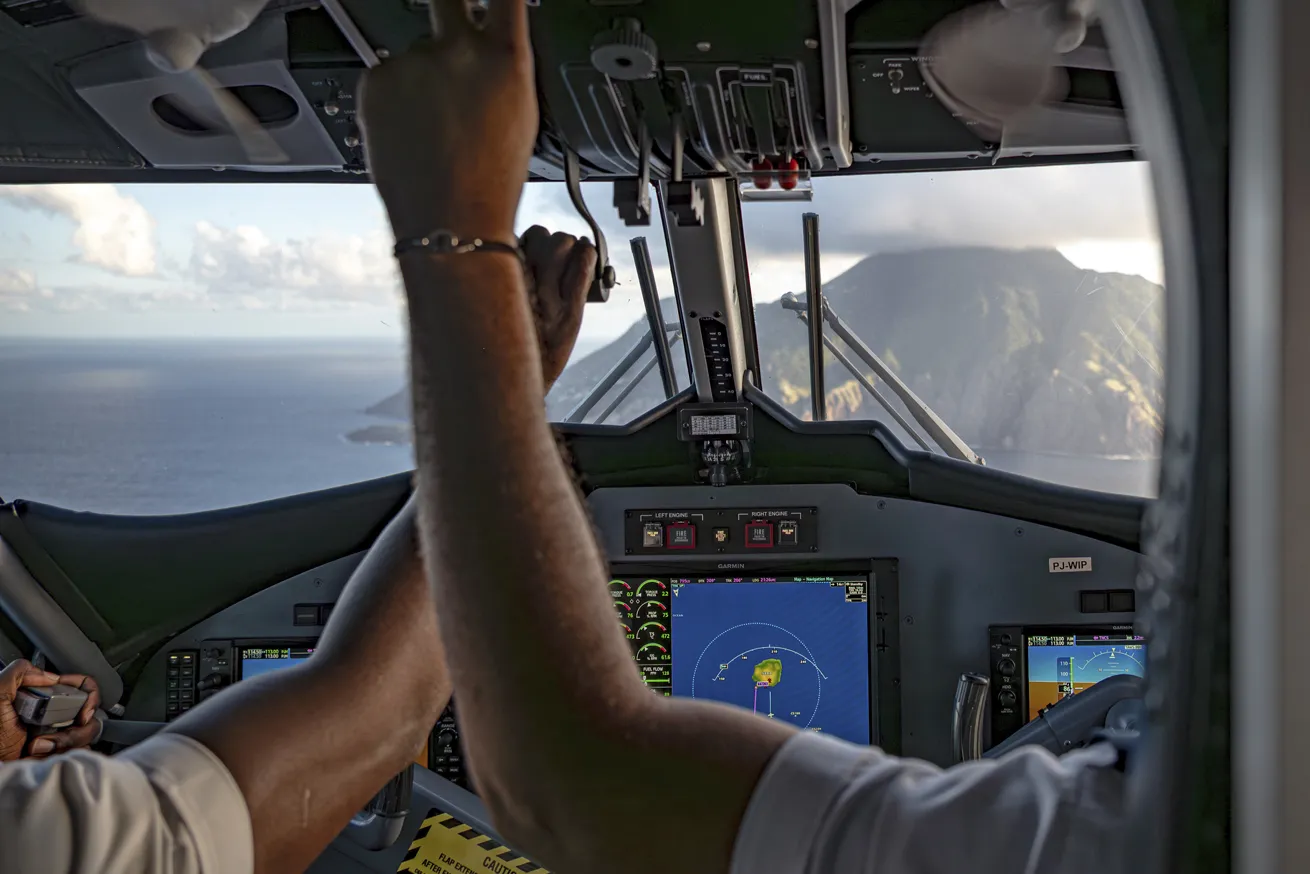
Dave TaylorWinair pilots sight Saba and ready to land on the shortest commercial runway in the world.
The Volcano in the Sea
Saba is unlike any other Caribbean island I’ve been to—a volcano that rises like a great green pyramid directly out of the wind-rippled sea. Nowhere else have I seen such a dramatic vista. My first glimpse of its verdant green slopes is from a small Twin Otter propeller plane operated by Winair. Saba is home to the shortest commercial runway in the world, and landing on the island by plane is not for the faint of heart. The runway stretches from cliff to cliff, both sides ending in a sheer drop with nothing but rocks and ocean below. Though I’d initially planned on taking the ferry from St. Maarten, Alicia Johnson, a destination editor at Lonely Planet, told me I had to fly in. “It’s worth it,” she said. “And, if you fly out, you can watch the plane land too. That’s a cool video.”
For the next five days, I’ll be staying at Juliana’s Hotel, a laid-back favorite among divers who want a pool, lush gardens and easy access to the town’s handful of restaurants and world-famous hikes. My room doesn’t face the sea, but that evening I wander to the poolside bar just as the sun begins to dip below the horizon. From my perch above the rooftops of Windwardside, I watch the sky ignite in bands of tangerine and rose as the sun sets.
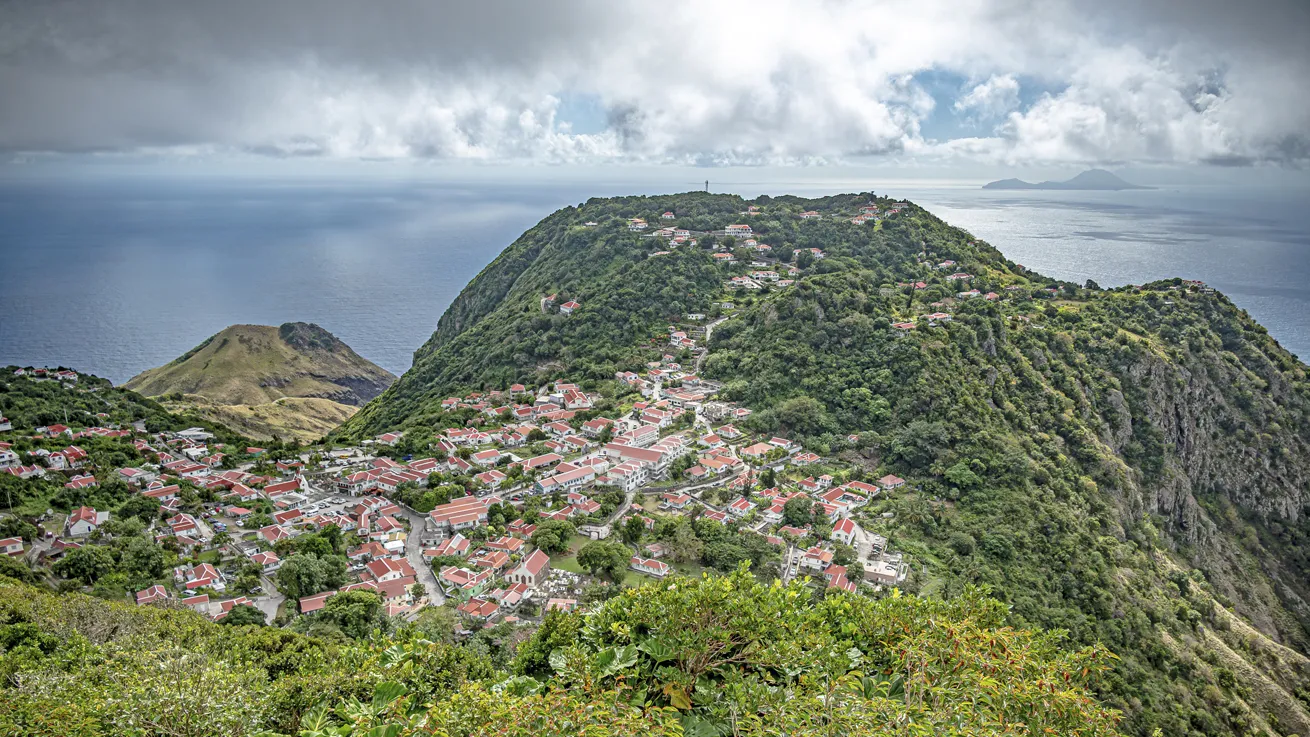
Dave TaylorA view of Saba from above, captured on a hike.
That night, Cuchie, a well-known local taxi driver, drops me off at Rendez-Vous at Ecolodge, a small restaurant hidden in the forest. To reach the restaurant, I descend a stone staircase and follow a narrow, unpaved trail about five minutes into the trees. I’ve never entered a restaurant like this before. It’s a little unusual but fun, and it offers a glimpse into why Saba is considered a hiker’s paradise. Though I’m doing this alone in the dark, I feel at ease. With a population just over 2,000 and virtually no crime, the island seems as safe as it is serene.
Threading the Needle
My first dive with Sea Saba, the island’s only dive shop, takes me to what many consider Saba’s signature site, Third Encounter. The real draw here is a submerged pinnacle called the Needle, which rises dramatically from the seafloor and peaks at about 90 feet below the surface. There’s no mooring line attached directly to it, but it’s a short swim from a nearby buoy and the rest of our dive site. At first, the water looks empty, just vast endless blue dotted by the occasional barracuda, but then the Needle emerges from the deep, a monolith, and I’m stunned.
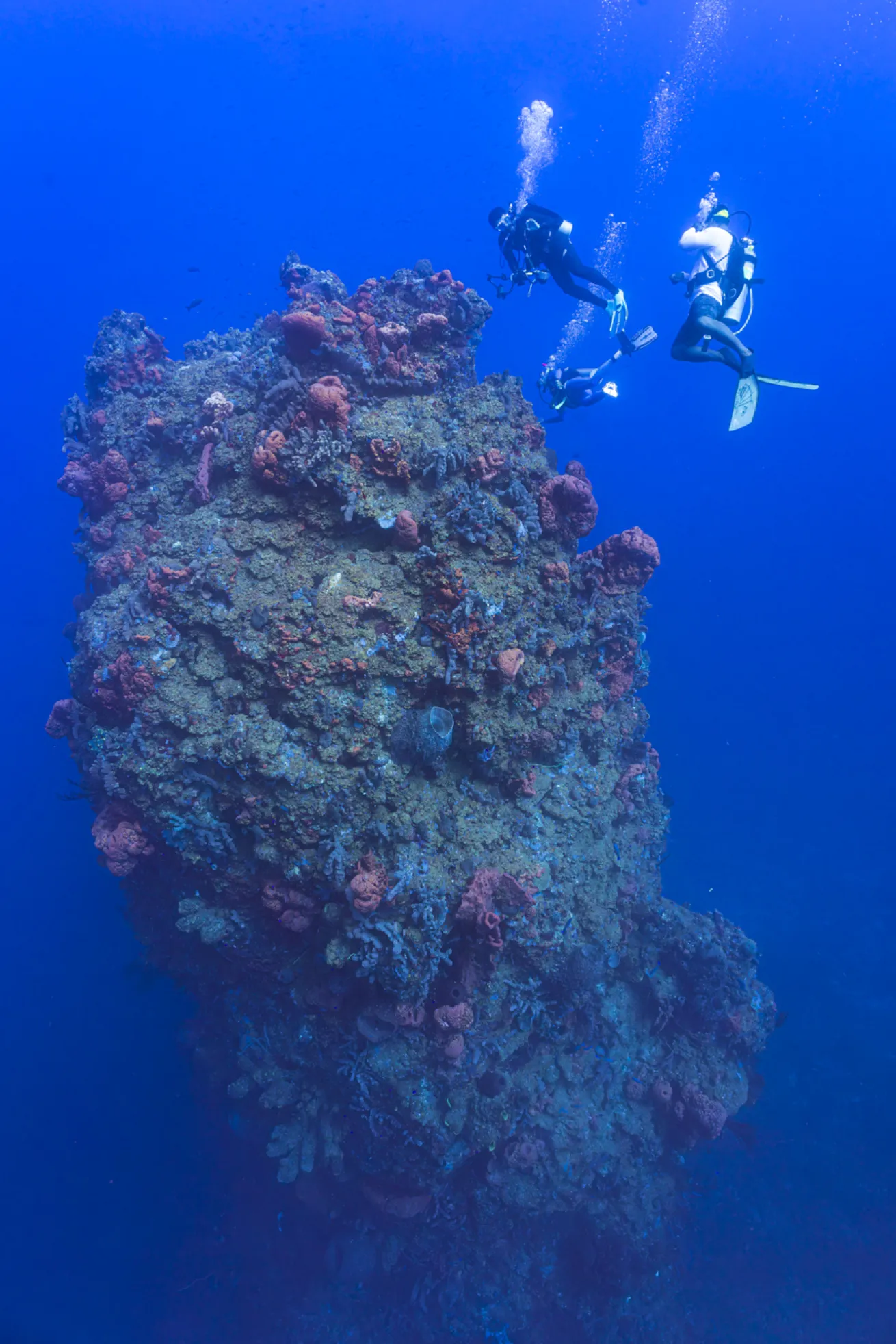
Candice LandauThe Needle, one of the island’s best-known dive sites.
I’ve seen pinnacles before but none quite like this. It’s fully visible in a single glance, and looks like a gigantic stalagmite in a cave. True to its name, it’s needle-thin and can be circled in 30 seconds. The surface of it is encrusted with sponges and coral. I try to focus on the smaller creatures my dive guide Lenny points out—a curious eel, a wide-eyed grouper and a few small arrow crabs—but I’m too mesmerized by the Needle’s sheer scale.
I switch tactics. Hoping my camera’s low-light settings will suffice, I back up and line up a shot with a few divers in the frame for scale. Without powerful strobes, the reef’s vibrant colors are lost to the blue, but the shape, the enormity of it, that part comes through. At least, I hope it does.
After Third Encounter, we head to a shallower site called Big Rock Deep. Dave, a fellow cold-water diver and a Canadian cartographer, lends me one of his video lights so I can capture shots of the smaller critters. It’s a generous gesture as it leaves him with just one light of his own. I agonize over a single lobster but ultimately find myself more intrigued by the expansive vistas and a curious porcupinefish with eyes that look as though they contain miniature galaxies.
Over the next few days, we dive most of Saba’s best-loved sites: Twilight Zone, Tent Reef, Diamond Rock, Core Gut, Outer Limits and Man O’ War Shoals. All our dives begin with depth, something I am quickly learning to love as it means I’m in for more of the epic vistas I’ve begun to associate exclusively with Saba.
Related Reading: Conserving the European Lobster
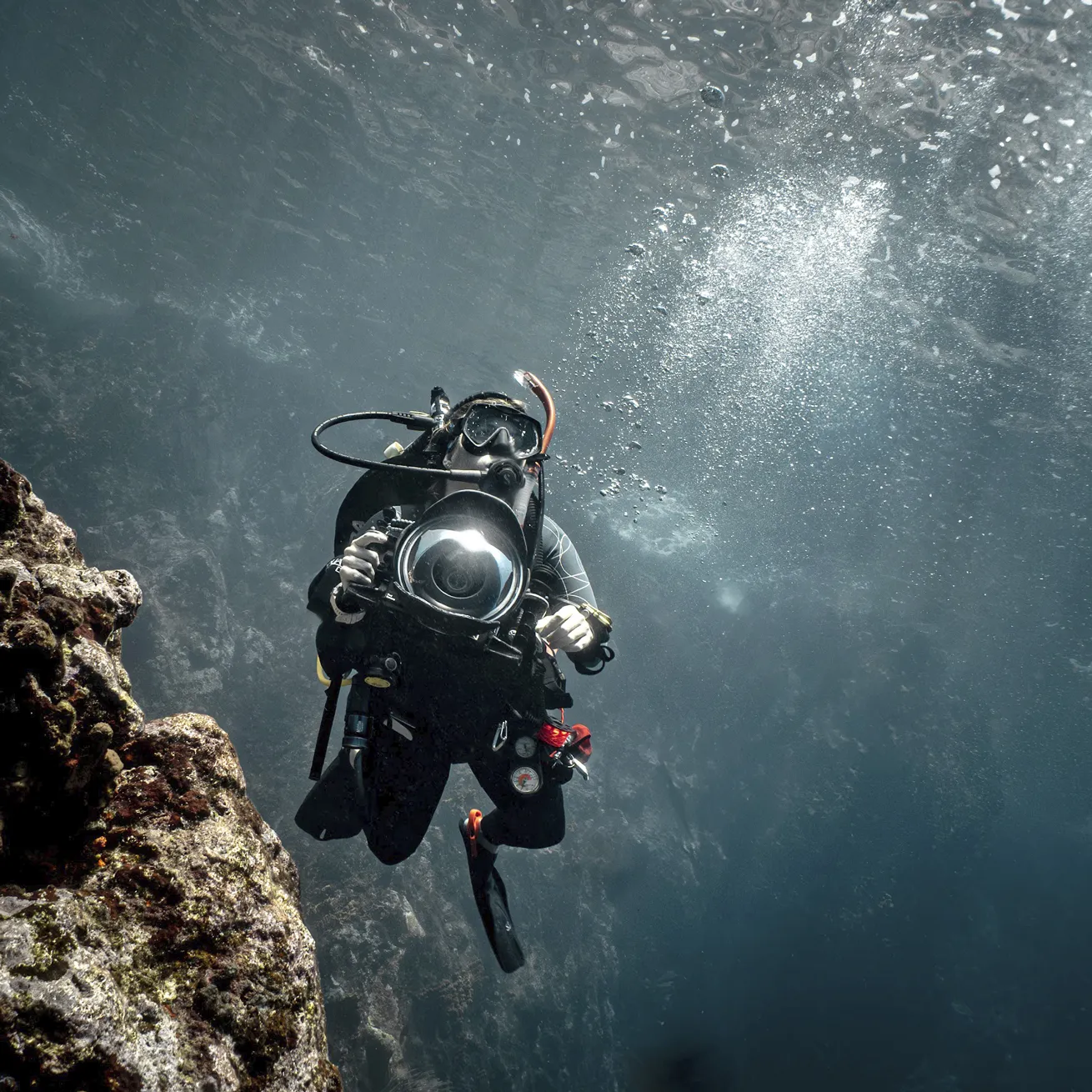
Dave TaylorThe author and her strobeless camera.
Complacency Is a Slow Burn
On the second day of diving, I commit another photography crime. I forget to check that all my equipment is properly screwed on to my camera. For someone who likes to attach a number of odds and ends to the housing, you’d think this would be second nature. Apparently not. As the boat captain hands me my camera housing, my DJI action camera and its heavy metal attachment—unsecured to the housing—spin off and spiral into the depths, far below the boat and the buoy. I’m too slow to react, and by the time I’ve realized I need to chase it, it’s long gone. With a nitrox tank on my back and a dive site I don’t know, with no bottom in sight, there’s no possibility of dropping into the unknown alone to attempt to recover it.
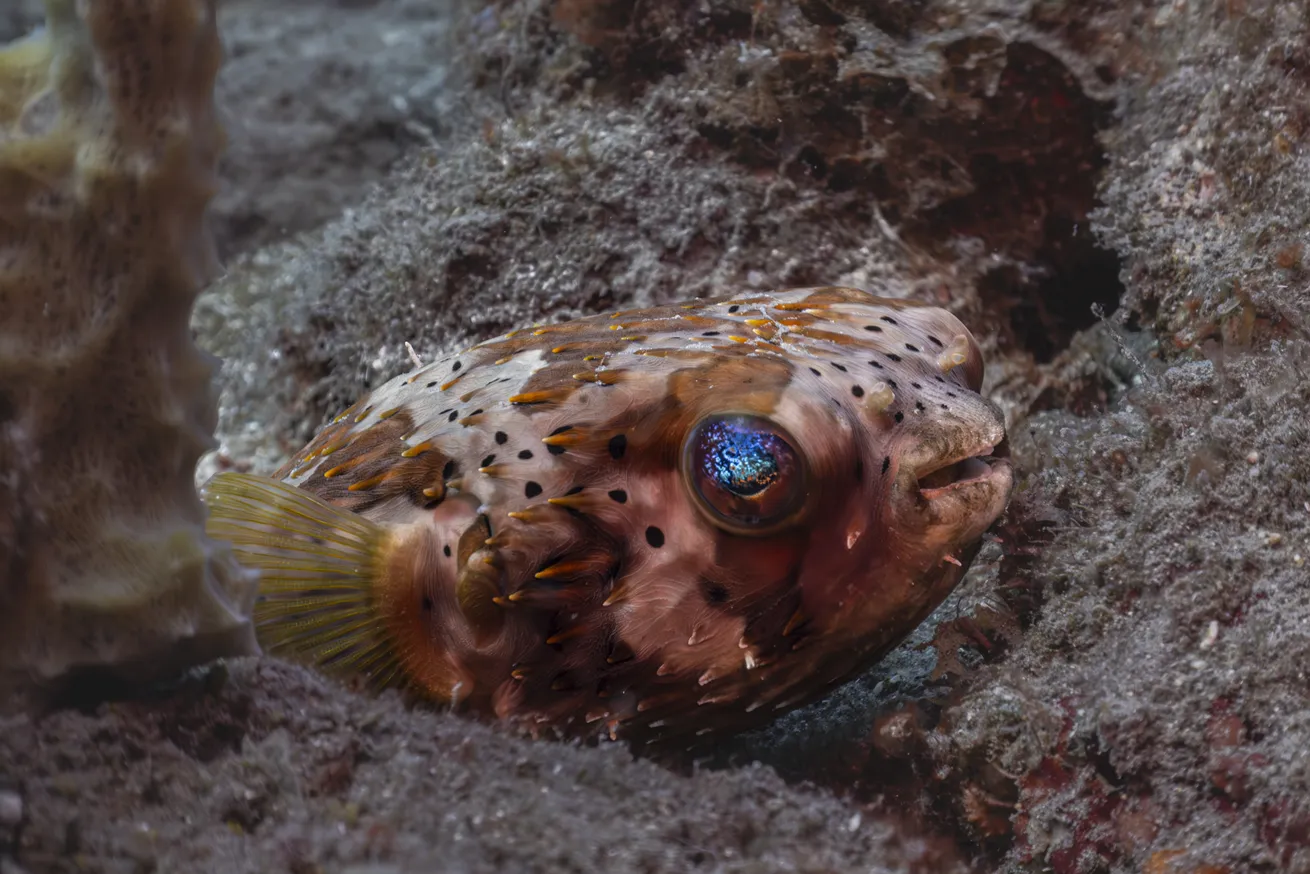
Candice LandauA wary porcupinefish with eyes that look as though they contain universes.
Rum, Maps and Meatless Magic
Every day after diving, I find a new place to eat. My favorite restaurant is unsurprisingly the one that understands we vegetarians consume more than salad and plant-based burgers. It’s named Brigadoon. Though pricier than some of the other restaurants, the options are creative and packed with flavor. Dave joins me for dinner here, and in addition to getting one of Deep Dive Brewing Co.’s extremely quashable beers, I ask to try a sample of the local rum, Saba Spice. A lover of all things licorice adjacent, I am an instant convert.
Over dinner we examine the topographic map of Saba that Dave has made for his own explorations. A cartographer by profession, he’s also an avid hiker, and he tells me about the trails he’s done so far, including one at Mary’s Point/Palmetto Point that tripped right over old village archaeological artifacts. I find myself wishing I had more time to spend on the island.
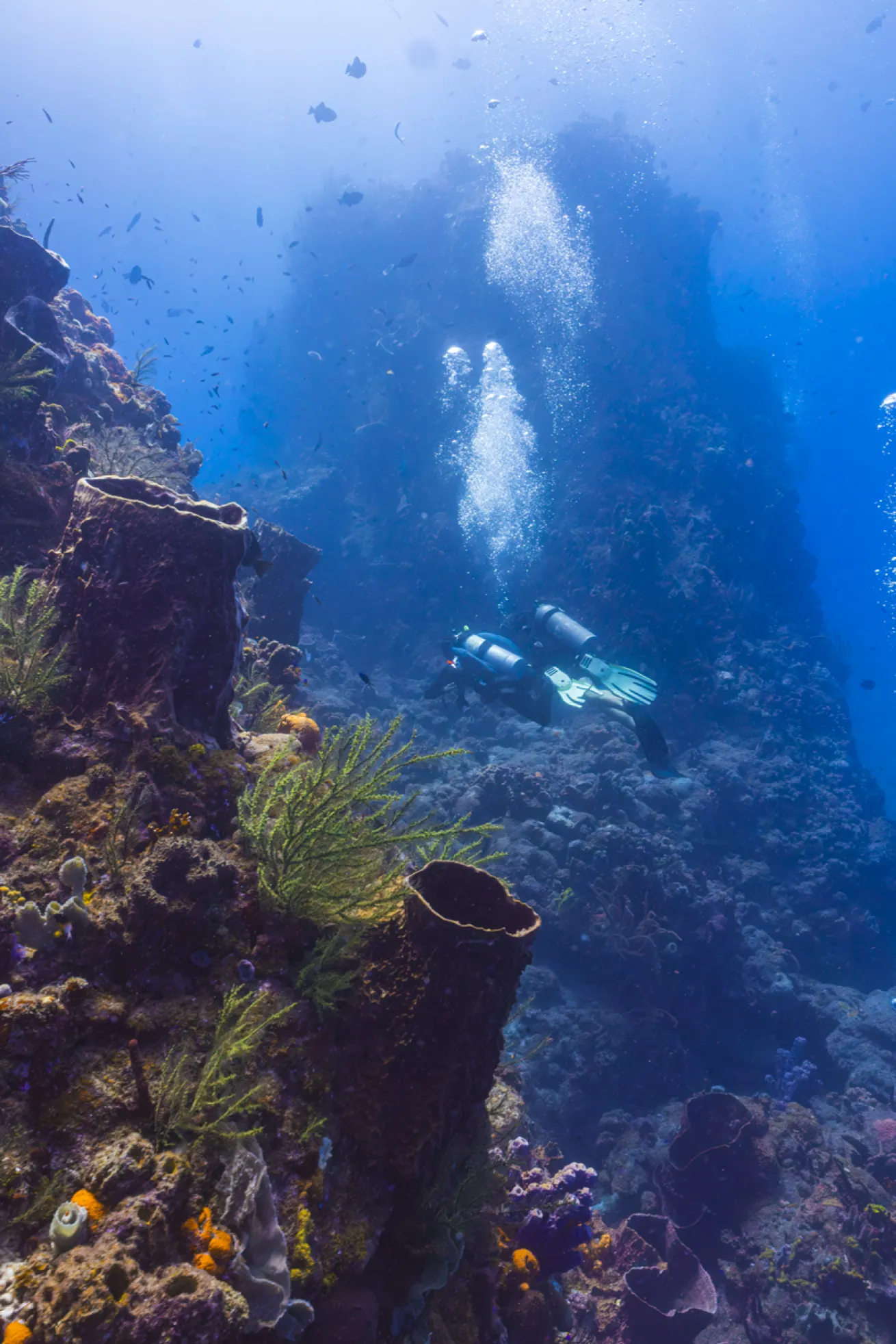
Candice LandauDivers at Man O’ War Shoals.
The Home of the Pinnacle
Though it’s really hard to pick a favorite dive in Saba, for me, Man O’ War Shoals stands out. The beauty of this site is that it’s relatively shallow (dropping to just 70 feet) and comprises twin peaks that rise to 15 feet below the surface. This means life is abundant in the bright light and easy to photograph thanks to that same light. It’s here I am mesmerized by schools of sergeant majors, a turtle slowly exhaling air as it rests, more butte-like vistas and a lobster den packed with more lobsters than I’ve ever seen in one go. On my safety stop, I’m also incredibly lucky to join a young turtle heading up for air. Together we make our ascent. At this depth, thanks to ambient light, my photos look so much better.
Diamond Rock is another striking pinnacle that extends well above the surface in a jagged rocky peak made white by years of guano from terns and other seabirds. In a cooler destination it might be mistaken for an iceberg. Below the surface, the site is a dramatic cone of life, with currents eddying about it in no discernible pattern. It takes a full 50-minute dive to circle twice. Near the end of the dive, I look up and stop finning. I’m entranced. At the surface, waves crash against the rocks, beating so hard I think I can hear them. From below, the result is a tumultuous storm of light and froth. When a diver swims near the chaos, I fire off shot after shot, captivated by the drama and the reality of how small we really are in the midst of nature.
Related Reading: Protecting the Sea Turtles of Timor-Leste

Candice LandauThe author, on her last dive, reveling in the freedom of diving sites that make for dramatic photographs like this one.
Turtle Town and a Sharky Sidekick
Our final dive takes place at Hot Springs, a site named after the hot water springs that vent from the seafloor. Though you can’t feel them on the dive, if you dip your hands into the sands where they change color, you will notice a distinct temperature difference.
Hot Springs is a little different from some of the other sites. For one thing it’s a good deal shallower, and much of the dive is covered in seagrass. In fact, every 20 feet we come across a sea turtle, happily grazing, completely unperturbed by our presence. After seven turtle encounters I stop counting, though that may be thanks in part to the sudden appearance of a nurse shark that seems to have a bit of an obsession with our dive guide.
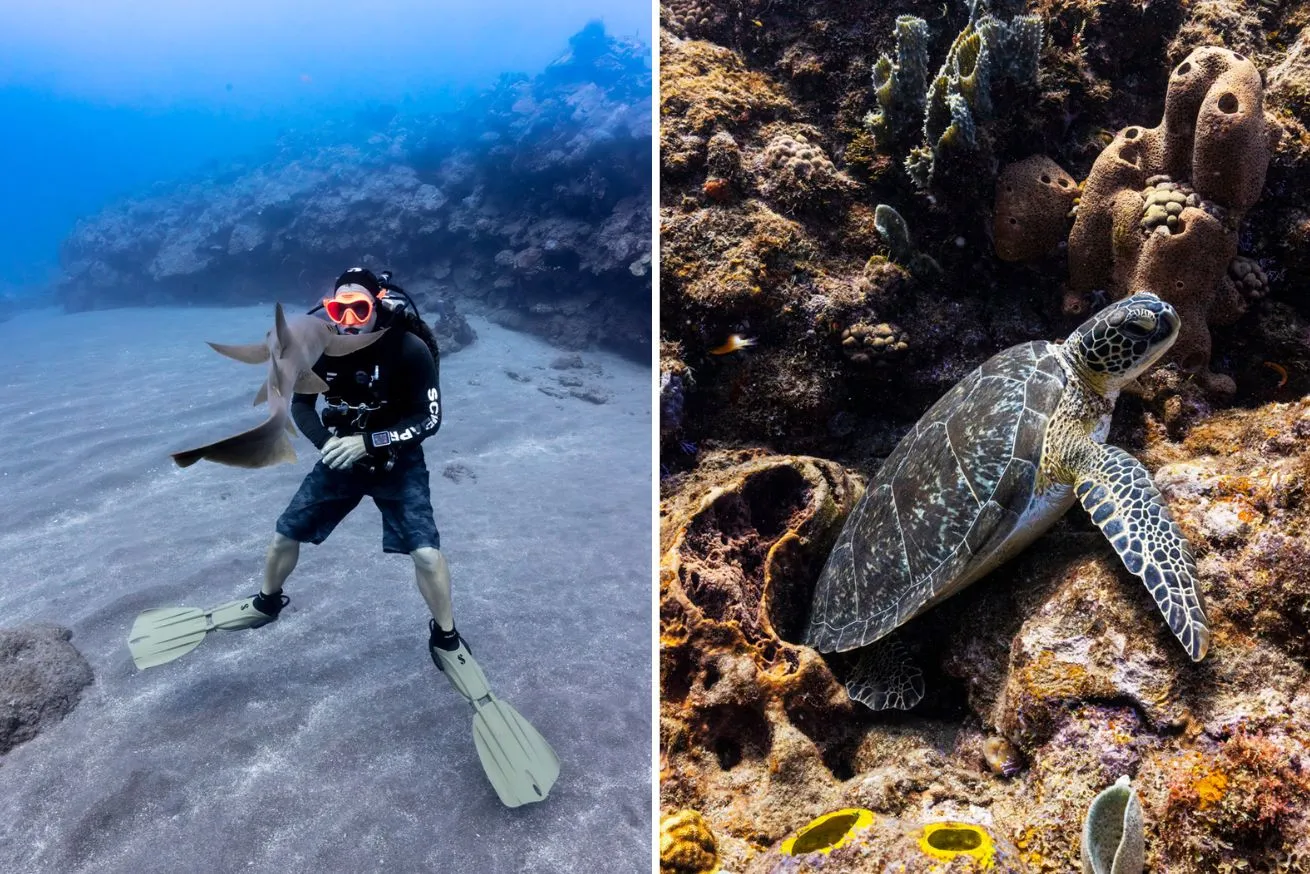
Candice LandauOur dive guide and his friendly nurse shark companion see eye-to-eye on some matters; A turtle rests at Man O’ War Shoals.
In much the same way a cat greets its beloved human companion, this shark won’t leave our guide alone. It wends between his legs, hovers near his face and follows him dotingly for well over 15 minutes. He doesn’t touch it, but I can tell it’s tempting him. These rare moments where animals initiate curious contact leave me feeling emotional. They’re beautiful but bittersweet. Humans have turned animals into a resource, and rather than study them for their own sake, looking into how they think and feel, we focus instead on what they can do for us. Unless they’re companion animals or charismatic megafauna, more often than not their inner life is out of sight, out of mind.
The truth is, the ocean is a vast universe of life that thinks, feels and is still largely unknown. I watch the guide show the nurse shark a lionfish. The shark initially appears interested and is almost nose-to-nose with the lionfish before it turns away. Today lionfish in the Caribbean are hunted by humans, but perhaps one day the invasive species will be fine cuisine for intelligent and adaptable nurse sharks like this.
Related Reading: Best Islands to Dive in French Polynesia
Below me, a turtle wedges itself between two barrel sponges and then begins scratching its shell, moving back and forth. It allows one eye to drift closed in pleasure and uses the other to watch me. I wonder what it’s thinking. We must seem so strange and nonsensical. Noisy creatures who appear from the surface, flash bright lights and vanish just as suddenly. True unfathomable aliens.
It’s these quiet, wild, unfiltered moments that stay with me. Saba might be small, but it offers encounters that feel vast. With underwater pinnacles that rise like mountains, and topside trails that wend through cloud forest and volcanic cliffs, the island delivers beauty in every direction.
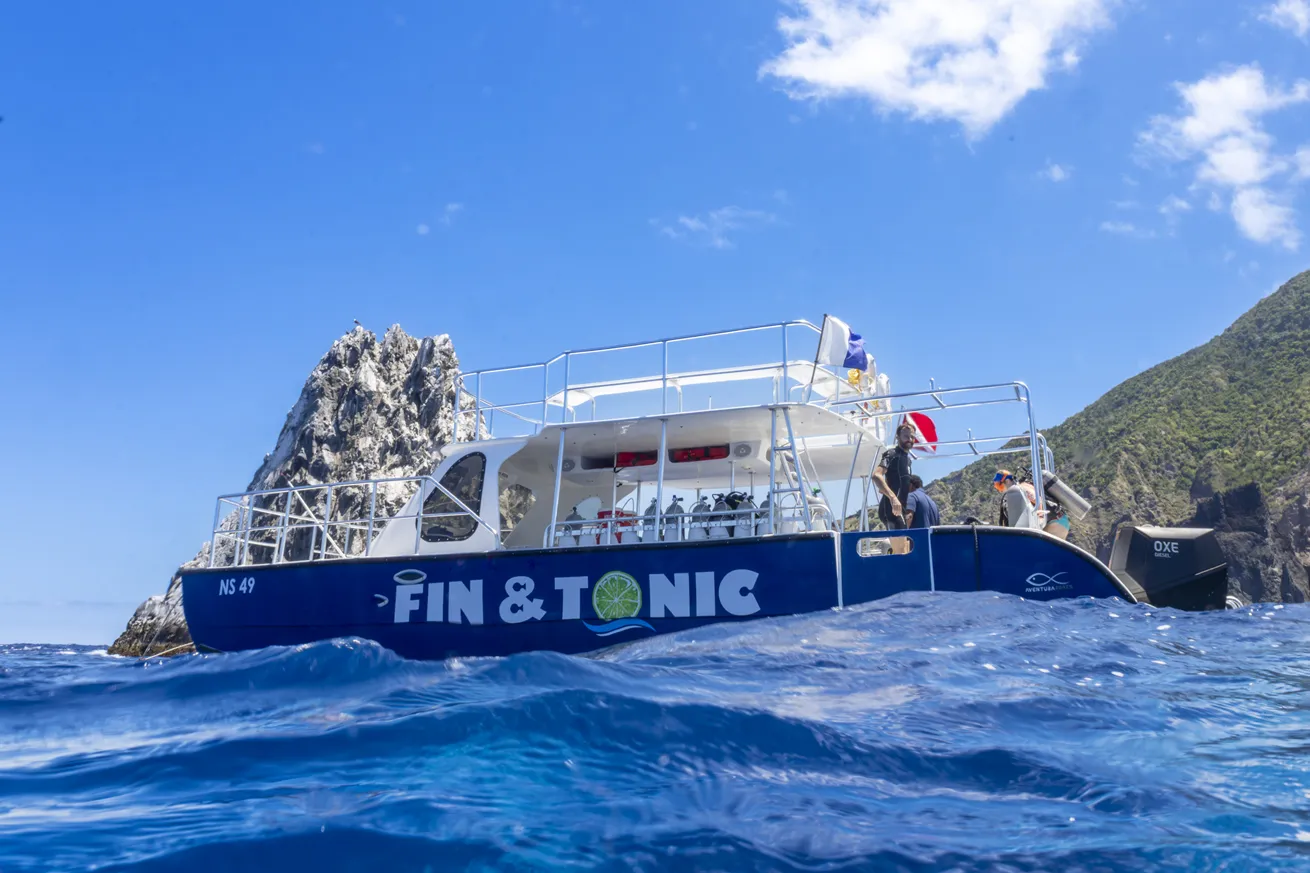
Candice LandauSea Saba’s dive boat, with Diamond Rock in the background.
Need to Know Diving in Saba
When to Visit Saba is divable year-round, with peak season from mid-December to mid-April. I visited in March.
Conditions Water temps range from 77 to 84 degrees Fahrenheit, with excellent visibility. A rash guard or 3 mm wetsuit is recommended.
Getting There Fly into Sint Maarten, then take a 19-seat Winair flight (20 minutes) or a 90-minute ferry to Saba.
Dive Operator Sea Saba (seasaba.com) is the island’s only dive shop. You can rent dive gear here.
Topside Tips Saba is compact, walkable and safe. Shuttles are available, or you can rent a car. No beaches, but incredible hiking and great restaurants. Save the date for Saba’s Sea & Learn festival in October.


