


Candice LandauA view over Porto Santo from Miradouro da Portela viewpoint.
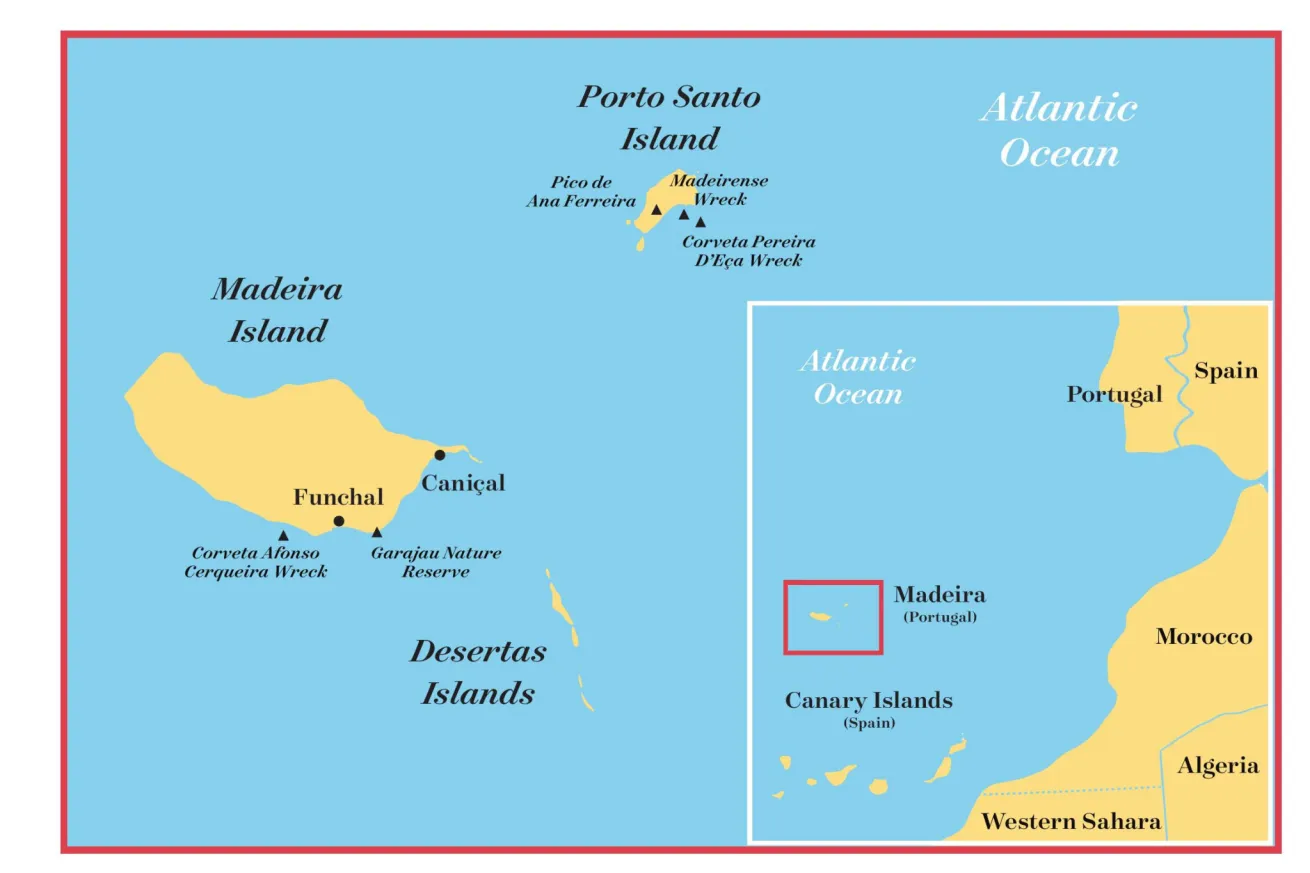
Madeira is often billed to Americans as the “Hawaii of Europe,” a volcanic archipelago with a subtropical, Mediterranean-leaning climate; switchback roads carved into cliffs covered with fruit trees; and a food-and-drink scene that revolves around fresh seafood, sugarcane and traditions that taste as good as they look—Madeira wine anyone? It also happens to have excellent diving.
When Arlindo Serrão, founder of Portugal Dive and Diving Talks, invited me to come see it for myself, I was in. Between diving the iconic Corveta Afonso Cerqueira and the Garajau Nature Reserve, I also had the opportunity to explore what makes this Portuguese island chain so special. Best of all, I covered a lot of ground, staying first at the luxurious new Dreams Madeira Resort Spa & Marina on Madeira and then on Porto Santo Island at downtown Hotel Torre Praia.
Related Reading: Chasing the Shot: Tope Shark in Azores, Portugal

Candice LandauDivers explore the Madeirense wreck in Porto Santo, just a few minutes’ boat ride from port.
Alongside jeep tours, poncha tasting and top-notch restaurant experiences, I also fell in love with the accessible wreck diving scene, as well as the underwater topography, which at first can seem barren but on closer inspection is packed full of friendly grouper, curious cuttlefish and the slim but real chance of spotting a critically endangered Mediterranean monk seal, especially given the nearby Desertas colony.
Where Madeira’s main island might appeal to the diver in search of a decidedly European-feeling vacation, Porto Santo offers a glimpse of something different—a slower rhythm, long honey-colored-sand beaches and dive sites so close to the marina that you can grab a coffee while you wait out your surface interval, all without vacating your wetsuit.
An Alternative to the Caribbean
Unless you’re based out of Europe, chances are you might not know much about the Madeira islands, one of Britain’s most popular vacation hotspots. Things are changing though, with direct return flights from New York and Boston that cost as little as $450.
For scuba divers looking for something easily accessible but different from the usual Caribbean haunts, these islands have plenty to offer. For starters you’ll want to leave room for a rum tour and tasting at historic Engenhos do Norte (Northern Sugar Mills), where you’ll also have the opportunity to try a palate bomb in the form of a thick dark sugarcane syrup drizzled over thin ginger biscuits.
Before heading to your next dive destination on Porto Santo, spend a day exploring Funchal’s markets, where fresh poncha (the alcoholic predecessor to caipirinha) is rumored to cure the common cold and served in many flavors, including my favorites: passionfruit and tangerine.
If you can, make a dinner reservation at the Design Centre Nini Andrade Silva. It’s a unique art exhibition and restaurant combination that rises atop a stone outcropping and gives panoramic views of the city, especially beautiful at sunset. It also plates up some of the most artistic food I’ve ever experienced, a testament to chefs who know a thing or two about color theory and symmetry. Good wine is, of course, a given.
Related Reading: Diving in Brazil’s Caribbean-Like Paradise
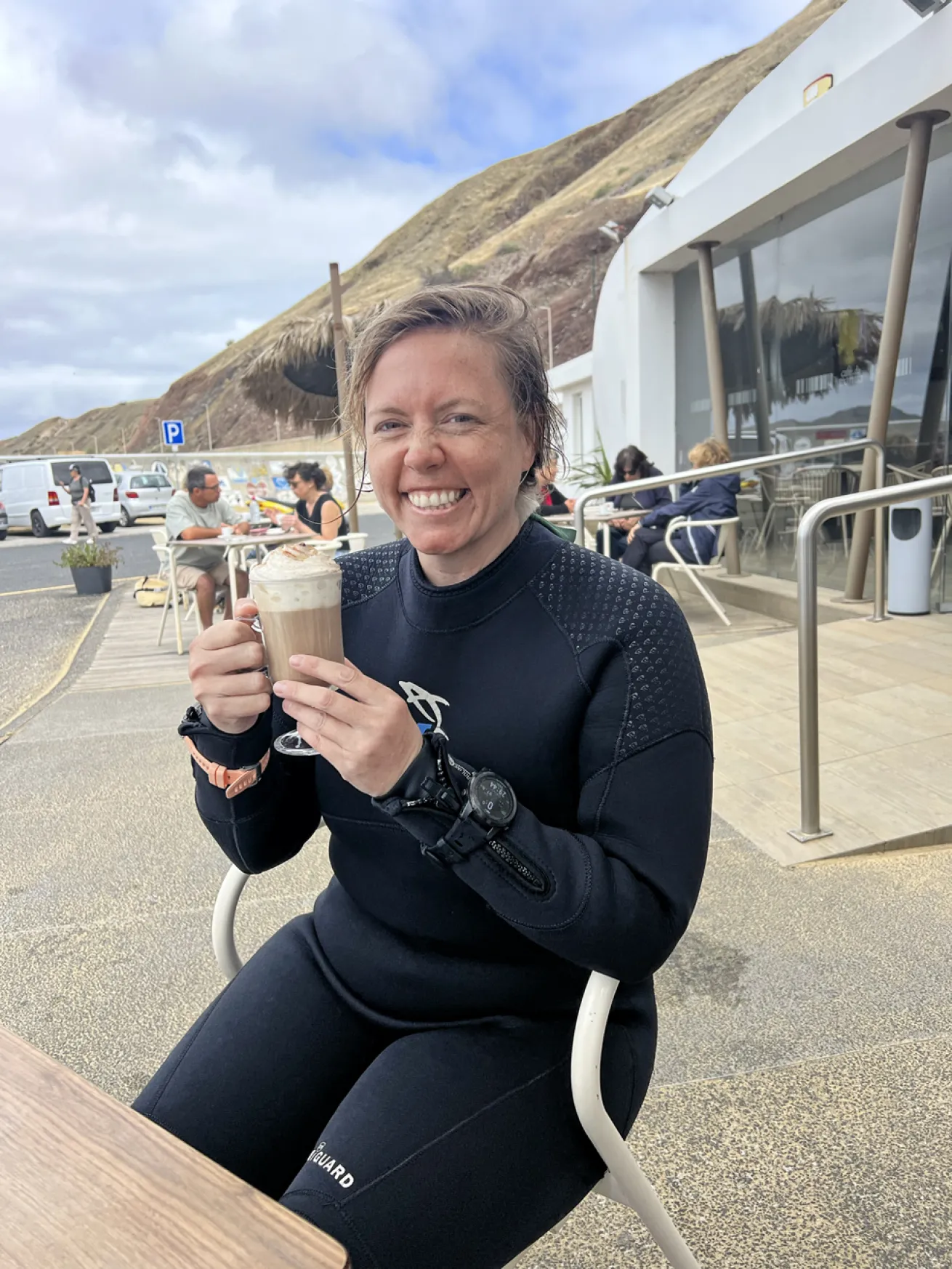
Candice LandauBecause many of the dive sites are so close to shore in Porto Santo, the author can enjoy a hot drink between dives at Café da Marina.
Have Your City And Dive It Too
Though I stayed at the new Dreams Madeira Resort Spa & Marina in Caniçal, I dived out of Funchal. The accessibility of the dive shop and access to other topside activities made it a great launching point, while still giving me space to head back to a sprawling hotel that would fit in just as well in the star-studded hills of Montecito, California, spilling over as it is with numerous swimming pools and restaurants, as well as its own church, and small street of shops and adventure operators.
If you’re keen on staying closer to town, consider VidaMar, the hotel that the Funchal Cipreia Dive Club is based out of, and the on-island dive shop I chose. No dive gear? No problem. They’ll rent it to you. Expect anything from a 5 to 7 mm wetsuit, depending on the time of year.
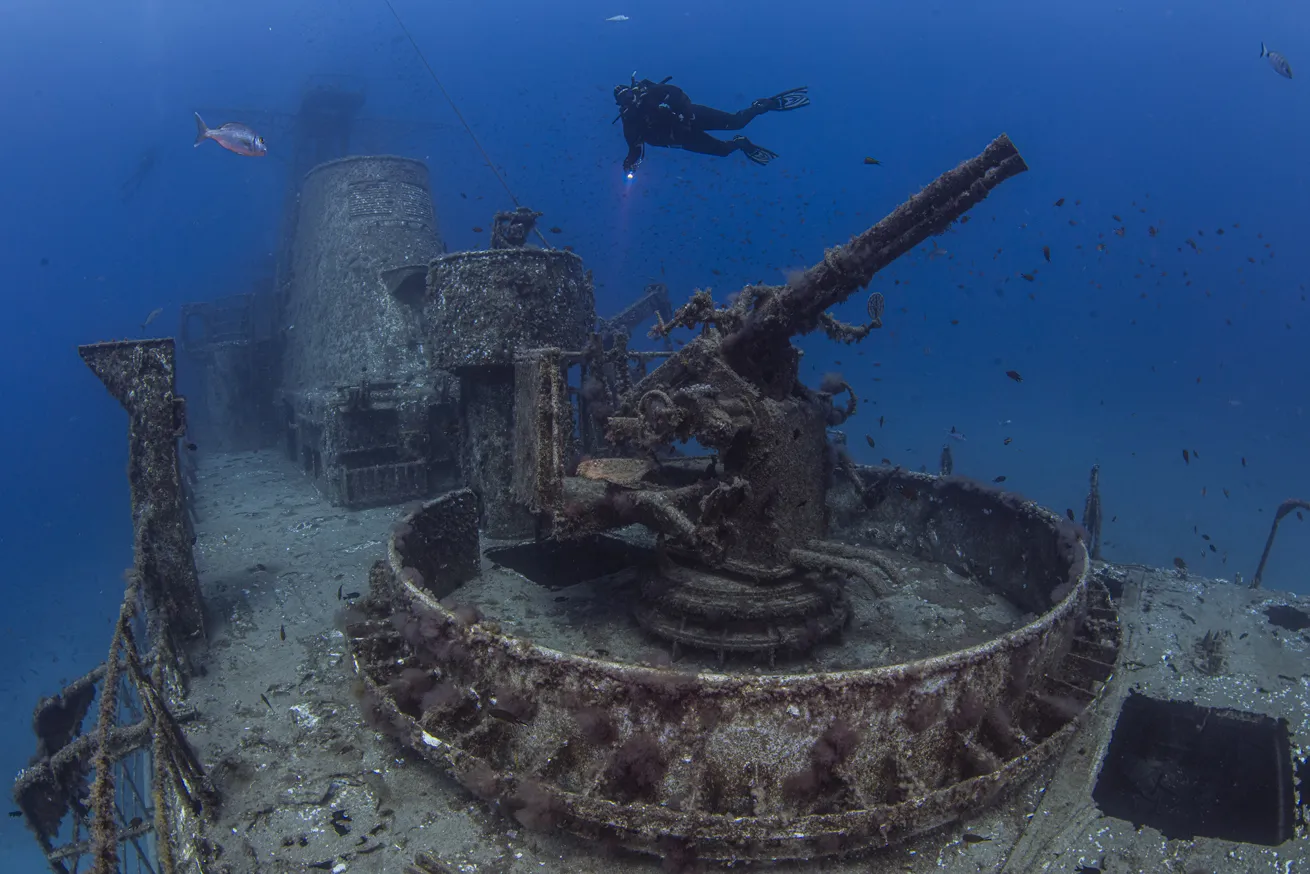
Candice LandauDoris, the author’s dive buddy, inspects the gun on Madeirense in Porto Santo.
My favorite dive site on Madeira’s main island is a wreck named Corveta Afonso Cerqueira, an artificial reef sunk in 2018. Of course, the fact that it’s a five-minute boat ride from the dive shop certainly doesn’t hurt. Here, I was charmed by a school of triggerfish that wanted nothing more than to inspect their reflections in my camera’s dome port. A friendly grouper also spent much of the dive giving me a guided tour of the Portuguese navy corvette ship. At 279 feet in length, it’s well worth a couple of dives, and it offers easy access to the engine room, with light pouring in so it’s hard to feel claustrophobic. Good visibility or not, you’ll still find its features impressive.
Another of my favorite sites is just a short boat ride away—Garajau Nature Reserve. Created in 1986, this protected area is a good place to spot dusky grouper, giant devil rays and even oceanic mantas. Garajau is also incidentally the first place I saw a cuttlefish. The unusual rocky landscape also makes for some beautiful photographs, with light streaming down over car-size boulders and schools of fish drifting confetti-like in the water column.
Related Reading: Best Scuba Diving in May
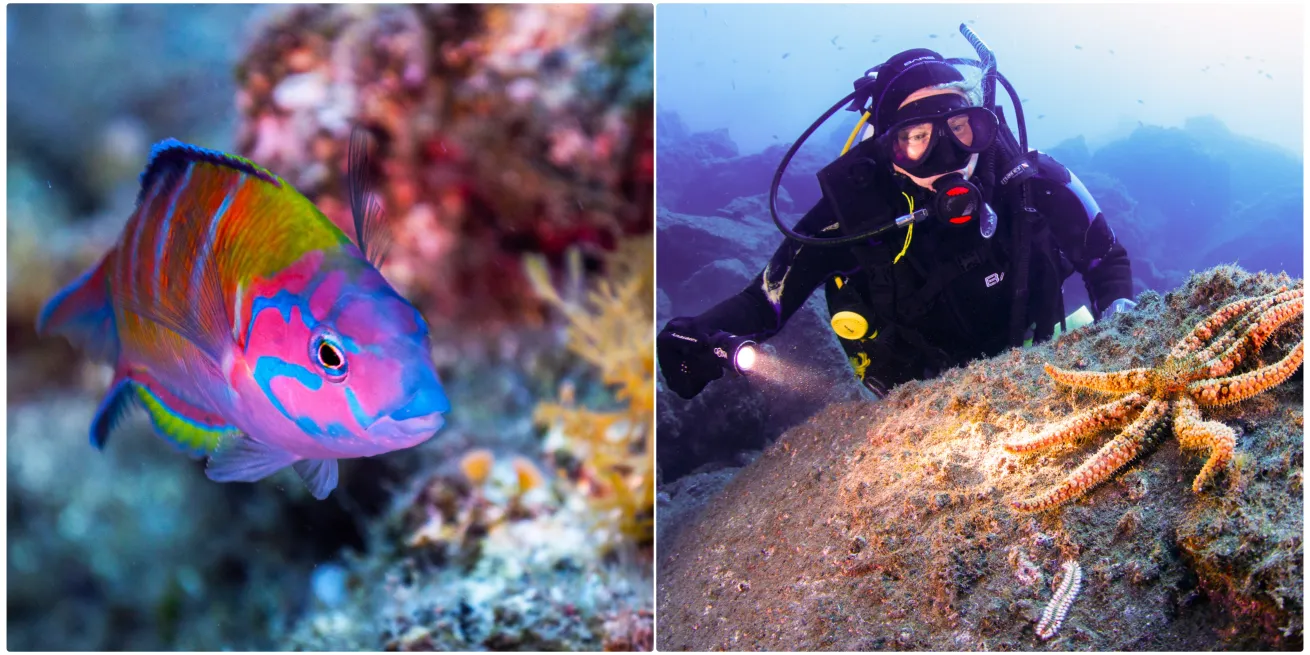
Candice LandauLeft: Ornate wrasse are common to see in Porto Santo’s waters; Right: Doris watches a sea star crawl over the boulders in Garajau Nature Reserve.
Changing Pace
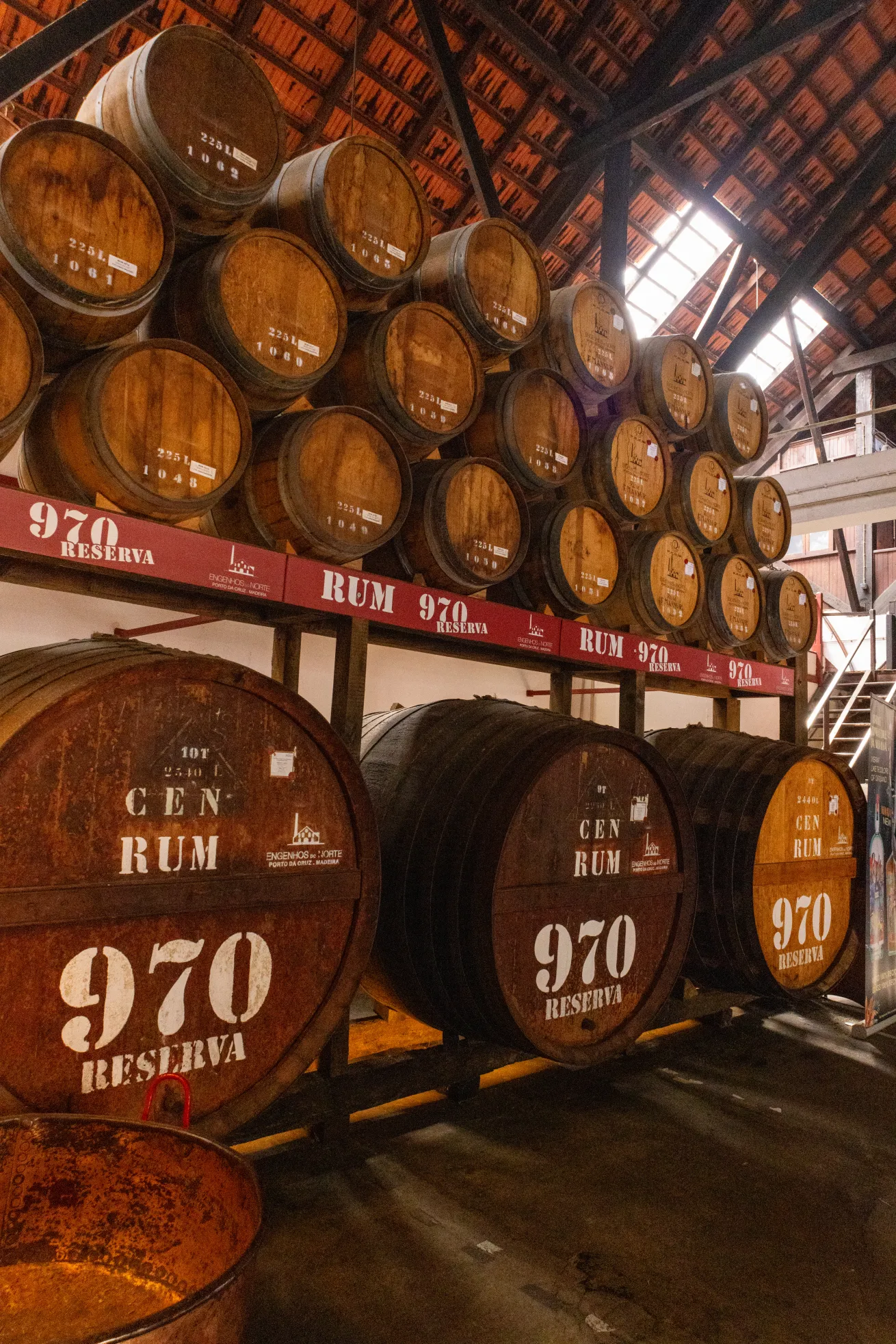
Candice LandauRum barrels at Engenhos do Norte.
If you’re hungry for a slightly different experience, hop on the Porto Santo Line ferry and take the two-and-a-half-hour trip to the next largest island in the archipelago. And if you want to try a little bit of everything, make a reservation at the onboard restaurant, or indeed go and watch a film in the ferry’s cinema (no, that’s not a joke).
Porto Santo offers a more laid-back experience, though it certainly doesn’t skimp on activities. For the outdoorsy explorers, it has good hiking, access to Porto Santo Golfe—a top European golf course—and unique geology, including the Organ Pipes, an outcropping of dramatic basalt columns found at Pico de Ana Ferreira—the likes of which you’ll only see in a few countries.
You’ll definitely want to split your time between eating and diving. My favorite restaurants included the Apollo 14 Bar and Bistro, the Pé na Água Restaurante & Beach Bar, and Restaurante Teodorico, which sits high up in the hills. If you love pepper as much as I do, get a side dish of the pepper sauce at Apollo 14; I drizzled it over everything. At Pé na Água, order the jugs of fruit-filled sangria. And, at Teodorico, download Google Translate to interpret the menu and enjoy an authentic Porto Santo restaurant experience, including views over ancient terraced hills framed by fuchsia bougainvillea. If you’re lucky, you may even get to taste the restaurant owner’s own rum distillation, though you didn’t hear it from me.
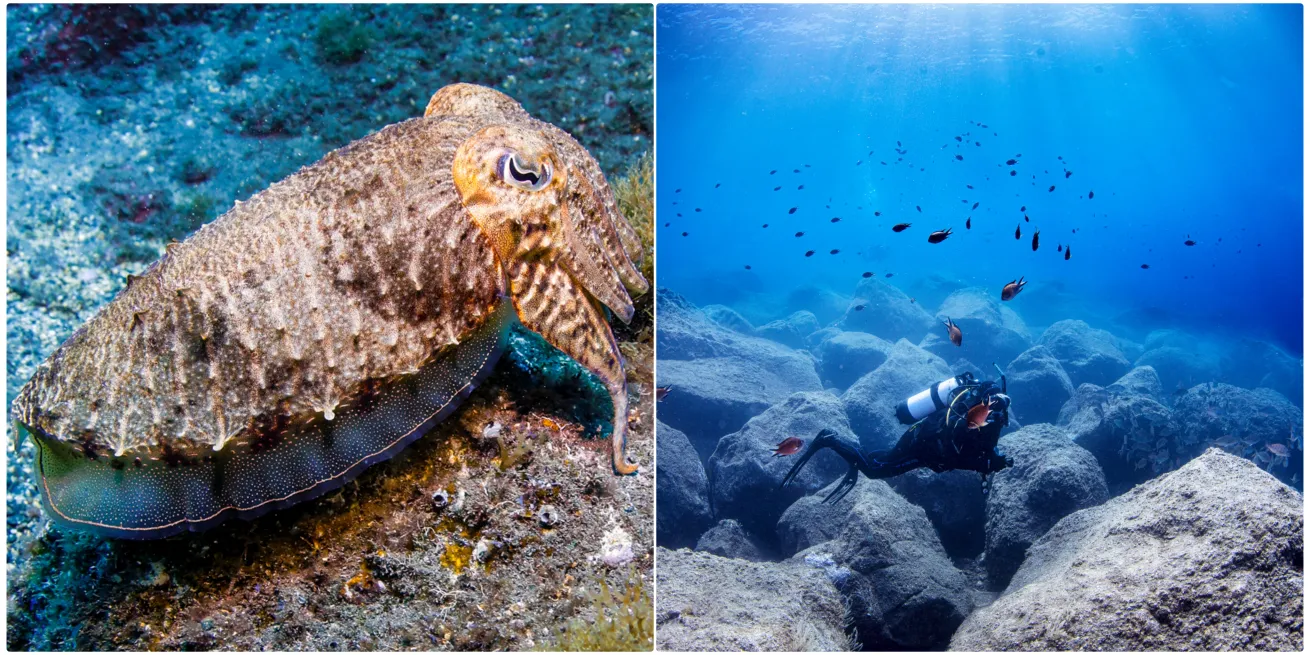
Candice LandauLeft: A cuttlefish poses for a shot.; Right: A diver fins over the dramatic boulders in Garajau.
Close to the Big Boys
As far as diving is concerned you’ve hit upon another gem. My favorite thing about diving in Porto Santo is how near to the harbor and dive shop all the diving is, including two large wreck dives that in many other countries might take an hour or more to reach. Here, your boat ride is five minutes long by Zodiac, and you can head back to the harbor to grab a hot chocolate, a cappuccino or even a meal at Café da Marina. Best of all, you can do it in a wetsuit, though fair warning you may still be ogled curiously as we were. Perhaps send someone dry in to place the order.
Cipreia also operates a dive shop on this island, with friendly staff who will provide the full concierge experience many divers long for. My favorite dives included the wrecks of the Madeirense and the Corveta Pereira D’Eça. Both are incredibly close to shore and a photographer’s dream, as well as portals into the past.
Related Reading: The Tempting Allure of Wreck Diving
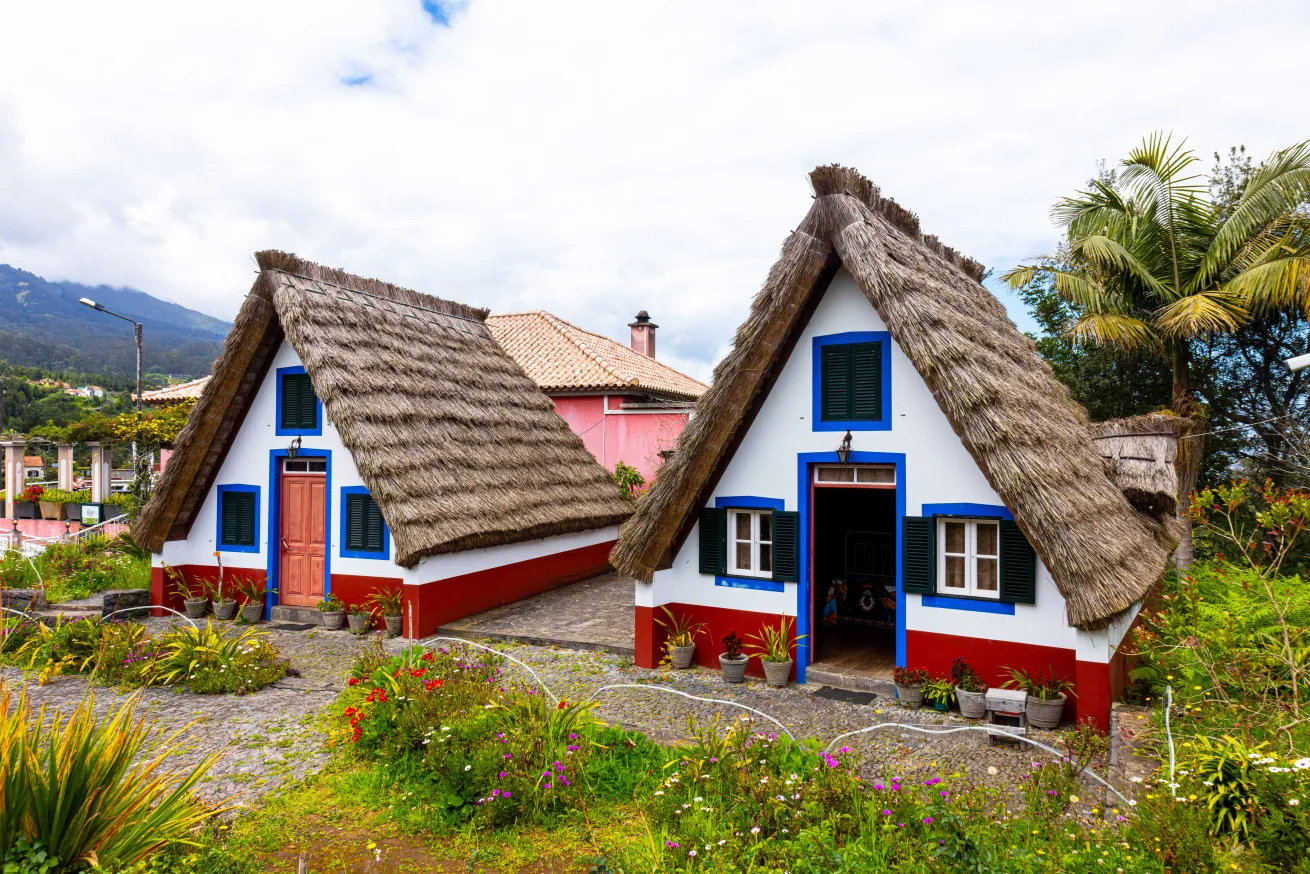
Candice LandauTraditional palheiros houses on Madeira.
If you took the ferry to Porto Santo, you might just recognize the Madeirense, which was once part of Madeira’s transport system, and whose model-size replica is displayed on board behind a small curio cabinet. Sunk in 2000, the Madeirense has had enough time to grow into a real reef full to the brim with marine life, including sand eels skirting its rippled sand bottom, as well as coral, tunicate and hydroid growth all over the rusting superstructure. Sometimes the schools of fish here are so thick you’ll have a hard time finding your way from bow to stern.
The Corveta Pereira D’Eça wreck is another navy vessel, not so dissimilar from the Corveta Afonso Cerqueira you may dive on Madeira’s big island. It’s also another artificial reef and was sunk in 2016. Watch your bottom time as these wrecks are fairly deep.
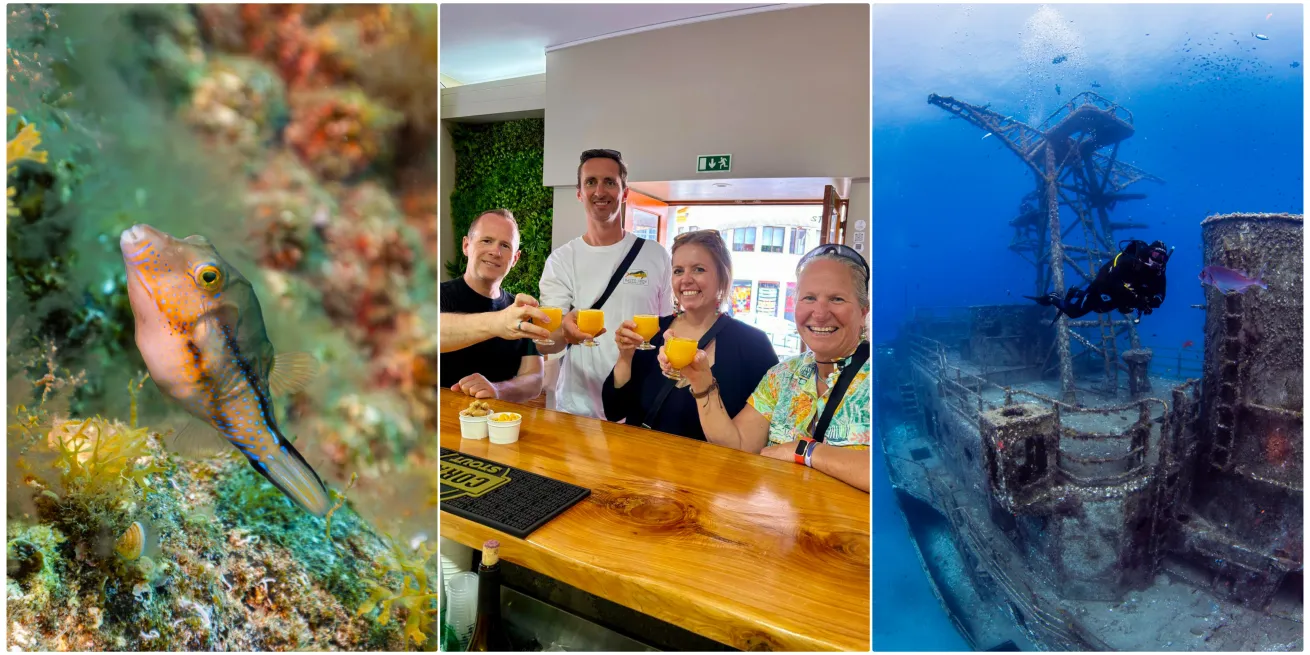
Candice LandauLeft: A sharpnose puffer picks along the rocks looking for food off Porto Santo. Center: Boutique da Poncha on Porto Santo serves fresh poncha in a variety of flavors.; Right: The author’s dive buddy explores the Corveta Pereira D’Eça wreck in Porto Santo.
All Roads Lead to Both
When all is said and done, I couldn’t tell you which island to prioritize. Both provide excellent diving opportunities as well as unique activities like canyoning, hiking along ancient canals called levadas, and food tasting that will simply knock your socks off. So do both: let Madeira bring the more classic European experience and Porto Santo the quieter decompression. With a ferry that connects them both you’ll be able to call it one trip well spent.
Planning Your Trip I highly recommend talking to Portugal Dive (portugaldive.com) to get the most out of the experience. Their team has expert knowledge of not only Madeira and Porto Santo, but also mainland Portugal as well as the Azores.
Operators Cipreia Dive Club (multiple locations), Azul Diving Center (in Funchal) and Haliotis Madeira Dive Center (in Machico).
When to Go Year-round diving; calm seas. Warmest water and peak visibility are typically between June and November.
Water Temperature 64 to 66 degrees Fahrenheit in winter (February to March) and up to 77 degrees in late summer or early fall (August to September).
What to Wear Wear a 5 mm wetsuit in summer and a 7 mm wetsuit in winter.
Signature Sites Must-dive sites include Garajau Nature Reserve, the Corveta Afonso Cerqueira (F488) and the Madeirense wreck.


