

Keri Wilk
Keri Wilk
Keri Wilk
You want big encounters. You want epic visibility. You want the Bahamas. This easy-to-reach chain of islands remains at the top of scuba divers' wish lists because it consistently delivers face time with sharks and dolphins; dives here also get you close to wrecks, macro life and schools of fish so massive that you lose yourself inside them.
Destination Primer
Average Water Temp: low 80s in summer; high 70s in winter
What to Wear: skin in summer; 3 mm wetsuit in winter
Average Viz: 100 feet
When to go: year-round
**Nassau, New Providence **
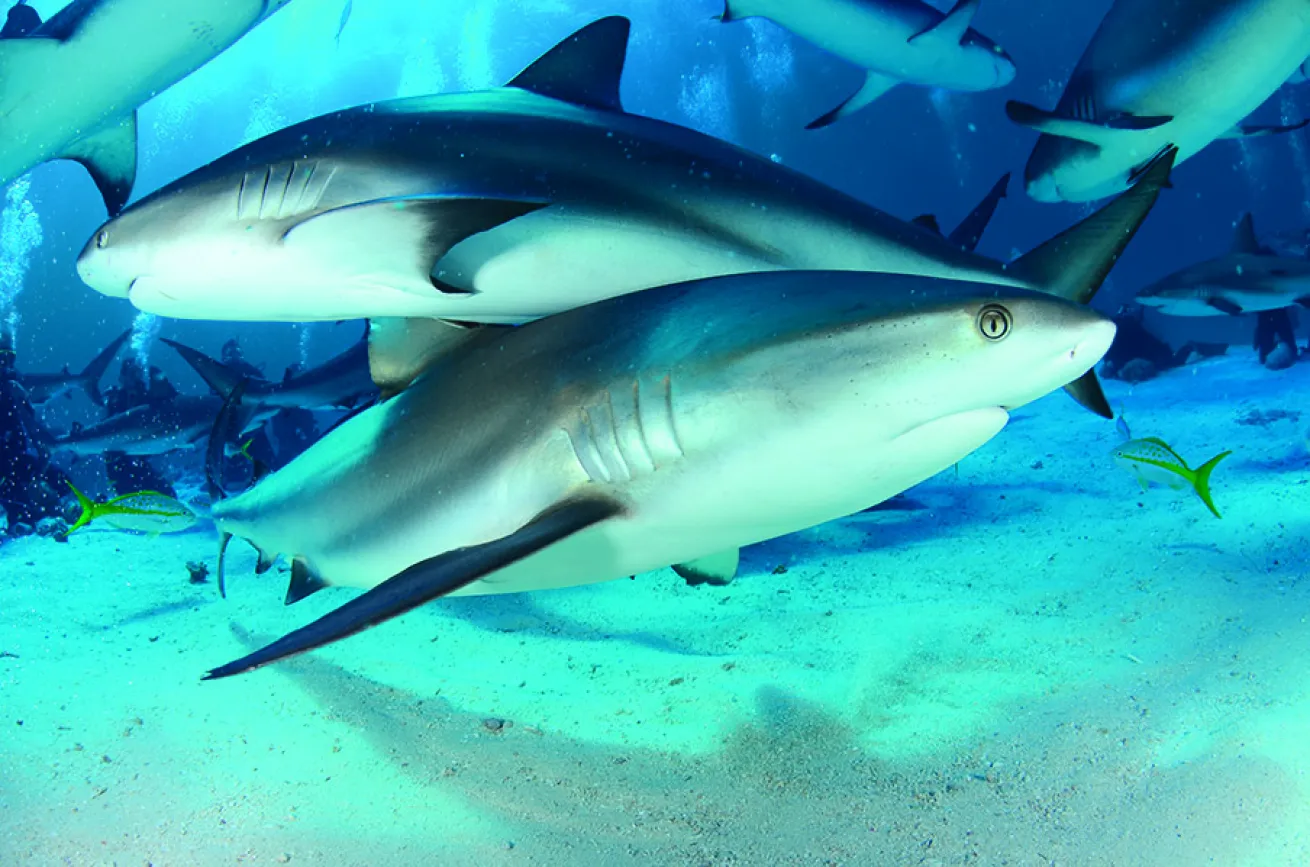
Everyone expects to see Caribbean reef sharks in action at Shark Runway, where as many as 30 arrive daily for an a la carte herring lunch — but at Ray of Hope -- downed cargo ship a mere 100 yards away -- it’s a welcome sight when a half-dozen linger, curiously. It’s not feeding time, but they still seem hopeful.
Earlier during his dive briefing, Chang Chin told us that shark sightings are more or less a given. He’s one of the chainmail-clad feeders at Stuart Cove’s Dive Bahamas -- a PADI Five Star Dive Resort -- and he knows the reefs well.
For the past 30 years, Stuart Cove's has been working alongside sharks, setting the standard for safety. With its fleet of 12 dive boats, the resort offers daily afternoon shark feeds, as well as charters to other sites around the island.
“These are mostly second-and-third generation sharks whose grandparents have been here since the feeding started,” says Chin. “They’re extremely comfortable around divers and are just hoping to figure out who has the food.”
Sharks aren’t the only big game claiming territory. While at Ray of Hope, a goliath grouper emerges from one of the ship’s walkways, studying us, as if wanting to protect its dwelling from unexpected guests.
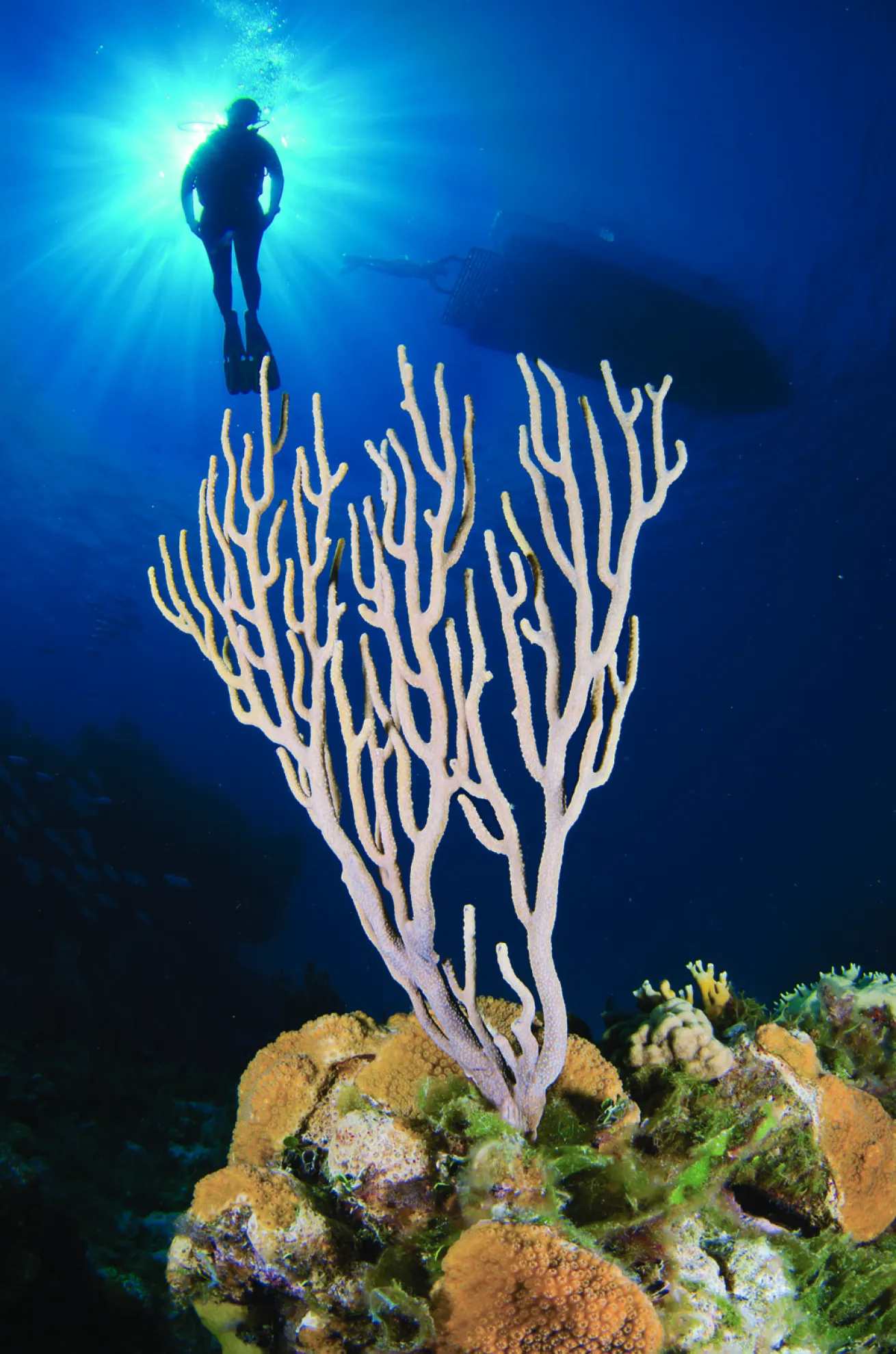
From the wreck, it's a quick swim to the wall where a coral head of Mesozoic Era proportions serves as a base for the army of snapper funneling around it. We stay fairly shallow, taking in the purples, oranges and yellows of the overgrown sponges slowly fingering across the reef.
Before ascending, we position ourselves inside the invisible circuit that the sharks swim repeatedly, and I recall what Chin had said of moments like this one.
“Even if a group of divers has done the shark feed, they get excited seeing sharks in their natural habitat. They know that’s what the Bahamas is all about.”
Bimini
Divers looking to log deep dives shouldn't target North Bimini -- many of the best sites are also the shallowest at Bimini Big Game Club, a Guy Harvey Outpost Resort & Marina.
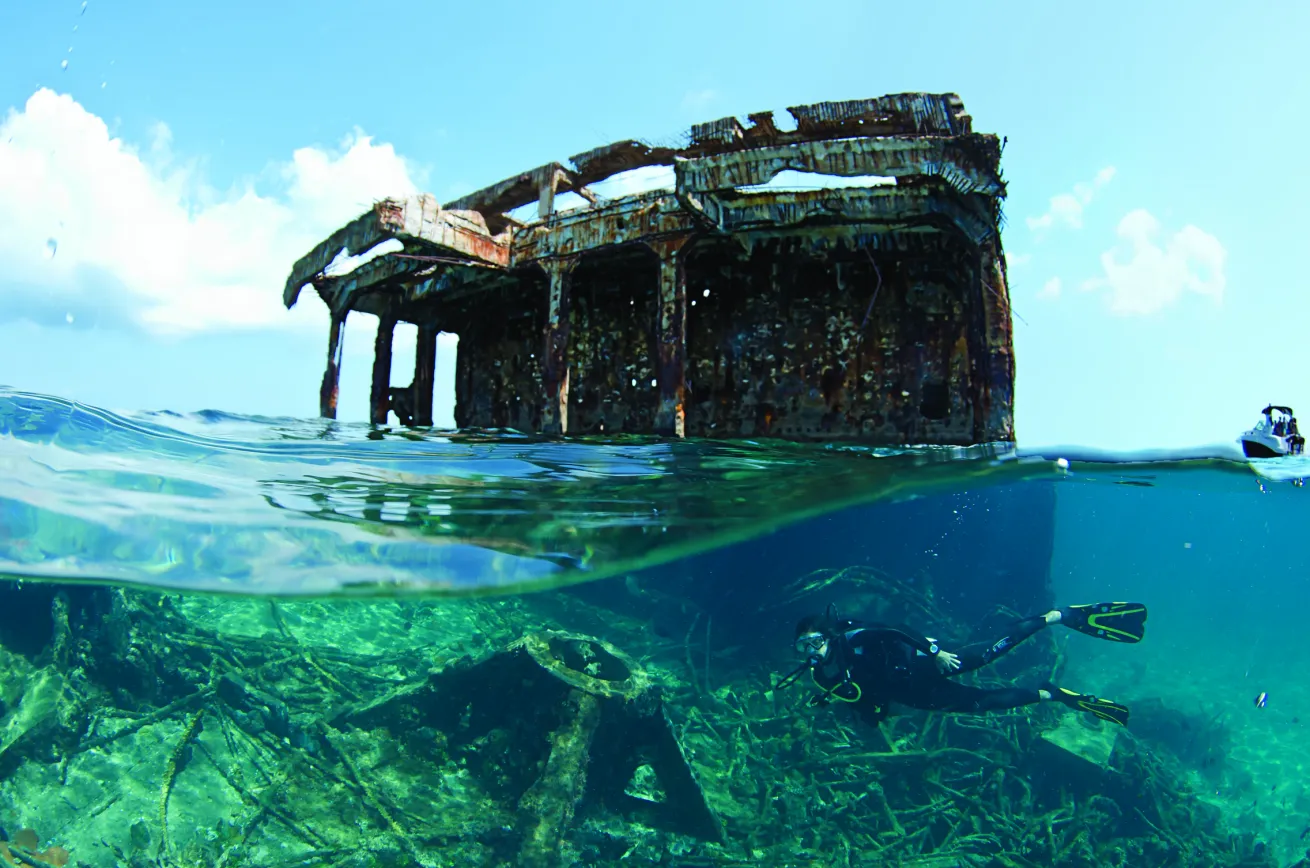
Capt. Joey Lawless is taking us to the SS Sapona, a cement ship that wrecked on a shallow reef when a 1926 hurricane barreled through, relocating it to 18 feet of water.
The ride to the site couldn’t be smoother: We’re aboard the operation’s 63-foot-long custom boat that easily handles seas of any condition. And the boat isn't the only customized feature -- Dive Bimini offers charters at times that best suit guests’ schedules. Not an early riser? Not a problem.
When we arrive at the Sapona, our captain briefs us on the wreck.
“Its fate was the same as every other boat here in the islands,” Lawless says. “It had several careers — as a troop transport ship, a rumrunner and as a target for Navy drills. But it had run its course, so they islanders left it to become a reef.”
About half of the 270-foot ship juts above small waves. The hull is awash with purple and orange sponges, attracting queen angelfish. The swim-through near the prop leads to a hold filled with French grunts; nearby, scattered wreckage shelters a nurse shark.
Post-dive, we return to the Bimini Big Game Club for sunset. The poolside bar starts to crowd with suntanned travelers. At the end of the dock, a man cleans the anglers’ bounty, tossing the guts into the drink. Within minutes, a handful of opportunists — stingrays and a couple nurse sharks — appear. Here in Bimini, you don’t even have to get wet to watch predators feeding — you can do it while holding a cocktail and enjoying the sunset.
STELLA MARIS RESORT CLUB & MARINA
Long Island
The Bahamas might be the worst place to work toward navigation certification: The 100 feet of visibility makes cheating easy. Today's only goal is to wind around the 110-foot-long _M/V __Comberbach_ and the sailboat lying just off the freighter’s starboard side. _Comberbach_ lies in a depth of 115 feet, so we’ll have to closely monitor our air consumption.
In the water, a slight current means we’ll work harder, but we'll also find greater reward. As we reach the deck, an eagle ray wings toward the stern. Inside the cargo hold, a green turtle eyes us before easing toward the surface.
After much time weaving around the wreck, it’s time to surface before our dive computers punish us. Luckily, at the PADI Dive Shop at Stella Maris Resort, the emphasis is on enjoying the surroundings and not keeping to a rigid schedule. You might return a bit later, but it will be for good reason: a suface swim with dolphins or a longer dive profile when something unexpected swims by.
During our surface interval, the group visits Conception Island, a protected site that serves as a sea turtle nursery. Today, this spot allows us to snap photos of white-sand beaches disappearing into the turquoise water.
Next, we visit Split Coral Reef. The structure rises some 50 feet from the bottom, surrounded by rippled sand and a string of patch reefs. As I watch a pair of tarpon approach, I realize that Long Island is a stellar place to study animal behavior. Visibility like this dramatically increases how much marine life divers see, and stretches each encounter from moments to minutes — epic indeed.
CAPE ELEUTHERA RESORT AND YACHT CLUB
Eleuthera
Five thousand cobias swarm the same site one and a half miles off the Cape Eleuthera Resort and Yacht Club. Granted, they’re stocked annually into a shark-proof netted cage, but this massive structure acts as an anchor for a thriving reefscape. The lot is fed daily, and the flotsam of extra pellets attracts snapper, grunts and small tropicals. These, in turn, attract dorado, wahoo and schools of horse-eye jacks. The diamond-shaped structure sits at a depth of 90 feet, just at the edge of the reef wall where predators can’t help but notice the activity.
It’s a site that stands out even to local live-aboard captains who regularly journey the 54 miles to the area, known throughout the Bahamas for its protected location; Cape Eleuthera enjoys a leeward position where seas and visibility are ideal 300 days a year.
“Tons of bull sharks, monster goliath grouper and the occasional tiger shark join us,” says Neal Watson Jr., owner of the on-site PADI Dive Resort, Cape Eleuthera Divers.
The morning we drop in, a small school of midnight parrotfish nibbles its way across the top of the 60-foot wide cage. Inside, the torrent of cobia rushes in all directions, creating a flurry of activity that’s hard to focus on. Take your wide-angle lens on this dive -- the structure makes an excellent backdrop.
That afternoon at Hole in the Wall, we slip into a cut-through that leads from 55 feet to 90. Visibility in the Bahamas never disappoints, so when we exit and find ourselves hovering over a bottom 2,000 feet below, a tinge of vertigo strikes.
“It’s unreal,” Stephen Kappeler, general manager of the shop, says of the site. “You feel like you pop out of the side of a skyscraper into the abyss.”


