

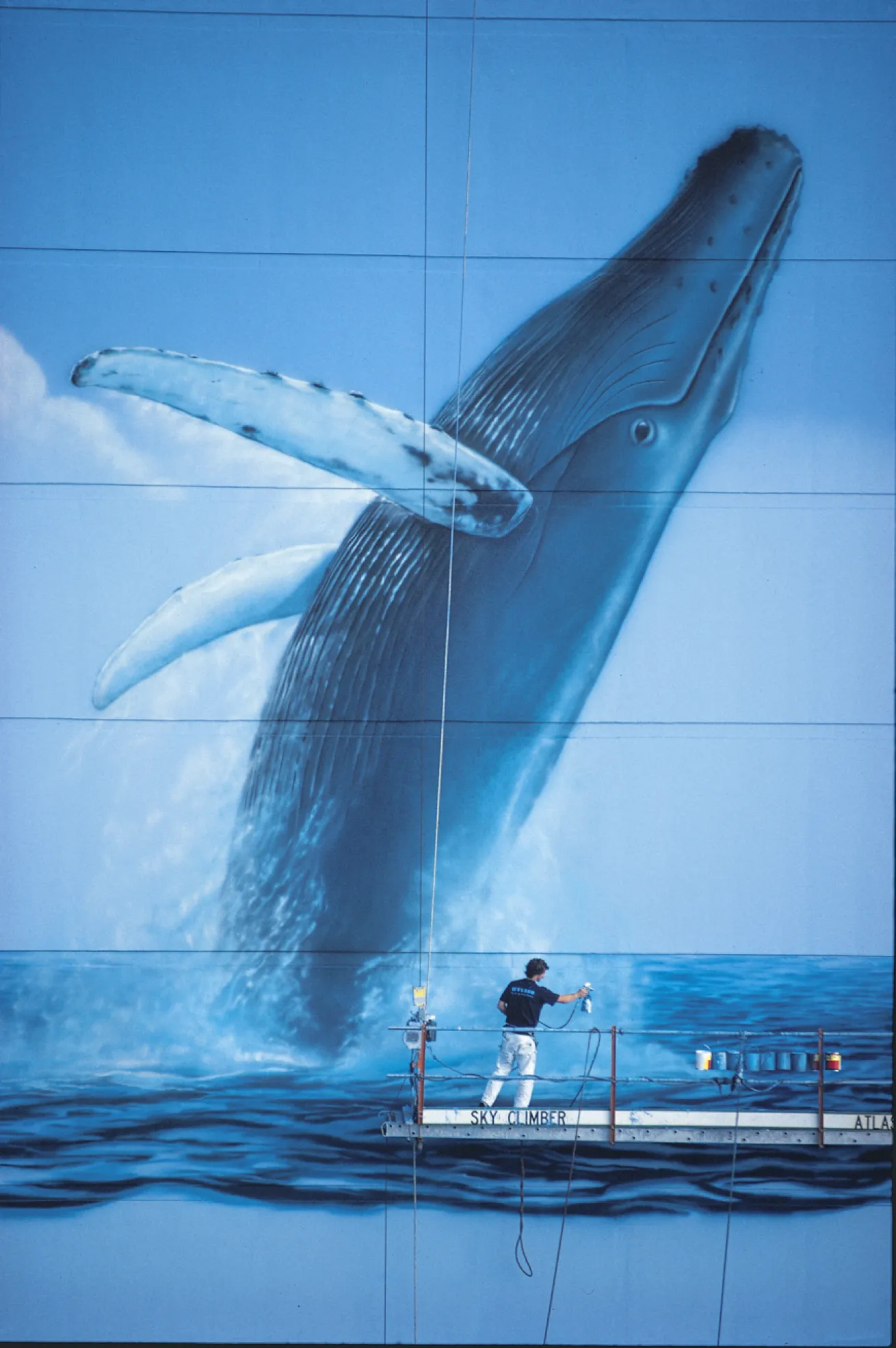
Courtesy WylandThe Whaling Walls series helped put Wyland’s name on the map, both among artists and conservationists.
Born in Detroit, Michigan, Wyland discovered his connection to the marine world before ever setting foot in the ocean. “I’d watch my hero, Jacques Cousteau, and paint the things that he featured on his television show,” he recalls. At 14, during a family road trip to Southern California in 1971, Wyland saw the sea for the first time—and dived straight in. There, face-to-face with a gray whale and her calf, the moment would define his life’s work. “It was like I was seeing dinosaurs. If you see a whale, it changes your DNA.” The encounter left a profound impression that continues to echo through his art today.
Over the next decades, Wyland emerged as a leading marine life artist whose work blends awareness with beauty. He founded Wyland Galleries in 1978 in Laguna Beach and earned global recognition for his monumental Whaling Wall series—a sweeping collection of more than 100 life-size marine murals created between 1981 and 2008 around the world. Viewed by an estimated 1 billion people each year, the project remains one of the largest public art initiatives in history and earned him the nickname “Marine Michelangelo.” He is currently sculpting all the great whale species, as well as endangered and threatened animals from the IUCN Red List, for his latest endeavor: 100 Monumental Sculptures in 100 Great Cities.
“TOGETHER, WE CAN HAVE A PRO-FOUND IMPACT ON HOW WE TAKE CARE OF OUR HOME—OUR WATER PLANET.”
—Wyland
A renowned painter, sculptor, photographer, filmmaker and writer, Wyland has also become an influential advocate for ocean conservation. In 1993, he expanded his impact through the nonprofit Wyland Foundation, combining art and science in partnership with institutions like the United Nations and Scripps Institution of Oceanography to educate millions about urgent issues affecting U.S. waterways—from urban runoff to marine debris—and their impact on the ocean.
A member of the International Scuba Diving Hall of Fame, recipient of the Legend of the Sea award, and honored by organizations including the Sierra Club and the Academy of Underwater Arts and Sciences, Wyland’s legacy is both artistic and environmental. Through murals, sculptures and global education efforts, he continues to inspire a deeper connection to the water—and a lasting commitment to protect it.
Related Reading: Dive Industry Innovator: Julio Galindo Sr.
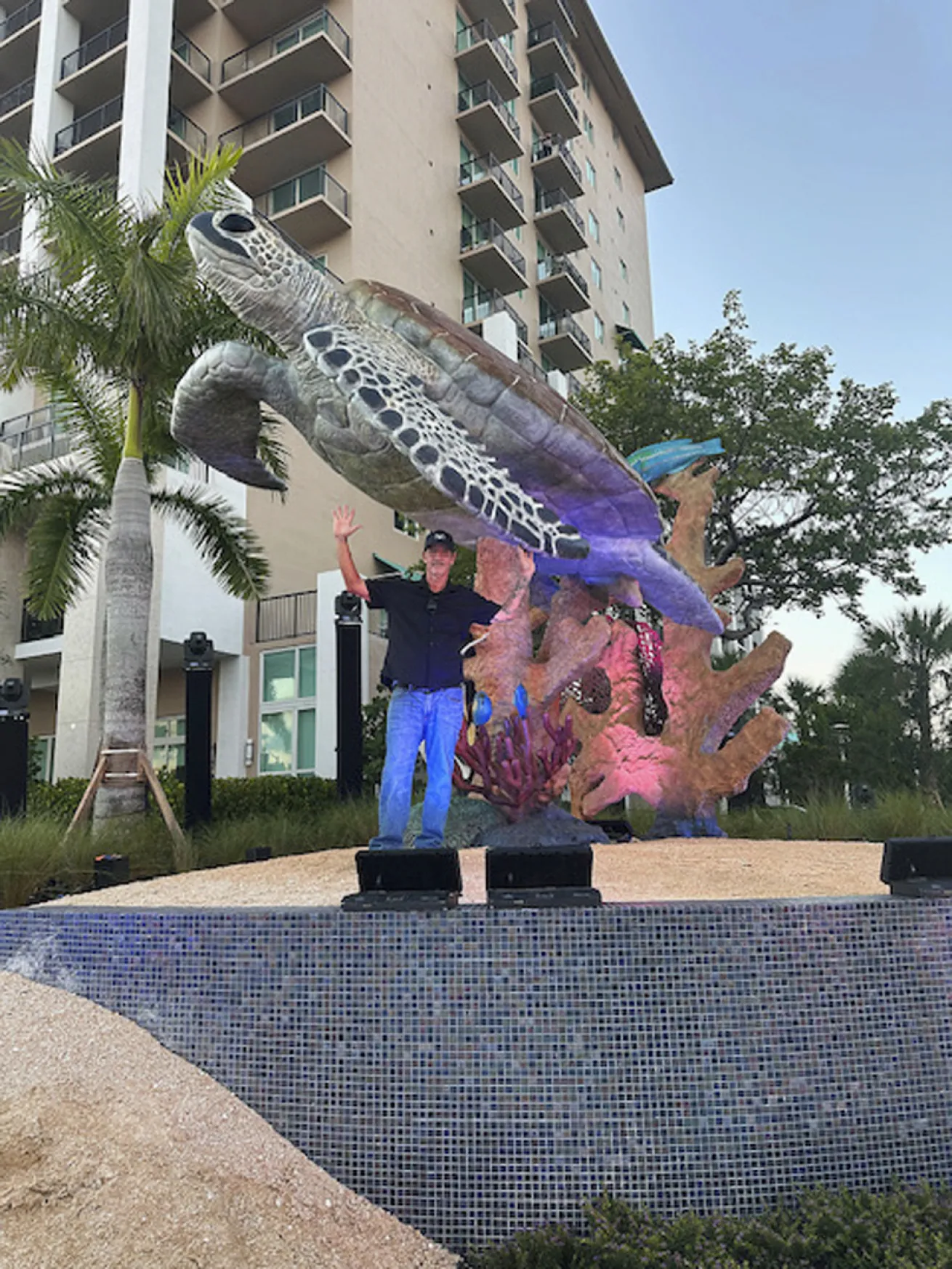
Courtesy wylandWyland stands next to his 2025 sculpture, The Sea Turtle Beach, in Dania Beach, Florida
Q: How has diving impacted you as an artist?
A: Diving’s the ultimate water experience. When you’re diving, you’re floating weightless, and your mind is connecting [with water] on so many levels. Diving has given me the ability to swim with great whales, such as the blue whale I swam with in the Sea of Cortez when I was making the documentary Wyland: A Brush With Giants. On the last day of filming, one swam right next to the boat. It was feeding on big clouds of plankton, so I jumped in with my cameraman, and he got me swimming up to the eye of the whale. It looked right through my soul.
Q: That’s incredible. Was that your favorite experience as a diver?
A: It’s way up there. I also had a chance to dive in Antarctica. I didn’t think I’d like it because I like warm weather, but it was magical to see the penguins and leopard seals, and to have the opportunity to go there with a lot of great divers. [Renowned dive photographer] Ernie Brooks was my roommate, and [pioneering marine biologist] Dr. Sylvia Earle was my dive buddy.
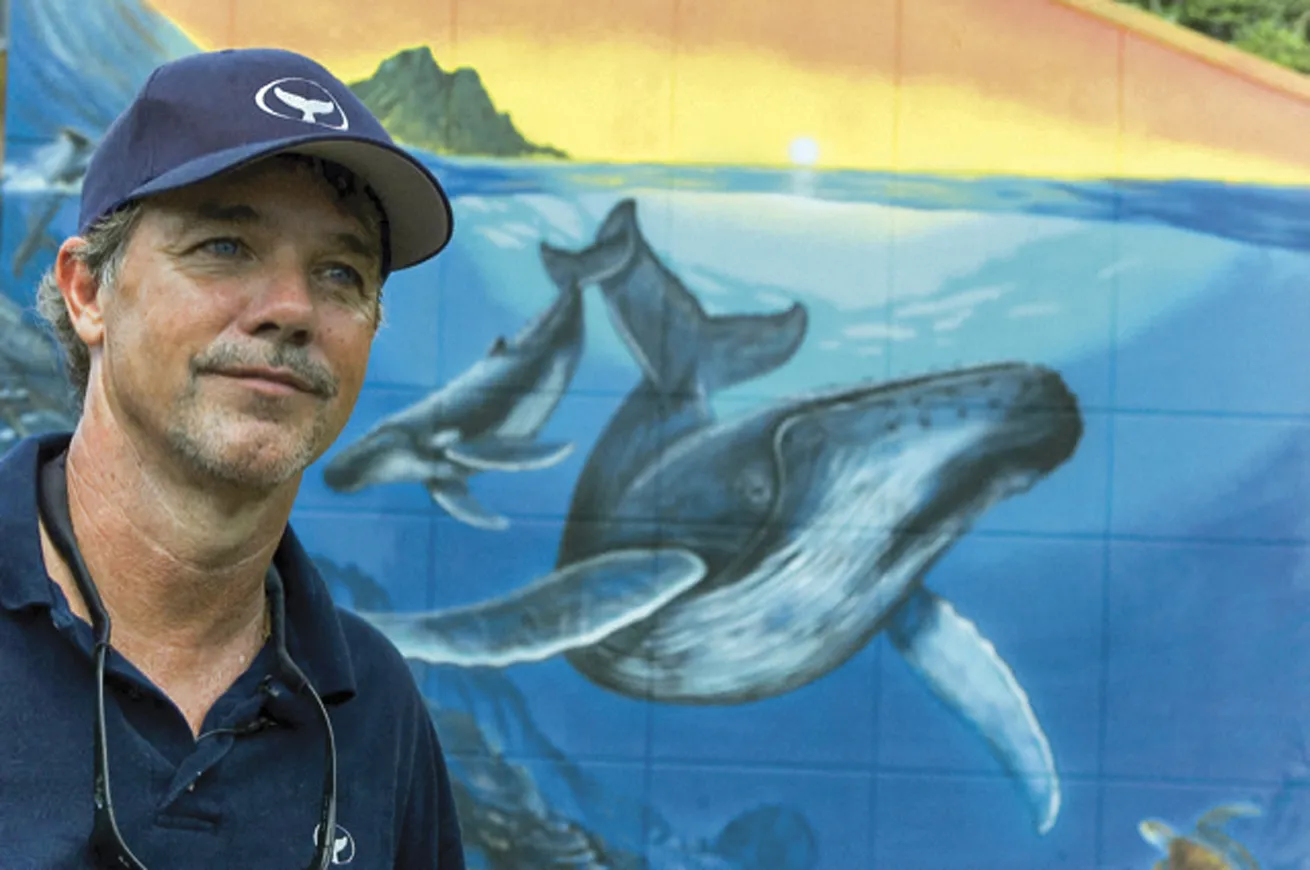
The artist in front of a Whaling Walls mural.
Q: A lot of artists look up to you because you’ve had an incredibly successful career, which is not something that’s easy to do.
A: I didn’t sign up for the starving artist thing! In fact, I wrote a book about it called Don’t Be a Starving Artist. I give it to all the young artists I see, and I just made it into an audiobook. I’m also creating my online master class on how to be a successful artist, which I hope to launch next year. When you go to art school, you spend 40-something thousand a year, but you don’t learn anything that will help you in the real world. These courses will cut straight to the chase.
Q: What currently inspires you when you’re diving?
A: Obviously I’m big on animals like dolphins, turtles and sharks. But I love seeing a beautiful, pristine reef. Unfortunately, I’ve also seen coral graveyards. I’m very concerned about that. But I’m also hopeful. We have to take care of our freshwater and saltwater habitats. That’s what the Wyland Foundation focuses on. It lets people know that every drop of water is connected, and every drop counts. Together, we can have a profound impact on how we take care of our home—our water planet—but it’s going to require all 8 billion–plus people to be involved.
Related Reading: Dive Industry Innovator: Margo Peyton
Milestone Moment
After his first encounter with gray whales off the coast of Southern California, Wyland fused his creative instinct with a growing reverence for marine life. “Diving with whales elevated my art immediately,” he says. “It changed the game.” For more than 40 years, Wyland has returned again and again to the ocean, studying marine life in its natural environment. Unlike early artists—who often depicted whales based on beached, disfigured bodies—he paints from experience, capturing their true proportions, movement and magnetic presence. “I have the rare opportunity to swim with whales and see how they look underwater so I can paint them life-size and to scale.”
That immersion has fundamentally shaped Wyland’s work, giving rise to his Whaling Wall series. “I knew it was going to be powerful once word got out and schools were bringing kids down in buses to stand under the whale and measure themselves and see how big a great whale is.”
For Wyland, the act of diving is inseparable from creation. “When I’m underwater, I’m painting in my mind’s eye,” he says. His commitment to accuracy is scientific, collaborating with leading researchers to ensure each subject is rendered faithfully, as with Whaling Wall 12 in Victoria, Canada, which depicts a resident pod of orcas off Vancouver Island. Leading researchers worked on the scaffolding alongside Wyland, outlining specific whale markings in chalk.
“What I do is not marine art. It’s marine-life art—it’s not man’s conquest of the sea, but man’s celebration of it.”


