

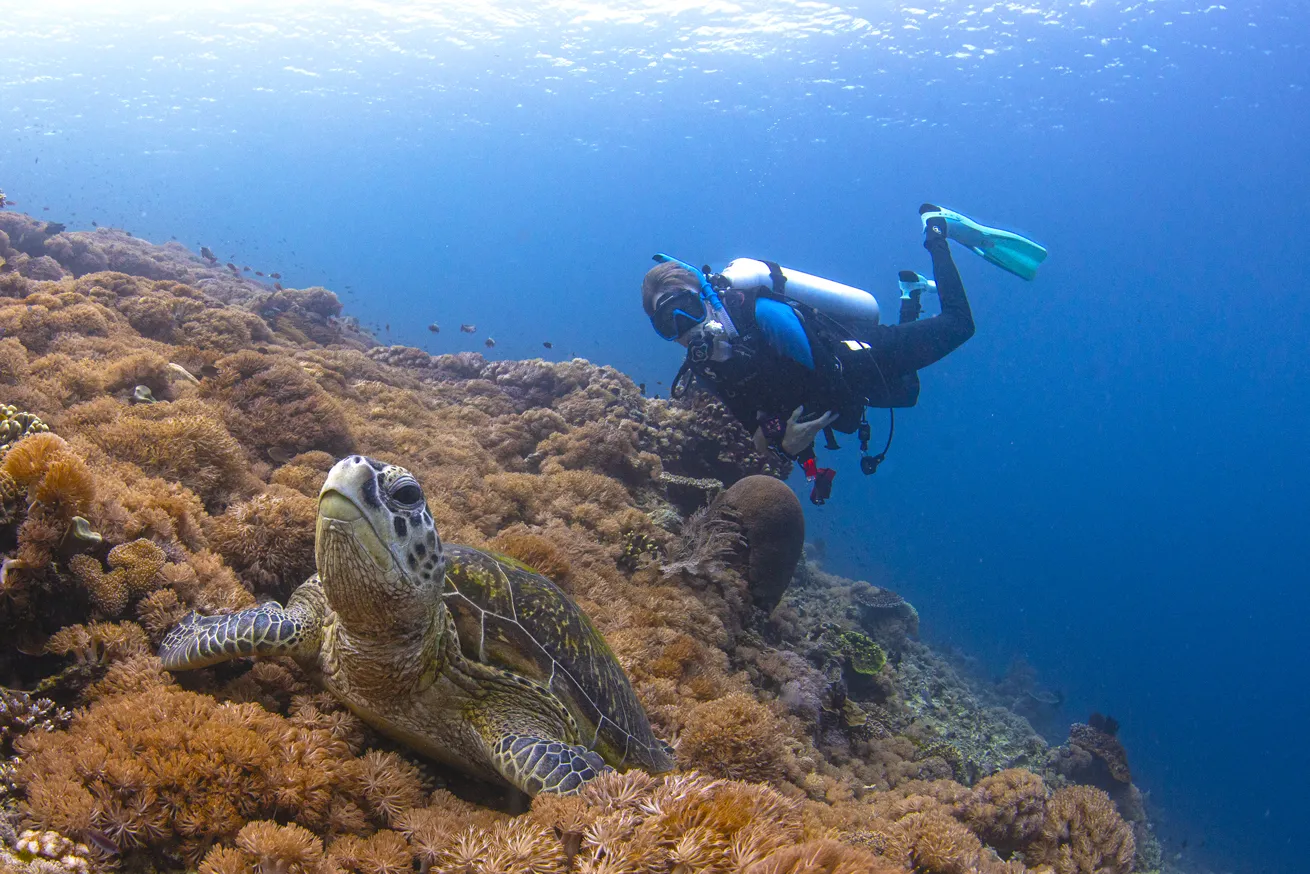
Candice LandauKomodo’s soft-coral terraces glow as a turtle lounges on the high spot. A diver observes from the periphery, giving the reef resident plenty of room.
I lose my dive computer somewhere in Shotgun’s rip and feel my stomach drop with it. Current howls, bubbles race sideways, and I spend the last 10 minutes pretending I’m not counting the dollars I’ve just lost. When I surface, our cruise director Queenky is grinning from the tender boat, holding up a small black Shearwater. “Yours?” The relief feels as physical as the warm towel and shoulder squeeze I know is coming. Even with the scare of losing expensive gear, the small rituals that follow quickly help to settle me.
Though I love novelty as much as any diver, I find I enjoy it more when the logistics are handled by someone else. Aggressor Liveaboards’ ritual comforts—hot chocolate after night dives, illustrated dive briefings, a quiet cabin for naps, and fish-ID books smudged with damp fingerprints—allow me to relax. I can slip into Komodo’s unknowns precisely because the topside is known. No meal planning, no taxi fares, no need to design my own schedule.
Before jetting off for a weeklong stay aboard Komodo Aggressor in September, I was feeling burned out from long working hours and tight deadlines. Thankfully it wasn’t long before I was reminded of why I dive: to relax, to recover, to explore the unknown, to interact with peculiar life-forms, and to meet new people all while partaking in an activity that gives my life a profound sense of meaning.
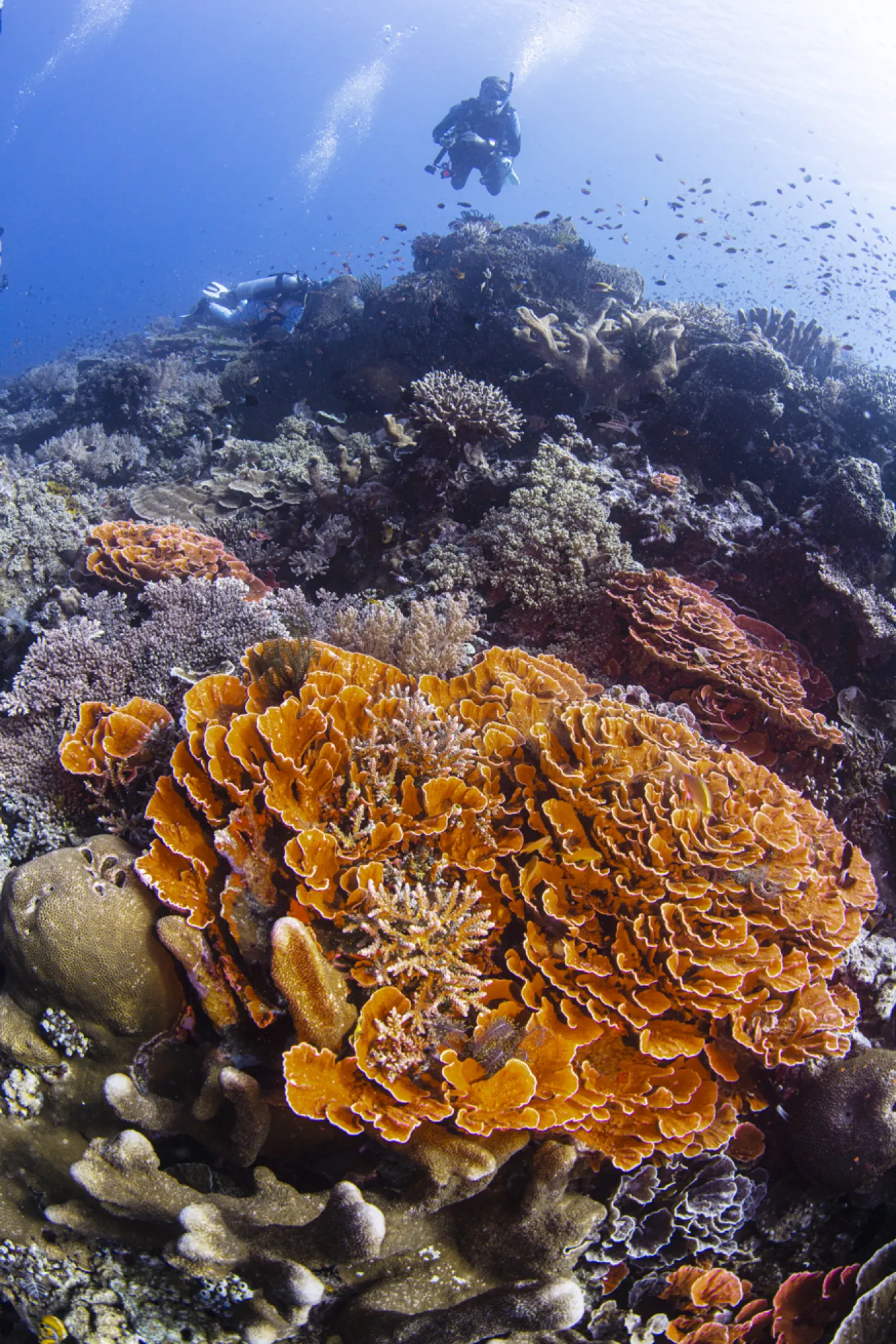
Candice LandauRuffled orange whorls stack into a living reef sculpture.
Living in the Moment
On the first day of our trip, we gather in the galley and make introductions. We tell Queenky what we hope to see and how many times we’ve been aboard an Aggressor liveaboard. I’m on my fourth Aggressor trip, and a couple of others have racked up well over 20, with one fellow coming in near 40—a number that has us all eyeing him with envy.
Though our itinerary for the week focuses on the northern sites of Komodo, our cruise director is willing to make some changes if the weather holds. One of the divers on the boat has put in a request for oceanic mantas, the largest species of ray in the world, with an average wingspan of around 15 feet. They’re in the south, so we’ll have to play that one by ear.
As other divers trade bucket-list critters, guilt pricks. I don’t keep a must-see list, and I catch myself wondering if that’s a gap in how I cover trips. I breathe, quiet the chatter, and remember why I’m here: to capture the lived experience, not a prepackaged story. After the briefing I head to my cabin, assemble my rig and lean into the thrill of the unknown.
Related Reading: The Soothing Effect of Drift Diving
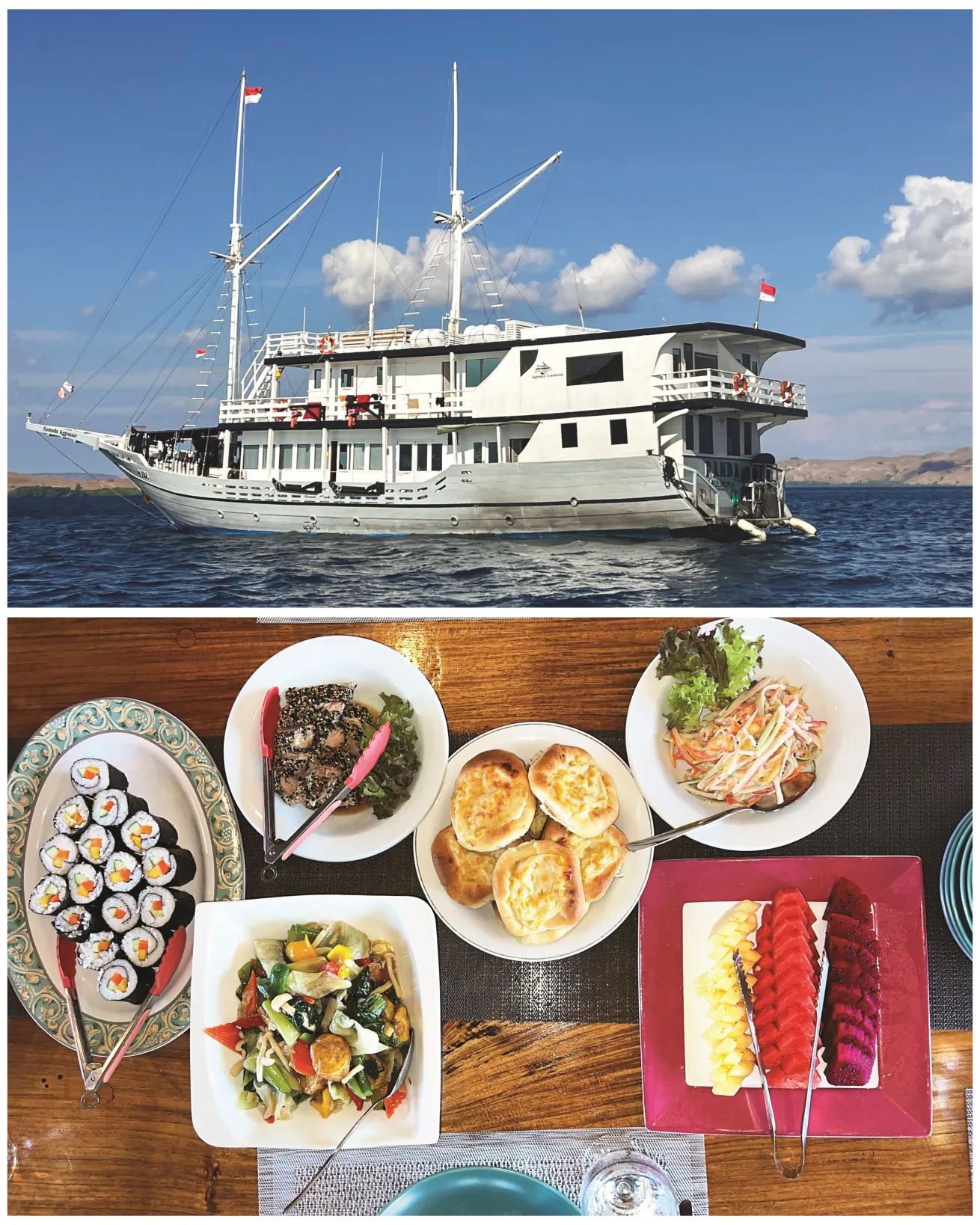
Candice LandauFrom Top: The phinisi-style Komodo Aggressor yacht; Food on board caters to all diets.
We logged 21 dives, including four after dark, sometimes returning to the same reef from a different drop. The names offer clues if you know them. Most are Indonesian: kecil (small), besar (big), batu (rock), bolong (hole), tengah (middle). A few are English or borrow from other local languages.
» Sabolon Kecil
» Sebayur Kecil
» Tatawa Besar
» Shotgun
» Crystal Rock
» Gili Lawa Darat
» Castle Rock
» Tatawa Kecil
» Batu Bolong
» Leok Sera
» Manta Alley
» Secret Garden
» Padar Kecil
» Police Corner
» Siaba Besar
» Wainilu
» Batu Tengah
Light Play
A site known as Tatawa Kecil quickly becomes the dive to beat. It has a variety of reef and rock formations as well as a plateau of healthy table corals. After exploring the sponge-encrusted overhangs we stay shallow for the return portion so that I can capture the way the light streams and ripples through the water and onto the reef below.
Though I often joke that diving is my religion, there’s an element of truth to it. The long light rays and dappled shapes that skitter across teeming schools of fish fill me with a sense of reverence, a feeling I often encountered touring England’s cathedrals, looking up into stained glass windows that, when the light hit right, painted the stonework in a mosaic of colors. This, I think, is what makes one believe in something bigger.
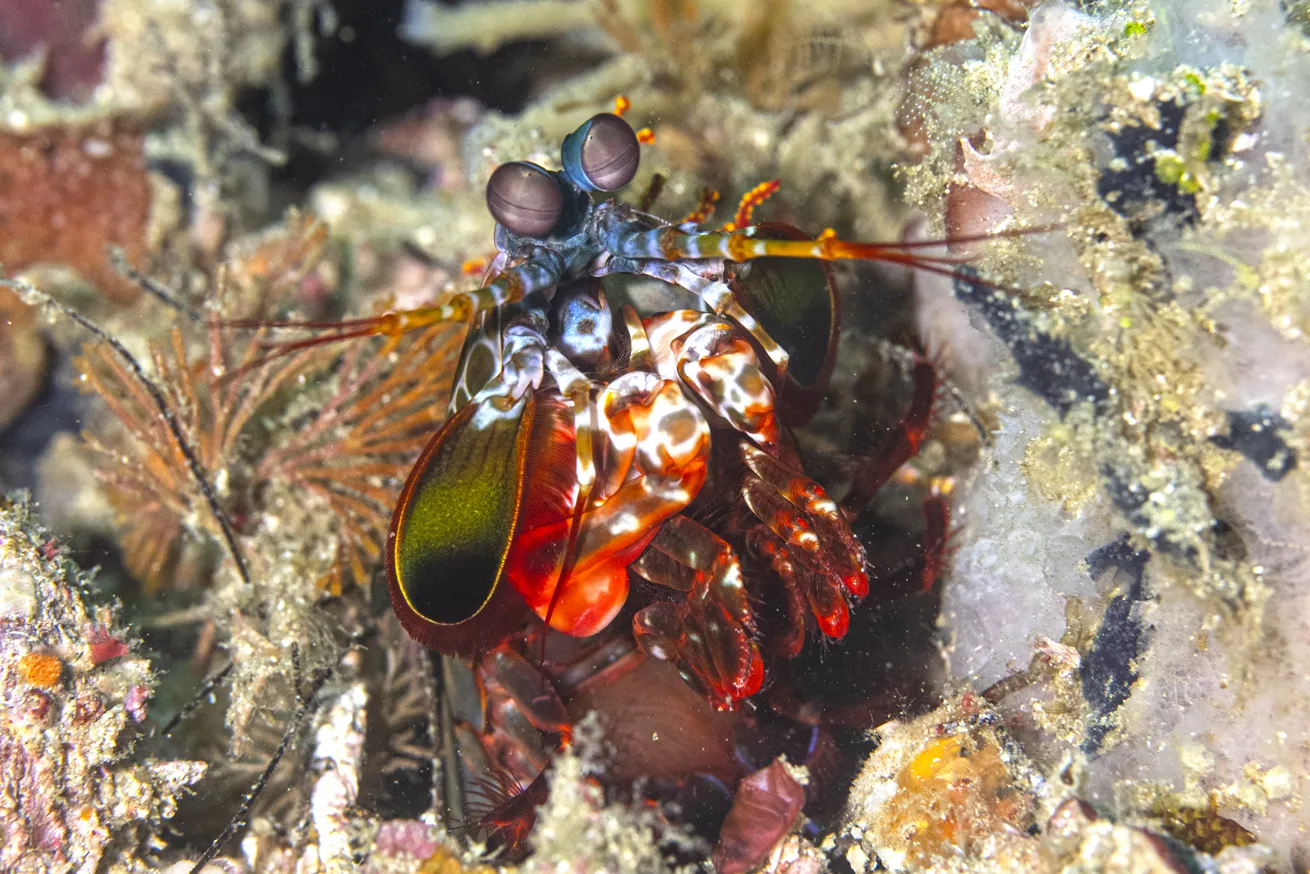
Candice LandauA peacock mantis shrimp pokes its head out of its den to watch divers pass.
Muck Diving After Dark
I’ve never been muck diving before, but the first night dive in Komodo—at a site called Sebayur Kecil in the Lintah Strait—gives me a taste for it. When my dive guide, Rizald, ventures away from the reef and out onto the open sand flats I can’t help but feel indignant. We’re on a time limit here, and I want to photograph critters, not crawl along the sand at 60 feet. What on earth is he doing?
Unsurprisingly, he knows better than me because soon enough he’s pointing to a hydroid atop which curls a nudibranch that looks more like a string of blue and yellow beads. After the nudibranch we spot a cuttlefish on a crest of sand, its smile-shaped eye closed to avoid my bright Kraken video light. I shift the dial down and give the cuttlefish a break. Soon after, Rizald finds a leaf scorpionfish that looks only a bit like a leaf and a lot like a tiny yellow warthog. I spend a minute trying to backlight it before deciding it too needs a break.
I spot a red shrimp nestled inside a sponge and marvel over how its eyes shine like small amber stones, reflecting in my video light. Every rock reveals a selection of neon tunicates: hot pink and purple, turquoise and orange. I’m sure the guide is perplexed as to why I’m taking photos of them, but I can’t help myself; the colors and the delicate veins inside their bodies make for beautiful close-up photos.
Related Reading: How to Photograph Nudibranchs
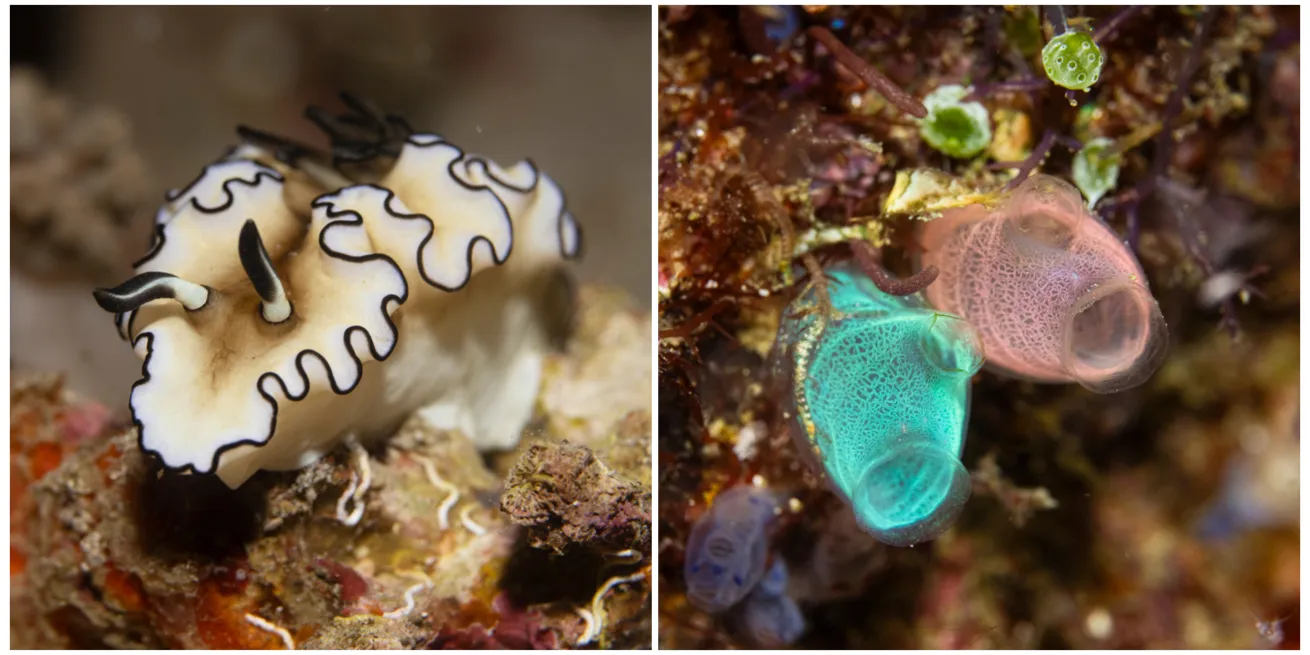
Candice LandauFrom left: A black-margined Glossodoris nudibranch makes its way over the rocks; Lace-veined tunicates in candy colors filter plankton through twin siphons on a night dive, adding bright pops of color to photographs.
Though I love night diving, it never ceases to make me feel inconsiderate as my light passes over the many sleeping fish tucked into corals or rocky crevices. I’ve learned to skim over these things and never to photograph fish after dark when they’re resting.
The following night I find myself entranced by cassiopea, a photosynthesizing jellyfish more commonly known as the upside-down jellyfish. It beats like a heart on the sand below and looks like something that would be better placed on a Christmas tree.
In general, it’s hard to know what animals one can photograph without causing damage to their vision.
On our third night dive we happen upon a creature that looks more like something out of the movie Dune. It’s called a conspicuous sea cucumber and is often as long as a diver. The one I watch has a bubble-wrap texture running the length of its body and a number of protrusions around its mouth, not unlike octopus arms. It’s truly an amalgamation of creatures.
Later I learn these feathery tentacles are used to collect food and particles from the environment. These are then transferred to the mouth. Were it not so fascinating, I’d be horrified by it as the tentacles seem to move as independently as fingers.
Related Reading: How to Use Snoots to Light Your Macro Photography
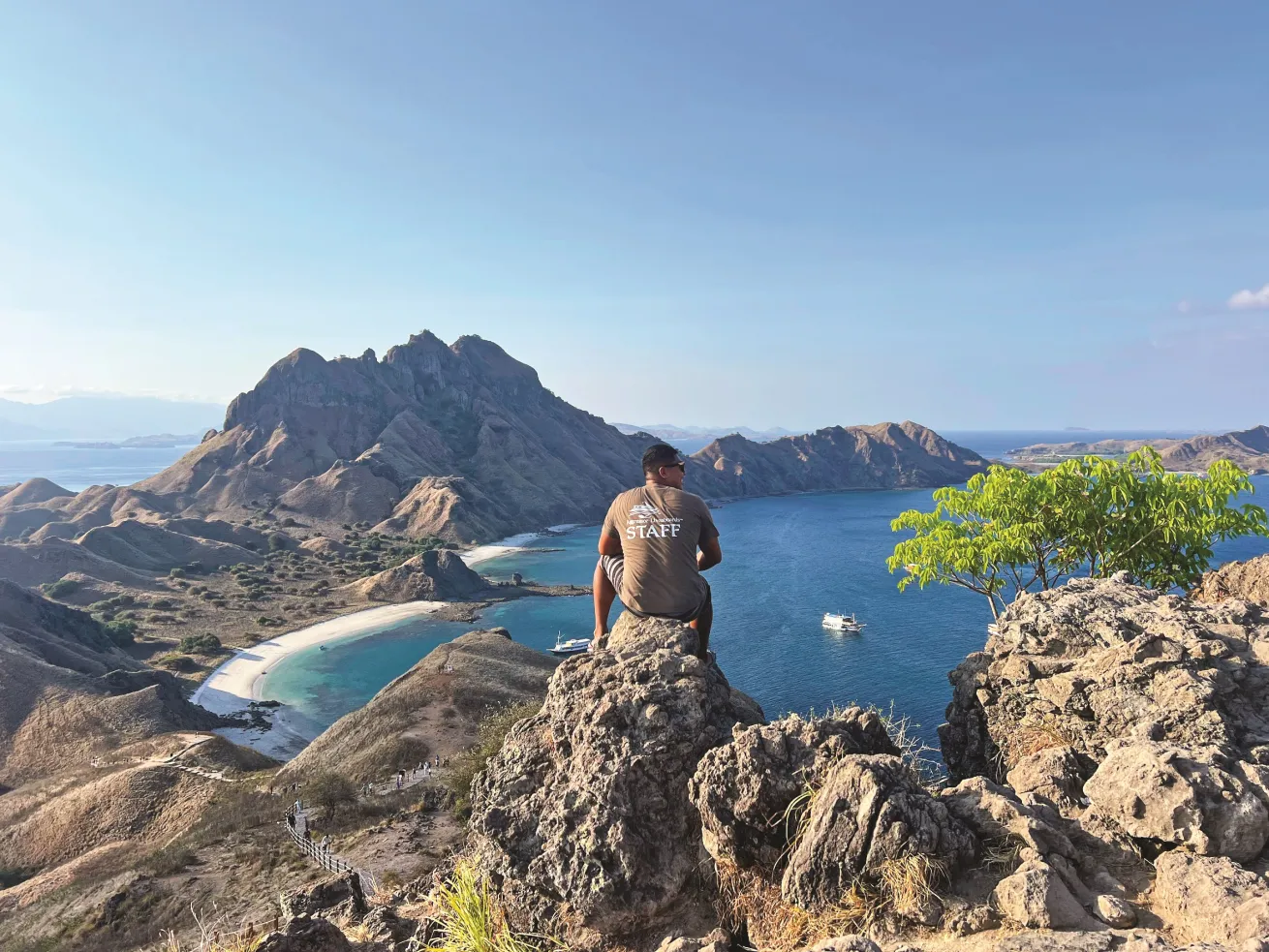
Candice LandauAn Aggressor staff member at the top of a popular hike on Padar Island.
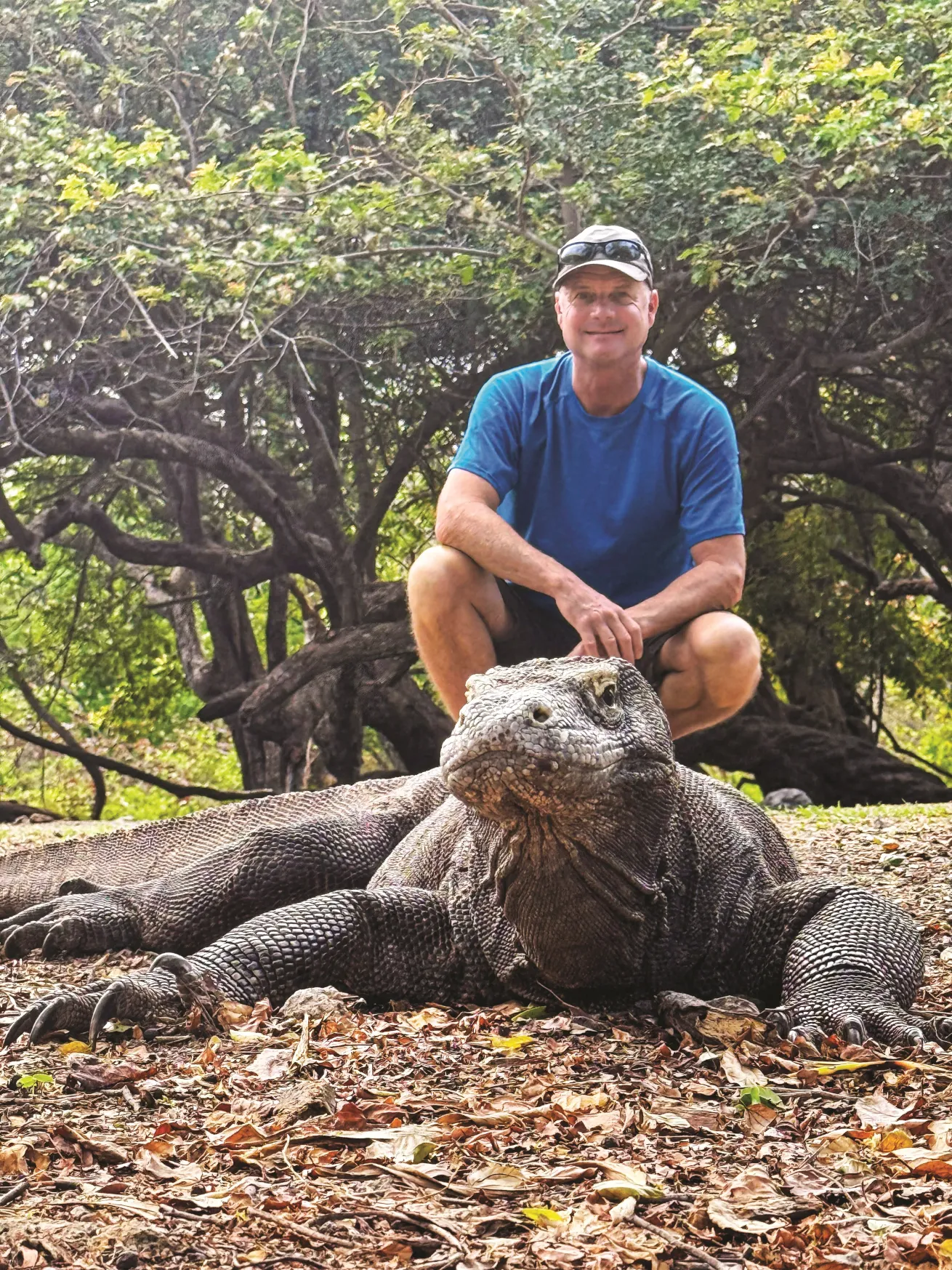
A park ranger’s photo of fellow Aggressor guest Jon posing behind a Komodo dragon.
Topside Distractions
When I ask the other divers what critters they’re most fascinated by, the answers range from frogfish and red magic carpet nudibranch to mantis shrimp and Komodo dragon—which we’re all here to see, in spite of being in Komodo primarily to dive.
Komodo National Park isn’t anything like I imagined. It’s not the rough and tumble experience I’ve had in other remote locations, or the orderly curated experience one gets from a zoo or an aquarium. It’s something in between, a combination of both a curated experience and a touch of the wild.
Jackie, one of the other divers on the trip, tells me it wasn’t always like this. Years ago, when she last visited, rather than take a wood-paneled sky walk—“the trekking path”—that stretches above Komodo dragon territory, she had to cross the open mud flats instead, walking past mangroves and sun-red soil and past surprisingly large water buffalo as well as many solitary Komodo dragons. Our trek is admittedly more pleasant.
At the visitors center we learn all about this peculiar reptile—they are ambush predators, their bite is venomous and they’re the largest lizards in the world, with a body weight of about 45 pounds.
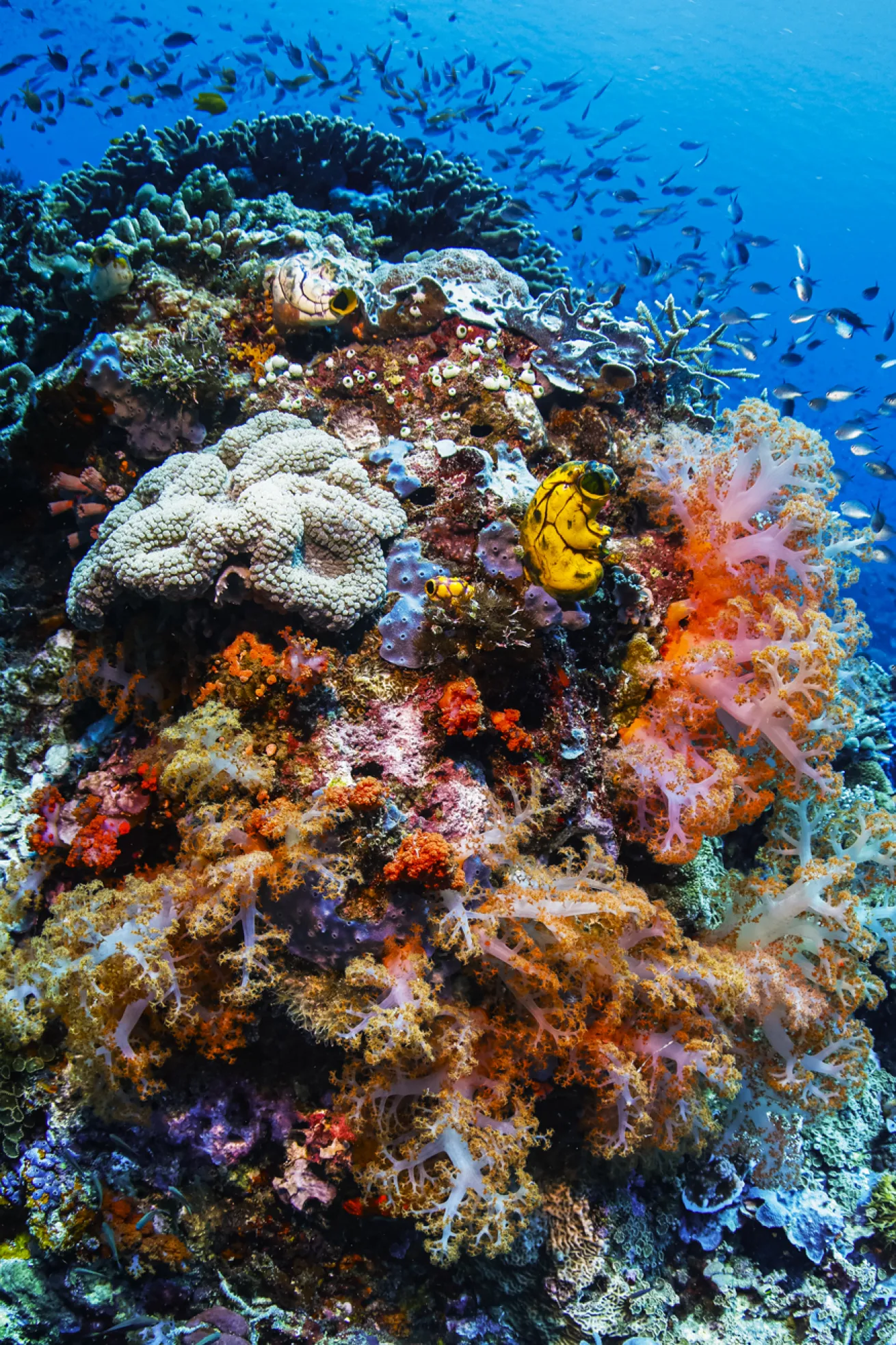
Candice LandauA current-swept bommie bursts with Dendronephthya soft corals and sponges.
As we traipse through the park, we spot many wild pig bones and even a couple of enormous water buffalo skulls. It feels a bit like going on a shark dive as each of the guides with us—one at the front of the group and one at the back—has a stick with them, just in case. And sure enough, at one point, we jump when we hear him fending off a hissing female who incidentally is only trying to get out of the way of a male dragon.
When the ranger asks if we’d like to pose with one of the almost 10-foot-long lizards, I shake my head “no” and instead watch a couple of braver divers-turned-lizard-admirers smile for a shot that makes the dragon look immensely closer to the person than it is. I regret not getting one the instant we move on.
Our one other land detour is a hike on Padar Island. The 360-degree views are worth the climb. By the time we descend, the heat has found us; I’m glad for the water I’m carrying and that we beat the swell of people. In my opinion, no sunset is pretty enough to trade for a queue, though we do spend a few minutes haggling over the carved wooden dragons sold at the foot of the hike. I can’t help myself; I walk away with two.
Related Reading: The Organization Helping to Protect Seahorses, Sea Dragons and Pipefish
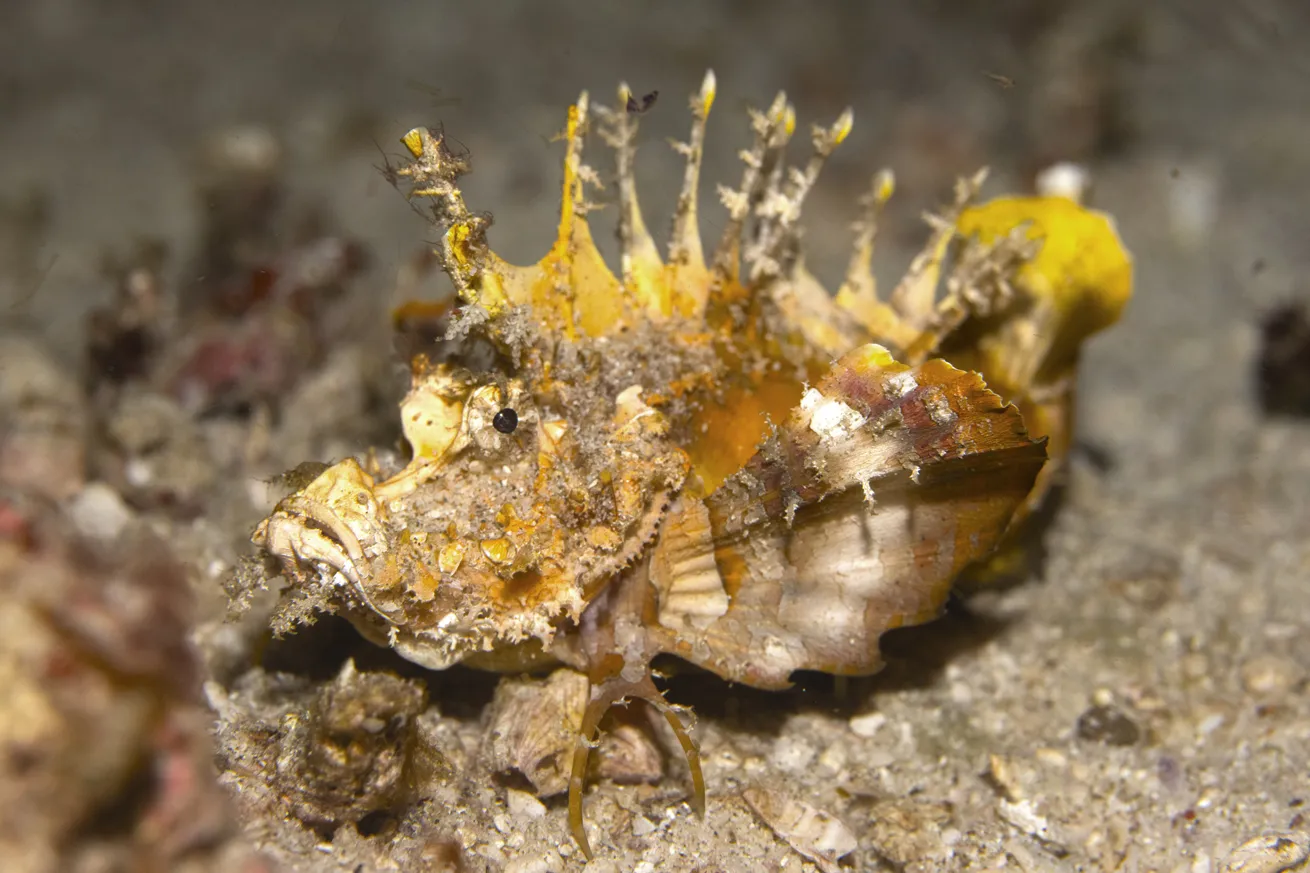
Candice LandauA spiny devilfish uses its two walking pectoral rays to shuffle across the sand.
The Last Dive
The final dive matches the others for beauty, and surpasses them because we take it slow and thus have plenty of time to enjoy looking for unique critters. We slip from the tender, settle on a desert of corrugated white and start toward the reef. Immediately we spot a tight baitball of juvenile striped eel catfish. I’m mesmerized and I watch as the school behaves like a conveyor with individuals at the bottom feeding in the sand, then rotating outward while others take their place, whiskers combing for morsels. It’s a small reminder that for many there’s safety in numbers.
What follows is a calm drift over an endless field of healthy cabbage coral, as well as a number of portrait shots featuring my dive buddy and turtles: sleeping, scratching their back, munching on the reef. At one point our guide signals “ray,” waving his arms up and down, and I peer into the water column, distantly spotting his find. When I surface and ask Jon, another diver, if he enjoyed his dive as much as I did, he looks at me and grins. “We saw a dugong.” Better yet, he captured it on video.
As I wrap my hands around a fresh-squeezed glass of fruit juice and listen to him replay his encounter, I’m not even jealous. OK, maybe a little. The topside rituals are doing their job: Nerves downshifted, senses open, I feel content. I’ll see my dugong someday. For now, the strap on my Shearwater is one notch tighter and the sea still has secrets for me to uncover.
The Boat Komodo Aggressor, a 95-foot phinisi yacht, has eight staterooms and capacity for 16 people. The itinerary was an adapted version of North Komodo itinerary (seven nights), and we completed between three and four dives a day. All diving was done from two tenders.
When to Go Komodo Aggressor offers six distinct itineraries, each scheduled during the best time of year to dive. Though Komodo can be dived year-round, the optimal time to go is between May and October as rain and rough sea conditions are much less likely.
Getting There Take a round-trip domestic flight from Bali to the Komodo International Airport near the city of Labuan Bajo ( LBJ) in Indonesia.
Water Temperatures Water temperatures can vary greatly depending on where you are going within the area. In the south, the water is a little cooler, with temperatures dropping as low as 72 degrees. In the north, temperatures can reach 84 degrees.
What to Wear In September, I was comfortable in a 3 mm wetsuit. Some people enjoyed wearing hoods.
What to Take A reef hook and SMB with spool are required.
Cost Prices start at $3,325 and go up from there depending on room, itinerary and number of nights. Additionally, there is a port/park fee of $250. Credit card payments on the yacht incur a 2.5 percent service charge. Nitrox and internet charges are additional. Tipping is voluntary.


