

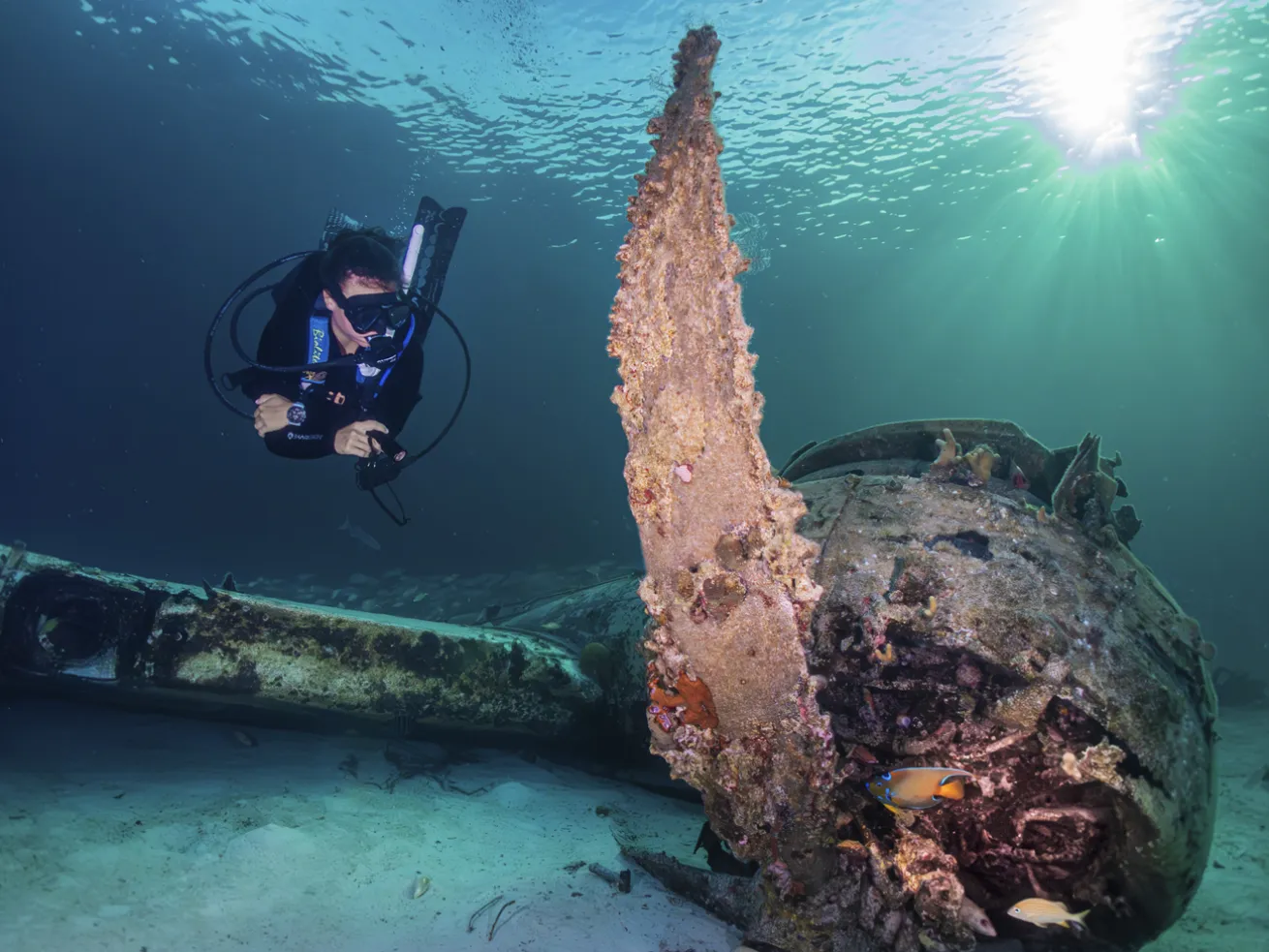
Dive guide Victoria inspects the Smuggler’s Plane wreck.
I’ve known my dive buddy for less than half a day when we share a thrilling underwater encounter.
We’re at Tri Wrecks, a signature Bahamas dive site with three intact freighters purposely sunk in the 1980s to promote reef growth. Victoria, our divemaster, sketched the site layout from memory at breakfast and now we navigate it with confidence. While I’m on the hunt for photo-worthy features like a coral-encrusted anchor or propeller, Terri is here to enjoy everything that comes with being submerged—the feeling of weightlessness, being immersed in nature, the space to relax, the animals. Sportingly, she’s even agreed to model for a few of my photographs.
Attentive to my focus, Terri pauses to pose amid a school of glittering silverside fish, coral dripping down from above her like so many strings of colored jewels. I take a picture, and we continue. As we crest the hull of one of the wrecks, I see the rest of our group hovering midwater. Two dolphins are spinning between them, looping and whirling, eyeing each diver as they pass just feet from outstretched action cameras.
In 10 years of diving, I have never once seen a dolphin underwater. For two minutes the pair keeps us company, arcing within arm’s reach of our group, giving us the hairy eyeball before breaching the surface for a breath of air. My heart hammers wildly and I feel joy so intense my throat throbs and my eyes blur. Later we review each other’s footage around the long dining table, gawking at the incredible videos Catherine and Alec—a young couple from Boston—managed to capture.
Related Reading: Discover Reconnect in Indonesia’s Untouched Togean Islands
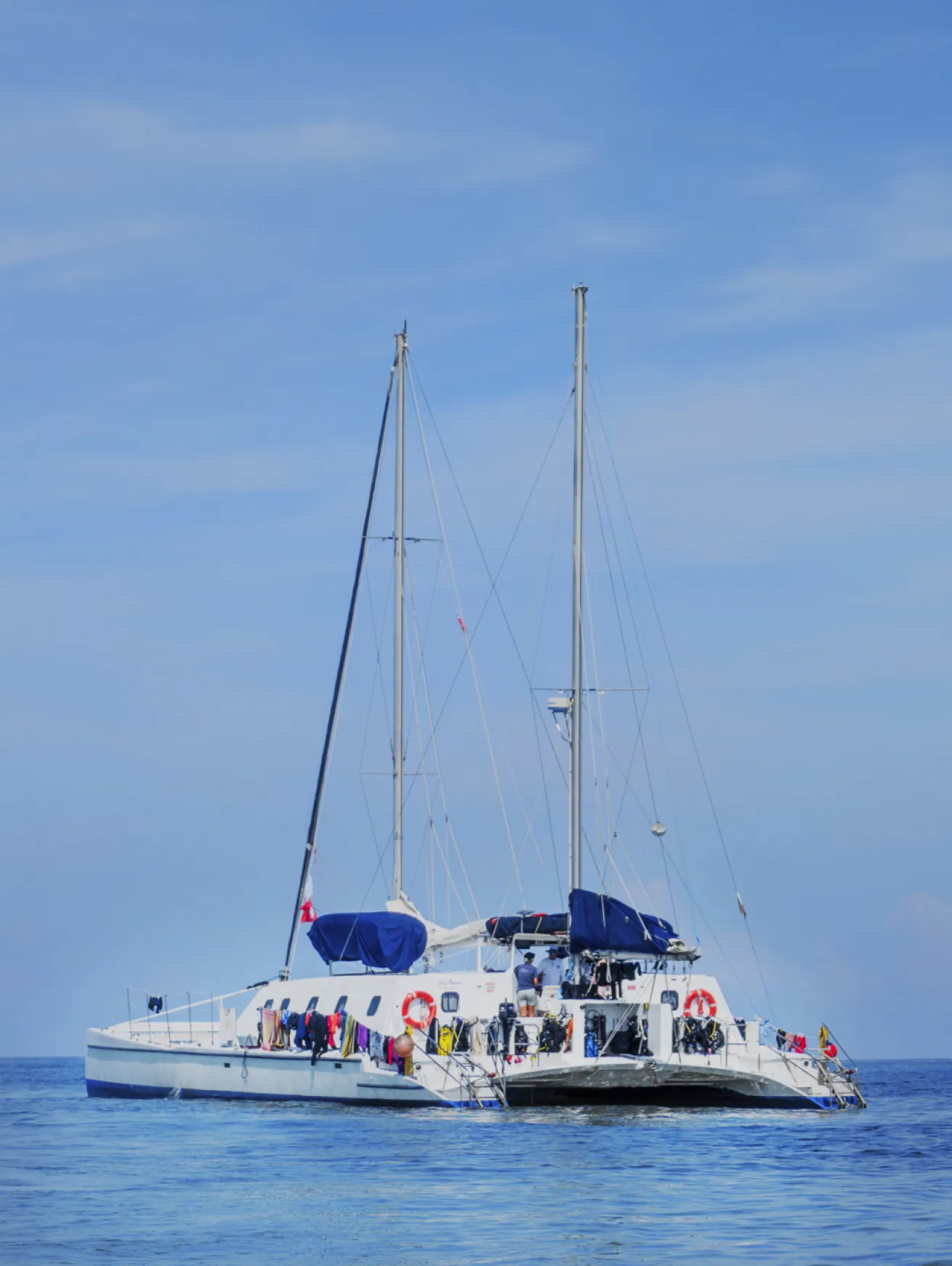
Candice LandauCat Ppalu awaits returning divers.
Punch Above Her Beam
Though I’m no stranger to live-aboard diving, I’ve never roomed aboard or dived from a catamaran like All Star Liveaboards’ Cat Ppalu, nor in the Bahamas. I can’t help but wonder how one fits 12 guests and four crew on a 26-foot beam with room left for an air compressor, six cabins, a galley, two heads and enough space that one can peaceably loiter and sun between dives.
I get my answer at the dock. Captain Bill—a veteran Scottish sailor—shakes my hand, his lilting accent and gentle sense of humor immediately putting me at ease. He introduces the crew: Jen from Germany, who normally captains another All Star vessel; Chris from South Africa, engineer and chef; and Victoria from Delaware, our divemaster.
I discover quickly that though Cat Ppalu is indeed a little more snug, its very size lends it a number of advantages, chief of which is flexibility. We can tailor the itinerary to our desires—be they land-or sea-based—and we can maneuver into spaces larger vessels with a deeper draft can’t. And that’s all without mentioning the camaraderie that develops when you live, dive and relax in such close quarters.
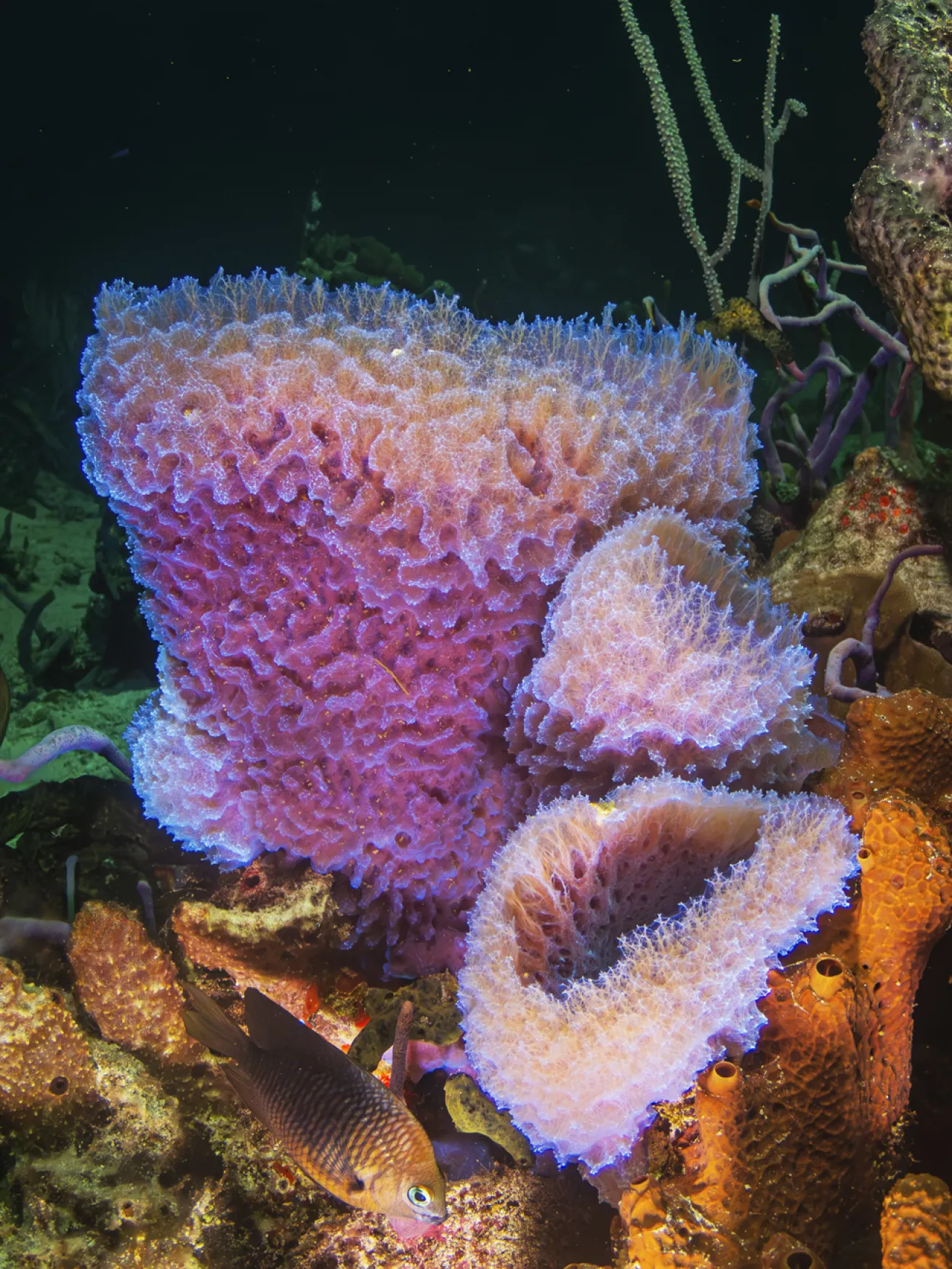
Candice LandauPurple vase sponges add a blush of color to the reef.
When three passengers have delayed arriving flights, we’re offered a chance to relax or dive. And thus, not three hours after landing, I’m giant-striding into the water and onto the Mahoney, a shallow steamship wreck close to Nassau. I’ve never done a check dive on day one, let alone such a beautiful dive, covered as it is with wafting purple sea fans, thick schools of yellowtail snapper, parrotfish crunching heartily on the reef, and Christmas tree worms stuck like buttons to yellow hard coral everywhere the eye stops. When I clamber out of the water, I’m tired but happy. I forgot how much fun shallow diving can be. Though I certainly like my deep dives too, I’m not upset that a few people have put in requests for shallower dives. After all, they do make for fantastic photographs.
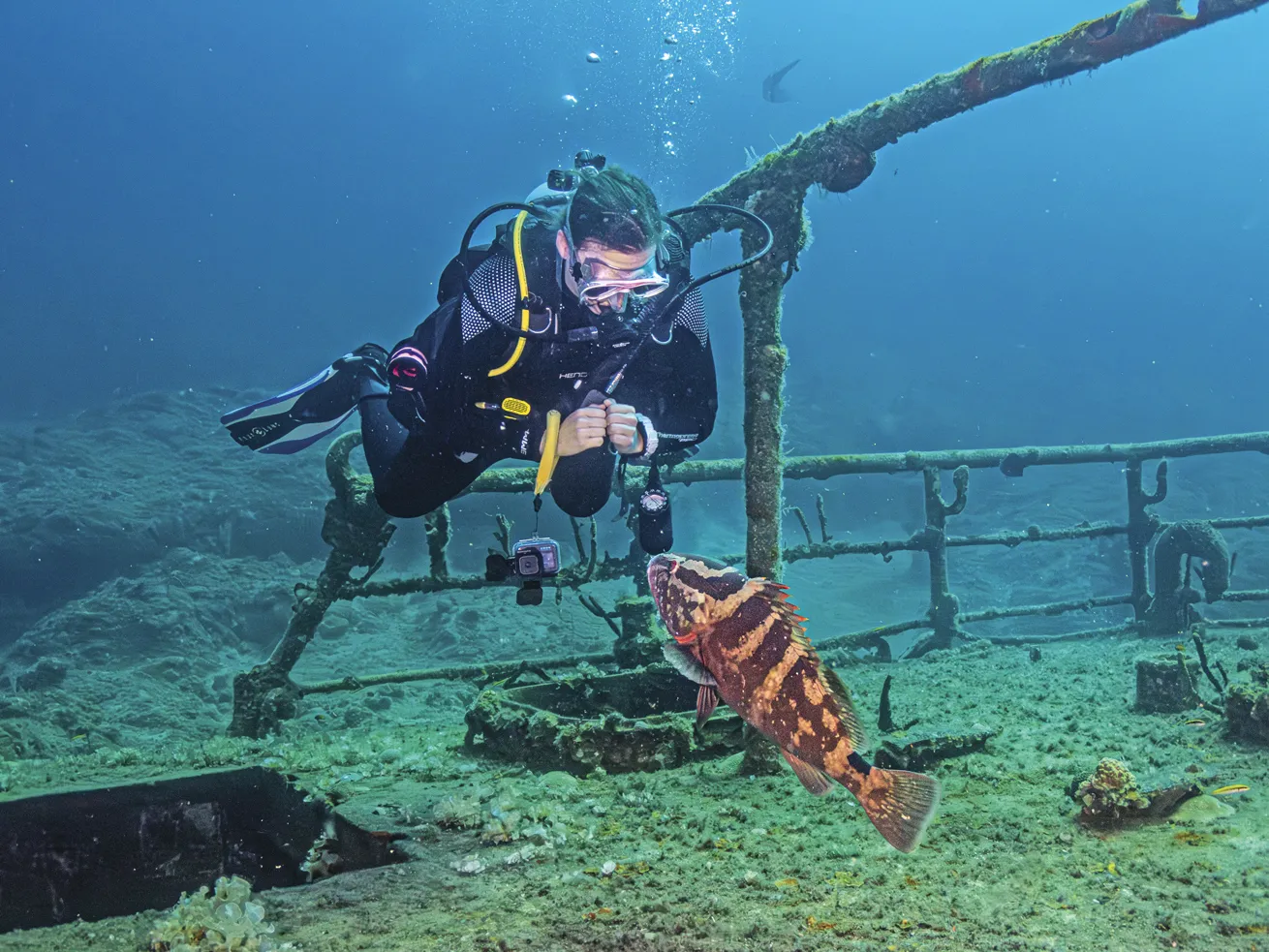
Candice LandauCatherine shares a unique interaction with a Nassau grouper.
Witnesses on the Austin Smith
Our itinerary takes us from port on New Providence to the remote Exuma Cays, a sprawling string of more than 350 islands that also includes a marine protected area. While most of our Exumas dives are coral reefs, the dive at the wreck of the Austin Smith—a 90-foot, purpose-sunk Bahamian patrol vessel—is the one that stands out.
Victoria leads us as we plunge down, cross a vista of corals alongside the abyss of the Exuma Sound, and are greeted by a Nassau grouper. The fish follows us all the way to the Austin Smith, where it takes a particular liking to Catherine. I focus my camera on the pair as the grouper noses up to Catherine’s face. It might be inquiring after food, or it might have decided that something about this woman is special.
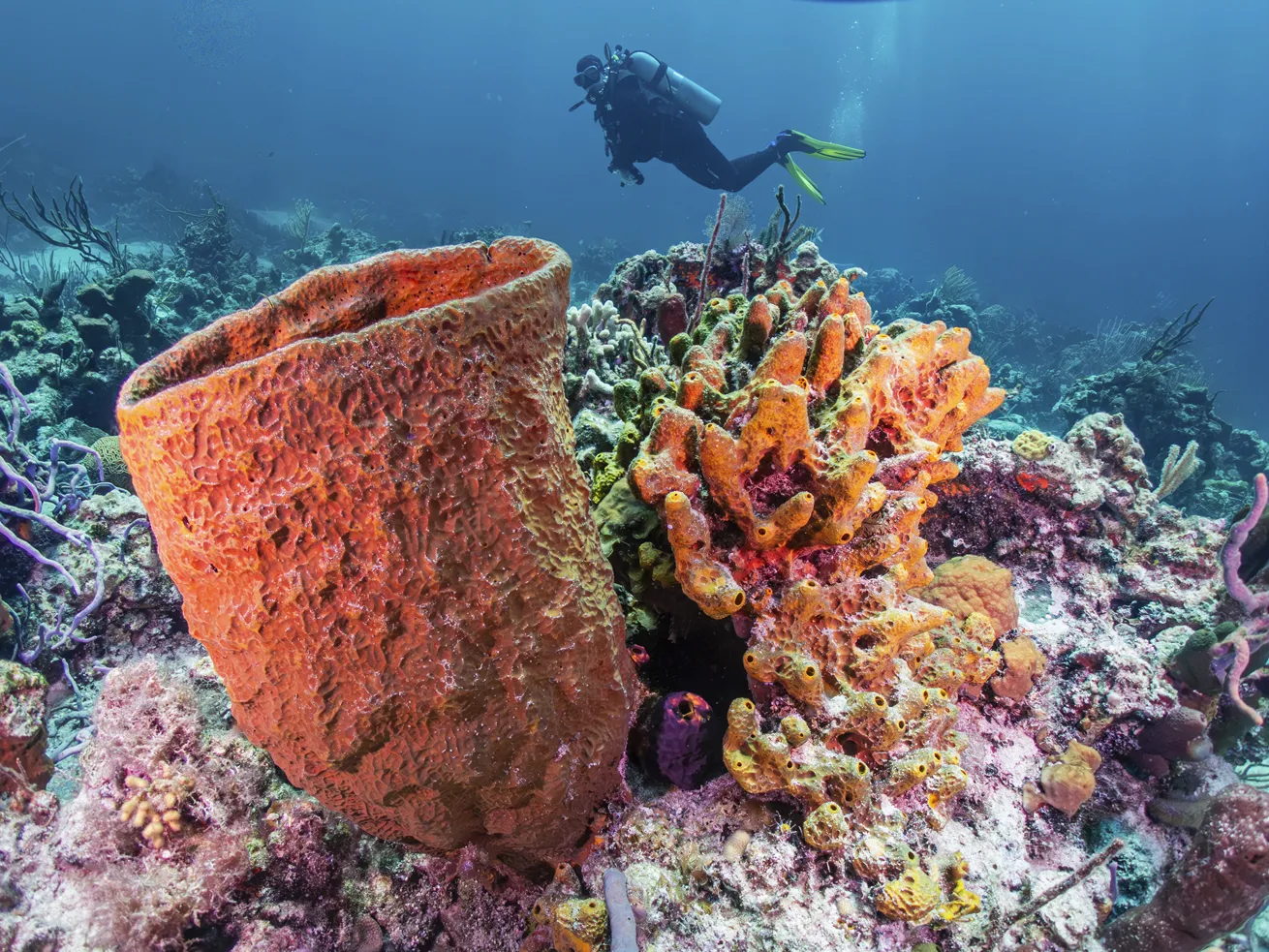
The author’s dive buddy swims past a giant barrel sponge.
As I spin around Catherine snapping shots, the grouper turns to check me out, possibly to fend me off from its chosen person. I want to laugh as it photobombs my frames and gives me some serious eye contact. Then I look back at Catherine and see Alec beside her. He’s unfurled his SMB and is holding it lengthwise in front of Catherine. Written on it, in large capital letters, are the words, “Will you marry me?”
I squeal into my regulator and watch as Catherine and Alec take theirs out and kiss. A yes, then. The grouper, as if it had known all along, returns to Catherine and stations itself in front of her. It moves between Alec and Catherine as if to ordain them, then settles in front of them and poses for a few shots. I turn away to give them privacy and find myself face to face with Gracie, another diver from our boat, who points at them and makes the universal “exploding-head” gesture. Mind blown. I laugh and take a photo of her expression. If the closer quarters hadn’t established a feeling of camaraderie already, this would.
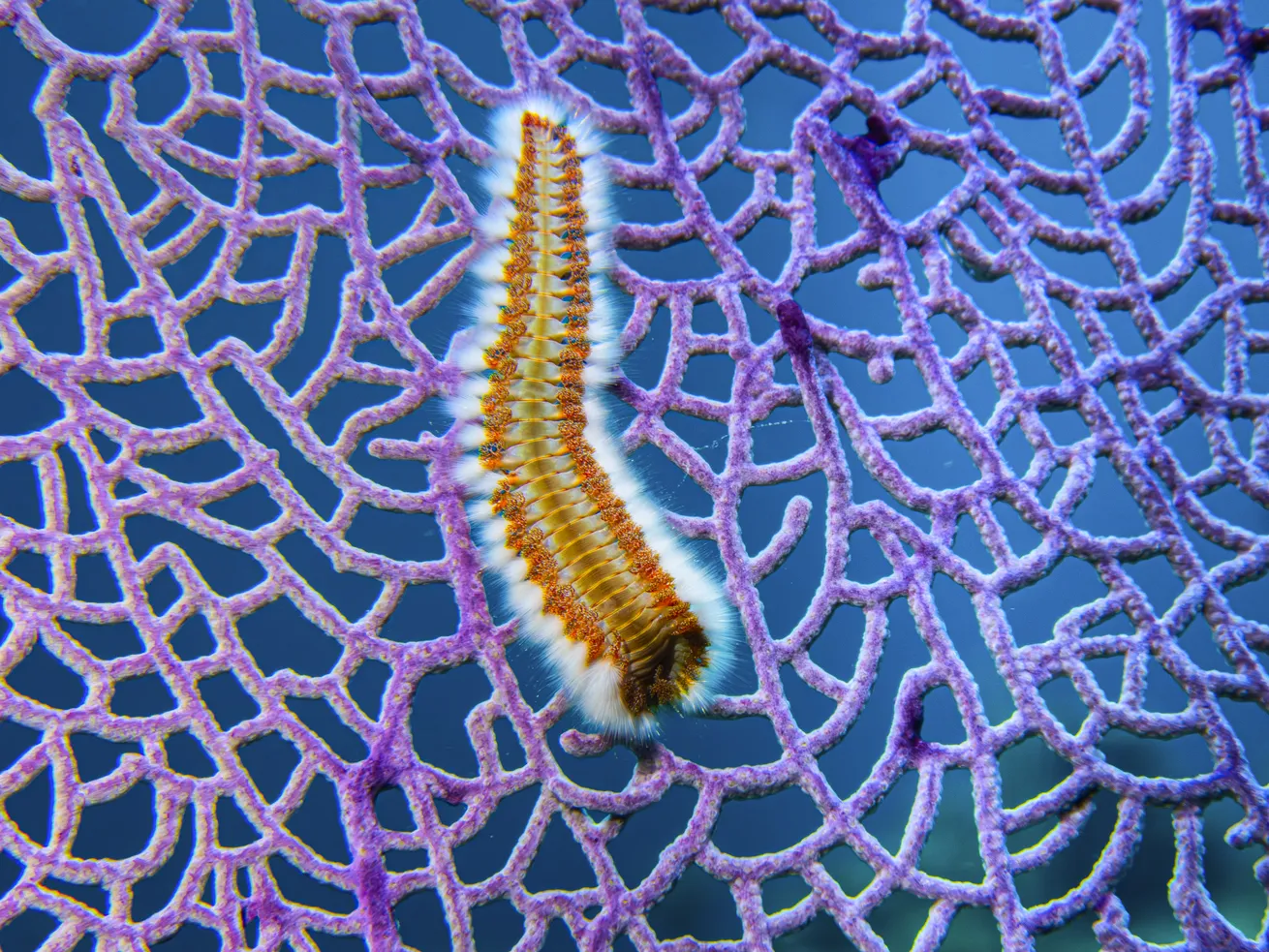
A bearded fireworm sits atop a purple sea fan.
All Hands on Deck
The morning after the proposal, I wake at 6 a.m. to rain lashing the window and the howl of wind I associate with Florida tropical storms. Surely not, I think, just as the boat’s engine starts up. The catamaran feels calm. There’s no frenzy of shouting above. Must just be bad rain. I try to sleep through it. Half an hour later, the voices upstairs win and I throw on a jacket and peer out.
To my surprise, most of the boat is awake. Jen is vacuuming the saturated galley carpet. The rain cover blew off, she tells me; she rescued the clothes from the drying lines and brought my camera gear inside before that went too. One of my rash guards and a strobe diffuser didn’t make it, but it’s the least of my worries. Outside, Cat Ppalu’s new dive flag has been torn into something that looks more like a pirate flag.
Later we learn the storm clocked over 72 knots—tropical storm force. Cat Ppalu was the only boat in our anchorage that didn’t drag. Some of the others ended up beached. I go back to my cabin and sleep, secure in the knowledge that the crew knows what they’re doing.
By lunch, Chris has tacos on the table, and in spite of everything, we still manage to dive three times that day. The whole morning has been handled—the storm, the cleanup, even assisting other sailors—without asking anything of us, the passengers.
Related Reading: Galapagos, Party of One
Eighteen Dives
Every dive earns its place in my dive log. At Ray’s Reef, I stride off the back deck into 80-degree water and follow my torch through a parade of small lives. It brushes over a sleeping trunkfish, a shrimp with glowing red eyes that skitters out of the dark, spaghetti worms pouring from beneath a rock, and blood worms drifting from my beam onto coral polyps that bloom to feed on them as I watch. Amy, another of my dive buddies, points out one of the largest basket stars I’ve ever seen and an octopus that changes color at least three times before dipping out of sight.
Crab Wall delivers the opposite scale, a vertical face dropping a thousand feet into Exuma Sound. I look up to see two reef sharks circling the catamaran. It’s a site with beautiful vistas.
I dive Smuggler’s Plane twice—first for 15 minutes in daylight, snapping photos of the props and wings, Victoria posing for scale, and then again after sunset for a full hour. In the pitch black, the wreck transforms, covered over with fish and basket stars.
At Barracuda Shoals, Victoria tells me that our captain, as a young boat engineer in the late 1980s, partook in research that traced a die-off here to ship ballast water and the loss of black sea urchins. The reef is healthy again now, and alongside Terri and Amy, I spot at least a few of the urchins. Velvet black, they’re impossible to photograph well.
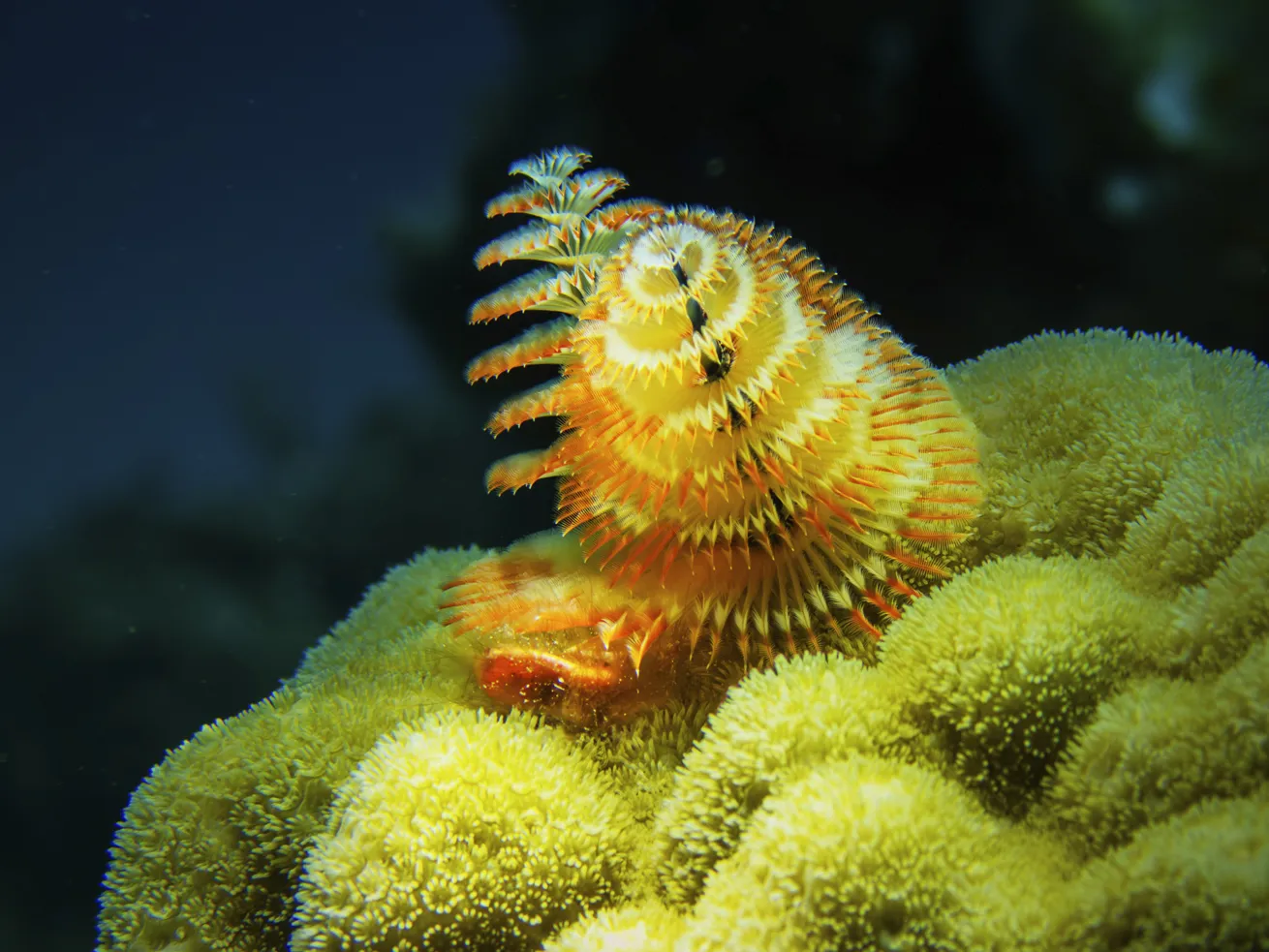
Christmas tree worms add pops of color on nearly every reef in the Exuma Cays
Above the Waterline
Above water, the Bahamas is just as alluring. At Ship Channel Cay, we feed pigs while standing in waist-deep water. Kevin, the pigs’ guardian, points out his favorite, Oreo, a black-and-white pig that is a pro at taking carrots from our hands. I’m a bit more partial to Slippers, a young brown pig, friendly and the size of a puppy, that has a knack for swimming and eating at the same time. On another small island we clamber onto the beach to meet and feed grapes to iguanas. For the most part, we are the only boat on our dive sites. I find it strange that this is possible in the Exumas. I had expected it to be busy, but the chain of small islands has the aura of the untouched, and everywhere bursts with history, archaeology and discoveries still to be made.
Down the Blue Hole
By the time we reach the Lost Blue Hole on the last morning of our itinerary, the Exumas are behind us and Nassau is a few hours off. Bill and Victoria both refer to it as one of their favorite sites, and as I sit and listen, I already feel the longing and nostalgia that accompany a good dive trip coming to a close.
The blue hole is a hundred feet across, ringed by a coralline reef that is rich with life. Before we drop into the abyss, I float above and look down. Unlike the Great Blue Hole in Belize, which is so vast it’s impossible to make out except from an aerial vantage point, this one can be seen in its entirety while underwater, and that’s in spite of the ever-present silt that reminds me of the steam rising from one of chef Chris’ dishes. It’s both eerie and awe-inspiring.
Not even the sharks are immune to the call of the deep, and I watch as a reef shark torpedoes vertically into the hole before returning to its normal horizontal swimming position, circling calmly, round and round. I witness this behavior a couple more times and begin to wonder if the sharks are playing. Currents aren’t strong inside the hole, but they are present. As my buddy and I explore, we notice that here and there, wedged into cracks are dozens of nurse sharks.
When we hit our no-decompression limit, we rise to explore the reef that skirts the rim. It’s alive with stingrays and parrotfish, eels and silver sennets that look a lot like miniature barracudas.
As I fin back to the boat, I take it all in: the divers silhouetted on the rim or hovering above the hole; the glittering shafts of light moving across the seagrass; the distinctive underside of Cat Ppalu’s twin hulls on the bright ceiling above.
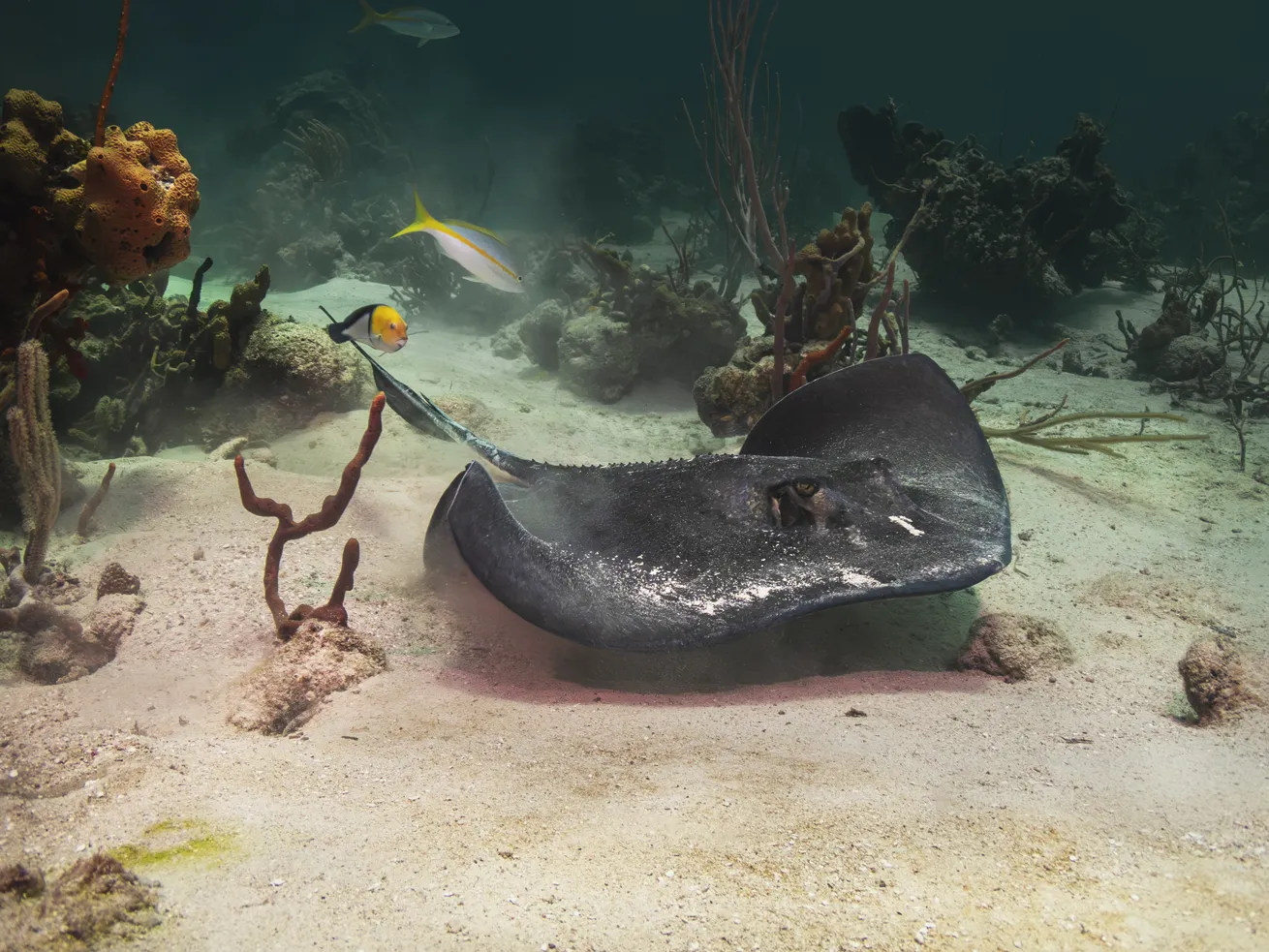
Candice LandauA stingray scans the sandy bottom.
.png)
Later, when I ask the other passengers why they chose to vacation in the Bahamas on Cat Ppalu, the answers align with my own conclusions. It’s a beautiful and peaceful place, it’s easy to get to, the flexibility of the itinerary is refreshing, and the diving is accessible. Even the crew, who have lived and dived all over the world, are hooked. Earlier in the week Captain Bill tells me there’s nothing better than waking to an endless horizon of water, always in the midst of nature. I know what he means, as every morning I’ve wondered why I return to land.
By lunch, the plane will take me back across that horizon. Cat Ppalu will turn around tomorrow with 12 new strangers, and the crew will start the engine, perhaps even hoist the sails, and head back out toward that endless horizon.
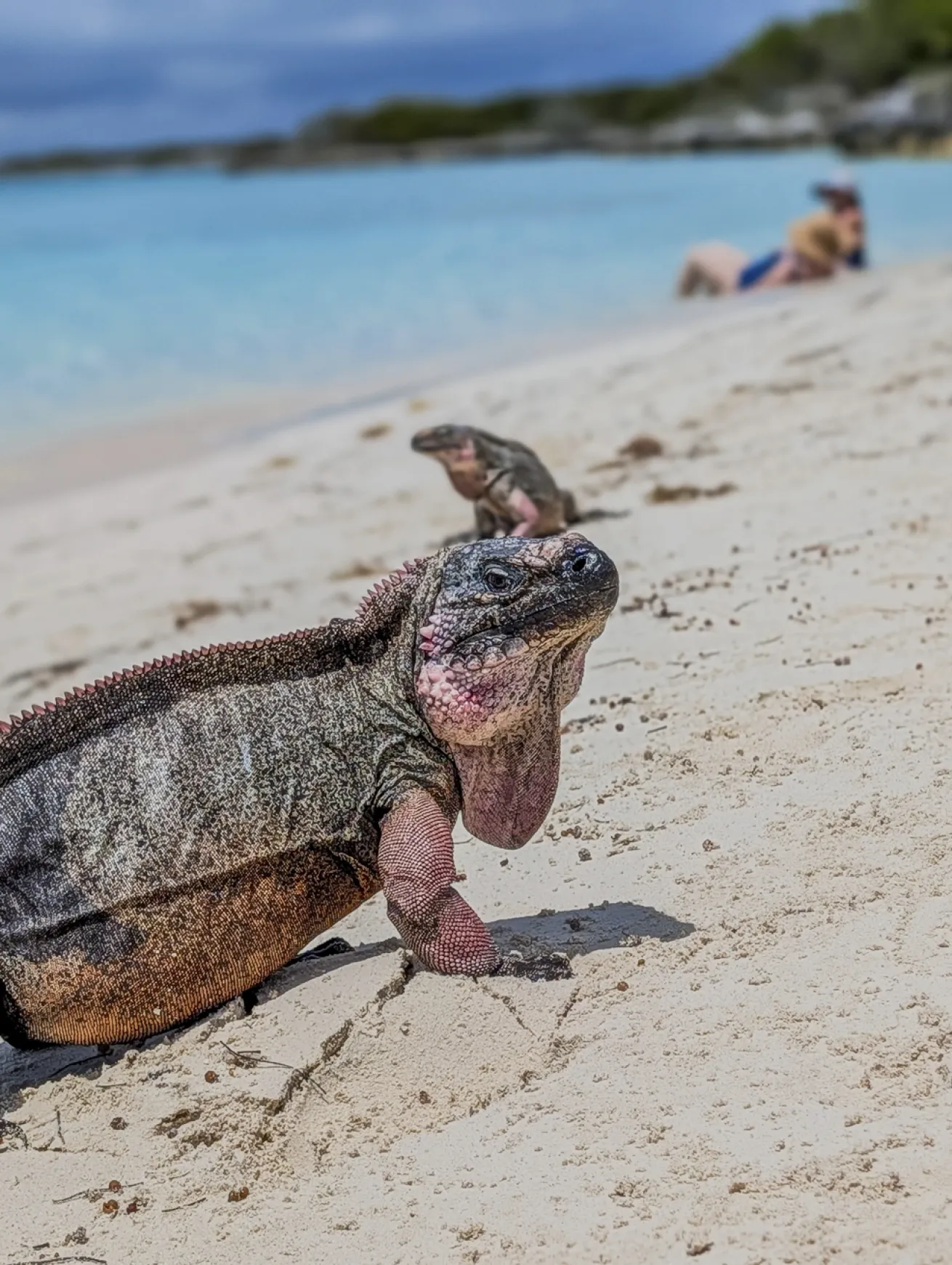
Candice LandauRock iguanas on the Exuma Cays chain.
FAQ Diving Cat PPalu Bahamas Liveaboard
What is the best way to get there? Cat Ppalu departs from Nassau Harbour Club Marina on Saturdays. Airport transfers can be arranged from Lynden Pindling International Airport (NAS).
What is diving with Cat Ppalu like? A 65-foot sailing catamaran with a 26-foot beam. Six air-conditioned cabins (four doubles, two twins), two freshwater heads with showers, four-person crew, 12 guests maximum.
What is the itinerary for liveaboad diving in Bahamas? Six nights, Nassau to the Exuma Cays and back, with the route customized to weather and guest preferences. Up to 19 dives, plus optional kayaking, paddleboarding and island excursions.
What type of diving can I expect on a Bahamas liveaboard? Open water–diver friendly. Most dives are unguided after a thorough briefing. A guide enters the water for the check dive, drifts, night dives and the shark feed.
When is the best time of year to dive in the Bahamas? Year-round. Spring and early summer bring the calmest seas and warmest water. Spiny lobster migration runs October to November. Water temp is 72 to 86 degrees and coolest between January and March. A 3 mm wetsuit covers most of the year. Sub a rash guard or shorty in peak summer and a 5 mm in winter.
What is the cost of a liveaboard trip in the Bahamas? From $1,845 per person. Includes meals, beverages, internet, tanks, weights and dives.
What operator do you recommend? All Star Liveaboards (allstarliveaboards.com)


