

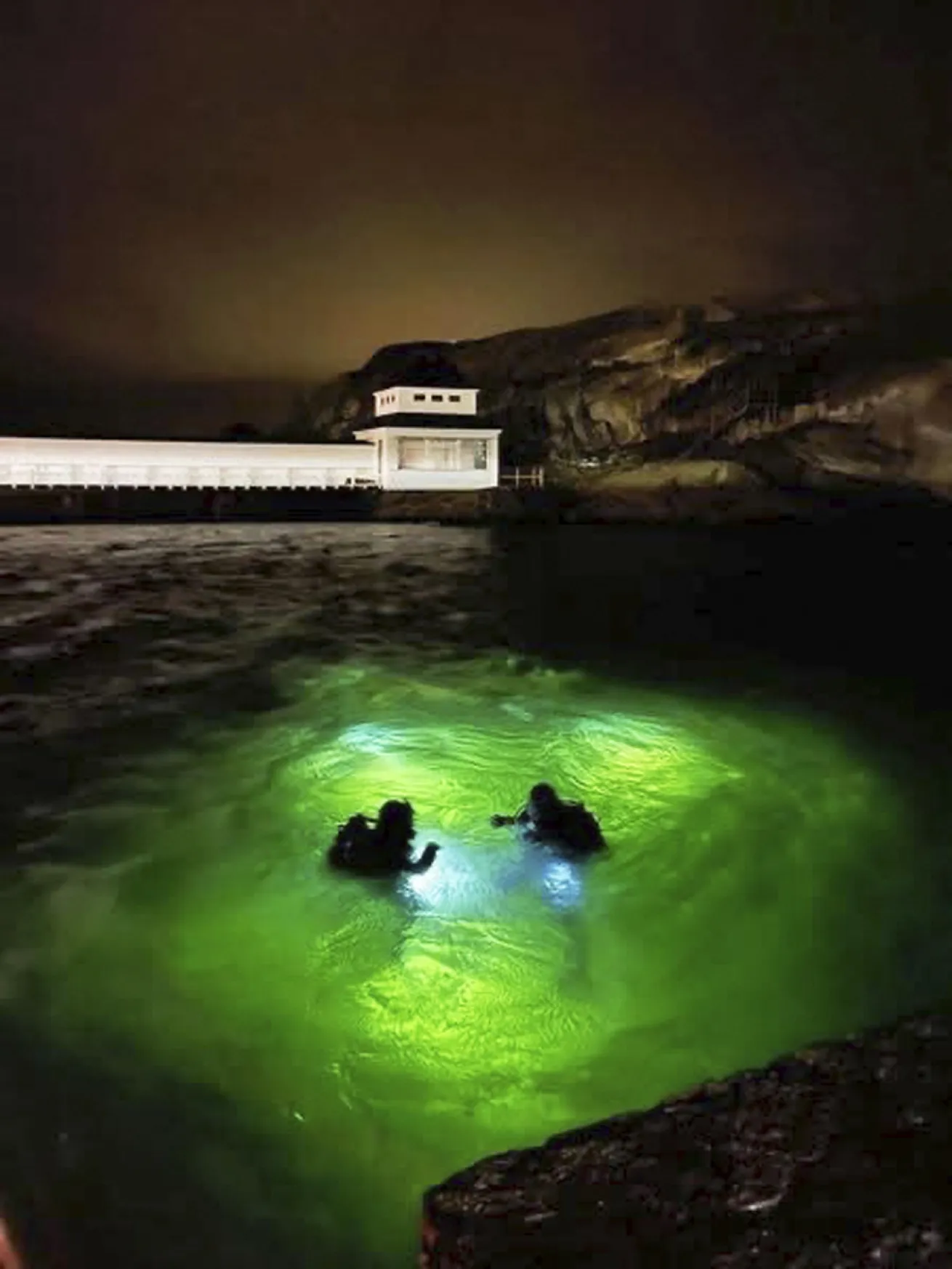
Courtesy Daniel Tiger DahlströmDuring a night dive, the water’s green hues are especially noticeable.
Släggö, which roughly translates to “sledgehammer island,” is a coastal dive site in Lysekil, Sweden. It’s about equidistant from Gothenburg and the Norwegian border, positioned at the entrance to one of southwestern Sweden’s hallmark fjords. The Gullmarn fjord is home to Sweden’s first protected marine park.
Marine Life
“Släggö is located just outside of the threshold from the fjord Gullmarn,” explains Daniel Tiger Dahlström, PADI Master Instructor with Dive Team Lysekil in Sweden. “One of the first things people talk about when they dive in Sweden for the first time on the west coast: The light is very different, and the water is truly green. [Where it’s] shallow, it is almost green-yellow, and deeper [is a] rich, dark green.”
The fjord is just over 15 miles long and nearly 2 miles wide at its widest. The volume of water and environmental conditions are ripe for a wide range of underwater flora and fauna to flourish.
“Marine life here is very diverse. The most species you can see in Sweden are possible to find at the dive site Släggö. During the night, active creatures come out, looking for food and—depending on the season—a partner,” says Dahlström.
Ernestas Budreika, a PADI Open Water Scuba Instructor from Norway who chronicles his dives on YouTube, enjoys diving Släggö with his friends and girlfriend.
“Our first dive was unforgettable: a massive wall structure, rich marine life, large rocks filled with lobsters, crabs and fish hiding in every crevice. Time underwater passes incredibly fast at Släggö.”
Related Reading: 5 Takeaways from DEEP on the Future of Human Aquatic Living
The Diving
“We always dive with our own equipment and typically drive to Lysekil,” Budreika continues. “There is a small parking area directly by the dive shop, and if that is full, a larger parking lot is located near the main entry point. We usually unload gear by the shop first and then park the car. There are many memorable dives at Släggö, but one of the most memorable is the dive around Släggö Island. For this dive, entry is made from the secondary pier, which is normally used by swimmers and beach visitors.”
This route takes divers counterclockwise along a submerged wall. It takes about 40 minutes to arrive back at the pier on a single tank, Budreika explains, and divers may want to do an initial dive to get more familiar with the underwater landscape before attempting to go all the way around the island. There are several other dive options to choose from, including wrecks and beneath the marina.
“By following the wall down to the seabed, the maximum depth is approximately 26–27 meters (85–88 feet).”
Each season has its perks at Släggö, says Dahlström. “Winter is cold, and that means great visibility. Marine life is slow, trying to preserve energy to last the winter. So, with a camera, you can come really close. Spring is when all the eelgrass in the shallow parts explodes with marine life. Little things hide in the grass to grow. Summer is wonderful, both because of the diving, but also because of the happy people, boats and human life. Autumn is nice because the water is at a good temperature, and marine life is big after the summer. The night dives are great with the fluorescent bioluminescence. We long for autumn night dives, since we can’t really do night dives in summer [when] the sun is almost up all day.”
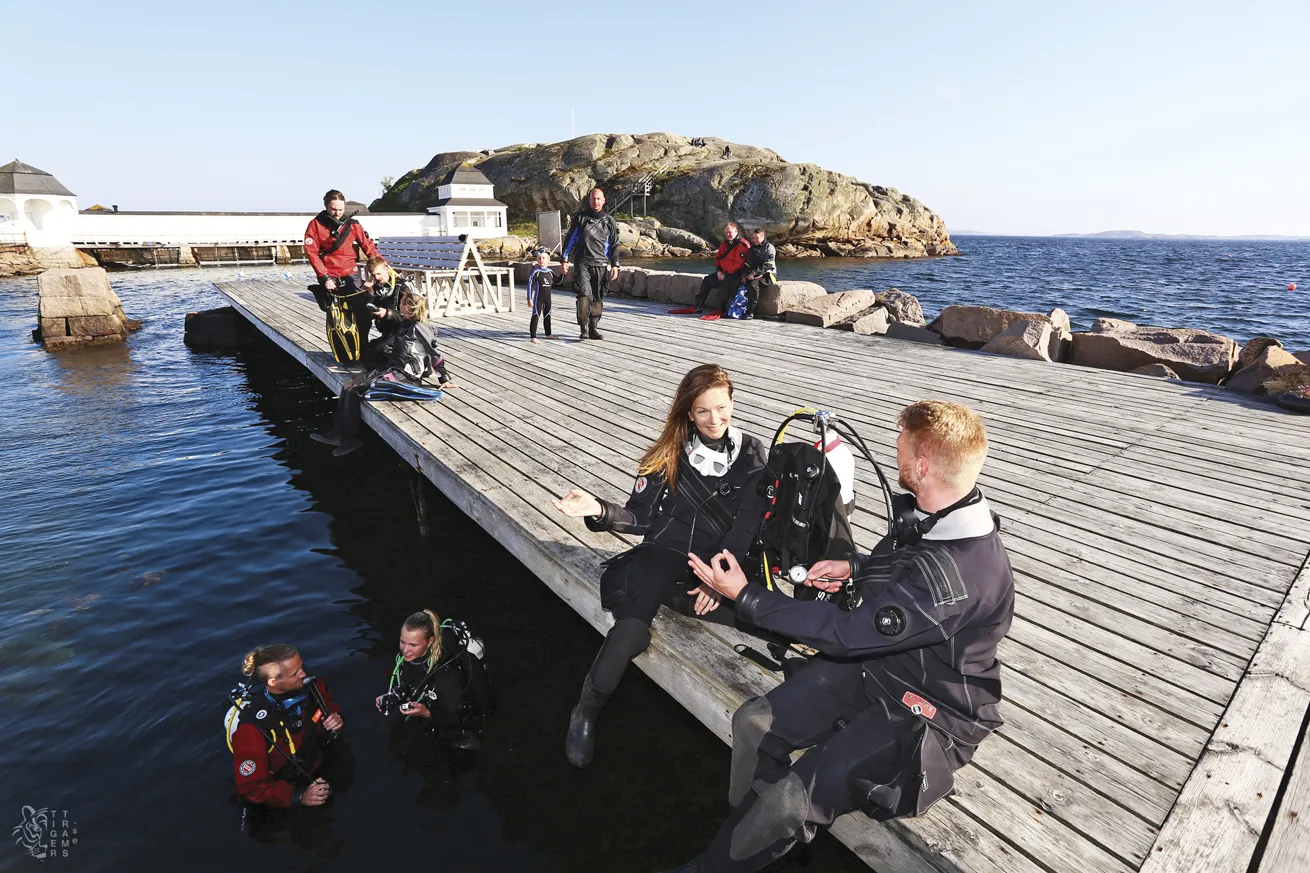
Courtesy Daniel Tiger DahlströmDonning drysuits to combat the chilly water temps, divers meet predive at a pier in Lysekil.
The Community
“At Släggö, the easy entry and welcoming atmosphere remind every diver that the ocean is open to everyone, inviting those with the curiosity and willingness to take that first breath underwater,” says Jolanta Budreikaitė, PADI Master Scuba Diver and Budreika’s sister. Budreikaitė is part of a local group of friends who discovered their love for Släggö at the recommendation of a nearby dive retailer.
“We were instantly impressed by how thoughtfully designed the site is for divers: easy access, dedicated rinse areas, drying facilities and a welcoming atmosphere,” Budreika says. “The pier and diver ladders had been installed relatively recently, and we especially appreciated that the dive flag is permanently painted on the signage and that boats are prohibited in the immediate dive area. Since dive flags are mandatory in Sweden, this added a huge layer of safety and peace of mind. From that first visit, we knew this was a site we had to dive.”
By chance, the group also met Dahlström when visiting Släggö that first time—an experience that positively influenced future trips.
“Dive Team Lysekil has been incredibly supportive,” says Budreika’s girlfriend, Eglė Aganauskaitė, a PADI Master Scuba Diver. “They even let us test some equipment before buying, and their instructors’ passion for teaching truly shows.”
Budreika sums it up: “Släggö is an exceptional dive site, and the experience is further elevated by the outstanding service provided by the Dive Team Lysekil crew.”
Related Reading: Diving Oklahoma's Lake Tenkiller
_0.png)
FAQ Diving Sledgehammer Island, Sweden
What to Bring?
Drysuits work year-round, but you might be comfortable in a wetsuit from April to October.
What certification do I need?
Learn to record your adventures with a PADI Underwater Videographer course.
When is the best time to visit?
Avoid visiting during the Midsommar holiday in mid- to late June.
Where can I learn more?
Visit the Stronkbuddy YouTube channel: youtube.com/@Stronkbuddy
What shop do you recommend?
Dive Team Lysekil diveteam.se
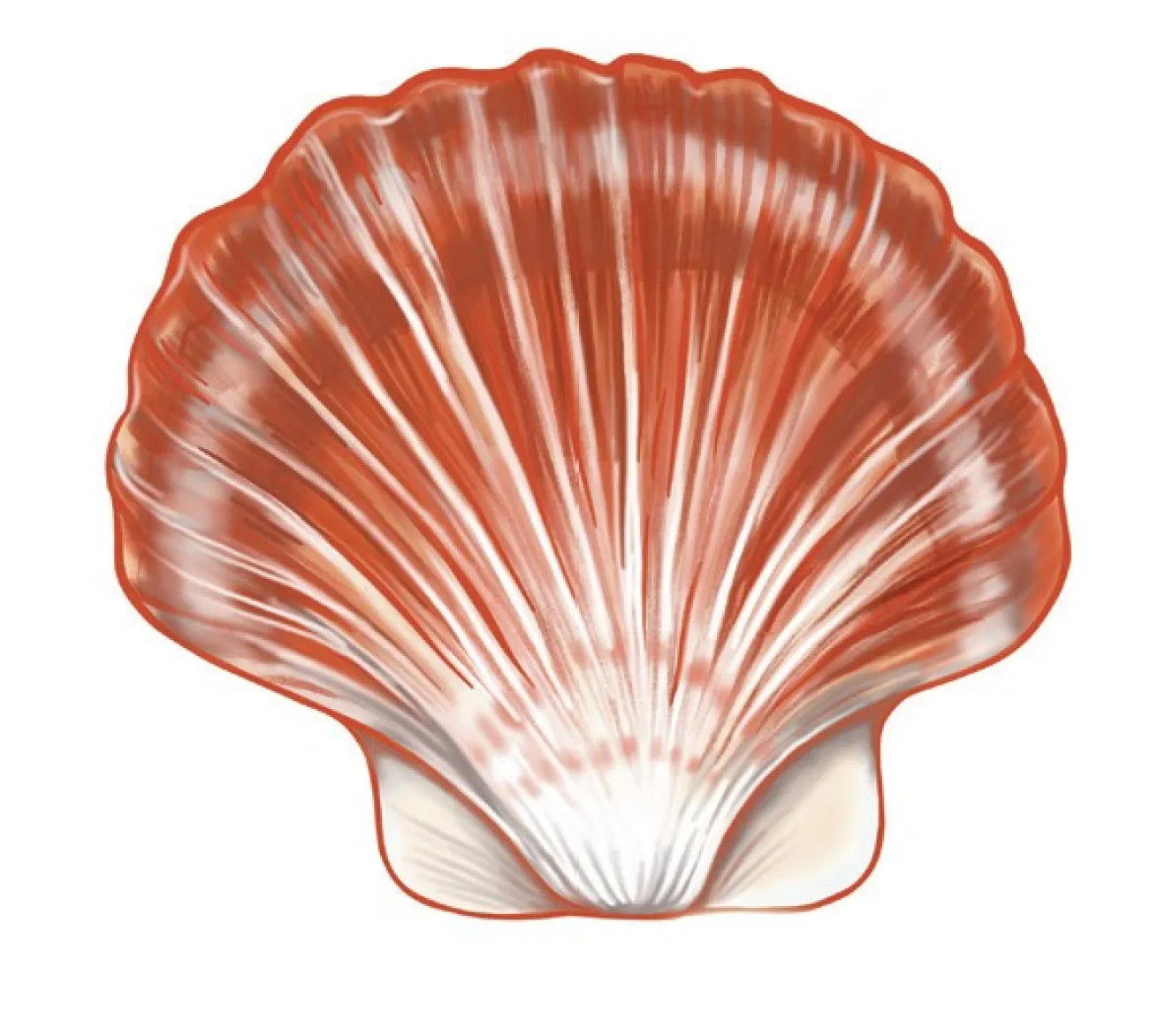
Site Spotlight: Great Scallop
Divers might be lucky enough to encounter a large bivalve of northern Europe’s Atlantic coast in a dive around Släggö: the great scallop (Pecten maximus). Found adjacent to strong currents like those found in the Gullmarn fjord, these big mollusks are known to escape from predators using their own form of swimming: snapping their valves open and shut, and shooting out water.
Fascinatingly, they have many tiny eyes dotting the inner rim of their shells. Scientists have observed them moving in response to changes in light or water. Also called giant scallops or Coquille St. Jacques, great scallops earned that title from growing to nearly 8 inches across. Found in depths reaching over 300 feet, they can reach over 20 years of age and reproduce through external fertilization in the water column.


