

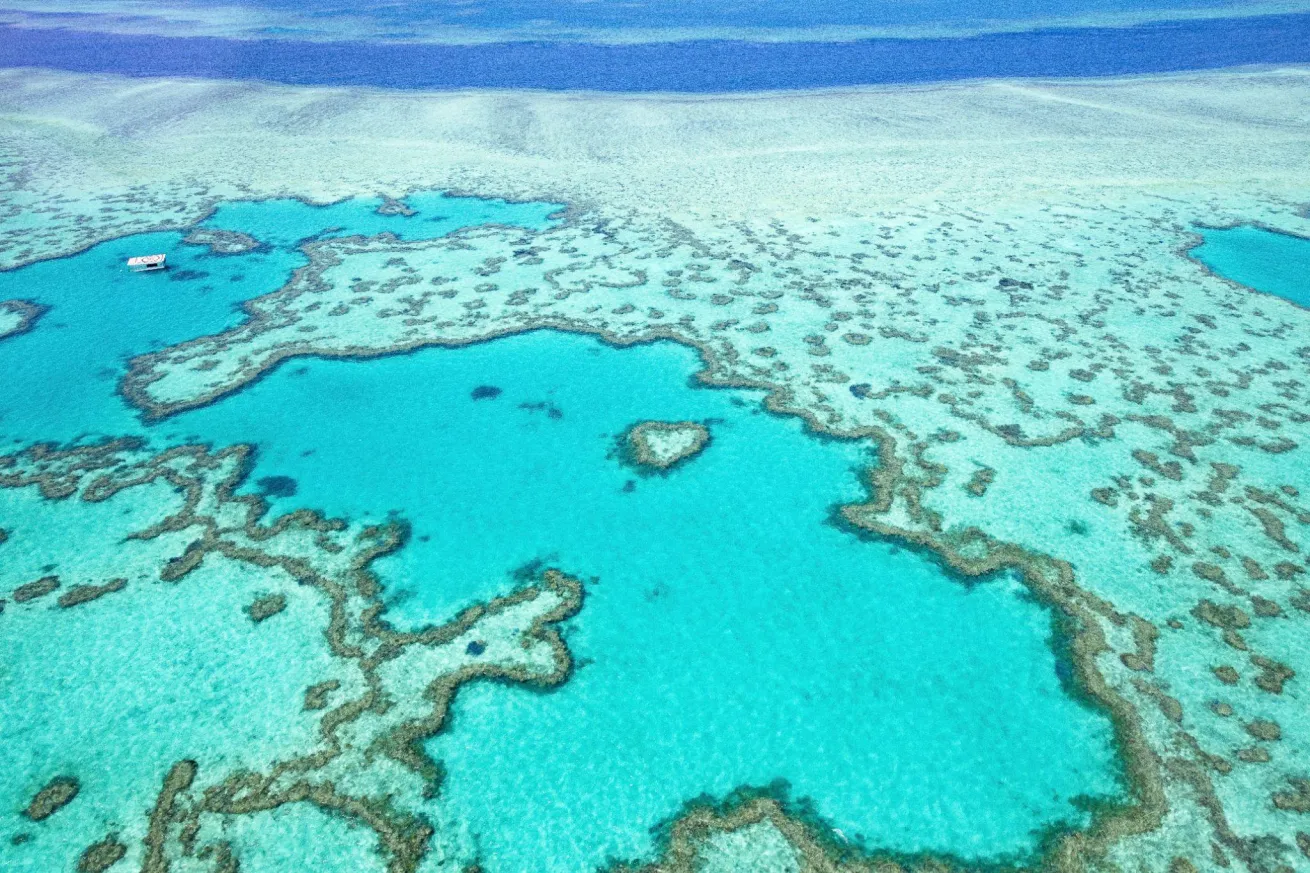
Shutterstock/Cynthia A JacksonYou can help protect the Great Barrier Reef from home.
Most screen time disappears into the void. But with the Great Reef Census, a few minutes online can help protect the world’s largest coral reef system.
The census allows anyone to become a citizen scientist, exploring the Great Barrier Reef virtually while helping researchers monitor coral health at an unprecedented scale. Here’s how you can get involved.
What Is the Great Reef Census?
The Great Reef Census is a modern citizen science program by the Australian conservation organization Citizens of the Reef. The census combines human and artificial intelligence to measure coral cover on the Great Barrier Reef.
The GBR is the world's largest coral reef system. It spans an area of more than 134,000 square miles and comprises more than 3,000 individual reefs—a size and scale that makes the system nearly impossible to survey in its entirety.
Related Reading: Lessons Learned from 25 Years Diving the Great Barrier Reef
“Full credit to the many amazing, really important monitoring programs out there, but they don’t cover everything,” says Sophie Kalkowski-Pope, marine operations coordinator at Citizens of the Reef. “Only about 2 percent to 5 percent of the reef is regularly monitored each year, so there are a lot of gaps. Our aim with Census is to fill these gaps so researchers have coral cover data from reefs they would not normally have information from.”
Over the past six years, the Great Reef Census has collected data on roughly 25 percent of the Great Barrier Reef. And that’s 25 percent of all reefs—not just those that are fit to survey.
“If we remove reefs that aren't safe to go to because of crocodiles or reefs that are too deep, it’s something like 40 percent that we’ve actually covered,” Kalkowski-Pope says.
How the Census Works
The census has two stages: First, in-water data collection, which runs from September through to January each year for the Great Barrier Reef.
To fully survey a site, a diver takes 80 photos—one every five fin kicks or so—with a GoPro pointed straight down at the reef. Anyone with a GoPro can participate, and the average site survey takes only about 15 minutes.
“It's not so much like a traditional survey method where you have measuring tapes and species ID or this kind of stuff,” Kalkowski-Pope says. “It's a quick, rapid-fire, really good first pass.”
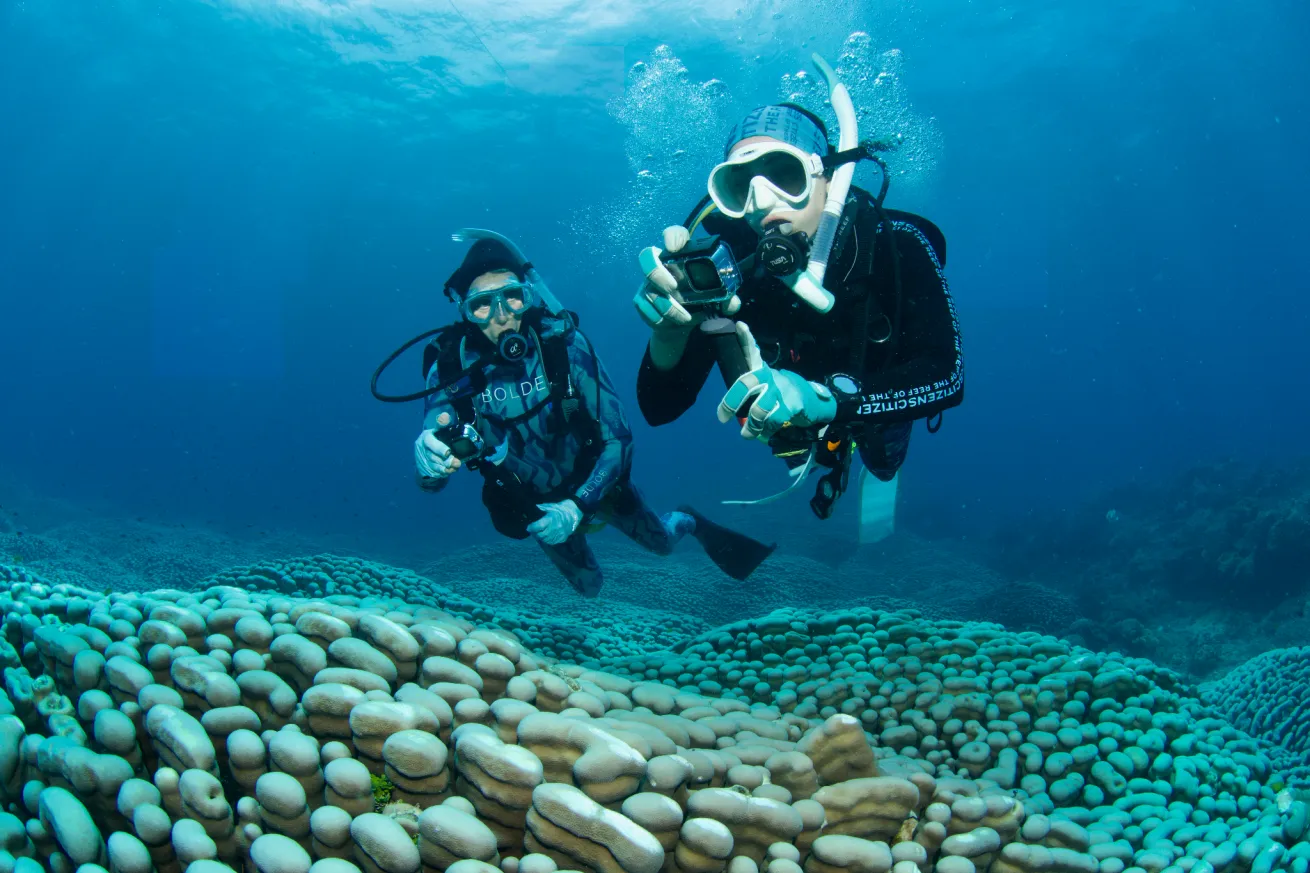
Courtesy Richard Fitzpatrick/Biopixel Oceans FoundationSophie Kalkowski-Pope and Jan Pope survey a record-settingPavona clavuscoral colony for the Great Reef Census.
Next, the photos are uploaded to the Citizens of the Reef online database, and there begins a monthslong period during which the organization relies on staff and volunteers, along with AI algorithms, to analyze as many images as possible. Analysis focuses on identifying hard coral cover, a standardized indicator used to assess the health of the Great Barrier Reef.
Related Reading: Meet the Divers Bringing AI Underwater to Power Reef Restoration
“Each image is analyzed by four different people, and it's also analyzed by our AI model. What this means is we're not just going based on AI, and we're not just going based on people,” Kalkowski-Pope says. “When we combine AI and the human eye, we can get an accuracy of up to 98%, which is pretty incredible.”
The measure of accuracy and overall data validation comes from comparing the AI and human analysis to an analysis of the same image by students at the University of Queensland’s Marine Spatial Ecology Lab.
How to Get Involved
Anyone can contribute to the Great Reef Census from home. To participate, visit greatreefcensus.org and click the “Analyse A Photo” button.
You’ll begin with a short, 10-question training module that introduces the different types of coral and how to identify them. From there, you’ll be presented with your first reef image.
“We keep it really, really simple,” Kalkowski-Pope says. “We are only looking for the three main types of hard coral: branching coral, boulder coral and plate coral.”
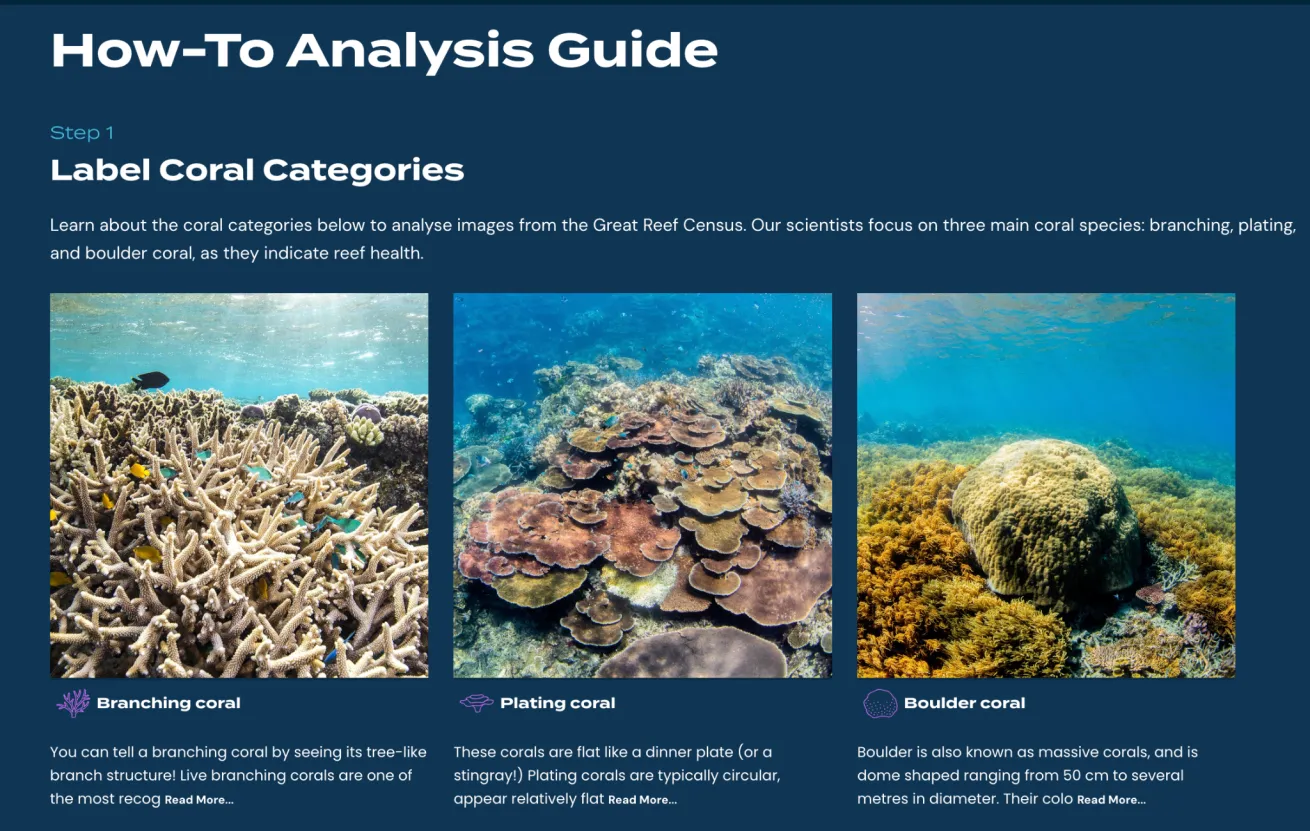
Courtesy Citizens of the Reef/greatreefcensus.orgThe Great Reef Census website teaches volunteers how to identify different types of coral.
As you go through more images and improve your accuracy, you can unlock additional tiers of analysis. More advanced tasks may include identifying soft corals or signs of coral bleaching.
Beyond contributing valuable scientific data, the experience is designed to be engaging and educational. Each new image offers a glimpse into a different part of the reef, allowing you to explore the Great Barrier Reef from home. And every image analyzed helps researchers better understand and protect one of the world’s most important marine environments.
Where Does the Data Go?
The data collected through the Great Reef Census supports several major conservation initiatives across the Great Barrier Reef, helping researchers and organizations make strategic decisions about where to focus protection and restoration efforts.
“What you're doing is actually making a tangible difference,” Kalkowski-Pope says.
Related Reading: How Can I Help Protect the Ocean?
Key Source Reefs
The first use is identifying what are called “key source reefs.” These are reefs that are particularly well connected by ocean currents, and when they spawn, they help repopulate reefs downstream. Researchers from the University of Queensland’s Marine Spatial Ecology Lab use the census data alongside ocean-current modeling to determine which reefs are most connected, and this information helps conservation groups prioritize limited funding and resources.
For example, if one reef helps support five other reefs while another can repopulate only one downstream reef, protecting the more connected reef can have a far greater impact on the broader ecosystem. Using a combination of data on coral cover and currents, researchers can identify these critical conservation hotspots and guide future reef protection strategies.
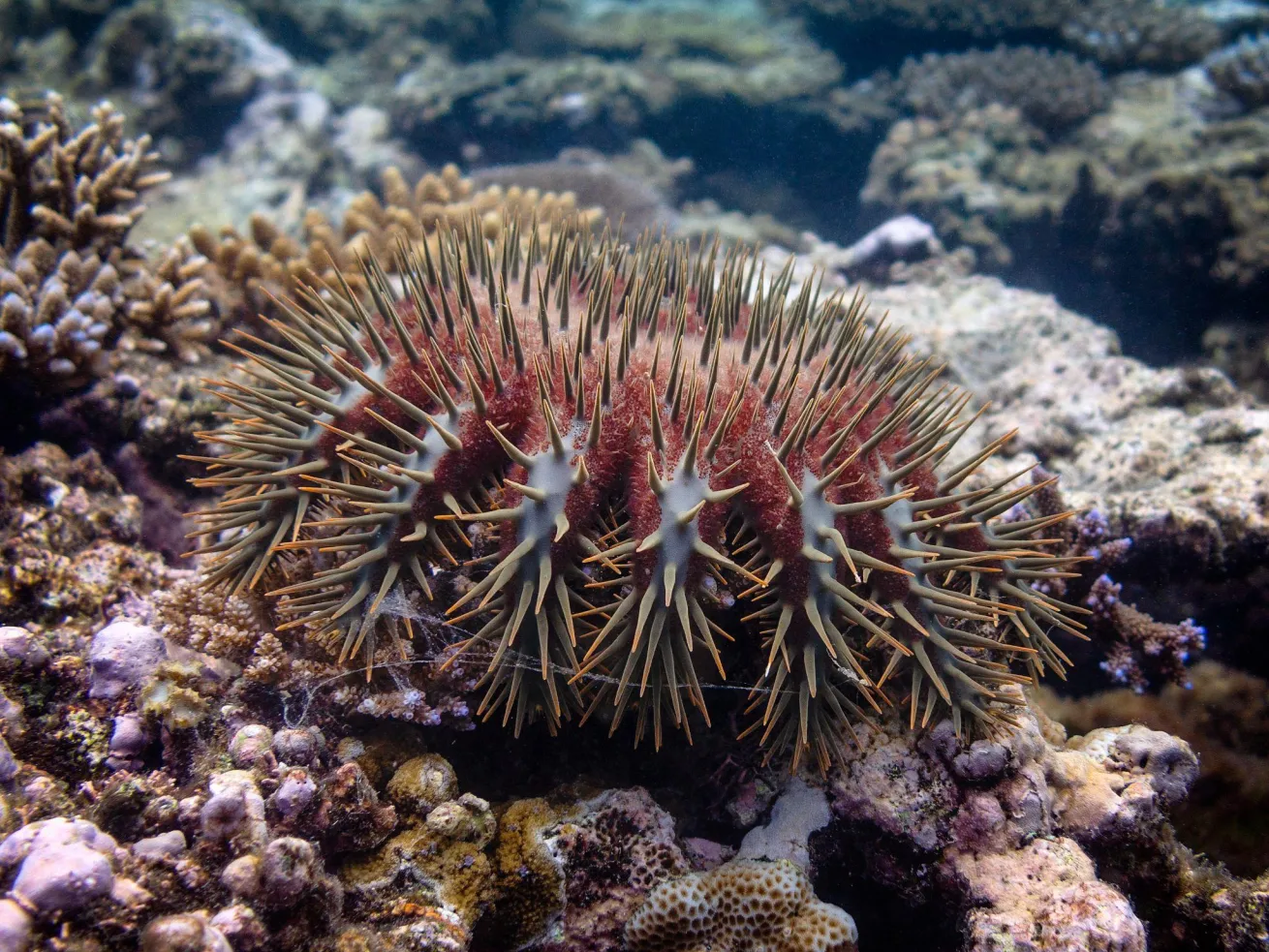
Shutterstock/Nico FaramazCrown-of-thorns starfish eat coral. Outbreaks of these animals can decimate reefs.
Crown-of-Thorns Starfish Removal
Next, the data is shared with the Great Barrier Reef Marine Park Authority to support its Crown-of-Thorns Starfish (COTS) Control Program. Crown-of-thorns starfish prey on coral, and they overrun areas of the reef roughly every 10 years. COTS outbreaks are one of the biggest threats to the reef, as the animals can devastate coral cover if left unmanaged.
To combat outbreaks, specialized dive teams travel to priority reefs and manually remove the starfish. Great Reef Census data helps determine where those teams should be deployed by identifying reefs most at risk and areas showing signs of decline.
Reef Rebuilding Efforts
Finally, the census data is used to inform Mars Sustainable Solutions’ Reef Stars program, which revives areas of reef rubble into thriving habitats.
The program relies on deploying hexagonal structures (called Reef Stars) to create artificial reefs that attract coral and sea life to settle. The structures are affixed with coral fragments and coated in resin and coral sand to promote healthy growth.
Images and analysis from the Great Reef Census helps MSS pinpoint potential sites for restoration on the GBR.
Additional Impacts of Surveying
Beyond providing useful data to governments and NGOs, census work has prompted exploration and even led to discoveries such as the record-setting Pavona clavus colony found by Kalkowski-Pope and her mother, Jan Pope.
“We have a family boat we dive from, and we have for a very long time,” Kalkowski-Pope says. “Because of Census, we were going out and exploring areas that we don't normally get to. It encouraged us to return to reefs we hadn't visited for many years or dive on sites we don't normally dive at.”
Related Reading: Largest-Ever Coral Colony Recorded on Great Barrier Reef
On one dive day, Pope noticed an unusual pattern below the surface while boating over a particular reef area. She jumped in to investigate and found what would later be measured as the largest-ever recorded coral colony.
“The second-largest coral was discovered by National Geographic on this big, amazing expedition,” Kalkowski-Pope says. “This was a mom and daughter in their backyard.
“It really shows the power of citizen science… We talk about this idea of tangible hope, and that's what the Great Reef Census is to me, whether that's in the water or online. Giving people something they can contribute to when they might be losing hope or feeling a bit disenfranchised is a really powerful thing.”
So, if you’re looking for a way to help the ocean—even from afar—head to greatreefcensus.org and start analyzing images to effect real change for the Great Barrier Reef.


