

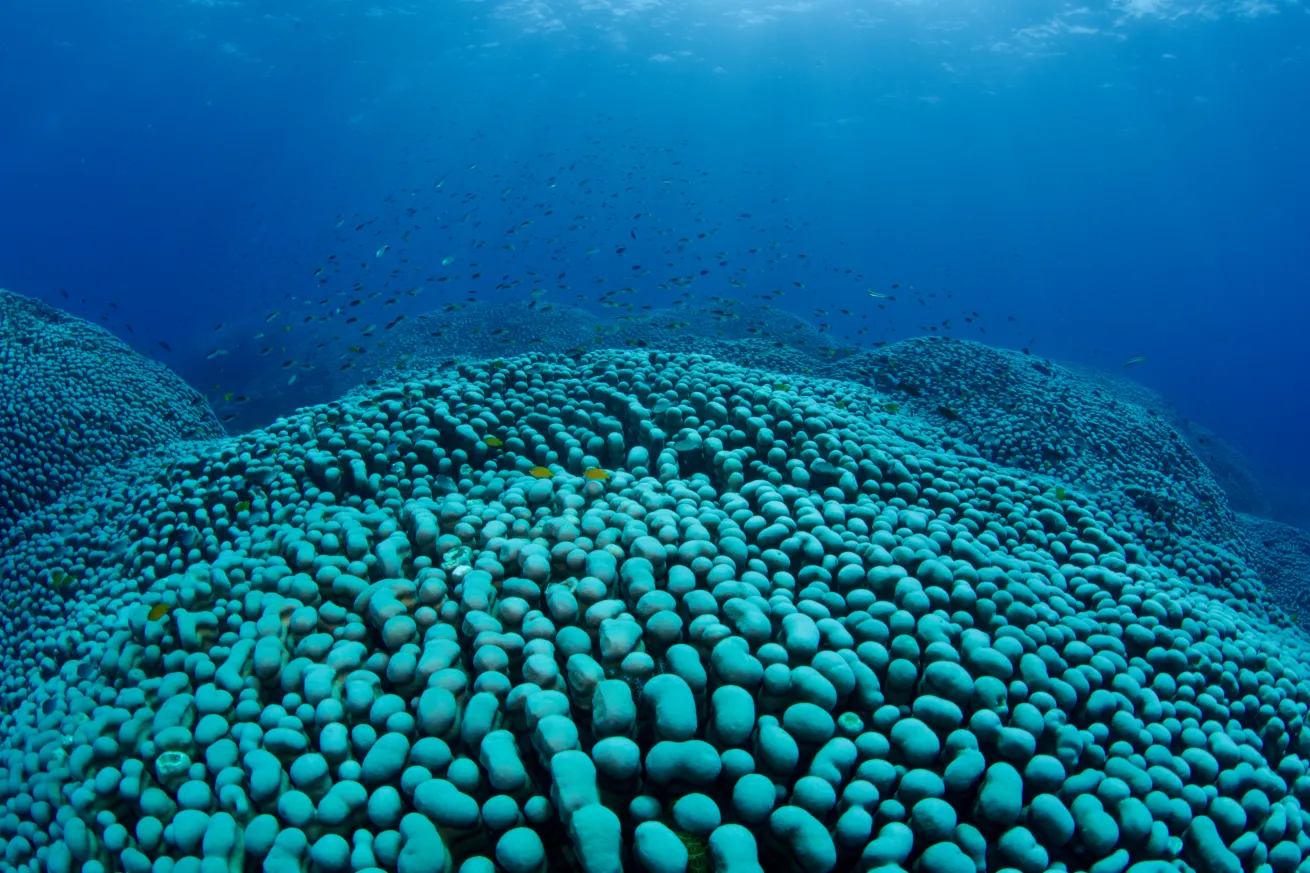
Courtesy Richard Fitzpatrick/Biopixel Oceans FoundationThe patch of Pavona clavus coral in the Great Barrier Reef is the largest colony on record.
A massive coral on the Great Barrier Reef has been identified as the largest colony ever recorded.
The Pavona clavus colony measures 364 feet (110 meters) long—roughly the length of a football field, including both end zones—and covers an area of nearly 43,000 square feet. It was discovered by a mother-daughter team working with the Australian marine conservation nonprofit Citizens of the Reef.
Jan Pope spotted the enormous colony while surveying reefs for the organization’s citizen science project, the Great Reef Census. It was a flat day on the water, and Pope, who’s lived in Cairns for decades, noticed an unusual pattern below the surface. She jumped in to investigate and immediately knew she had stumbled upon something extraordinary.
The next week, she returned with her daughter, Sophie Kalkowski-Pope, marine operations coordinator at Citizens of the Reef.
“She had told me, ‘There's this really unusual coral field. I've never seen something like it,’” Kalkowski-Pope says. “As soon as I hopped in, I was like, ‘holy moly, this is incredible.’ It's just one continuous meadow of the same coral for as far as the eye can see, so it’s very visually stunning.”
Related Reading: Marine Biologist Jacinta Shackleton Named April '25 Sea Hero
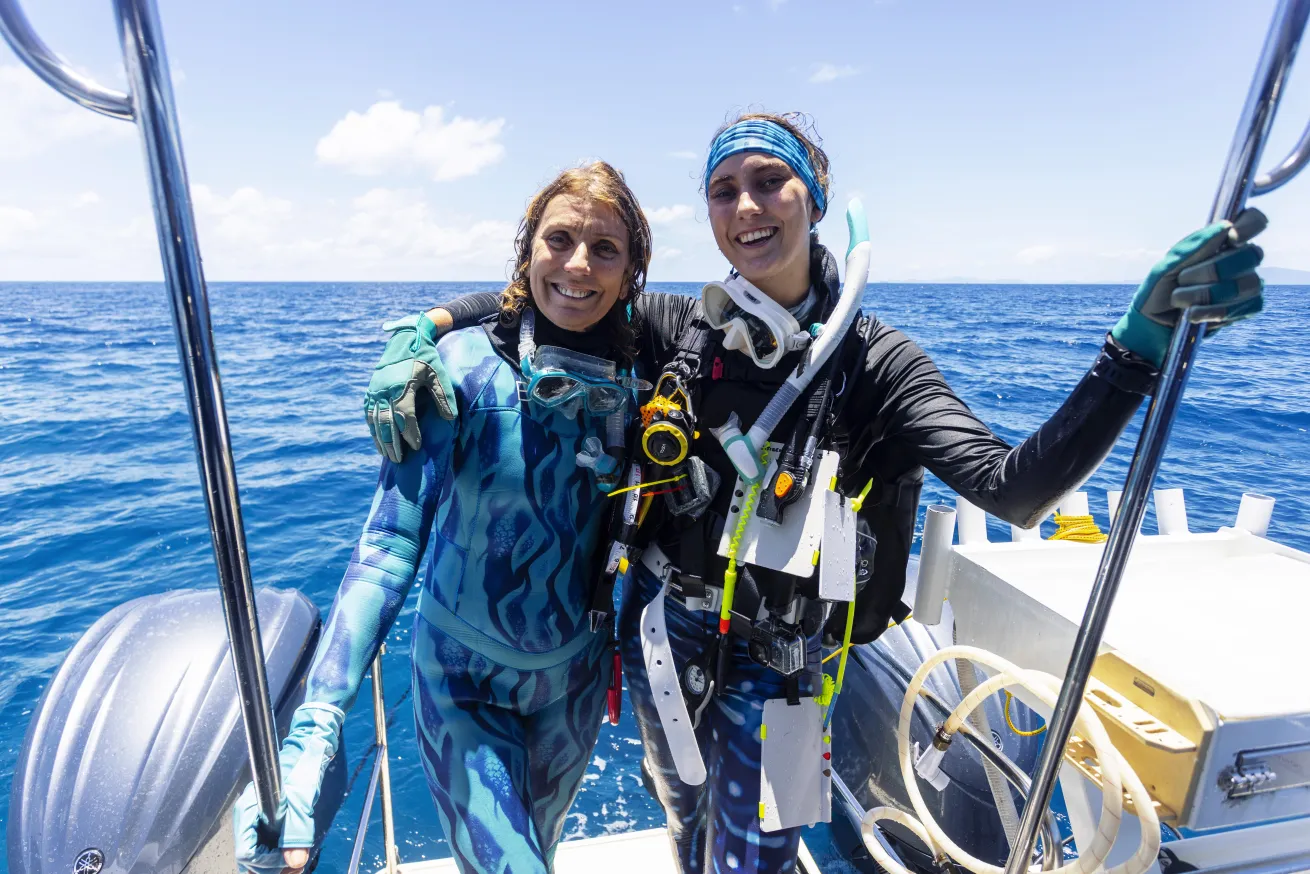
Courtesy Citizens of the ReefJan Pope (left) and Sophie Kalkowski-Pope smile after finding the record-breaking colony off the coast of Cairns, Queensland, Australia.
Measuring a Giant
On a subsequent dive, Kalkowski-Pope, along with her mother and her partner, Josh White, took initial measurements of the J-shaped coral colony using a standard measuring tape and traditional underwater surveying procedures.
“I so vividly remember writing the measurements on my slate, and during my safety stop, I’m frantically doing the math—20 meters, plus 30 meters, plus five, plus 20…” Kalkowski-Pope says. “I’m double-checking my math, thinking, ‘It’s over 100 meters—I think it’s a record.’”
Citizens of the Reef then worked with traditional owners, the Biopixel Oceans Foundation and the Queensland University of Technology’s Centre for Robotics to take accurate measurements of the colony using photogrammetry.
“Photogrammetry is effectively taking a whole bunch of photos from lots of different angles of the same thing and using a very powerful computer software that stitches them all together to construct a 3D model of that structure,” Kalkowski-Pope says.
Researcher Serena Mou from QUT played an integral role in the modeling. She deployed drone boats, or unmanned surface vehicles, with GoPros attached to capture the necessary images of the colony.
“You could pretty much program it like a lawnmower, just doing this grid pattern back and forth,” Kalkowski-Pope says. “She’d have three boats working simultaneously, each mapping out different sections.”
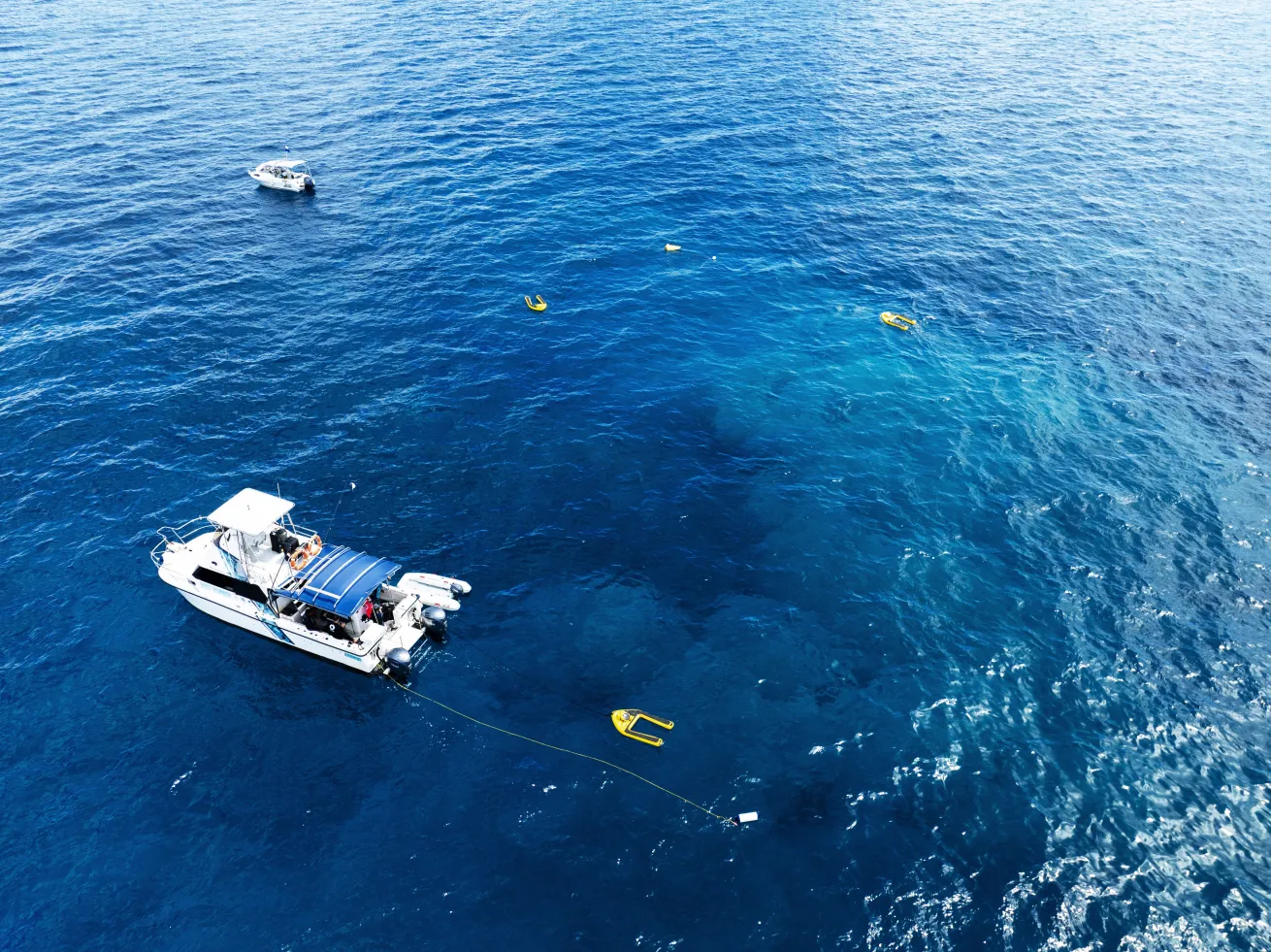
Courtesy Citizens of the ReefThree unmanned surface vehicles, or drone boats, take images of the Pavona clavus. Using photogrammetry, the images were stitched together to create a 3D model of the site.
After putting the 3D model together, the team found this colony to be about four times the size of the next-largest colony on record, another Pavona clavus found in the Solomon Islands during a 2024 National Geographic expedition.
“[This discovery] really shows the power of citizen science to do something tangibly powerful for our oceans,” Kalkowski-Pope says. “The other largest coral was discovered… on this big, amazing expedition. This was a mom and daughter on their family boat, going out and doing surveys in their backyard.”
Related Reading: Meet the Divers Bringing Artificial Intelligence Underwater to Power Reef Restoration
More to Uncover
There is still much to learn about the colony, such as its age. Jo Manning, communications officer at the Australian Institute of Marine Science, says Pavona clavus grows at a rate of about 1/3 inch to 1/2 inch per year, which is slow compared to fast-growing corals that can grow up to 8 inches in a year but slightly faster than other slow-growing species.
AIMS estimates the colony to be “at least a couple hundred years old,” though Kalkowski-Pope says some coral reef ecologists from the University of Queensland believe the colony may be over 1,000 years old.
“It raises so many amazing questions in the face of climate change, like why has this coral gotten so big, and how has it survived so long?” Kalkowski-Pope says. Have the currents in the area offered protection by bringing in fresh flowing water every day? Does the fact that it’s a deeper site (sitting in around 25 to 50 feet of seawater) keep the water from stagnating and warming up like it does on reef flats?
“Knowing where these large colonies persist offers an opportunity to coral reef scientists to reconstruct climate histories and understand future trajectories of coral populations,” Manning says.
Another question is whether it is one single, genetically unique colony or a whole field of individuals that has merged over time. To find an answer, researchers would need to perform genetic testing on about 90 samples from different parts of the colony. Though Citizens of the Reef doesn’t have the ability to fund or perform this testing in-house, they hope to partner with a university or research institution to continue studying the coral, Kalkowski-Pope says.
The team has not disclosed the location of the coral to the public, instead handing the information to the Great Barrier Reef Marine Park Authority. Stakeholders are currently in discussion about how to manage the site for long-term protection.
Related Reading: Diver-Operated Microscope Give Insight Into Coral Bleaching
Hope Amid Crisis
Despite a decade of environmental stress on the Great Barrier Reef—including mass bleaching, cyclones and crown-of-thorns starfish outbreaks—researchers say the colony is a largely healthy hotspot of life, showing only minor natural and human-caused damage.
“The reef is host to so much biodiversity,” Kalkowski-Pope says. “It has these incredible anemone beds between the coral—and I say beds because it’s literally the size of a bed. One anemone colony might be 4 or 5 meters (13 to 16 feet) long; it’ll have, like, 100 anemonefish.”
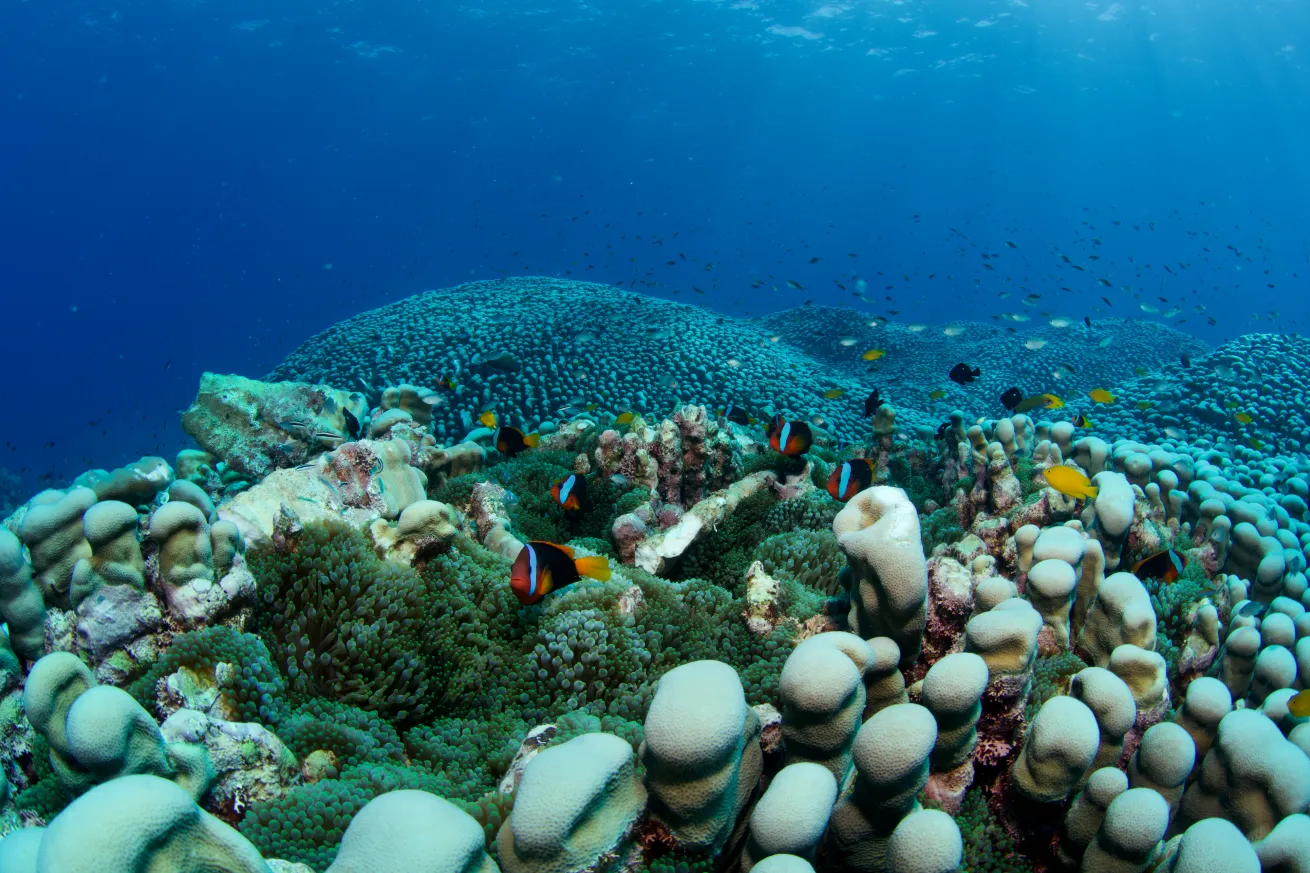
Courtesy Richard Fitzpatrick/Biopixel Oceans FoundationFish swarm a large anemone that’s tucked amid the Pavona clavus coral colony.
Manning says the colony’s condition highlights a pocket of resilience on the reef.
“It is encouraging to see a huge colony like this so obviously thriving,” she says. “Colonies of this size are important contributors to coral larvae, which support the replenishment of populations.”
However, Manning and Kalkowski-Pope agree the thriving colony shouldn’t obscure the broader threats facing the reef.
“AIMS monitoring has told us other reefs in this (area of the GBR) have been impacted by disturbances recently,” Manning says. “The Reef has shown that it has the capacity to recover between disturbance events. Massive corals are generally tougher and can withstand more pressure. But it’s no guarantee that the next heat wave won’t affect it.”
Kalkowski-Pope adds: “Knowing that there is a living structure out there that is this scale is absolutely remarkable. In some ways, it’s a beacon of hope… But just because there’s this one resilient colony doesn’t negate the fact that there are other threats to the ecosystem, and we need societal change, climate action and local targeted action to support the reef.”


