

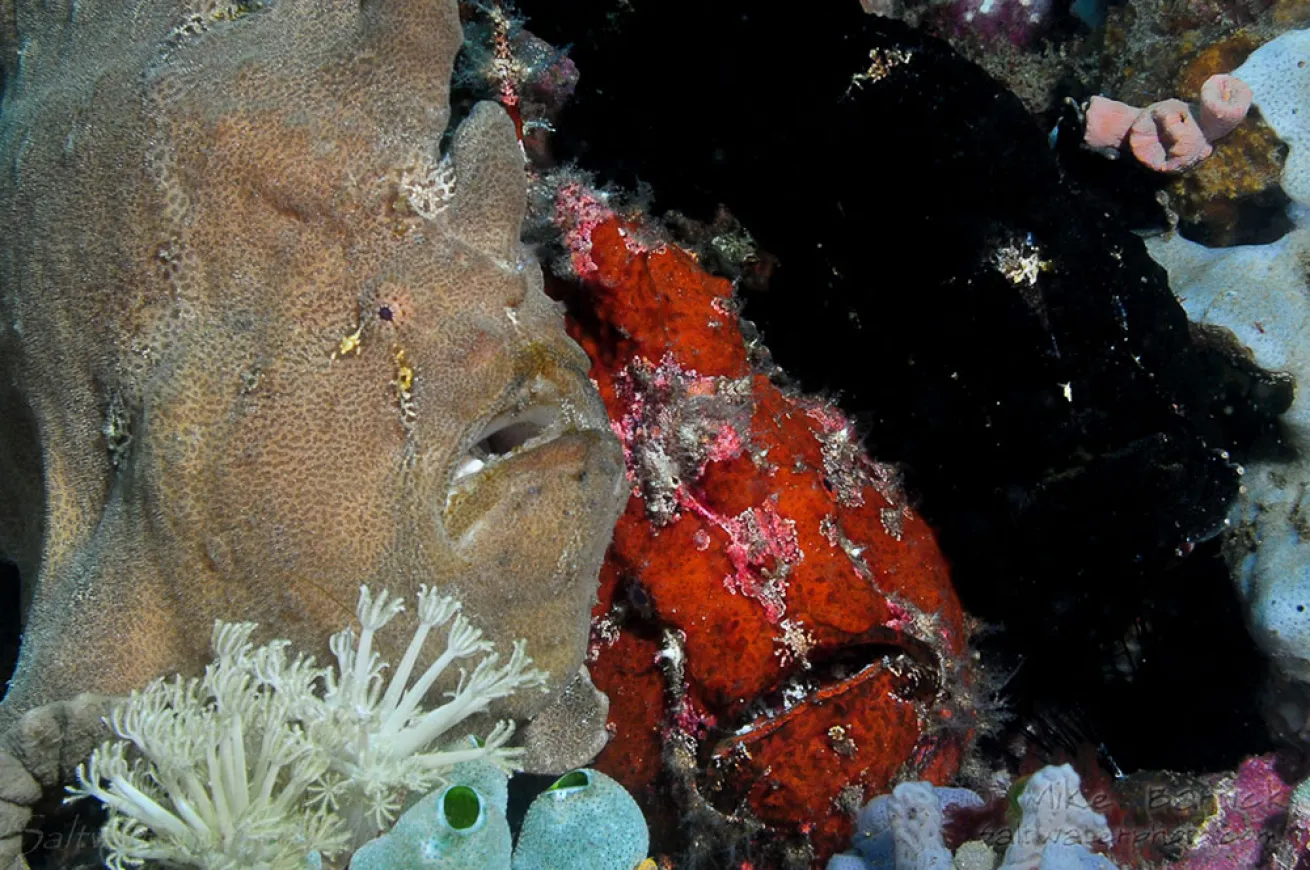
Mike BartickLike bookends, the two male frogfish in this photo (A. commersoni) surround the female, while vying for her affection and the opportunity to extend his bloodline. The mate blocking and aggressive behavior continues sometimes for several days before one lucky male emerges as the victor.
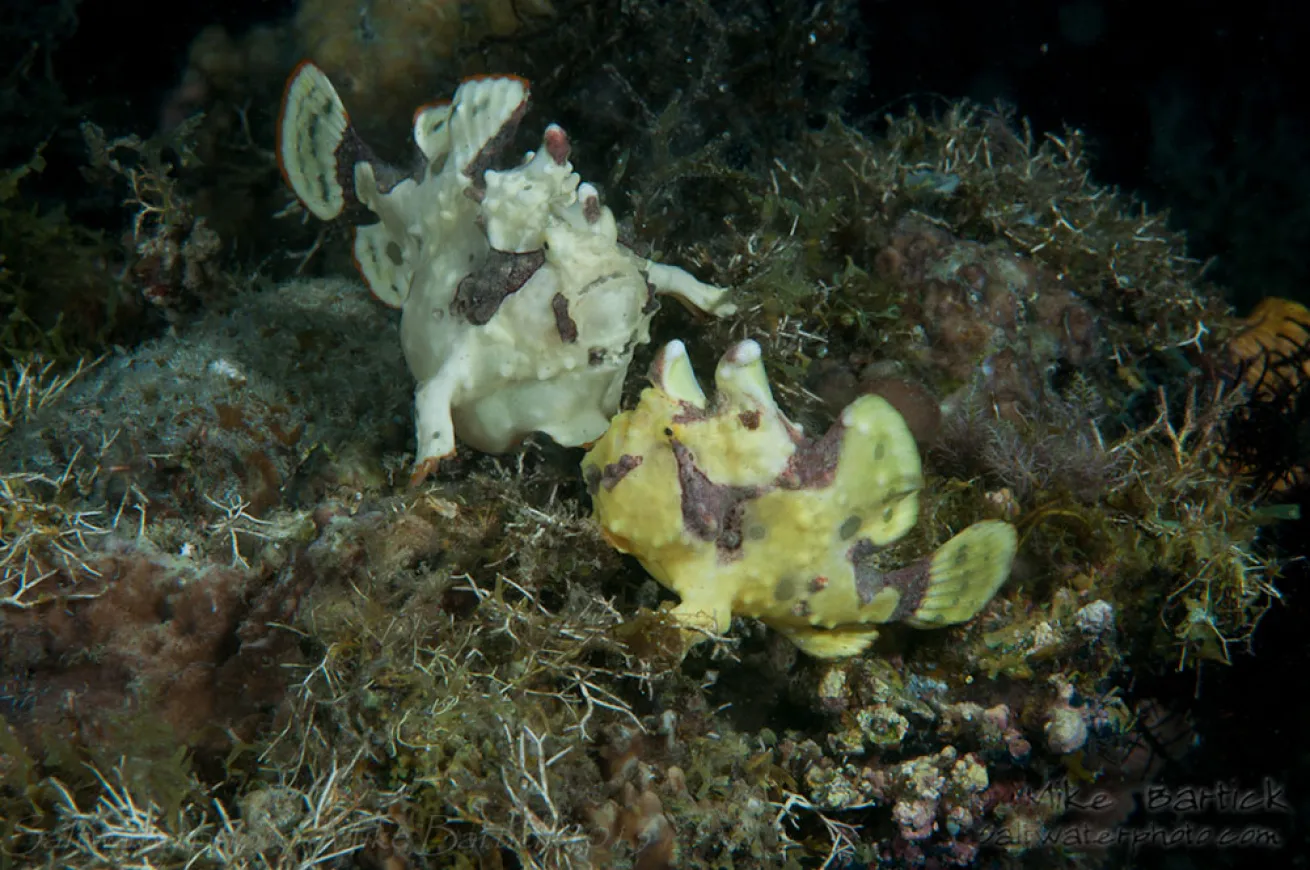
Mike BartickThe female, bloated with eggs, seems to pant uncomfortably and is otherwise unable to swim on her own power. Alerting the male with a series of sharp and deliberate twitches, he moves into position quickly to assist her before she changes her mind. Nudging her abdomen and prying her away from the reef, she begins to move.
Mike BartickThe male moves under the female on cue as if choreographed, and she steps on his face. Pushing off like a springboard, he catapults her up and away from the reef.
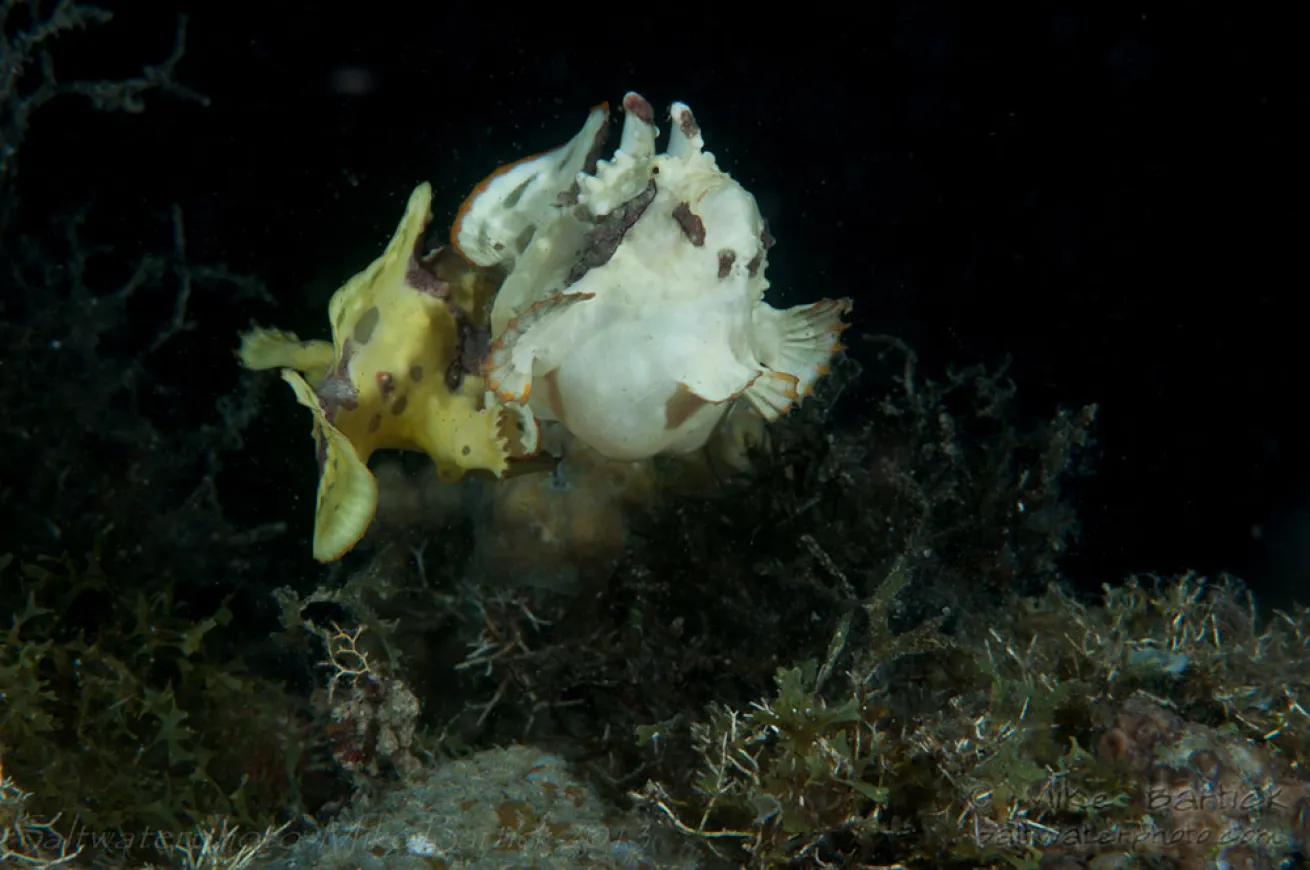
Mike BartickNow buoyant but motionless, the female resembles a floating balloon. The male nudges her from below, flipping his tail with all of his might. He pushes her upward as they both begin to build speed.
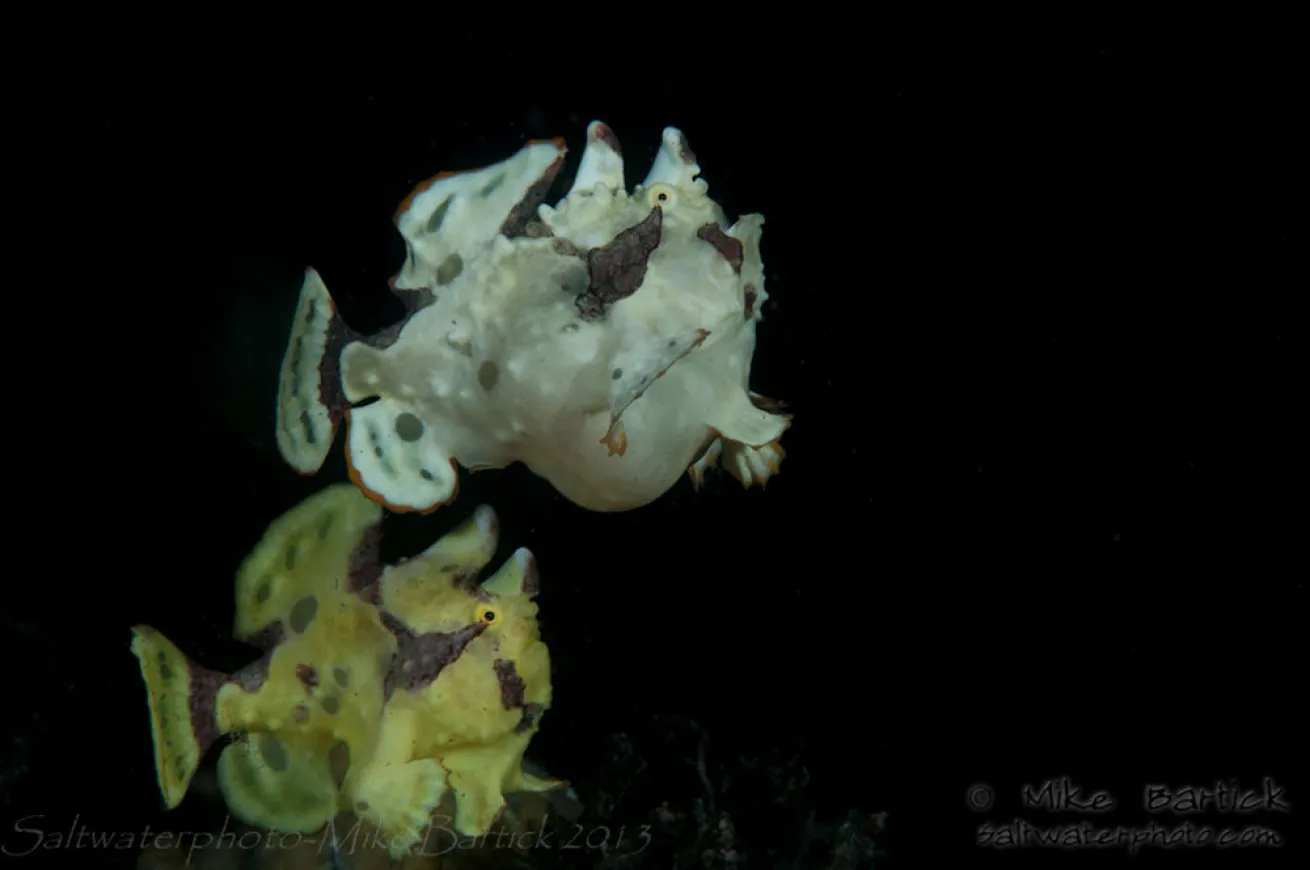
Mike BartickMoving quickly while pushing and bumping her upward, the mated pair begins to gain speed, as they move toward the surface.
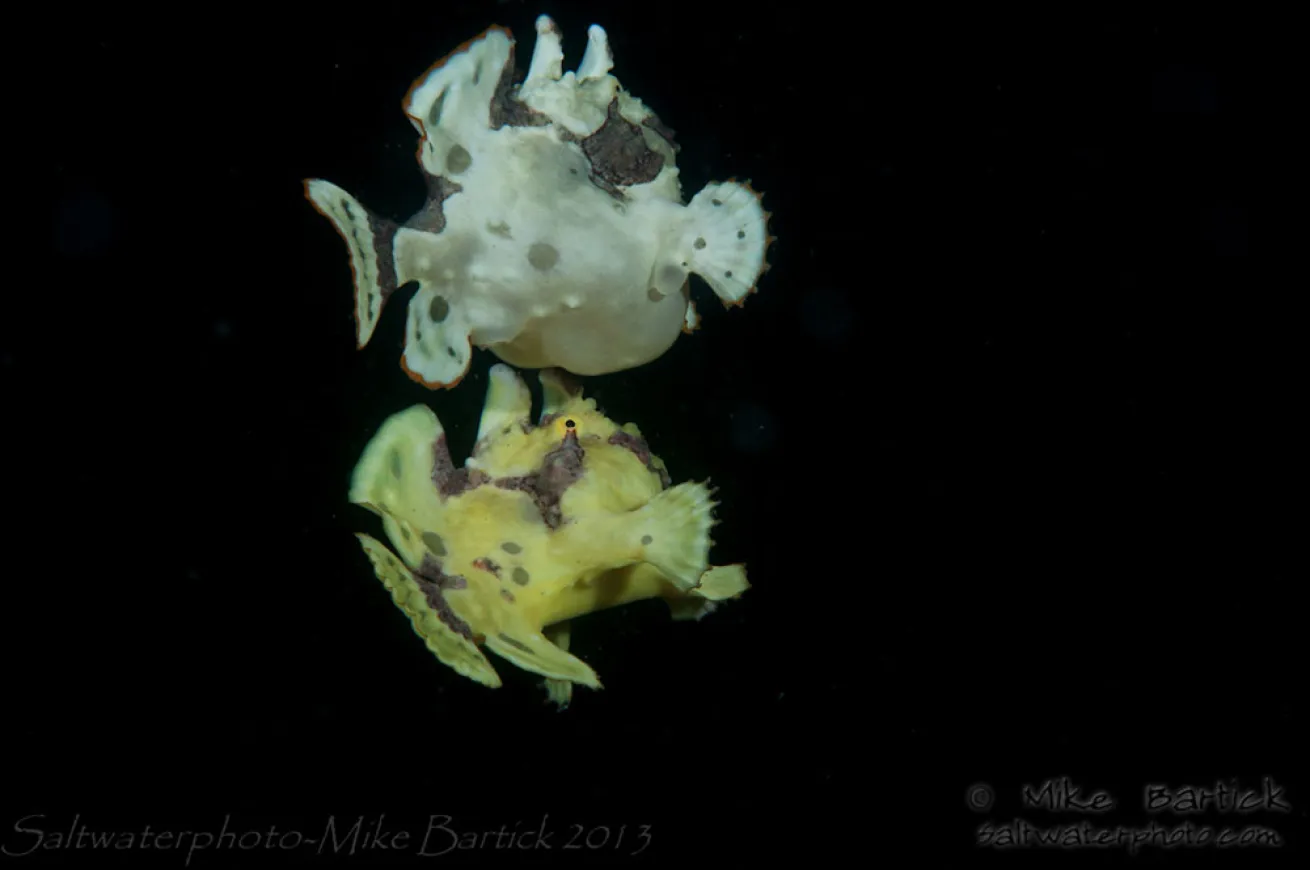
Mike BartickThe male begins to spin upside down in a blur. My camera is shooting three frames per second, as I float upward trying to keep the frogfish in the frame.
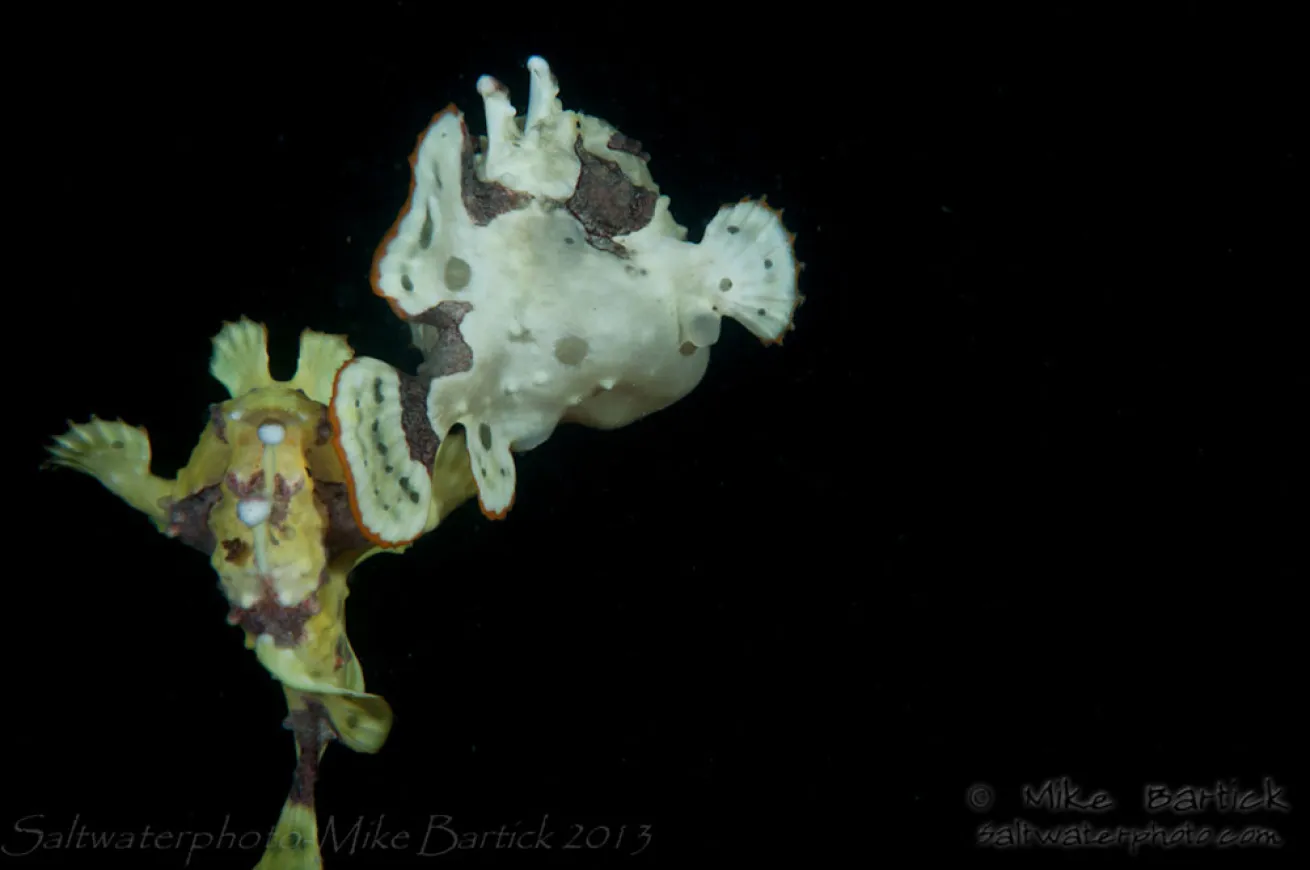
Mike BartickAs both frogfish are nearly belly to belly, the male releases his sperm, and the two continue upward just a few feet from the surface.
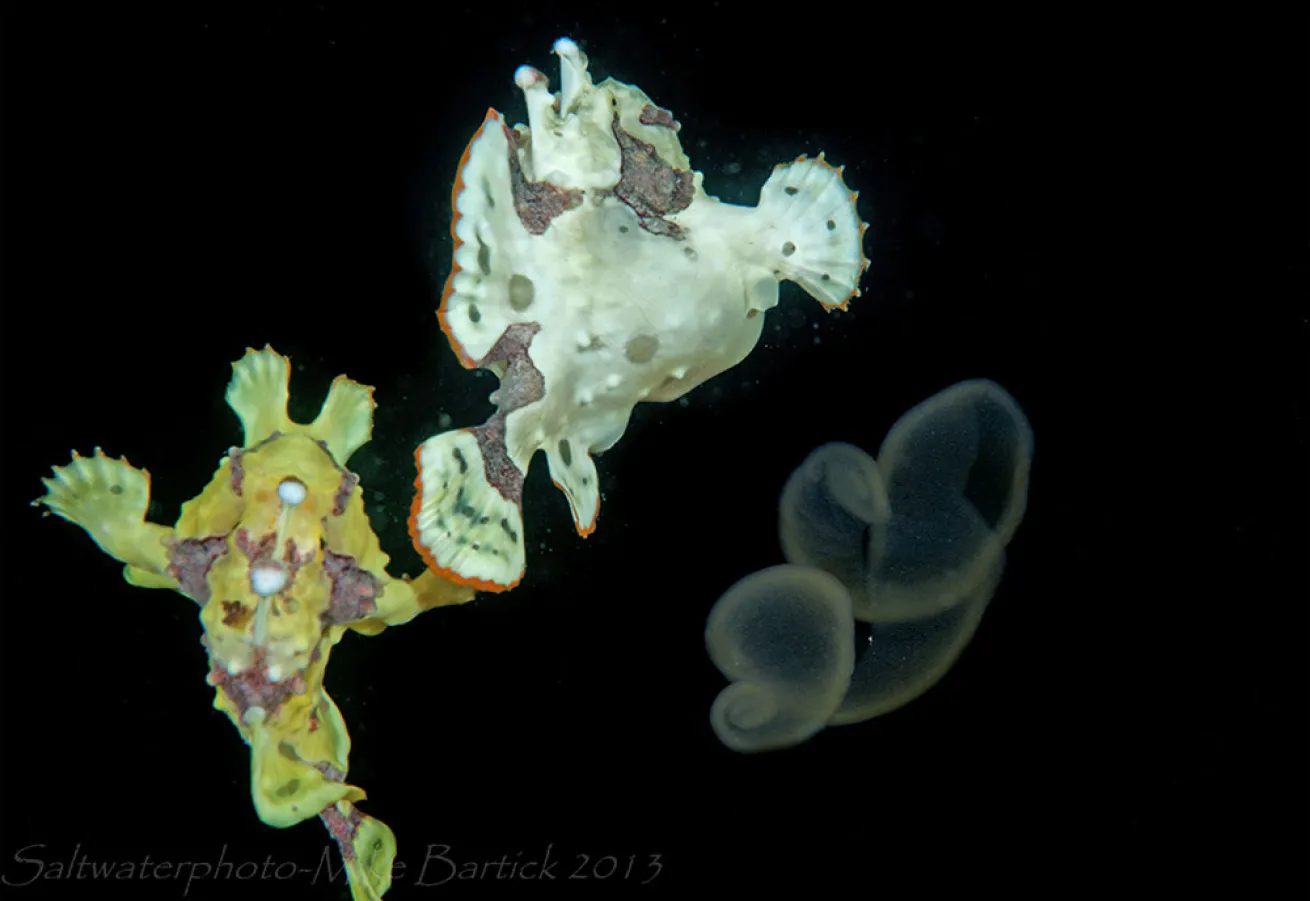
Mike BartickThe female releases her egg capsule, which quickly unravels into the cloud of male reproductive fluid, beginning the first steps toward fertilization. The male darts back to the substrate, as the female continues her plight toward the surface. Note: This is a composite photo. The female is blocking the actual eggs in this shot so the photographer added the eggs to illustrate the act more clearly.
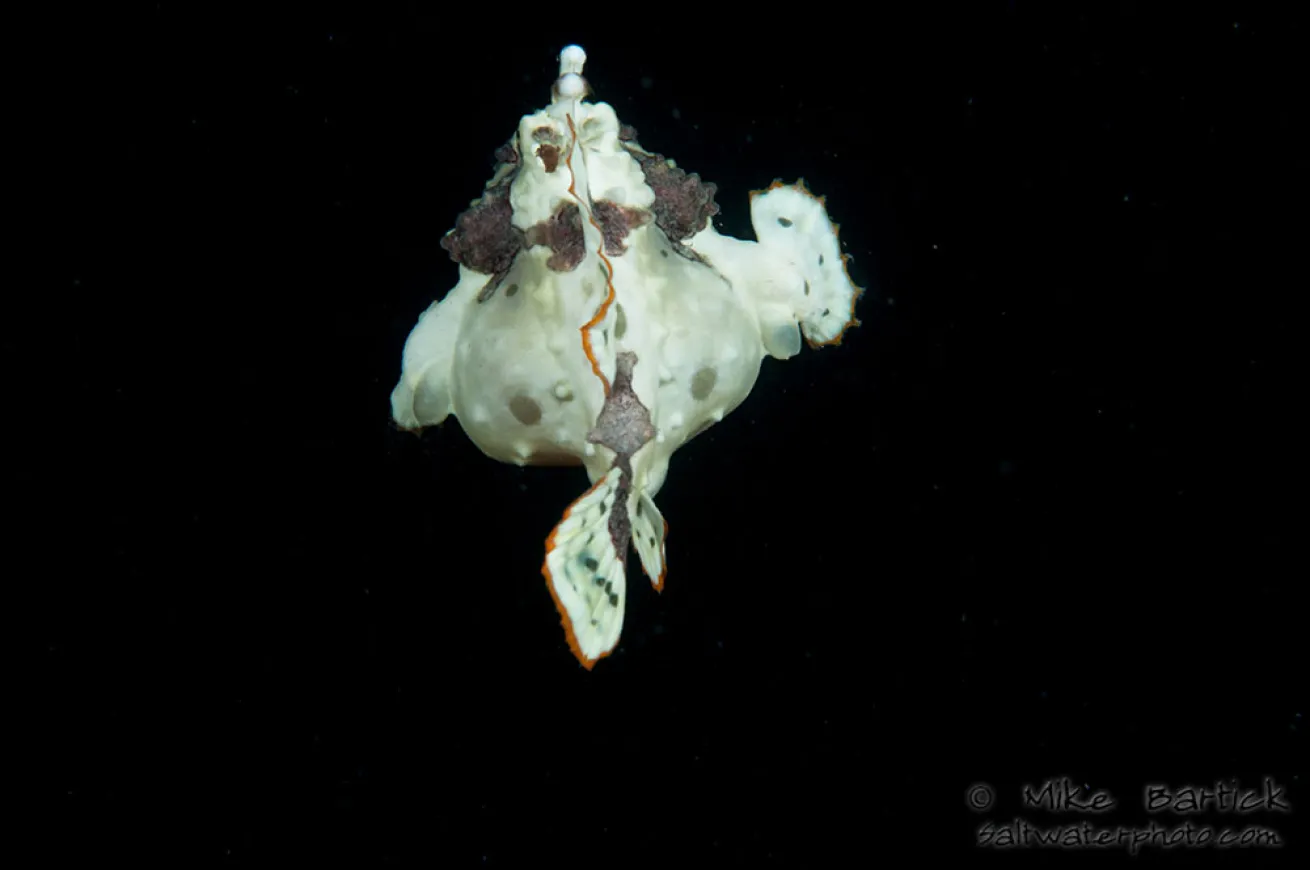
Mike BartickThe female ensures that the eggs are set adrift – performing her only motherly gesture. The eggs will drift along until they begin to mature, become heavy and eventually sink to the bottom.
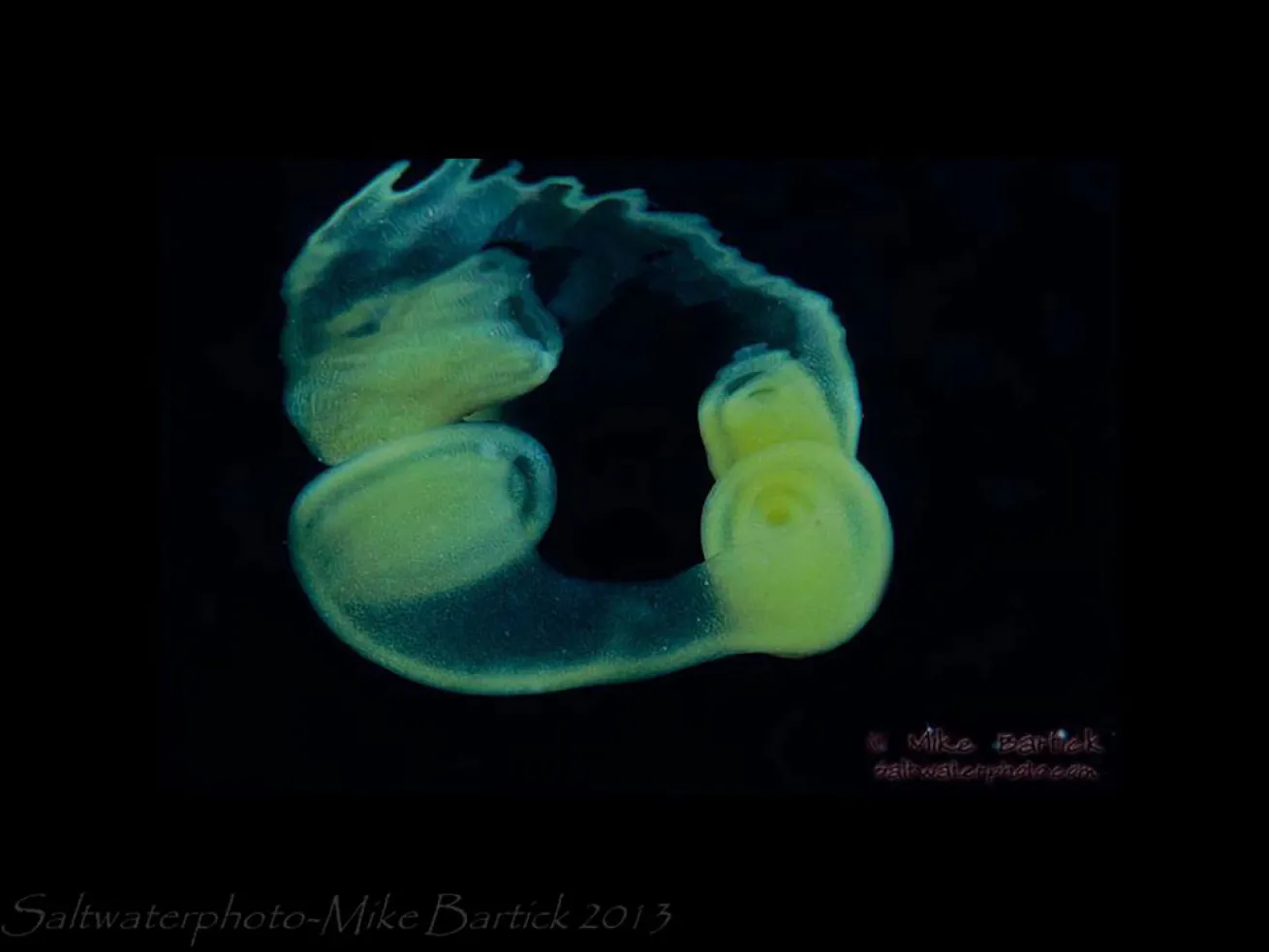
Mike BartickThe egg raft reflects back against the surface.
THE SIGHTING
Glancing at my dive computer, I noticed that 120 minutes had elapsed since we rolled into the water at one of my favorite dive sites, The Pier. The site is located at the back of a sheltered bay similar to an estuary with beds of sea grass, broken rocks and an expanse of sand flats found just under the boat in a few meters of water. Normally dived at night, The Pier, which isn’t really a pier but a wet market, is a hub of activity during the daylight hours. But just as the sun begins to set, the local dive boats creep in. The shallow depth and substrate create a perfect environment to lose track of time, and keep a photographer busy for hours.
I was returning to the boat when I noticed a bright yellow warty frogfish (Antennarius maculatus) perched motionless under a ledge of a shallow rock mound. This dive had been particularly fruitful up to this point, as I spotted a total of six frogfish. I contemplated the best way to photograph this final find when I noticed the second, white colored maculatus sitting on the top of the same ledge, bloated and panting. I immediately recognized the courtship, however I had never seen frogfish actually mate before this event.
FROGFISH COURTSHIP
Female frogfish normally live a solitary life with very few friendly encounters with other frogfish. Prior to beginning a mating cycle, the female frogfish must find her mate by releasing a powerful pheromone into the water, alerting nearby males that she is getting ready to produce eggs. This powerful scent drifts along on the current line exciting male frogfish far and wide, often attracting several at a time. Once the male frogfish have located the female, a period of courtship follows prior to mating, however it’s not as easy as a dinner and a date; The male frogfish must compete with one another for her affection. This period of competitive courtship can last several days and involves each of the males aggressively bumping, yawning and even snapping their tails with an audible crack in an attempt to intimidate other males. Often times the males will surround the female like bookends with the third male bouncing around flaring his fins, trying to impress and spook the others. The determined males attempt to prevent the third male’s access in what is called a mating block, as the female is squeezed even tighter. The female watches on, seemingly uninterested in the males’ heated behavior. Eventually one of the male frogfish wins out and will now attempt to reproduce with the female. Exhausted from days of fighting and lack of nutrition, the new beau’s work isn’t finished just yet.
MATING PROCESS
Like many other fish, frogfish culminate the mating process by cast spawning, which is not the most efficient way of reproducing, but it does serve a specific purpose. Cast spawning is achieved when the male and female frogfish swim into the water column and away from the reef together. The male releases his sperm in a cloud surrounding the female as she ejects the encapsulated eggs. The eggs unravel like a ribbon in the cloud and become saturated by the sperm fertilizing the eggs. The ribbon then begins to slowly ravel back up creating a raft that drifts away from the reef with the current. Cast spawning seems a bit clumsy, but this simple process enables fish to quickly fertilize a large amount of eggs (approximately 45,000 or more for A. maculatus) while simultaneously moving them away from the reef and the hungry mouths of predatory reef fish.
Courtship can take days, though the act of mating is a blur of upward movement that takes just a few seconds to complete once initiated. The odds of survival are stacked against the frogfish, and out of the 45,000 or so eggs just a few will actually hatch. Of those few, they will either be cannibalized or quickly eaten by other creatures. If one single frogfish survives from this round of mating, then the entire process should be deemed a success. The female can mate up to three times a month but frogfish are still considered rare.


