

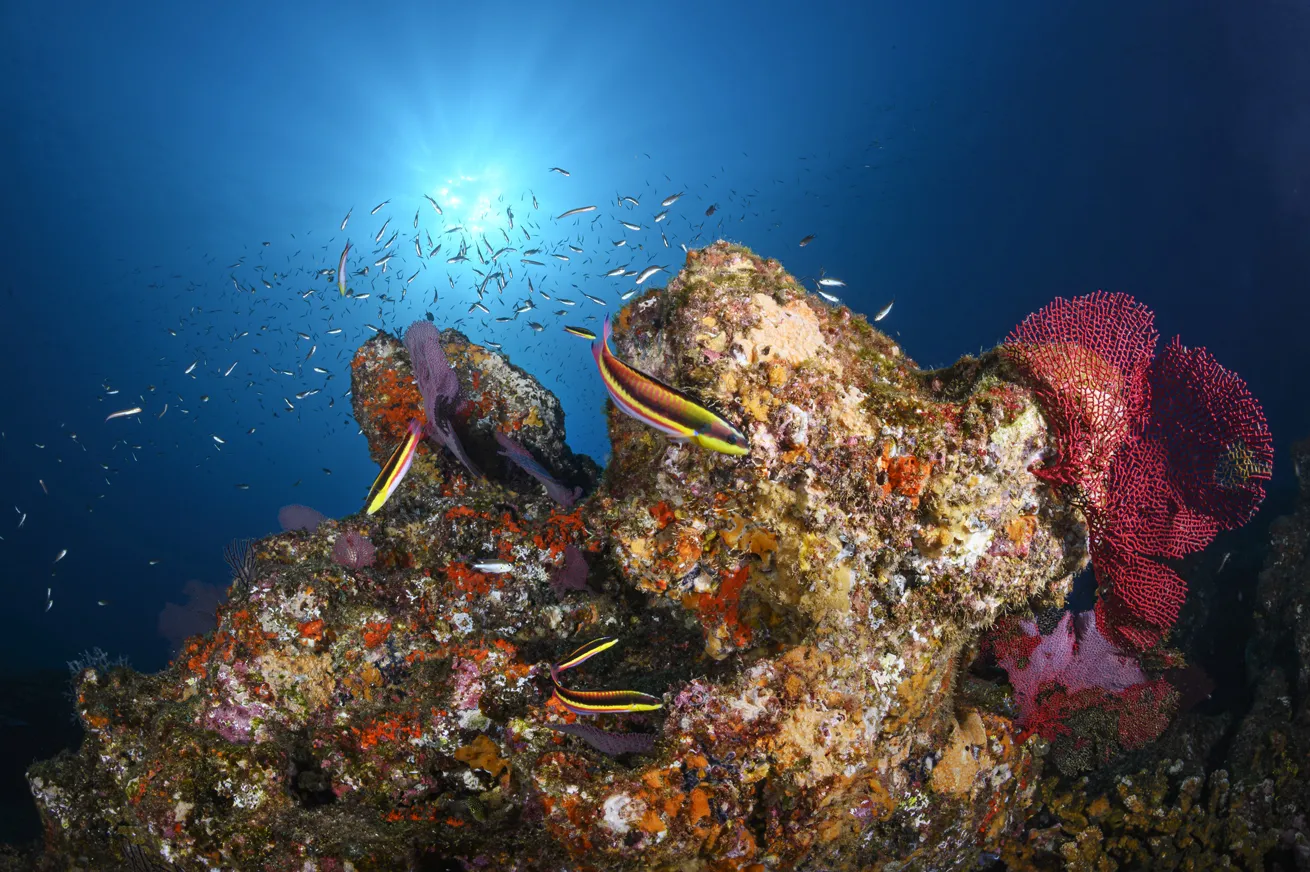
Thomas AndersonRainbow wrasse dart around on the reef in Cabo Pulmo, Mexico, with a well-defined sun ball lighting up the background.
One of my favorite types of background to capture is the sun ball. Bright sun rays combined with rich, blue water make perfect backgrounds and iconic underwater shots. Sun balls add epic drama and are fun to photograph.
Best Gear for Achieving Sun Ball Images
A variety of setups can help capture sun balls. For starters, a camera with manual settings will provide the control you need. Since sun balls have high contrast, use a camera with good image quality and decent dynamic range; some compact cameras with smaller sensors won’t capture the right look since their sensors can’t handle the higher dynamic ranges. Cameras with faster flash-sync speeds also make capturing sun balls easier.
A wide-angle lens works great, with fisheyes, rectilinear wide-angle lenses, and wet-wide lenses/conversion ports the best options. I prefer fisheyes since they are super wide, which adds drama to the scene and allows for close focusing.
For lighting, a good pair of bright strobes will work best—sun balls, especially when shot in shallower, brighter environments, require a lot of strobe light to overcome the higher ambient light associated with this type of shot. Weaker strobes struggle to light these scenes, while brighter, more powerful flashes will more easily light the foreground.
Related Reading: How to Pack Your Underwater Photo Gear
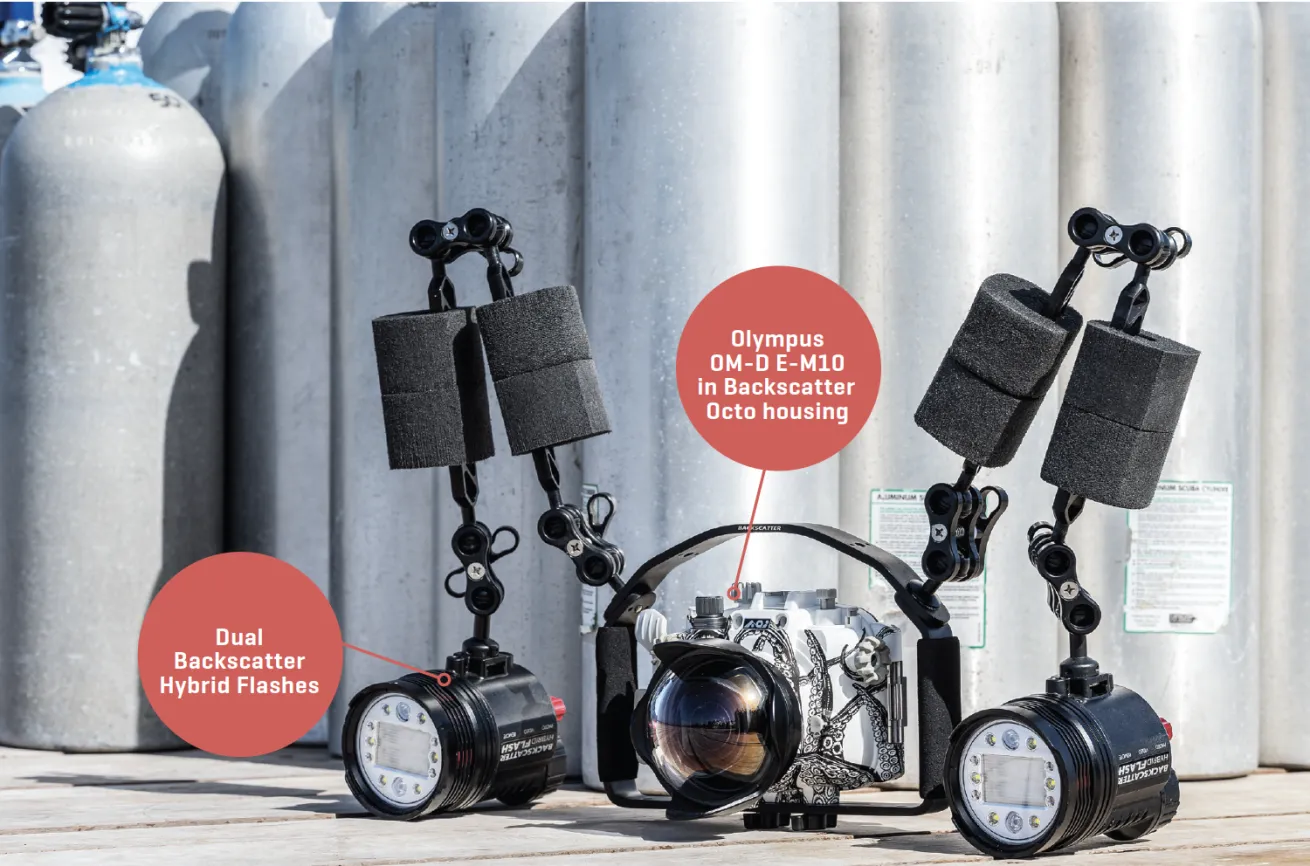
Thomas AndersonRecommended gear for capturing sun ball photos.
Settings for Capturing Sun Balls
The right settings make it easier to capture stunning, well-defined sun balls. First, consider shutter speed, which controls the background of the exposure and typically has no impact on the strobe’s ability to light the foreground, unlike aperture and ISO. This is critical for darkening the background and controlling how the sun ball appears. A faster shutter speed will reduce background ambient light and better capture the bright sun ball. A slower shutter speed will make it look more like an overexposed sun blob.
Start with the camera’s maximum flash-sync speed—this is the fastest shutter speed the camera can use without the shutter cutting off part of the image in the form of a black bar. This is typically between 1/160 to 1/400 for most cameras, with 1/200 being the most common. The faster the camera’s sync speed, the easier it will make capturing this type of image.
For aperture, you’ll want to use a higher range, typically f/16 to f/22. This reduces ambient light and keeps the sun ball from “blowing out.” Higher f-stops also create better-looking rays.
Use lower ISOs to reduce ambient light—100 to 400 is a good range. Lower ISOs are especially useful for cameras with slower flash-sync limits. This compensates for longer shutter speeds; however, it will require more strobe power. Since lower ISOs and stopped-down apertures are global effects, more flash power is needed to light the foreground. For this reason, and the high ambient light, it’s not uncommon to set strobes to full power for this type of scene.
Related Reading: How to Master the Motion Blur Photo
Technique and Tips
Sun balls are a great opportunity to “shoot for the background” since they add an interesting and dynamic element. First, consider where the sun is and line it up with the foreground. Then, dial in the background by taking some test shots using a fast shutter speed, stopped-down aperture, and low ISO. Review the background and check whether the sun ball is properly exposed. Use highlight and shadow warnings to check for major issues with exposure.
With the background dialed in, now it’s time to expose the foreground using your strobes. Start with full power and check if the foreground is well exposed. Backscatter is a concern due to higher strobe powers, so make sure your strobes are lighting the subject rather than the water column in between. If you’re shooting in poor visibility, get closer to the foreground and light more selectively to manage backscatter. Consider adding a midground subject, such as a model, to give the image more depth. Silhouettes can create a more complex background, with the dive boat being a great built-in background element. Another fun way to experiment is shooting ambient light with sun rays—this places the focus entirely on the sun and its rays for a more muted but equally impactful image.
Sun balls are a great way to add drama, depth and color to your shots. With the right gear, dialed-in settings and sound technique, they’re easy and fun.
Related Reading: How to Use Snoots to Light Your Macro Photography


