

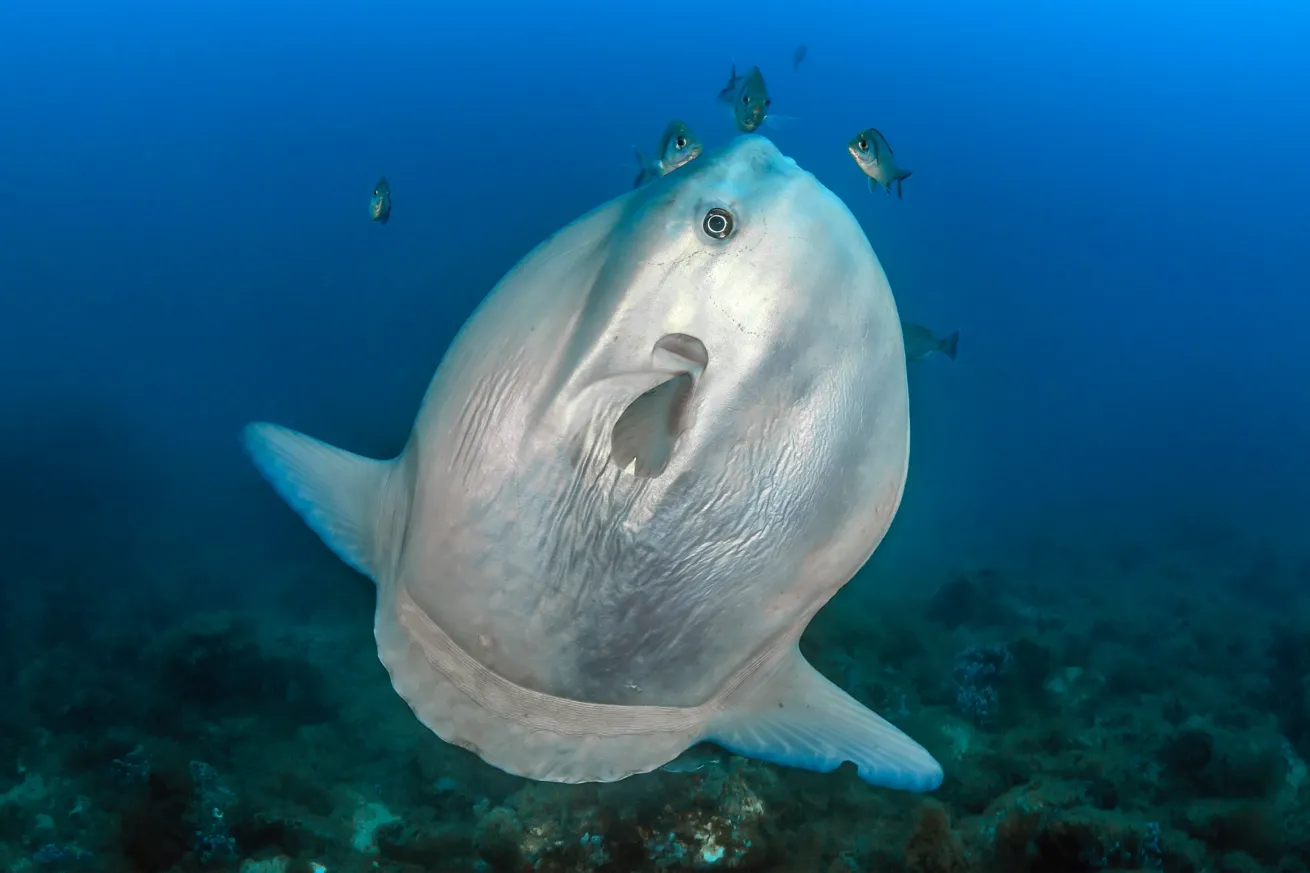
Shutterstock/David CarboMola mola or sunfish at a cleaning station.
Imagine diving in the ocean and coming face-to-face with a fish as big as a rhinoceros, lazily floating on its side like it’s sunbathing. It might look a little odd—even a bit clumsy—but the ocean sunfish is one of the most fascinating animals in the sea. Diving with ocean sunfish offers a rare chance to witness something truly unusual, if you should be so lucky.
8 Amazing Facts About Mola
1. There are five species in the family Molidae, commonly known as ocean sunfish.
2. Mola are the heaviest bony fish in the world, reaching up to 5,000 pounds, 14 feet vertically and 10 feet horizontally.
3. Like floating solar panels, mola often sunbathe at the surface to warm up after daily epic treks to deeper depths, earning them their nickname, sunfish.
4. Mola teeth are fused into a beak-like structure, making their mouths permanently open.
5. They can host over 40 types of parasites, relying on fish and even seabirds to pick them out of their thick, rubbery skin. To ensure birds don’t peck at their eyeballs, they’ve developed a muscle where they can pull their eyes deep into their eye sockets.
6. Mola lack a gas-filled swim bladder found in most bony fish to help with buoyancy. Instead, they stay buoyant thanks to a thick, jelly-like material beneath the skin, made of collagen and elastin.
7. During breeding season, a female mola can produce up to 300 million eggs, more than any other animal with a backbone. Survival is low with no parental care, so less than 1 percent survive.
8. They are a more recently evolved fish that come from bony fish but have a lighter and even reduced, skeleton made of mostly cartilege tissue—similar to sharks and rays—to help stay afloat.
Related Reading: Protecting Bali's Lush Reefs
Meet the Mola
Mola belong to the family Molidae—but look a bit like a fish that someone forgot to finish. Their bodies appear almost cut off behind the dorsal and anal fins, giving them a distinctive half-fish shape.
In place of a true tail fin, it has a stiff, rounded structure called a clavus. This pseudo-tail acts more like a rudder than a propeller—helping the mola steer through the water rather than push itself forward. They can cruise up to about 2 miles per hour. For propulsion, they flap their dorsal and anal fins in sync, like a pair of wings.
The name mola comes from the Latin word for millstone, a nod to their round, flattened bodies.
The Five Species of Mola
- Ocean sunfish (Mola mola)
- Southern (giant) sunfish (Mola alexandrini)
- Hoodwinker sunfish (Mola tecta)
- Sharptail mola (Masturus lanceolatus)
- Slender sunfish (Ranzania laevis)
The hoodwinker sunfish was officially identified in 2017 after a specimen washed ashore in New Zealand three years prior—making it the first new mola species described in over 130 years. Scientists had already uncovered genetic evidence of an unknown fourth species, but its appearance and range remained a mystery.
That changed with this unexpected discovery, offering a rare glimpse at a species that had been hiding in plain sight. It is now known to inhabit mostly the Southern Hemisphere, with occasional records off the coast of California.
How to Tell Mola Species Apart
Telling mola species apart can be tricky as they all share a similar rounded shape, but a few key features help.
The ocean sunfish (Mola mola) is the most common, with a smooth, rounded body, while the southern sunfish (Mola alexandrini) is larger, with head and chin bumps.
The hoodwinker sunfish (Mola tecta) is mostly found in the southern hemisphere, and has a rounded, smoother-looking tail (clavus) and a subtle fold along its back. The sharptail mola (Masturus lanceolatus) stands out with its pointed tail extension, and the slender sunfish (Ranzania laevis) is much smaller, reaching only 2.5-feet in length, more streamlined, and looks more like a typical fish.
Related Reading: Spain's Most Enchanting Dive Destination
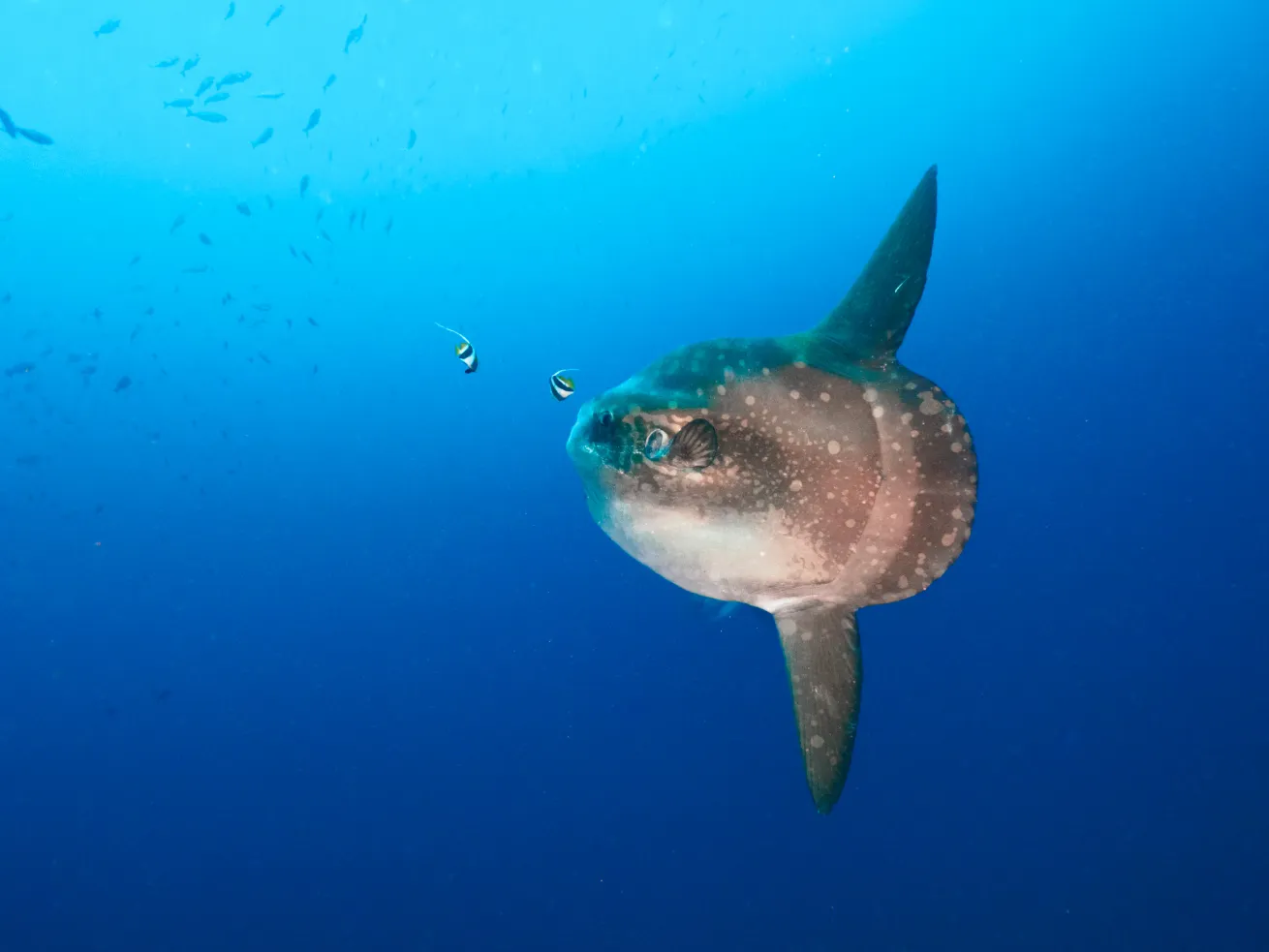
Shutterstock/Mayumi.K.PhotographyHoodwinker sunfish in a blue water off Nusa Lembongan, Bali, Indonesia.
Where Do Ocean Sunfish Live?
Mola are true ocean wanderers. They begin life as tiny planktonic larvae that look like little pea-sized spiky starbursts, before growing up to 60 million times their body weight into the massive, oddly-shaped giants.
Mola live in tropical and temperate oceans worldwide, but they prefer waters that aren’t too cold. If the temperature drops below about 54 degrees Fahrenheit for too long, they can become disoriented.
Around the world, molas are known by many names, including moonfish, headfish and makua in Hawaii, poisson lune in France, pesce luna in Italy, manbo in Japan, lua in Brazil and pez luna in Cuba.
Most of their lives are spent in the open ocean traveling from the surface to deep depths. Tagging studies show they can dive as deep as 4,000 feet. They come close to shore near kelp beds and reefs for cleaning stations and to warm up.
Very few animals prey on mola due to their large size and tough, leathery skin. However, predators like orcas, sea lions and large sharks will sometimes hunt them—and the encounters can be surprisingly brutal. In some cases, orcas have been observed tearing off the sunfish’s dorsal and anal fins, leaving behind a rounded body. They may then toss the remains between one another, almost like a game of frisbee.
Where and When to Dive With Ocean Sunfish
Nusa Penida and Nusa Lembongan in Bali
Located off the coast of Bali, Nusa Penida and Nusa Lembongan are some of the best and most reliable places in the world to dive with mola.
The sunfish usually live in deep water, but during the dry season they rise closer to the surface to visit cleaning stations. Sites like Crystal Bay and Blue Corner are prime locations, thanks to nutrient-rich currents that attract a wide range of marine life. Here, cleaner fish, including the bannerfish and angelfish, remove parasites from the mola’s skin. Crystal Bay offers the highest chance of sightings, with a deep drop-off and strong currents that mola seem to prefer, though they are also regularly seen at Blue Corner and nearby sites.
When: June to October
Dive type: Drift diving, boat diving
Conditions: Clear water, strong and sometimes unpredictable currents
Diving here typically involves drifting along steep reefs and drop-offs while currents carry you. Encounters often happen in open water, where pelagic species like mola and manta rays pass through. Due to currents, surge and occasional downcurrents, this is best suited for advanced divers or those comfortable in challenging conditions.
Galápagos Islands, Ecuador
In the Galápagos Islands, nutrient-rich currents create ideal conditions for ocean giants—and mola are no exception. Sightings of M. mola,* M. alexandrini* and M. ramsayi are possible year-round, but are more consistent during the cooler, drier season (June to November), when plankton blooms attract marine life and cleaning stations become more active.
Punta Vicente Roca, on the west coast of Isabella Island, is one of the most reliable dive sites, featuring a dramatic vertical wall that drops into deep water. And when not with mola, keep an eye out for other pelagic species such as eagle rays, mobulas, sharks and even orcas.
When: Year-round, June to November best
Dive type: Liveaboard, advanced boat diving
Conditions: Strong currents, surge, deeper profiles
Diving here can be challenging, with strong currents and surge, so experience is essential. Most divers visit via liveaboard, which allows access to remote sites and increases the chances of encountering mola alongside other large pelagic species.
Musandam Peninsula, Oman
Tucked away in the far north of Oman, the rugged fjord-like coastline of the Musandam Peninsula is one of the ocean’s best-kept secrets.The region is better known for seasonal whale sharks, but that’s only part of the story. With fewer crowds, divers have a good chance of spotting shy Mola mola alongside thriving reefs.
When: October to May offers the best visibility and calm conditions.
Dive type: Liveaboard, intermediate and advanced diving, with some day trips from boats
Conditions: A mix of reef and pelagic diving, including drift dives with occasional strong currents, plus dramatic underwater terrain with caves and tunnels
Izu Peninsula, Japan
Along the coast of Izu Peninsula, Japan offers one of the most unique opportunities to dive with mola. These fish are known to gather here seasonally, with some evidence from research suggesting they even spawn in nearby waters.
Divers most often find mola at a handful of well-known sites, including Osezaki, Nakagi, and Futo, particularly around Mikomoto Island. Osezaki is thought to act as a cleaning station, where mola visit to have parasites removed.
When: April to August
Dive type: Boat trips and shore diving
Conditions: Ranging from relatively calm, accessible shore dives to more advanced, current-driven sites where mola are more likely to appear.
Other Places to See Ocean Sunfish
Other places where mola sightings are possible include the California Coast, the Sea of Cortez, Mexico, the Hebrides, Scotland, and the Costa del Sol, Spain, where nutrient-rich currents and open ocean conditions occasionally bring these elusive giants within reach of divers.
Along the California Coast and in Mexico’s Sea of Cortez, mola are often found where deep ocean waters meet coastal features like kelp forests, seafloor rises and island drop-offs. These transition zones draw pelagic species closer to shore, with mola sometimes seen basking at the surface or cruising offshore.
The Hebrides in Scotland are another possible mola dive spot. These remote islands have rich plankton blooms in summer, which attract jellyfish—and in turn, sunfish.
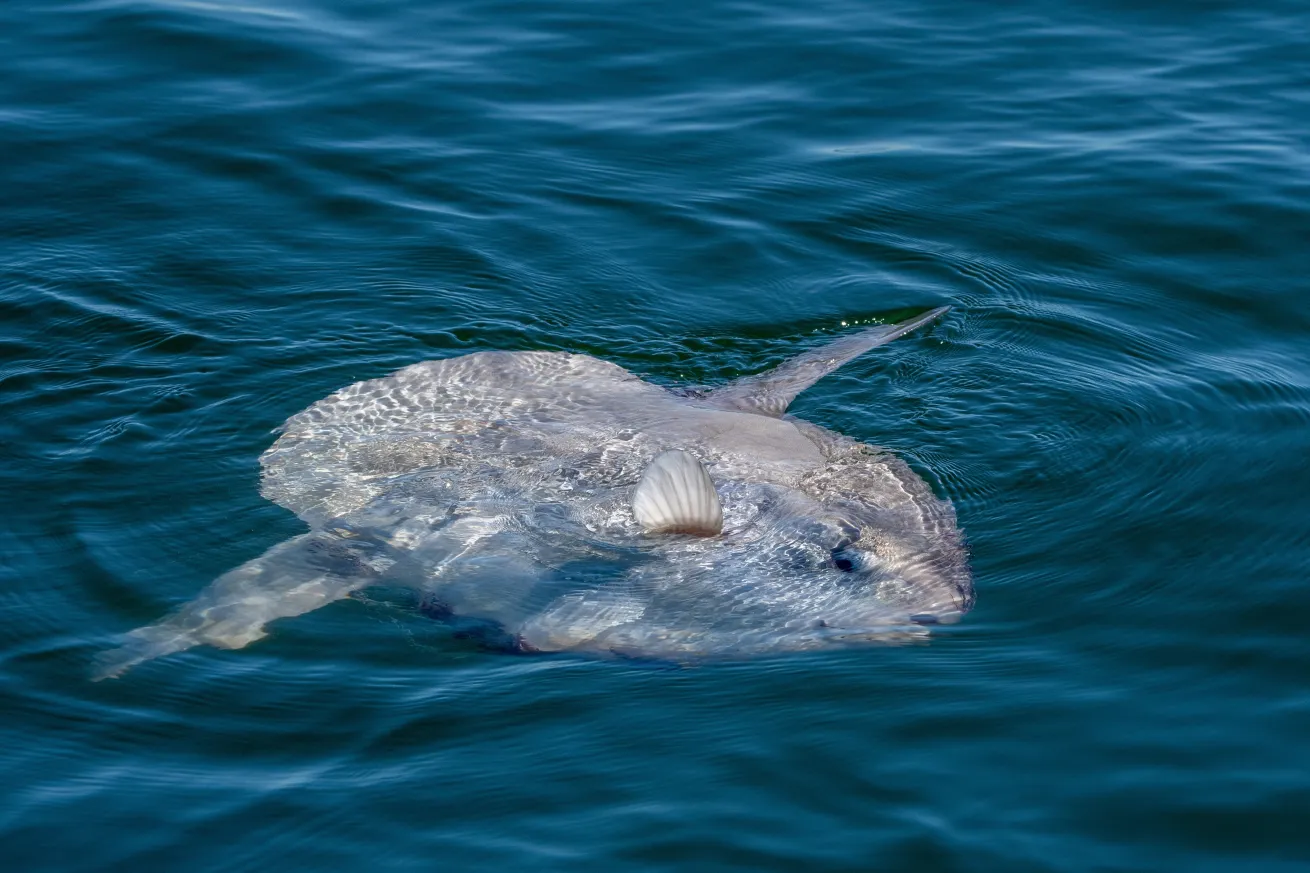
Shutterstock/Jeroen HuygheOcean sunfish (Mola mola) off the coast of Washington.
What Do Ocean Sunfish Eat?
Mola mainly eat jellyfish and other soft jelly-like animals, which are low in nutrients. This means they need to eat almost constantly and can spend up to half their day feeding.
They also snack on tiny drifting zooplankton, algae, and small fish. A special mucus coating inside their gut protects them from stings.
Surprisingly, the slender sunfish (Ranzania laevis) mostly eats squid. In one case from Australia, an almost 2-foot fish had 17 squid in its stomach, along with some crustaceans—showing that this slow-looking fish is actually a fast and agile hunter.
Conservation Status
Despite their size, mola face several serious threats, including accidental capture in fishing gear. While not a commercially important fish (although there is some market for it in Japan) Mola mola are the most common bycatch of the broadbill swordfish drift gillnet fishery off California. They make up about a third of all bycatch and far outnumber the target species. M. mola are currently listed as vulnerable on the IUCN Red List, with a decreasing population.
Less is known about the population status of other species and more data is needed to create conservation plans. The southern sunfish (M. ramsayi) is currently under review by the IUCN. Additional threats include plastic pollution that they mistake for food, boat strikes at the surface and climate change, which affects their food supply and movements.
Reducing plastic use, supporting sustainable fisheries, and practicing responsible diving can all help protect these unique ocean giants.
Related Reading: Best Destinations to Dive With Big Animals
Ethical Encounters With Mola
If you’re lucky enough to encounter one of these amazing oddballs, remember they are sensitive animals and easily spooked. To maximize your chances of a natural interaction—follow a few simple guidelines:
Lights and strobes: Keep power low and use diffusers. Avoid test flashes near cleaning stations.
Approach slowly: Glide in with gentle fin kicks to avoid disturbing the water.
Position carefully: Approach from the side at the same depth—never head-on or across their path.
Stay neutral and calm: Hover quietly and control your breathing to avoid disrupting the scene.
Keep groups small: Only a few divers should approach at a time, while others hang back.
No touching or feeding.
Respect cleaning stations: Don’t hover directly above—let cleaner fish do their job.
Let the mola lead: If it comes closer, stay still; if it swims away, give it space.