

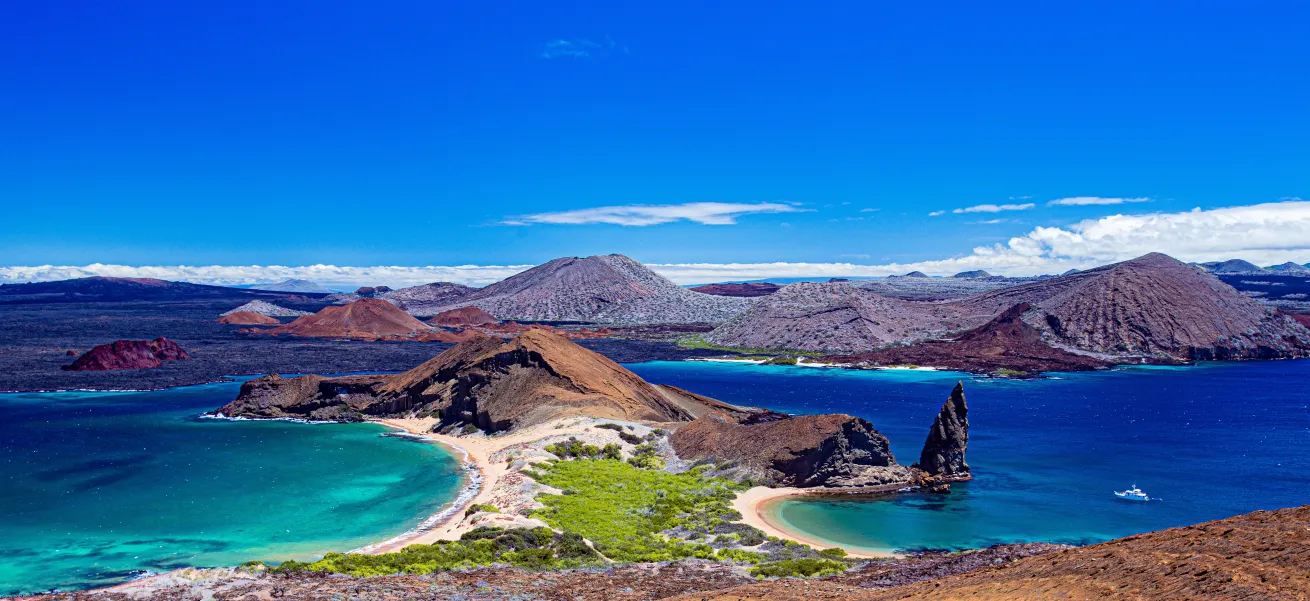
ShutterstockThe Galapagos is a legendary, bucket-list destination for many divers.
The Galapagos Islands cover an enormous area: a 53,300-square-mile archipelago of red and dun volcanic islands baking under the equatorial sun, 620 miles from the Ecuadorian coast. It’s a place where time is standing still and accelerating simultaneously. Even Charles Darwin’s celebrated finches, an example of his theory of evolution, are still evolving.
Divers know all about the Galapagos Islands. It’s the underwater Serengeti, a legendary, bucket-list destination. The sheer amount and diversity of wildlife here is incredible: fish biomass is approximately twice the amount found in the second-highest area known to science.
Most divers opt for liveaboards as a way to dive the Galapagos. It’s a good choice and a great way to experience spectacular sites like Wolf and Darwin Islands with their schooling hammerheads, whale sharks, Galapagos sharks, silky sharks, turtles and more.
However, if liveaboards are out of your price range (or beyond your skill level), base yourself on Isla Santa Cruz. Along with epic diving, there’s also wildlife-watching of your dreams: giant tortoises, Galapagos sea lions, blue-footed boobys, the most northerly species of penguin in the world and marine iguanas, which Charles Darwin dubbed “imps of darkness.”
Related Reading: Don't Dive the Galapagos Without Reading This First
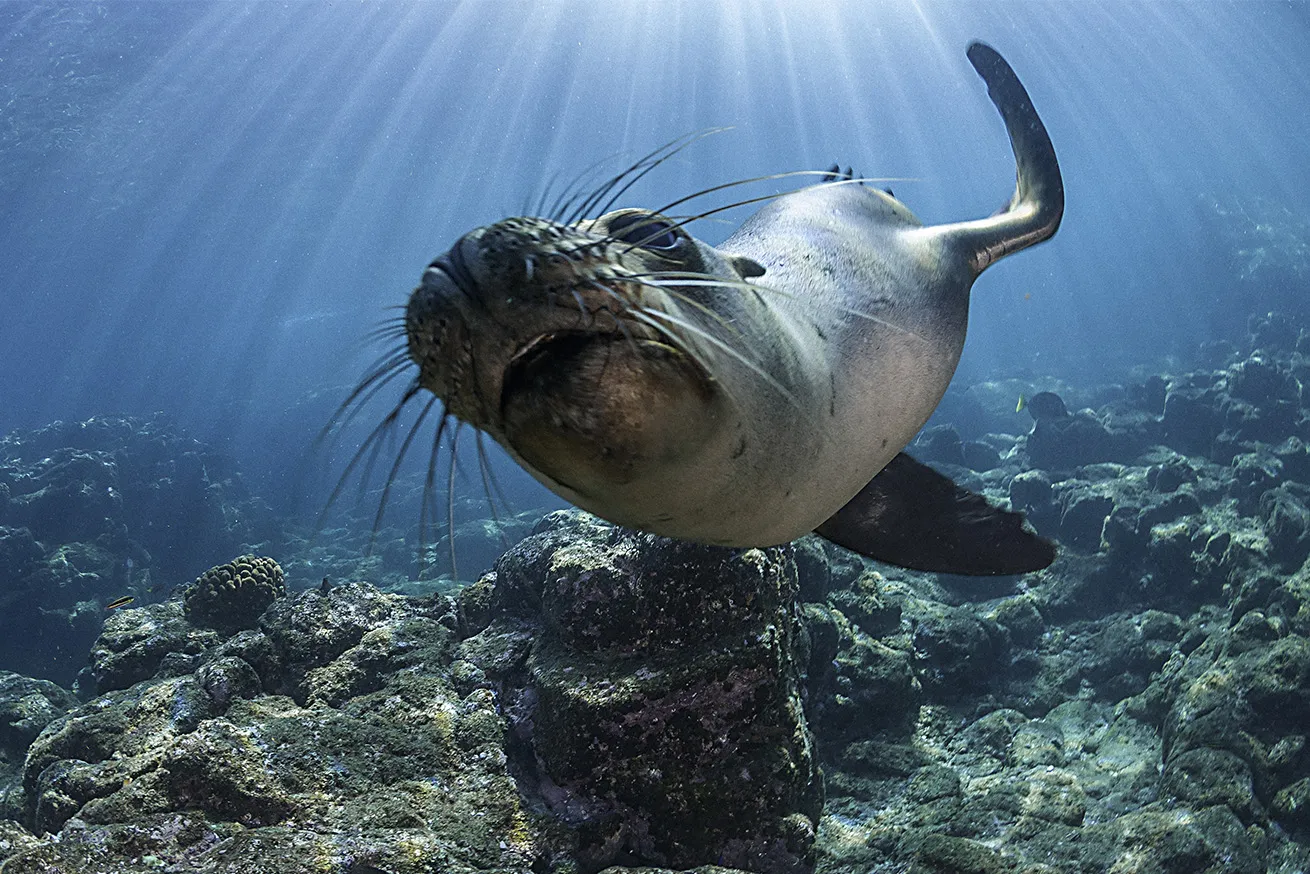
Shutterstock/wildestanimal
A Dive on the Wild Side
The Galapagos Marine Reserve is one of the most biologically diverse marine protected areas in the world, home to nearly 3,000 marine species and incredible diving. The islands sit at the intersection of three ocean currents converging over more than 300 seamounts. Most of the dives are cool-water drifts in low, greenish visibility due to the nutrient-rich waters. (The marine life is here to feed, so creatures don’t linger.)
On every dive, we found ourselves with more to look at than we could take in. On one dive, for example, we saw a mola mola, a school of scalloped hammerheads, sea lions, schools of tuna and barracuda and a squadron of mobula rays.
What impressed us most about the diving, apart from the abundant marine life, was the management of dive locations. There are several dive shops in Puerto Ayora and they’ve established a unique system of alternating dive sites. For example, on a Tuesday, one shop dives the Seymour Channel. This is a murky wall dive in the channel between North Seymour Island and Baltra Island that can be dived in both directions. It has big stuff like hammerhead and Galapagos sharks, manta rays, and eagle rays.
Meanwhile, another shop goes to Cousins Rock, another deep wall with Galapagos sea lions, mola molas, large schools of barracuda, and cold thermoclines at depth where Galapagos sharks like to hang out.
Divers can dive with one shop and rotate through different sites, or they can revisit a favorite site by going with the shop that’s diving that location on a particular day. This system gives divers a better experience, as you’re the only dive boat at the site, and it minimizes impact.
Dive trips tend to last most of the day, due to travel to the harbor (via shuttle), plus the boat trip to the site (distances vary).
Shutterstock/NatashaFa
Revel in the Wildlife Watching
There are plenty of opportunities to see the land-based wonders endemic to these amazing islands. Here are three must-do experiences:
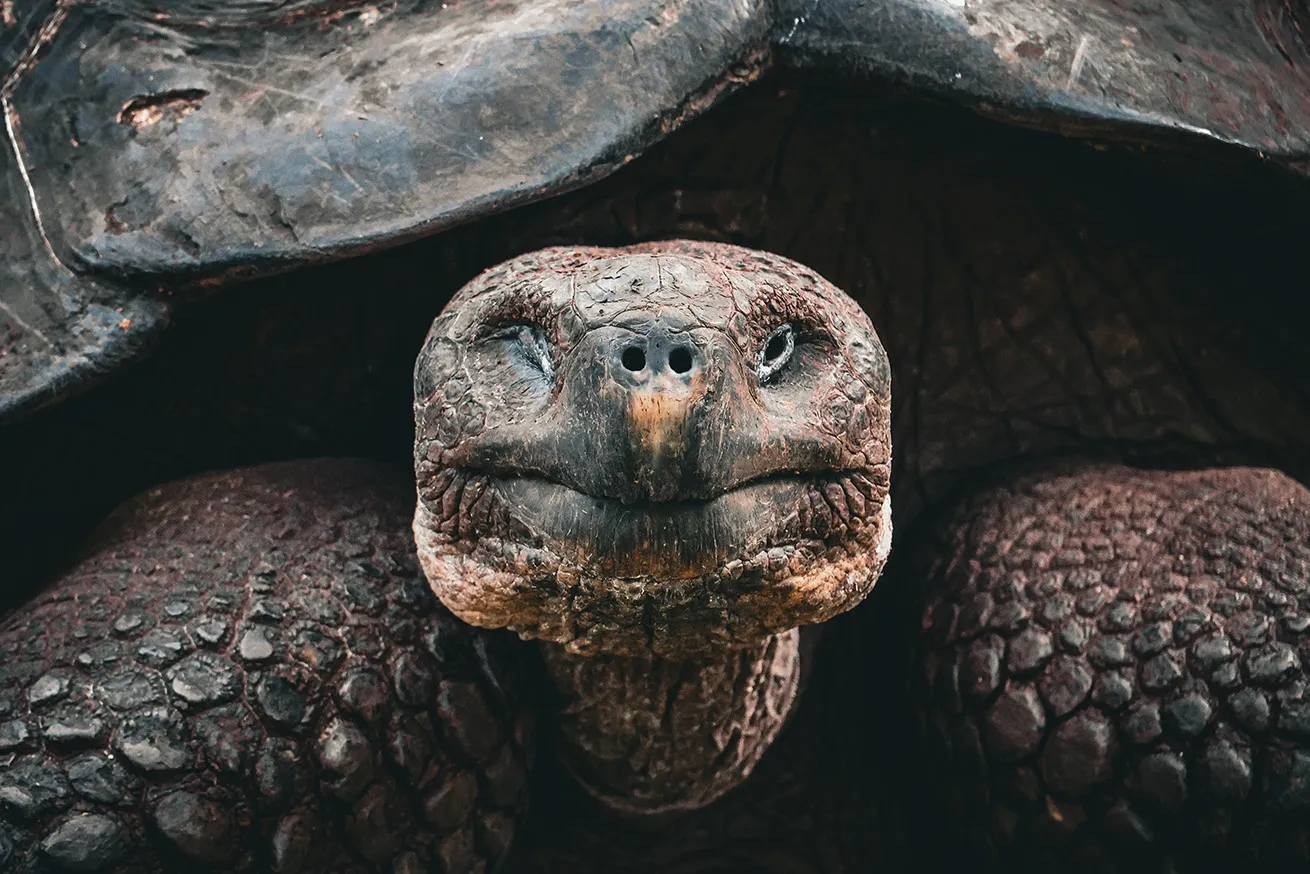
Lunch with giant Galapagos tortoises at Rancho El Manzanillo. Located inland from Puerto Ayora and surrounded by lush vegetation, we snacked on local specialities (like lemongrass iced tea and green banana chips with tamarind sauce) while watching some of the island’s 3,000 wild tortoises roam in their natural habitat. These are the world’s largest terrestrial reptiles (males can top 500 pounds) and the longest living of all vertebrates, averaging more than 100 years in age.
Take a day trip by boat to Santa Fe Island to see endemic Santa Fe Land Iguanas. Santa Fe was the first of the Galapagos Islands to be visited by Europeans, who described it as hell on Earth (no water, no shade). For us, it was an Eden: on an easy-paced guided tour, we saw jumping mobula rays, frigate birds, Galapagos sea lions, and a half-dozen Santa Fe Land Iguanas. There’s about 1,000 of them on this 9.3-square-mile island, staking out territories around the prickly pear cactus (also their food source).
Swim with marine iguanas in Tortuga Bay. This was our favorite Galapagos experience. Marine iguanas are the world’s only aquatic lizard. They are able to hold their breath for more than an hour, swimming out to sea and diving to depths of 30 feet to graze on seaweed and algae. It’s a 45-minute walk from Puerto Ayora to Tortuga Bay’s Playa Brava. The marine iguanas can be found on the western side of the beach, where there’s a mangrove-fringed lagoon they return to after their sea forays.
Related Reading: Diving to Protect the Galapagos
Need to Know Diving Santa Cruz, Galapagos
When to Go: December through May is hot, with daily rains giving way to sun and calmer seas. June through September are the busiest months for tourism, due in part to the increased animal activity underwater (like big hammerhead schools); prepare for rougher seas.
Dive Conditions: Visibility ranges from 25 to 49 feet. Water temperatures are around 70 degrees in winter and 77 degrees in summer. Depths average around 75 feet. Suitable for divers of all levels; ideal for divers with some experience.
Operators: Galapagos dive guides go through a strict certification process with the National Parks Authority: they’re highly skilled and knowledgeable. We dove with Scuba Iguana, an excellent shop.
Travel Tips: There are daily flights from Quito and Guayaquil on mainland Ecuador. Arriving 24 hours before your Galápagos-bound flight is prudent. There are strict biosecurity screenings and carry-on size is monitored. Make sure you understand and are prepared for the national park fee system prior to traveling. Once here, walking, bike rentals, water taxis, buses, and taxis are the way to get around.
Make a Difference: The Charles Darwin Foundation’s mission is to conserve the environment and biodiversity of the fragile Galapagos Islands. They do this through scientific research, action, advising the Government of Ecuador, and community engagement and education. Visiting the Charles Darwin Research Station, the operative branch of the Charles Darwin Foundation, is one way to support the work they do. Volunteering is another (vacancies are listed on the website). The foundation is completely dependent on donors, but what’s really needed is consistent, ongoing funding, to allow for future planning.
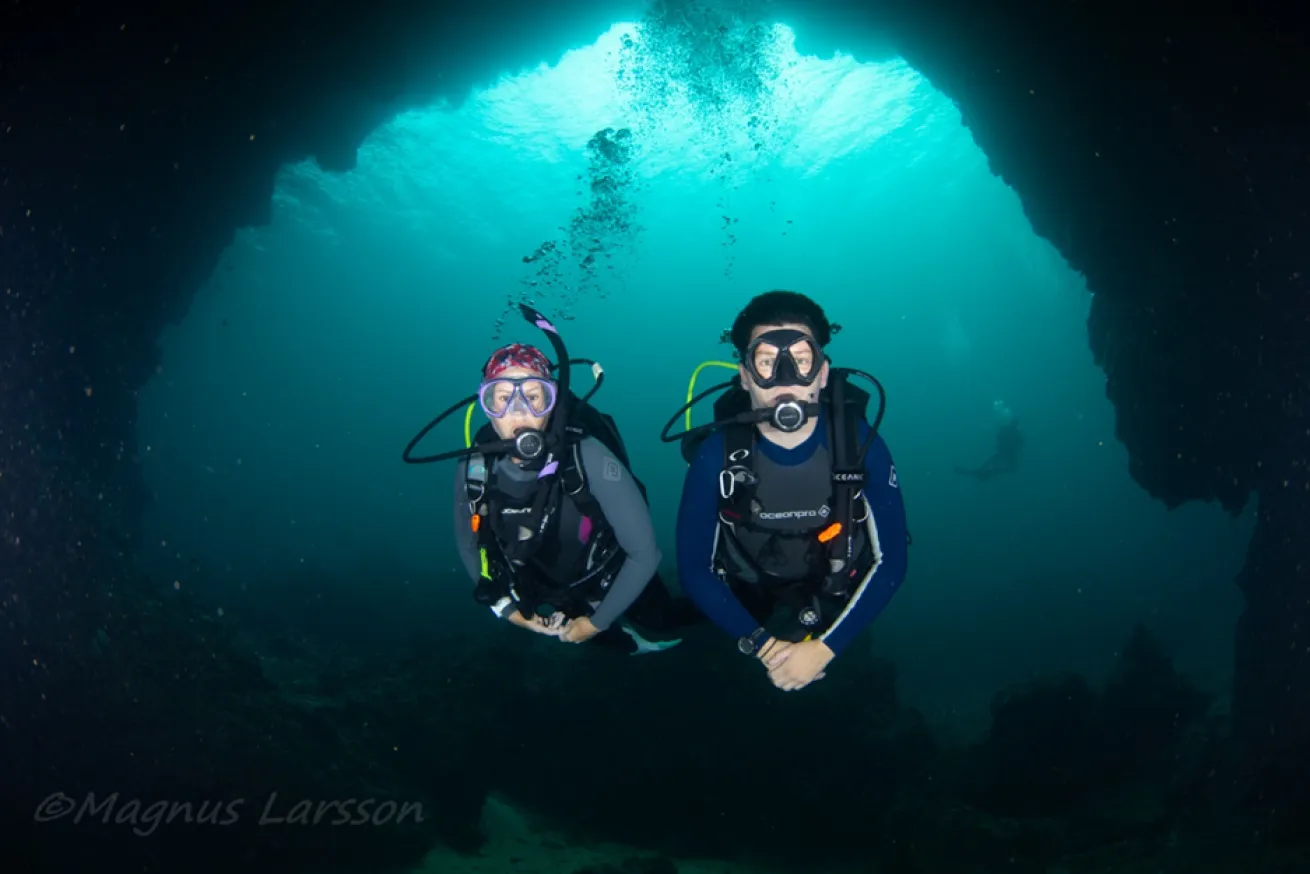
To create their unique National Geographic book, A Diver’s Guide to the World: Remarkable Dive Travel Destinations Above and Beneath the Surface , dive travel experts Carrie Miller and Chris Taylor traveled to 50 inspirational locations around the world, spending more than 250 hours underwater. Carrie is also the author of 100 Dives of a Lifetime: The World's Ultimate Underwater Destinations. @beneaththesurfacemedia; @carriemiller\writer


