
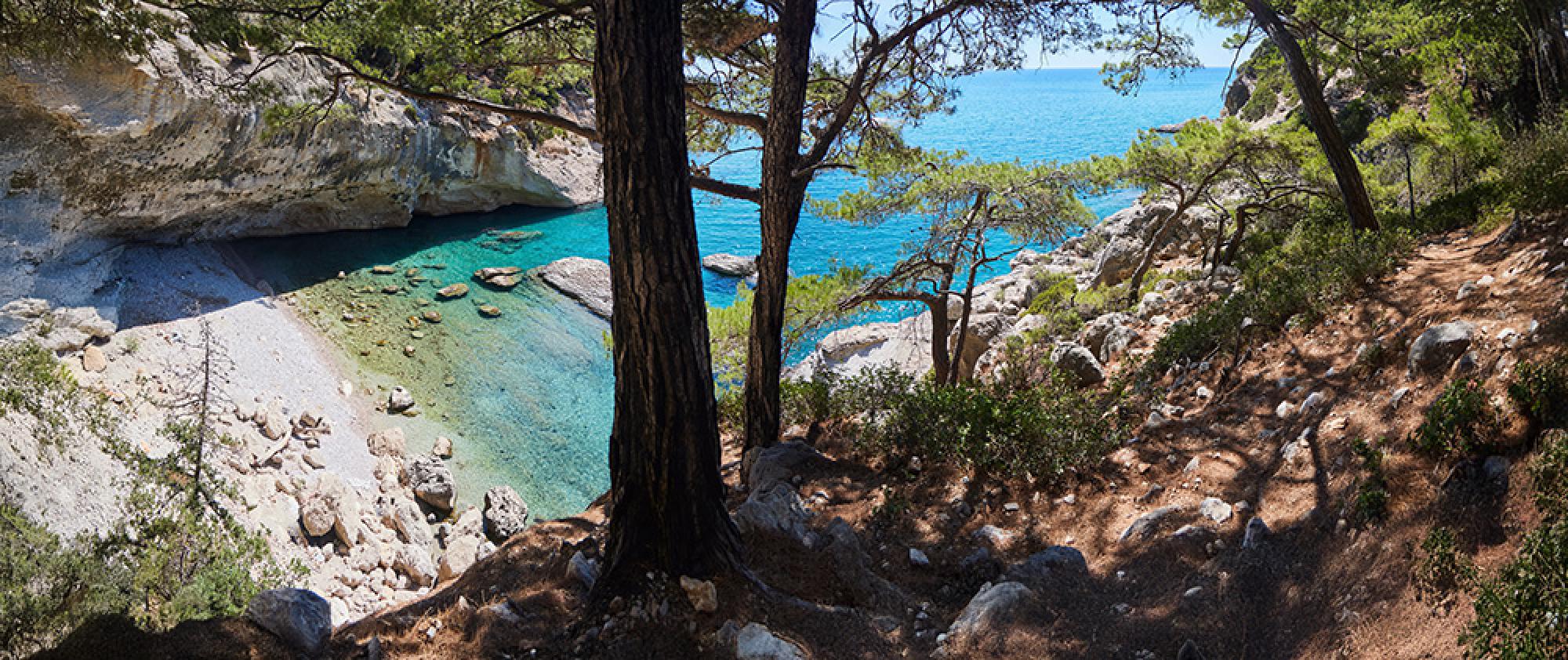

In some places, diving is the whole trip. You wake early. Two tanks. Back by noon. Repeat until your logbook is full and your world is reduced to depth and bottom time.
The Turkish Riviera works differently.
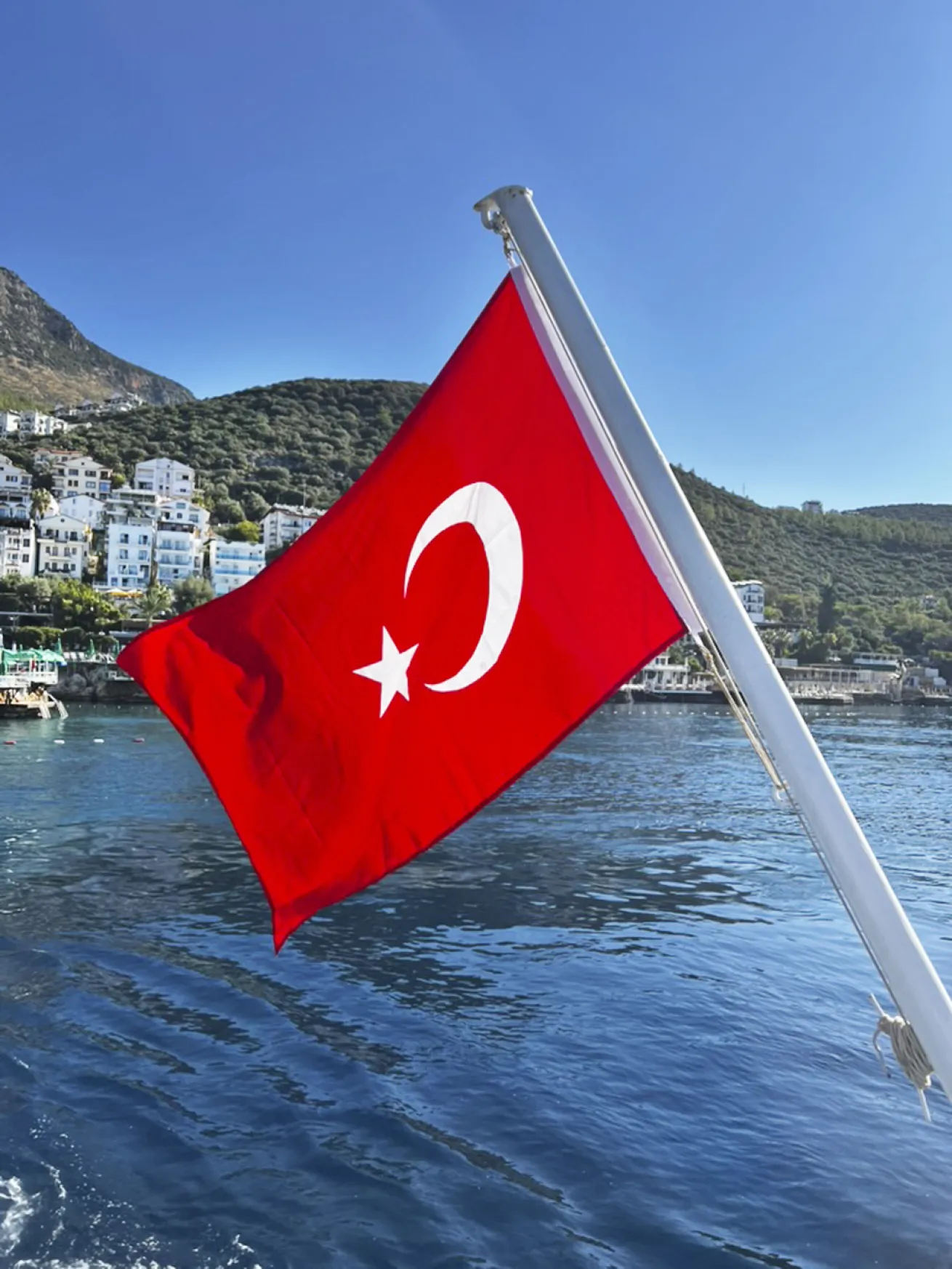
Alexandra GillespieThe dive boat sports Turkey’s official flag.
Here, the boat leaves the harbor heavy with tanks and beach bags. Families stretch out in the sun. Someone pours tea. Pine-covered hills slide by in the morning light, and the water turns that particular Mediterranean blue that looks staged.
“You don’t only dive,” says Asutay Akbayir, who started his career in Turkey in the 1980s and now oversees the region’s diving operations as a PADI regional manager. “We offer many things in the boat.”
He means it.
The boats feel more like floating terraces than dive taxis—wide decks, space to linger. You roll in for the first dive, surface to plates of grilled fish and tomatoes slick with olive oil, then drift in a quiet cove while someone launches a kayak off the stern. Between dives, there’s time. Time to swim. Time to nap. Time to stare at the mountains and remember you are on vacation.
In the seaside town of Kaş, you can paddle toward the submerged ruins of Kekova during your surface interval, looking down at the ghostly outlines of a Lycian city beneath the water. In Fethiye, you finish a morning cavern dive and spend the evening wandering a fish market or sipping something cold while paragliders arc overhead. In Kalkan, you surface from a World War I wreck and dress for a rooftop dinner.
The sea is central here, but it does not demand exclusivity. It shares space easily with archaeology, with long meals, with the slow choreography of a European summer.
You can come for the walls and wrecks. You should. They’re worth it.
But you’ll leave remembering the smell of pine on hot air, the taste of salt still on your lips at dinner, and the way the coastline never lets you forget how long people have been living—and sinking—here.
On the Turkish Riviera, diving is not an escape from the world. It’s how you move through it.
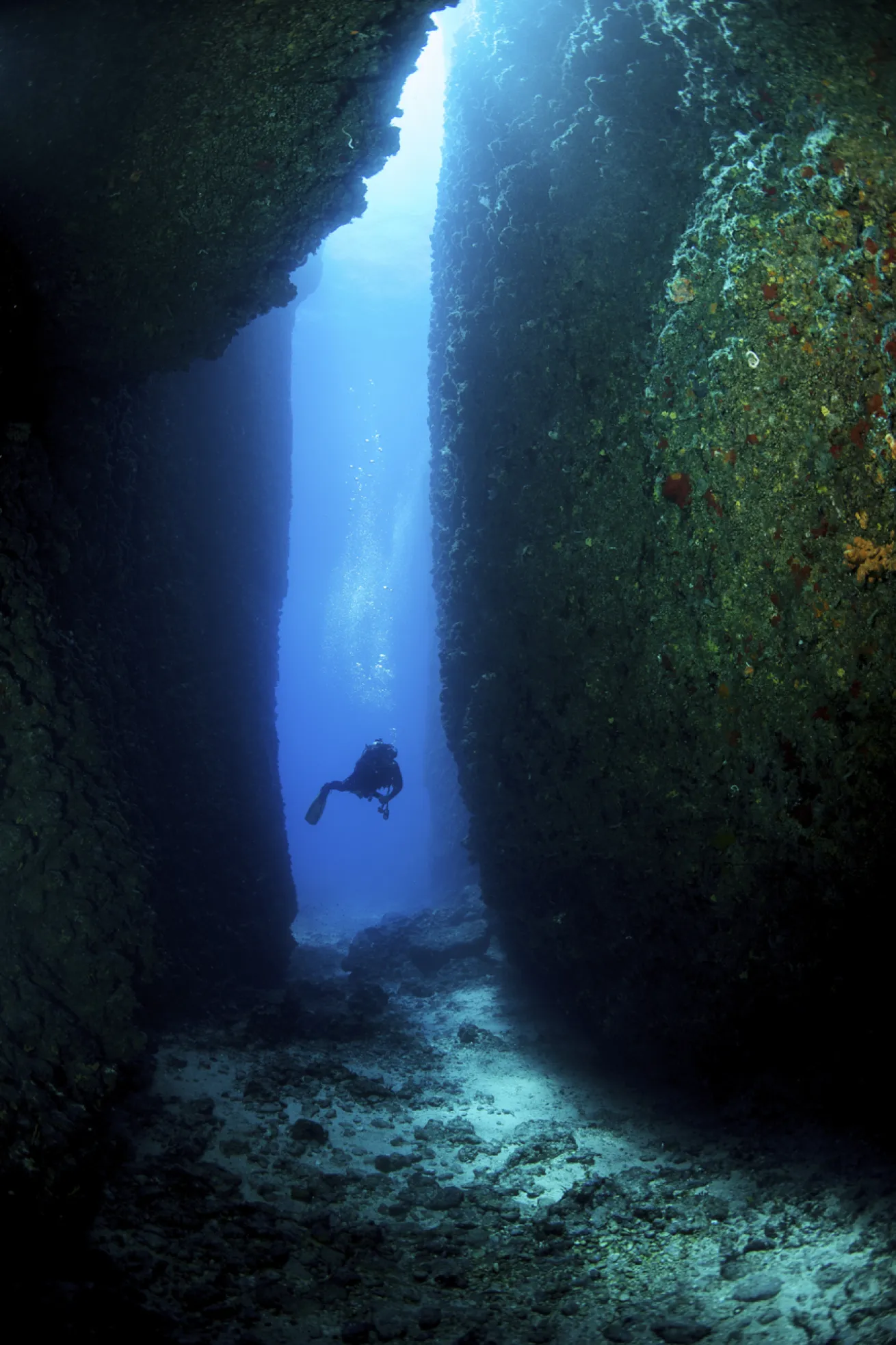
The sheer wall at the Canyon dive site makes for a dramatic path leading to an underwater cave.
Caverns Beneath Forests
Fethiye’s harbor is calm in the morning, the water flat as poured glass. Pine-covered hills rise steep and green behind the marina. British holidaymakers drift down toward the docks with towels over their shoulders and coffee still in hand. By afternoon the wind will roughen the bay, but early on the sea behaves.
The dive boats leave first thing, before the chop builds.
“Most people would probably ask to go to Aladdin’s Cavern,” says Kerrie Yener, who runs Elite Diving Centre with her husband, Ahmet. It’s the one everyone talks about. An Advanced Open Water certification is required. The line drops, bubbles rise and the wall falls away beneath you: “We descend down at the beginning to 30 meters (100 feet),” Yener says.
At depth, the Mediterranean shifts in tone—it becomes less postcard picture and more reverential, cathedral-like. The rock face is pale and sheer. You glide along it, keeping close. The entrance to the cavern yawns ahead. Inside, the light changes. It softens. Your breath sounds louder.
Then comes the turn.
“You would ascend up to about 12 meters (40 feet)… and you would surface in there,” Yener explains. “And this is open to the sky.”
They call it the Turkish Bath.
You break the surface inside stone. Rock walls surround you, with blue sky cut into a rough oval overhead. Water laps quietly against the cavern edge. It feels private. Secret. Like you’ve slipped into something ancient and stumbled onto the roof.
There’s no spectacle. There are no soft corals waving in current, no clouds of anthias demanding attention. It’s better than that. It’s restraint. Stone and shadow. Architecture shaped by time rather than by reef growth. The kind of dive that makes you look up as much as you look down.
You finish the dive, climb back aboard and the day continues. Lunch appears, and the boat shifts to a calmer site for the afternoon, perhaps Aquarium Reef, where nudibranchs and octopuses tuck into the rocks. It’s an easier dive. A softer landing.
By sunset, you’re back onshore, wandering through Fethiye’s fish market, choosing your dinner from crushed ice and letting someone else cook it over coals. Or you find a table at Secret Garden and order something slow and local. The next morning you might drive to Ölüdeniz and run off a mountain with a paraglider, drifting down over a lagoon mesmerizing in its blue hue. Above town, Lycian tombs stare out from the cliffs, cut into rock long ago.
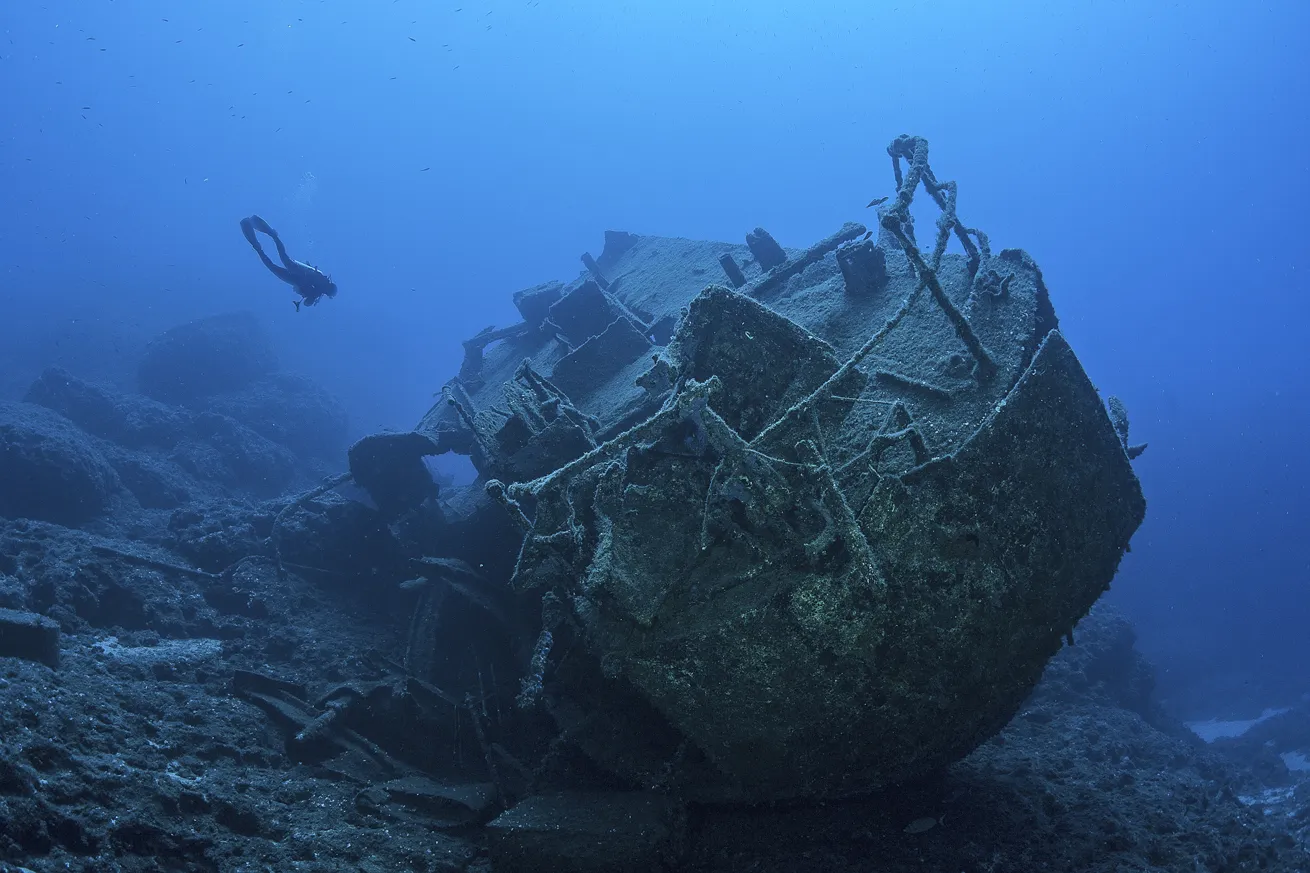
Courtesy GotürkiyeA diver approaches a wreck off the coast of Kaş.
A Wreck With Two Names
Kalkan feels smaller than Fethiye. Tighter. The hills press closer to the sea. Whitewashed houses climb the slope above the harbor. During summer days, the restaurants fill with British accents and the smell of grilled fish, but mornings are quiet.
Out past the bay, the water deepens quickly. The wreck they come for here is called Sakarya.
But that’s not the name on the bell.
“In 1995, two German guys… went into the deep end of the ship, 60 meters (200 feet), and on the sand they found the bell,” says Altan Kusat of Kalkan Dive Center. The bell reads Duchess of York, giving the ship its second name.
Nobody knows how the bell ended up there. The ship itself ran aground and snapped in two on July 11, 1943.
The bow is too deep for recreational divers. The stern—the part most visitors explore—rests along the reef between roughly 40 and 80 feet. It’s enough depth to feel serious without being out of reach.
In the 1940s, a salvage team came for what they could take.
“They used dynamite. They blew up the back of the ship—most of it—so it’s the only part you can really see,” Kusat says.
What remains is fractured steel, tilted plates, openings where cargo once sat. Groupers move in and out of shadow. In season, turtles pass over. The metal softens under growth. The sea does what it always does—it absorbs and repurposes.
There is current here. Some days the site is calm. Other days it is not. The wreck sits exposed, and the weather makes the call. This is not a protected swim-through. It feels open. A little raw.
You surface with the hills of Kalkan behind you, the town climbing upward. By evening, you’ll be seated on a rooftop terrace as the light drains from the bay. The wreck lies quiet again offshore, its borrowed bell still a mystery in the sand.
Related Reading: The Sea Hero's New Seawall
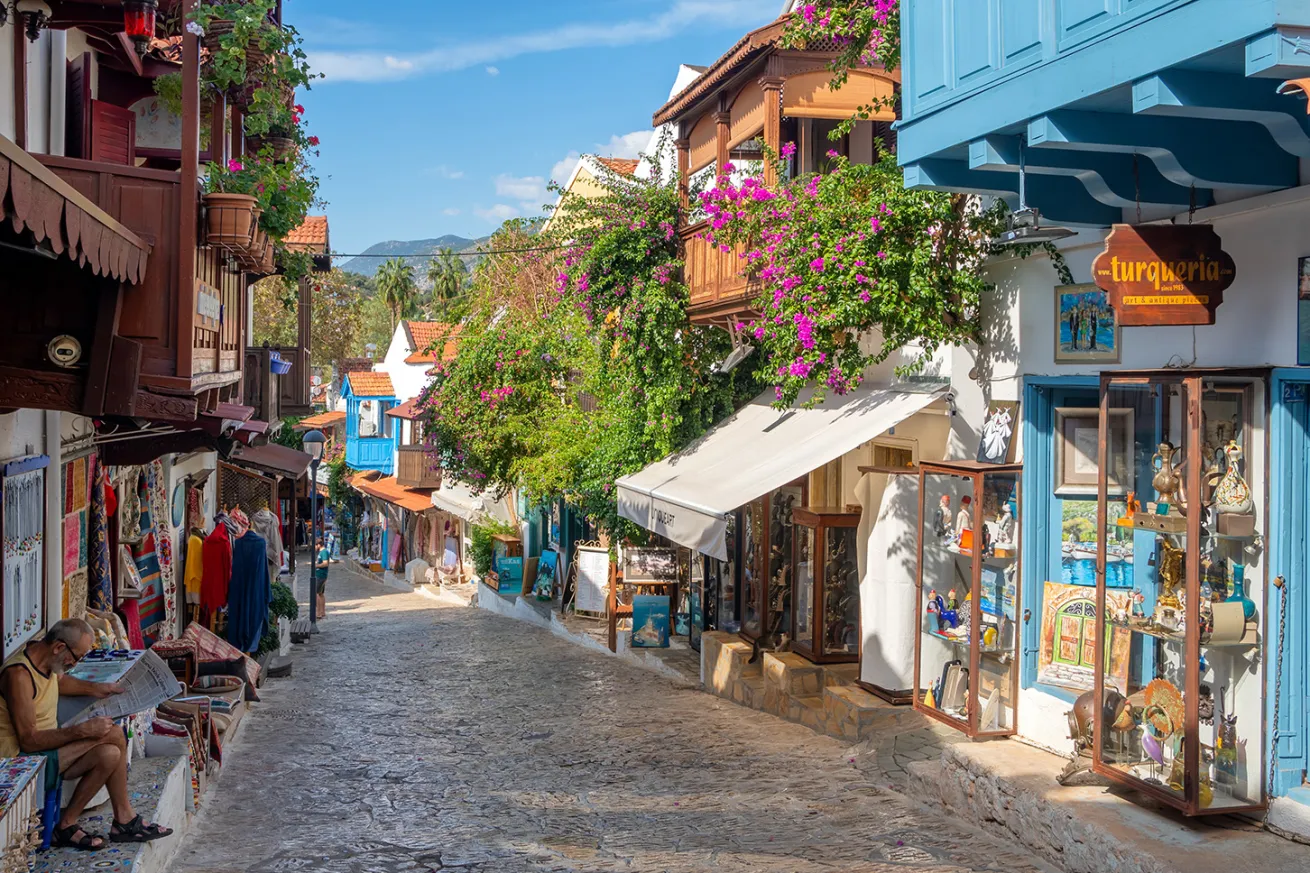
Shutterstock/Mazur TravelGrab a post-dive bite and people-watch at Kaş’s coastal shopping center.
Kaş: At the Edge of the Continent
Kaş is the kind of town where you plan to stay two nights and extend it to four.
The harbor curves gently, boats lined up bow to stern. Stone streets climb the hillside in switchbacks. Bougainvillea spills from balconies. There are dive flags, yes—plenty of them—but there are also galleries, wine bars, handmade jewelry in shop windows, linen dresses catching sea breeze in doorways.
You come here to dive. You stay because it feels good to be here.
Luckily, the Canyon sits only minutes offshore. At first it looks unremarkable—shallow rock in clear Mediterranean light. Ten feet deep. Bright. Calm.
“There is a canyon starting with 3-meter depth, a 90-degree wall going down, and below... there’s a cave,” says Akbayir.
He doesn’t need to dramatize it. The site does that itself.
One fin forward and the bottom vanishes. The wall drops straight and uncompromising, a clean geological decision. You hang there a moment, then tip and follow it down. The rock face is pale and vertical. The blue beyond it feels endless.
Below the drop, the cave opens, cool and shadowed, a pocket carved into the cliff. And not far off rests the Dimitri wreck, settled at 65 to 125 feet—steel laid gently into stone, cotton cargo long gone but the ship’s structure still intact to explore.
“All combined in one dive,” Akbayir says. “A wall dive, wreck dive, ‘cave’ dive.”
It’s efficient in the best way. You don’t have to chase experiences here. They stack naturally.
Back on shore, Kaş doesn’t rush you.
You peel off your wetsuit, rinse salt from your hair, and by evening you’re seated at a small table tucked into a narrow lane. Mezes arrive without ceremony—eggplant, olives, yogurt, herbs, bright citrus. The kind of meal that invites another round and then another story. Somewhere between courses, you realize you’re not thinking about bottom time anymore.
The next afternoon, instead of diving, you wander. You visit a gallery with oil paintings thick with color, or a small shop selling ceramics painted in blues that mirror the sea. You buy something you don’t need because it feels like it belongs to this place and you want a piece of Kaş at home.
Across the water, the Greek island of Meis sits close enough to feel like a neighbor. Above town, Lycian ruins scatter the hillsides—not roped off or overly curated. The past is layered here, but lightly.
Kaş does not force itself on you. It offers depth—in the water and out of it—and lets you choose how much you want.
Tomorrow, you can back-roll into the Canyon again. Or you can sleep in, drink coffee by the harbor and watch the boats go without you.
Both feel like the right decision.
Related Reading: Tusa's Quest for Comfortable Dive Gear
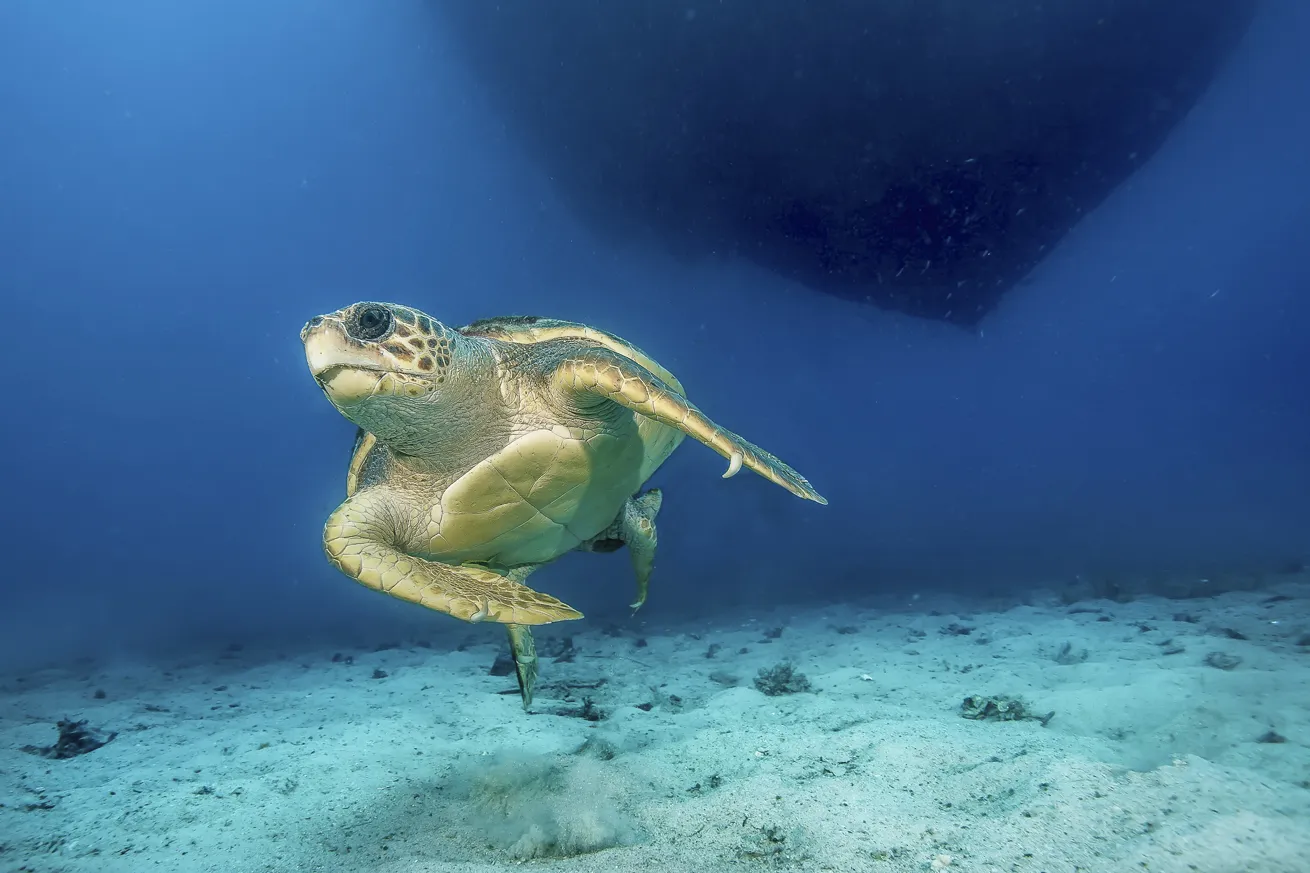
Gerald NowakA green sea turtle gracefully glides by for a close-up encounter.
The City Below the Surface
Not everything worth seeing underwater here can be dived.
From Kaş, boats run east along a coastline that feels quieter and less developed. The hills flatten. The coves widen. The water remains clear enough that even from the deck you can see the bottom in places.
Kekova’s Sunken City lies just offshore—the remains of a Lycian settlement that slipped partially beneath the sea centuries ago. Diving is prohibited to protect the site.
Instead, you approach slowly. Some operators bring guests by small boat; others launch kayaks during a long surface interval. You paddle out over pale stone shapes visible just feet below the surface—foundations, walls, the outlines of staircases. The structures are intact enough to recognize but softened by time and water.
Along this stretch of coast, history and water rarely separate cleanly. The same sheltered bays that host dive boats today once sheltered Lycian traders. The same currents that move over wrecks in Kalkan pass over submerged streets here.
You don’t need to descend to feel that connection.

Courtesy GotürkiyeBaskets filled with aromatic spices adorn the markets in Turkey.
Need to Know Diving in Turkey
When to Go
May to November is peak season.
Visibility
Up to 100 feet in calm conditions.
Water Temps
64°F–79°F in the peak months.
Suggested Gear
3 mm or 5 mm wetsuit
Suggested PADI Dive Certifications
Open Water Diver Advanced Open Water Diver Wreck Diver


