

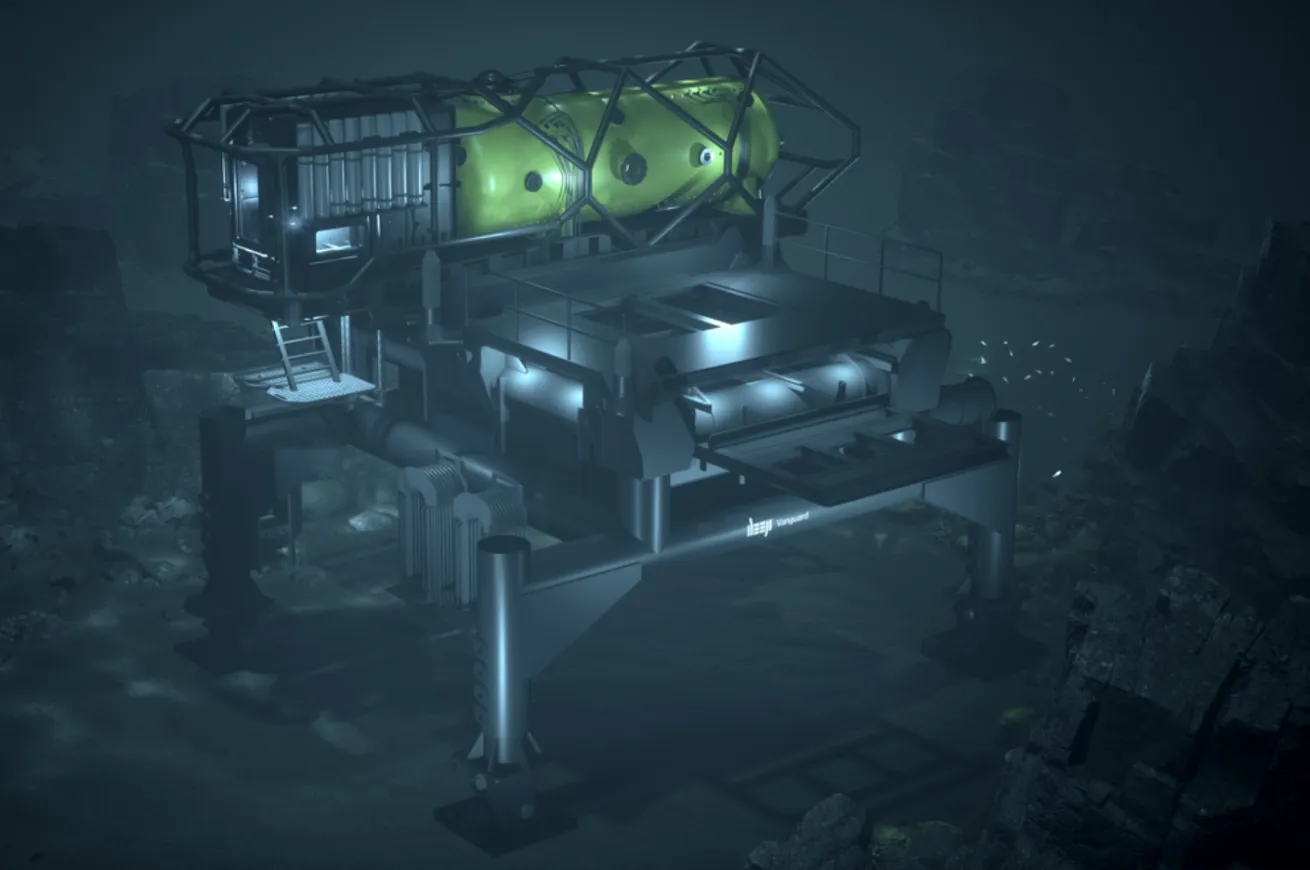
Courtesy DEEPVanguard is DEEP's pilot subsea habitat and marks the first step toward building a global network of subsea human habitats.
Imagine your diving experience, minus the surface intervals. Wouldn’t it be incredible to spend more time at depth, enveloped in the underwater environment and observing marine life for longer periods?
This has been a dream of the diving community for years, and reality is coming sooner than you might expect.
During a February 2026 PADI Live Panel, Katie Thompson, senior director of environment and sustainability at PADI, spoke with DEEP, an ocean technology and engineering company with a mission to make humans aquatic. The company recently announced a final testing and buildout plan for its pilot subsea environment, called Vanguard.
Vanguard is a 80-ton steel structure that maintains an internal pressure equal to its ambient pressure, or the pressure it’s exposed to outside. The goal is for people to utilize the concept of saturation diving to stay in the habitat for an extended period of time. Below, find key takeaways from this interview and learn more about what’s coming next for DEEP.
Related Reading: Meet the People Behind the Next Generation of Subsea Human Habitats
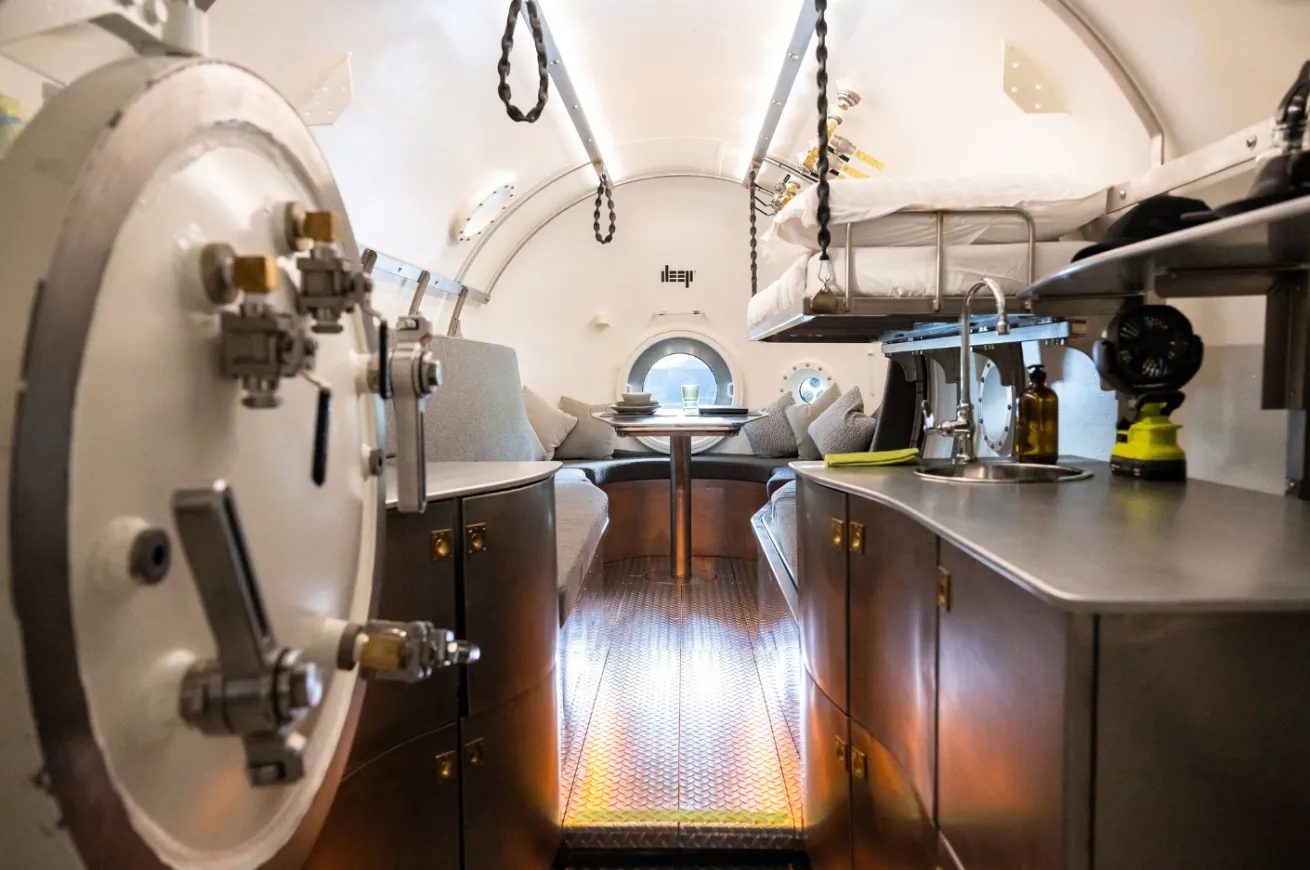
Courtesy DEEPA view of Vanguard's living chamber through the hatch.
Takeaway #1: History Informs the “Why”
“Saturation diving is not necessarily a new concept. It goes back many decades to commercial diving, military diving and also scientific diving,” says Dr. Dawn Kernagis, DEEP’s global Director of Scientific Research. “We're looking at taking this concept of saturation diving and moving it to the next generation with newer habitats. The last undersea habitat that was built was built in the 1980s. So we really want to evolve that concept.”
Conshelf I, Jacques Cousteau’s underwater habitat, pioneered weeklong saturation diving in 1962 at a depth of 33 feet (10 meters). Innovations based on this concept have continued to evolve: DEEP’s Vanguard is designed for people to live safely at 45 feet (14 meters) for seven days or longer.
“Why we are doing this is really to create an amplified and evolved toolset for researchers, for educators and for explorers to really amplify their time underwater,” Kernagis says.
Takeaway #2: The Future Lies in the Design
“I was inspired by the undersea world of Jacques Cousteau back in the day,” says Norman Smith, DEEP’s chief technology officer. “Today [we’re] building—and soon will install—a modern-era undersea habitat.”
The living space includes a galley, bathroom facilities and sleeping bunks. The surrounding framework is a 300-ton foundation built to withstand intense weather events such as hurricanes. Vanguard is outfitted with a “wet porch” containing high-pressure air cylinders and benches where divers suit up in harnesses and helmets before venturing out to perform underwater missions.
“That's the coolest part of Vanguard,” Smith explains. “In the floor is an opening called the ‘moon pool:’ the portal from outside in or inside out to the ocean realm.”
Related Reading: Is This the Future of Human Life Underwater?
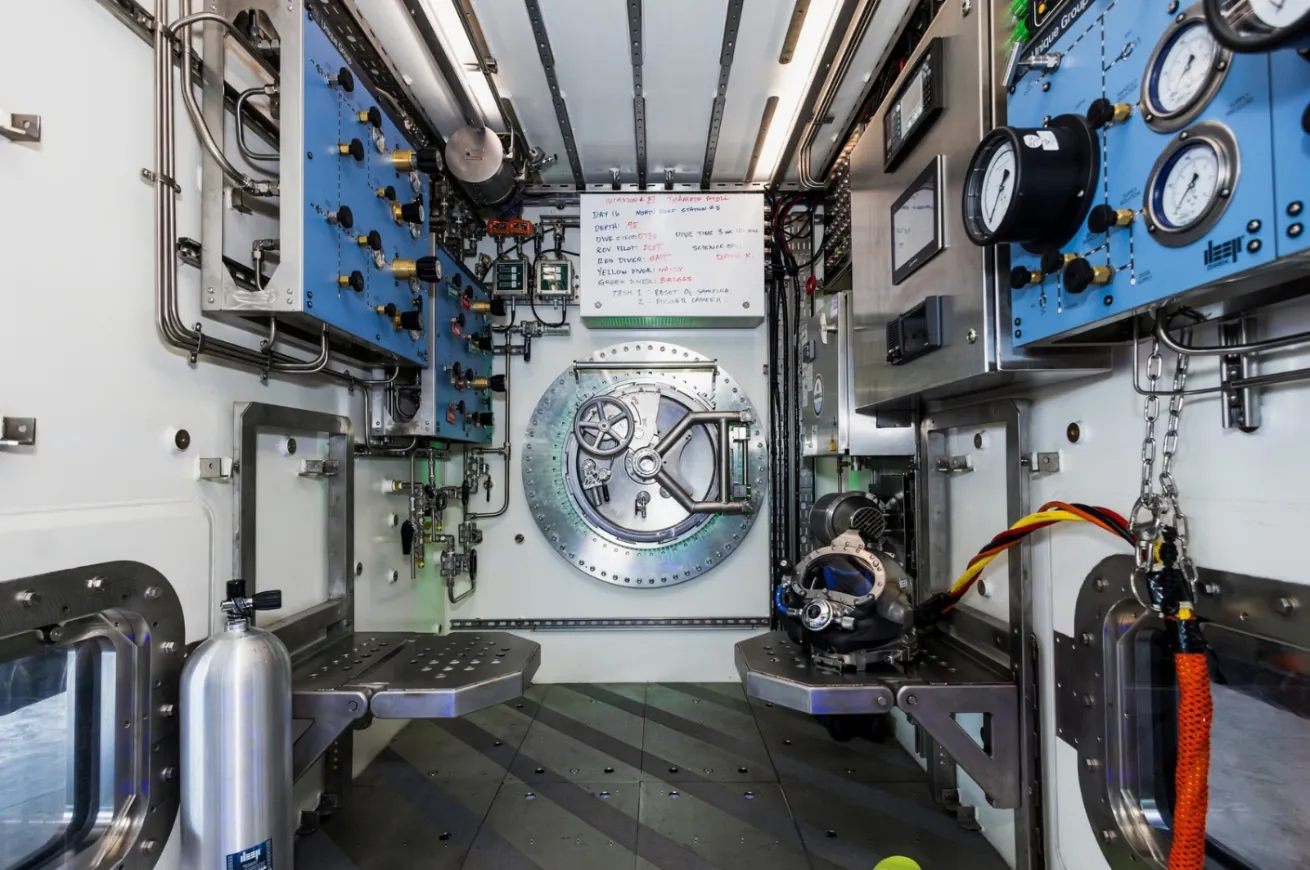
Courtesy DEEPThe dive center in the Vanguard subsea human habitat.
Takeaway #3: All-Encompassing Safety Ops
Safety is the first priority when it comes to pushing the boundaries of the human body in new environments. Roger Garcia, DEEP's Director of Habitat Operations, is a former U.S. Navy diver who has spent nearly 100 days living underwater. Garcia’s team has to consider everything from the weather forecast to equipment maintenance schedules to keep things running smoothly down below.
“We're coming with almost 40 years of experience combined,” he explains. “The life support systems, the way they're designed, the way we monitor the atmosphere for the oxygen percentage…not only down there at the Vanguard, but having having the ability to see that 15 miles away onshore is a game-changer, because that means that we don't have to have somebody out there all the time. We're on-call in case there's an emergency offshore, so we can respond immediately.”
The operations team monitors Vanguard logistics: everything from refreshing towels to restocking food supplies to performing inspections.
A key piece of tech will be the data acquisition panel on the wet porch: “That's where basically everything comes in,” Garcia says. “What the depth is, what the oxygen partial pressure is in there, the carbon dioxide, the depth, you name it. All that data comes in there. It's processed and there's a screen there for the operators that they can…see the three cameras on the port side, or left side, of the Vanguard.”
“In the very near future, we're looking to be completely autonomous, so we may not even have to have anything on the surface,” Garcia says.
Related Reading: Parts of a Rebreather and How They Work
Takeaway #4: In Pursuit of Data
One of the elements Kernagis is most excited about is the database of information that will be collected, both from the aquatic environment and from (willing) participants on the physical effects of saturation diving.
“If we're really going to make humans aquatic,” Kernagis says, “[we’re] thinking about a variety of characteristics that we want to tap into and understand how saturation diving impacts those individuals.”
“Think about Jane Goodall when she was studying primates and just really getting to know that environment,” Kernagis continues. “That's what we want to bring out again to scientists, explorers, educators. And then as we're doing that, also learn more about how that impacts the human body across a variety of individuals with a variety of characteristics.”
Takeaway #5: Technology Connecting Outer Space to Under Our Oceans
The Vanguard pilot project is a building block for a larger-scale, modular initiative called Sentinel. Sentinel will be able to house up to eight people and can be expanded using Lego-like engineering tactics. The goal?
“Multiple habitats, Sentinel habitats, and various configuration options installed in oceans around the world,” Smith says. The structures could be used for sustained subsea habitation for recreational divers, scientific researchers, and educators, while serving as training locations for the fields of space exploration and medicine.
The silver hatch on Vanguard’s wet porch, a piece of “precision engineering,” is just one of the elements inspired by Smith’s work in the spaceflight industry. The rigor with which every element is evaluated for DEEP’s projects is comparable to that of building space shuttles.
“There's a long history of using subsea habitats that actually paralleled [space exploration] for decades…and looking at how the two can play off of each other,” Kernagis says. “So we're just looking at an expansion and continuation of that similar work.”