


Jay ClueThe different parts that make up a Dive Rite O2ptima chestmount rebreather. From left moving clockwise: breathing hoses, DSV, Shearwater Petrel controller, counterlung with OPV & O2M MAV, scrubber canister & electronics head, electronics/battery canisters, and O2 first stage.
If you're new to closed-circuit rebreathers (CCRs), the jargon and components can be overwhelming at first. It's similar to when we learn to scuba dive with conventional open-circuit equipment. I vividly recall being baffled by all the gear and acronyms during my open water course. However, I gradually realized that scuba equipment is pretty straightforward. The fundamental concept behind a rebreather is also simple. Rather than wasting gas by exhaling it as bubbles into the water, CCRs recycle our exhaled breath by circulating it through the system, allowing us to “re-breathe” it.
We can visualize the system as a closed loop in which gas flows in a circular motion—not surprisingly, this is called the loop. The system is continuous, so let’s start with our exhale, following the gas as it passes through the loop and returns to us as replenished gas that we can safely inhale. Let’s take a simplified look at how an electronic closed-circuit rebreather, or eCCR, accomplishes this by tracing the path of our breath.
Related Reading: Manual vs. Electronic Closed Circuit Rebreathers: Which One Is Right for You?
Dive Surface Valve
Our journey starts at the mouthpiece of the rebreather. Unlike a scuba regulator, we need to prevent water from entering the system. For this reason, we must close the loop when the mouthpiece is not in our mouth to prevent water from entering it. Rebreathers have a special dive surface valve (DSV) that allows us to do this. When we're breathing from the loop, we switch it to “dive mode,” which means it's open and we can breathe from it. If we switch the DSV to “surface mode,” the system is closed to prevent water from entering the loop.
Gas must travel in only one direction in a CCR, so the mouthpiece also has two one-way mushroom valves (similar to the exhaust valves in a regulator second stage). This ensures that as we inhale or exhale, gas flows in the correct direction. With most rebreathers like my Dive Rite O2ptima CM, the motion is clockwise. When I exhale, my breath goes into the right hose. On inhale, gas comes into my mouth and lungs from the left hose.
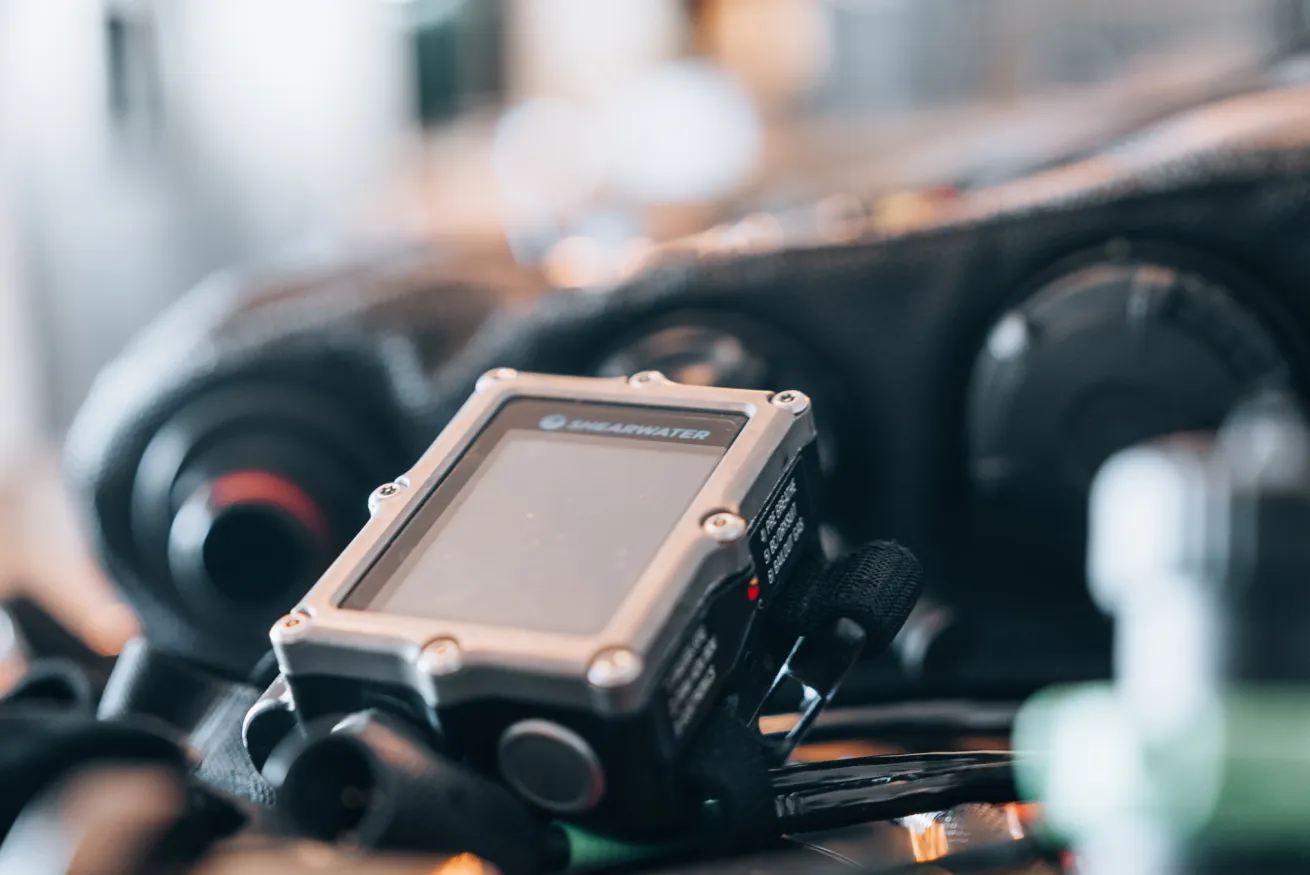
Jay ClueShearwater Petrel 3 rebreather controller / computer
Breathing Hoses
Breathing hoses connect the DSV to the counterlungs. While hoses may not seem crucial compared to the other features of a rebreather, CCR hoses may significantly alter comfort. Hose diameter and length affect the ease or difficulty in breathing, which is referred to as the "work of breathing." When diving in current, long hoses create more drag and may cause unpleasant vibrations while using an underwater scooter. Hoses that are too short, conversely, restrict head motion. There is no “correct” hose diameter or length. Instead, it is more of a personal choice of what fits you best.
Counterlungs
As mentioned earlier, when we exhale into the DSV, the gas flows through a one-way mushroom valve, into the breathing hose, and finally into a counterlung. A counterlung is a bladder that expands and contracts as we breathe so that gas can flow in a closed system. To help balance buoyancy and improve the work of breathing, many rebreathers have two counterlungs—one for exhalation and one for inhalation. Depending on the type of rebreather, the counterlung(s) can be found in various locations, each offering different benefits in terms of breathing and underwater performance.
The counterlung also features an overpressure valve (OPV), which is similar to the ones found on BCDs and drysuits. Its primary purpose is to control how much gas the counterlungs hold. The valve can release gas automatically as you ascend and the lung volume expands, or it can be manually controlled to release gas to achieve a comfortable minimal lung volume (you’ll learn more on this during your rebreather course).
Carbon Dioxide Scrubber
After the counterlung, our exhaled gas flows into the carbon dioxide “scrubber,” so-called because it “scrubs” carbon dioxide from your exhaled breath. Now, this is where the magic happens. Systems will vary, but to oversimplify it, the scrubbing system on most systems consists of a canister that contains the carbon dioxide absorbent, often referred to as sorb, which comes in a granular or cartridge form. As your exhaled gas passes through the canister, the carbon dioxide is removed through a chemical process…aka magic.
Electronics Head
After the gas has been “scrubbed” and carbon dioxide has been removed, there is one more step before you can take your next (safe) breath. Your body uses oxygen, even if you are simply resting. This metabolized oxygen must be added back to the loop to maintain the correct amount. To do this, the electronics head contains sensors that analyze the oxygen content of the gas, similar to how a nitrox analyzer works.
With an electronic CCR, the head analyzes the oxygen content and automatically injects more oxygen via a solenoid if it is needed. Essentially, you have a mini nitrox blending system diving along with you to give you the perfect gas mix throughout your dive.
Now that our gas is scrubbed and enriched with oxygen, it makes its way back to the inhalation counterlung and breathing hose, ready for us to take our next breath.
Automatic and Manual Addition Valves
Rebreathers have different valves to add diluent or oxygen to the breathing loop. On most eCCRs, there is one manual or automatic addition valve for diluent and one manual addition valve for oxygen. Diluent is a gas that dilutes what is in the breathing loop. The diluent is usually air, though more advanced tec CCR diving sometimes uses trimix or an enriched blend.
A manual addition valve (MAV) is a button the diver presses to add more diluent gas to the loop. An automatic diluent valve (ADV) is a bit like your scuba regulator. If you inhale and the gas volume is low, the ADV will add gas from your diluent tank to the system automatically. Some rebreather divers prefer to replace their ADV with a MAV to manually regulate the loop volume and add diluent as required.
For safety reasons, oxygen is always added manually because too much oxygen can be dangerous and lead to oxygen toxicity.
Controller and HUD
When diving with an eCCR, the controller is like a dive computer in conventional open-circuit scuba diving, but it also functions as the rebreather's control system. It displays important information such as the no decompression limit, depth and time.
What’s specific to a rebreather controller is that it will also show the oxygen partial pressure readings from the oxygen sensors in the electronics head that we spoke about earlier. Unlike a conventional dive computer, the controller is physically integrated into the eCCR.
Most rebreathers also have a heads-up display (HUD) that mounts to the breathing loop, giving the diver a constant view of how the system is functioning. These range from simple status lights to full information readouts. Either way, you can quickly notice a warning without needing to raise your handset. As a photographer, this is one of my favorite components of the rebreather since I am normally multitasking underwater.
Oxygen and Diluent Cylinders
For the system to function, we need a source of oxygen and a source of diluent. Since we only need to replenish the gas we metabolize or release from the loop, the CCR cylinders can be very small compared to open-circuit systems. For instance, my Dive Rite O2ptima CM uses a small aluminum 13 cubic foot /2 liter tank for oxygen. Some rebreathers have both tanks onboard, while others only have oxygen onboard and use a separate cylinder for diluent. For example, in the O2ptima CM, your bailout cylinder is also used for diluent.
Related Reading: Best Scuba Diving Gear for 2026
Bailout Cylinder
Speaking of bailout cylinders, when diving a rebreather, we always have a backup open-circuit gas in case a failure makes the rebreather unusable. This is typically a cylinder and regulator worn on the side. If there is a major problem we close the loop and “bail out” to our bailout scuba system. The gas in the bailout cylinder must always be a gas that can be breathed at any time, so it is chosen based on the dive's maximum depth. We also need to make sure we have enough life support to safely complete the dive in case of an emergency in which the CCR is completely unusable. Because of this, CCR divers who are doing technical dives requiring decompression may have multiple bailout cylinders or even a bailout rebreather.
Bailout Valve
Some CCR systems have a bailout valve (BOV) that works similarly to the DSV. With a bailout valve, when you close the loop, it simultaneously opens an open circuit demand valve to your bailout gas. This means when ‘bailing out,’ you do not need to take the mouthpiece from your mouth nor switch to a separate regulator.
Wrapping it Up
As you can probably see, CCRs differ from the open-circuit scuba you’re used to, but aren’t as crazy complicated as they might sound at first. When we exhale into the loop, our breath travels through the breathing hose into the exhalation counterlung, before making its way into the scrubber.
The sorb inside the scrubber canister removes carbon dioxide. Exiting the scrubber, oxygen sensors in the electronics head analyze the gas mix so the controller can determine if oxygen needs to be added to the mix, and then it does so as needed.
From here, the gas enters the inhalation counterlung, all scrubbed and replenished, so it's ready for our next breath. Additional valves adjust for changes in loop volume and provide manual control when needed, and we always have a bailout cylinder in case of a major system problem. Still a little confused or want to learn more? Don’t stress, all of this will be covered in much more detail by your instructor during your closed circuit rebreather course.

Cecilia Mar Ruiz
About Jay Clue
Exploring Rebreathers is a column following Jay’s journey into the world of CCR diving, sharing the best tips and info he has learned along the way. Jay Clue is an accomplished photographer, educator, and conservationist. He’s an experienced technical diver and instructor with over 6000 dives in all sorts of environments, from the cold waters of the North Sea to the beautiful caves of Mexico and exploring the open oceans in search of epic encounters with marine megafauna. His passion for marine conservation led him to the world of photography and storytelling in hopes of bringing the beauty of our planet's waterways to more people around the globe. Follow him at @jayclue on Facebook and Instagram, where he’s always happy to answer your questions and chat about diving.


