

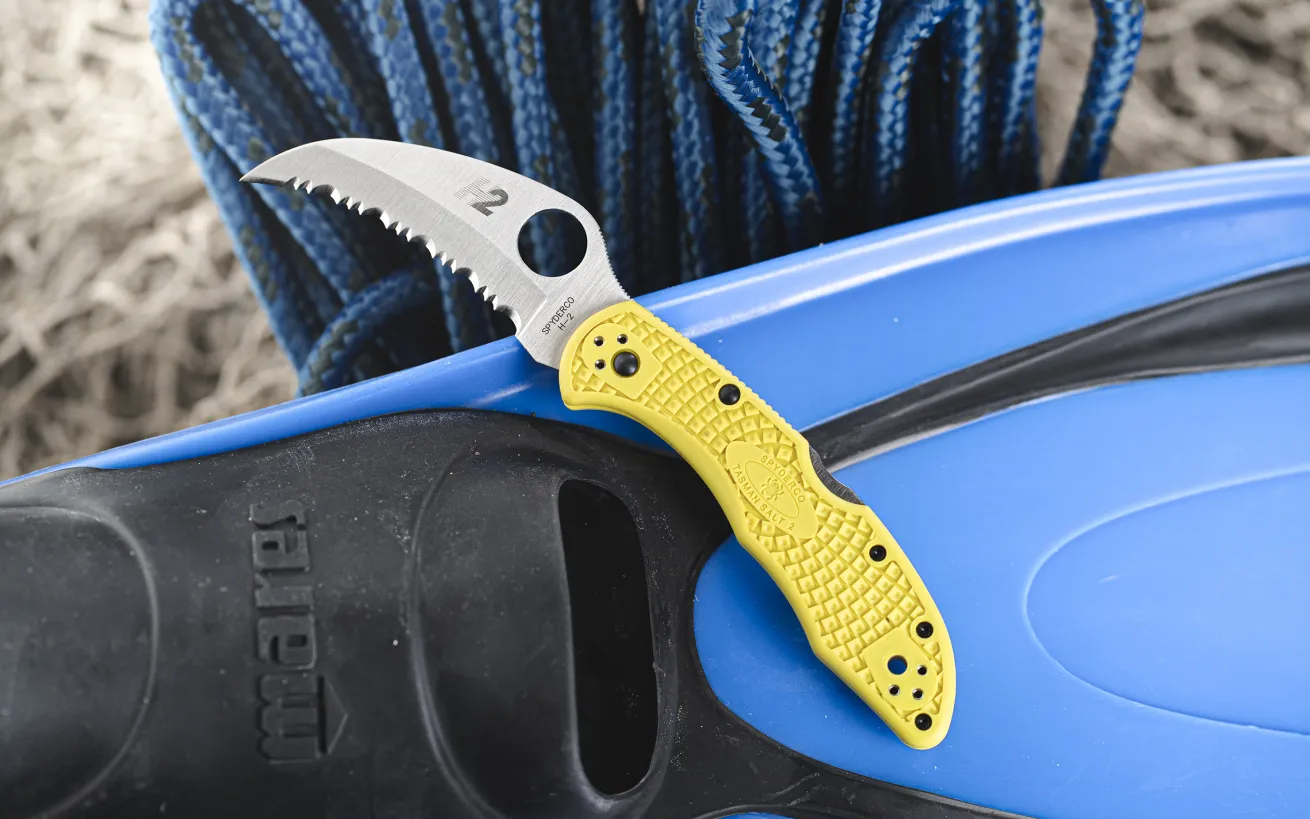
Courtesy Spyderco
Cutting devices. Dive knives. In the minds of many, they are long, sharp and strapped to the outer calf. An essential piece of our kits, they can make us feel powerful, ready to fend off international counter-intelligence terrorists in an underwater showdown—or at least a barracuda that gave us a threatening look. Yet, when these scenarios (for better or for worse) fail to materialize during my dives, I often wonder whether such a knife is truly the right tool for the job.
Like many other pieces of equipment, deciding on a cutting device can be a bit daunting. There is a wide variety of tools from which to choose: surgical shears, folding knives, dull tips, sharp tips and line cutters. I’ve tried all types. Learn from my experience to make the right decision for yourself.
Comparing Cutting Tools for Scuba Diving
My first cutting device was a pair of surgical shears. I won them in a Women’s Dive Day giveaway at my local dive shop about a month after I started diving. Shears are excellent for cutting through nylon straps and neoprene, so they seemed to be a great win. However, they turned out to not be so useful once they entered the water. The shears rusted after only a couple of dives, making them nearly inoperable when I needed to remove some monofilament from a piece of coral. While I do believe surgical shears can be essential for cutting away a wetsuit or BC in an emergency, they are better kept in a handy dry box than carried underwater.
Folding knives, like shears, have more moving parts and metal surfaces, which can make them more prone to rusting—even with frequent, thorough post-dive care. While there are folding knives made of higher-grade metals that are practically immune to rust, they generally cost more. Another consideration is that folding knives are often hard to secure due to their clips, which can loosen or fully detach with the slightest resistance—such as during a giant stride. Additionally, they can be challenging to open, close and clip while wearing any type of glove.
Standard fixed-blade knives tend to be extremely pointy and sharp and designed to pierce rather than saw through entanglements. They can accidentally cut you or other divers if not mounted correctly and wielded responsibly. The plastic sheaths that often house these knives can become brittle when exposed to sunlight, increasing the risk of the knife slipping out. Blunt-tipped knives, however, stowed in nylon sheaths, solve these issues and can be great tools in many environments.
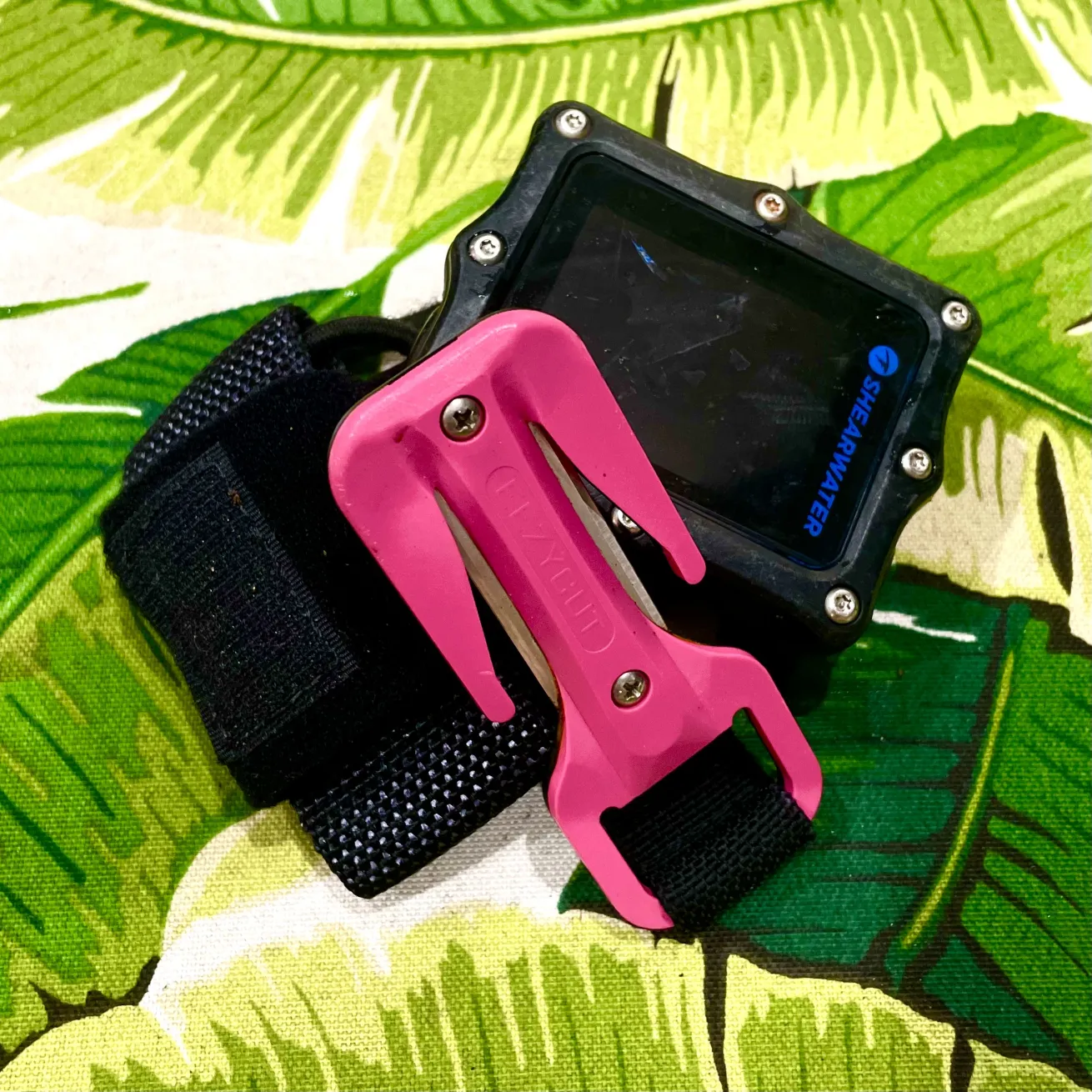
Sterling McMahanThe author's personal line cutter stowed on her wrist computer.
Line cutters are typically the safest and most reliable option. They are easy to securely mount in an accessible location for quick access. But they might not help in every hazardous situation.
Related Reading: Divers Remove 14,000 Pounds of Trash in the Florida Keys
Choosing a Cutting Device for Reef, Wreck and Kelp Forest Dives
Cutting devices should be safe, reliable, securely mounted and easily accessible. With all this in mind, which type is best? Well, the answer is: It depends. Cutting tools should be tailored to the type of dive and the anticipated encounters.
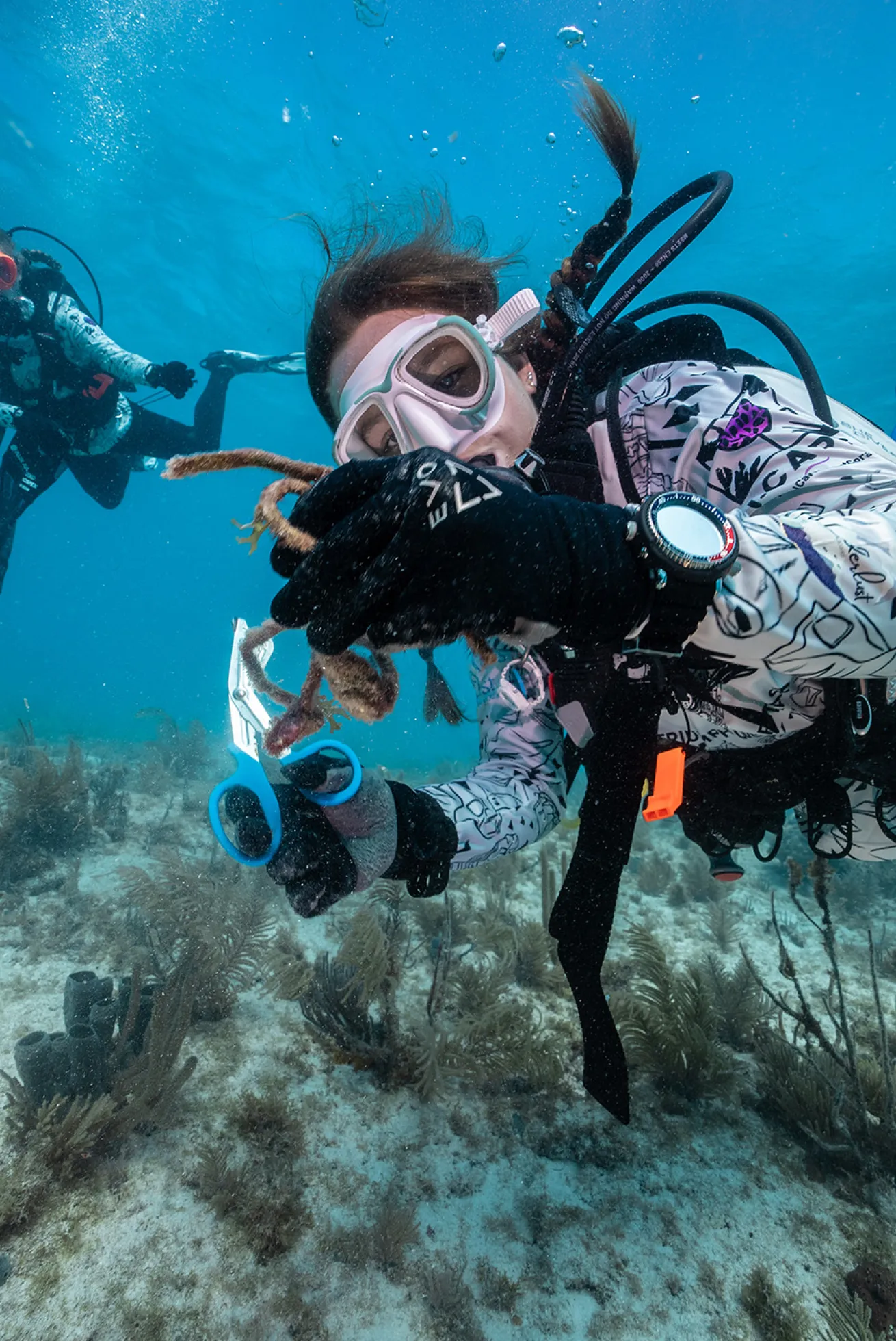
Kristin PaterakisA diver uses shears to cut rope away from a reef.
Best Cutting Tool for Reef Dives
On a typical reef dive, the primary hazard is monofilament fishing line. It can become thick and tangled in the reef’s growth; however, it is relatively easy to remove with the correct cutting device.
For reef dives, a simple trilobite-style line cutter is usually sufficient. These cutters have sharp, replaceable blades and protective cases that prevent fingers from touching the blades. In my experience, line cutters slice through monofilament—and even thick webbing—quickly and smoothly, whereas more traditional knives often require more strength and maneuvering.
Trilobite-type line cutters come in a variety of fun colors—mine are pink! My favorites have ceramic blades that do not rust and last longer than their metal counterparts.
Related Reading: IST Sports Line Cutter: ScubaLab Best Buy
Best Cutting Tool for Wreck Dives
Wrecks pose the same risks from monofilament as reefs do, but they also present thicker entanglement hazards such as rope or netting. I still remember my mentor taking me on my very first wreck penetration dive on the Spiegel Grove in Key Largo, Florida. Before we splashed, he pulled out a short, serrated knife with a blunt tip. While not as effective for cutting monofilament, the serrated edge is excellent for slicing through thicker entanglement hazards.
Because of the blunt tip, these knives can be safely stored in soft sheaths made of cloth or webbing without the risk of accidentally poking oneself or others.
Best Cutting Tool for Kelp Forest Dives
Kelp forests present another entanglement hazard. Not only can kelp fronds snag on gear (including poorly positioned knives), but water currents and surges can also push divers into the kelp or other environmental hazards. A short, serrated-edge knife is the best tool for cutting free from entanglements, especially when the kelp is too thick to snap with your hands.
Many serrated knives come with a sheath made from nylon webbing, featuring a Velcro flap and a loop to attach it to a belt or BC. This type of sheath is ideal because it secures the knife close to the body while also protecting the diver from any sharp edges.
Where to Wear Your Cutting Device
So, where can you safely store cutting devices while diving? While the outside of the calf is often perceived by novice divers as a place that makes one look tough, it is actually one of the worst locations to store a tool. First, the outer calf is not a streamlined area, creating a snag hazard in itself. Although placing the device on the inner calf reduces some snag risk, it does not address the second problem: accessibility.
The most important function of any cutting device is to free a trapped diver from entanglement. The calf is about as far from the diver’s hands as possible; therefore, it is one of the most difficult locations to reach. If a cutting device is not reachable, it is not usable.
Generally, the most ideal place to store a cutting tool is on the upper body. Excellent locations include the shoulder straps of the BC, the waist belt or attached to a wrist computer. Some divers use a pocket; however, this location can still pose accessibility issues in the event of an entanglement. It is also important for your cutting device to be reachable by either hand. For this reason, it is recommended to carry two cutting devices, each stored in a different location.
Related Reading: 2025 Scuba Diving Gear Guide
The Bottom Line
Personally, in my nearly 1,000 dives, I have found that two trilobite-style line cutters with ceramic blades are my preferred cutting tools. I carry one on my wrist, attached to my dive computer, and the other on the webbing around my waist.
This configuration best suits my personal needs and type of diving. When evaluating your own setup, remember the pros and cons of each type of instrument, as well as where you’ll be diving.


