

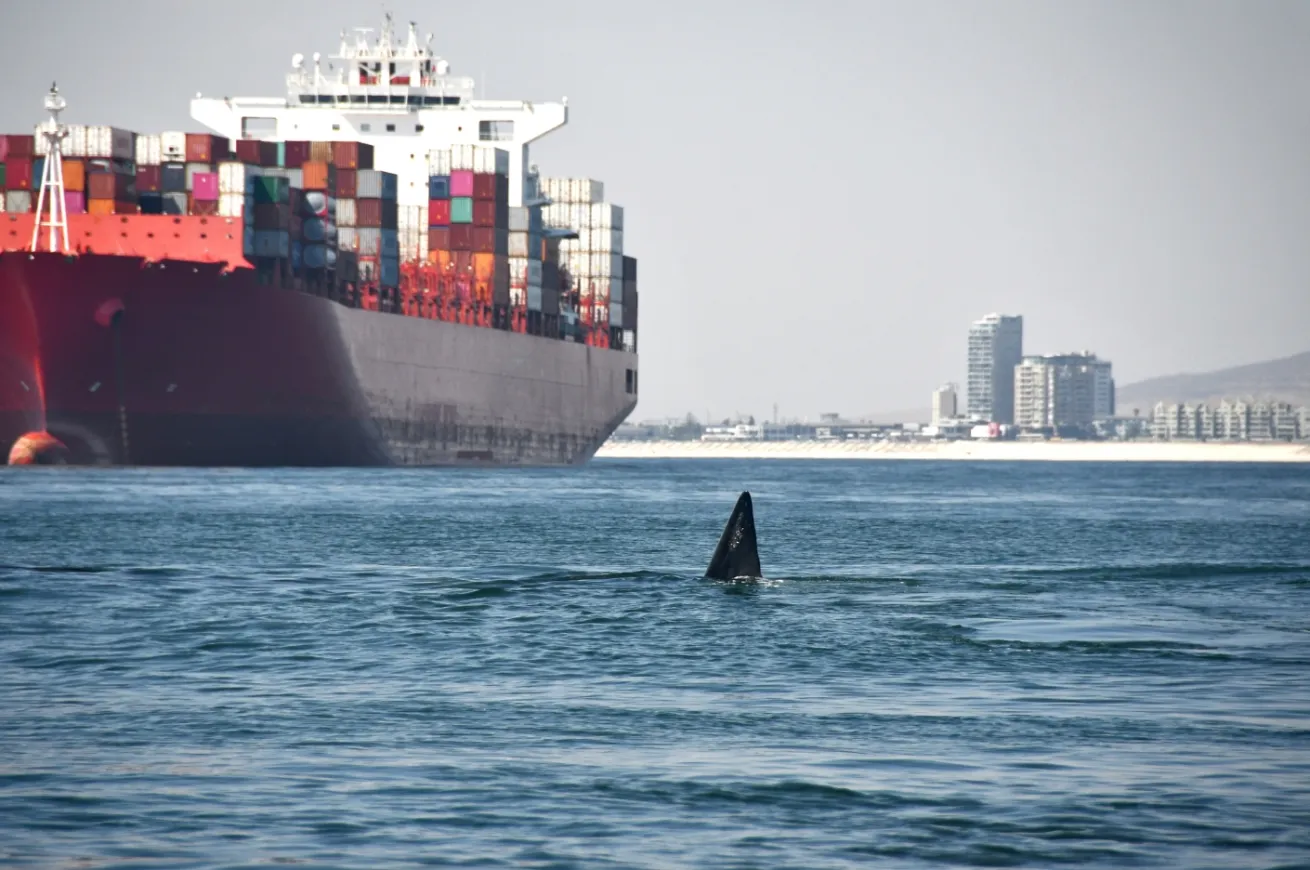
Shutterstock/Eriq Walker
Question: How do loud noises from ships impact marine animals?
Answer: Lots of marine animals, especially but not only whales, lead acoustic lives. Making it harder for them to hear, or damaging their hearing permanently, makes it harder for them to live their lives in many ways.
Have you ever been excited to catch up with a friend you haven’t seen in a while, but the bar you choose to meet at is so noisy you can’t really hear anything they say? Have you ever gone to a concert that’s so blaring that your ears hurt for a few days afterward? Have you ever been unable to sleep because the neighbors are having a fun, but loud, party? If the answer to any question is yes—and it’s OK to admit it; we all get older and less cool—then you understand the concept of noise pollution.
If you’ve been scuba diving in relatively shallow water and a boat has passed overhead, you know that even small vessels can make an awful lot of noise. In some places, ship traffic is increasing rapidly. For example, ship traffic in the Arctic has doubled in the last decade alone.
Related Reading: The Dark Side of Our Fascination with Antarctica
But engine noise is only one source of noise in the marine environment. Naval exercises, including sonar and munitions tests, generate a ton of noise. Construction of offshore energy infrastructure, especially pile-driving, can be up to 200 decibels—louder than a jet engine. And seismic airgun testing, which is used to detect oil and gas under the seabed, can be even louder.

So, what does all this noise actually do to marine animals?
First, it makes it harder for them to hear other members of their species, to find them for mating, or to communicate important things like, “There’s food over here,” or “Watch out—there’s a predator.”
It also makes it harder for them to hear prey animals or predators. It causes physiological stress that can build up over time, resulting in taking more energy to do normal daily tasks. It can disrupt all kinds of behaviors, including migration, and can be a cause of mass stranding events.
And at extremely high volumes, it can cause temporary (or permanent) deafness or even brain injuries. This is especially a problem for whales, but lots of fish species are also affected by it.
Related Reading: How to Become a Whale Defender
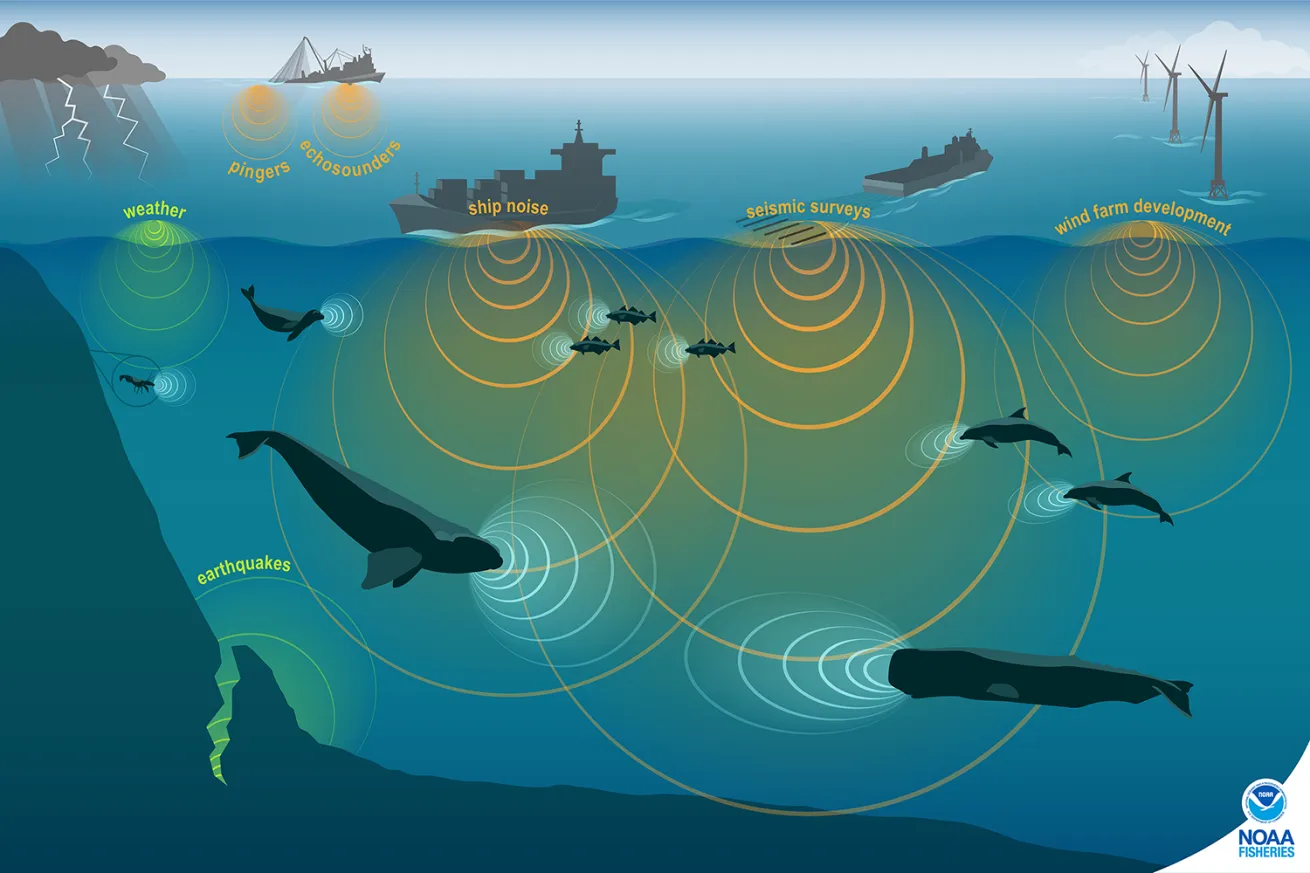
NOAA FisheriesA conceptual illustration of human, marine animal and environmental sources of sound and approximately proportional sound waves.
What Can Be Done to Help?
New ship designs are quieter, reducing engine noise, which, as a bonus, also improves fuel efficiency. Plus, some rules restrict when pile-driving or seismic air gun testing can be used based on the known presence of marine mammals of conservation concern.
Some countries, including the U.S., also have noise pollution strategies to help study and minimize impacts. Acoustic pollution can be disruptive (or worse) to many marine species, but like all threats to marine biodiversity, it is solvable if only we have the political will.
Ask a Marine Biologist is a monthly column where Dr. David Shiffman answers your questions about the underwater world. Topics are chosen from reader-submitted queries as well as data from common internet searches. If you have a question you’d like answered in a future Ask a Marine Biologist column, or if you have a question about the answer given in this column, email Shiffman at [email protected] with subject line “Ask a Marine Biologist.”

Dr. David Shiffman is a marine conservation biologist specializing in the ecology and conservation of sharks. An award-winning public science educator, David has spoken to thousands of people around the world about marine biology and conservation and has bylines with the Washington Post, Scientific American, New Scientist, Gizmodo and more. Follow him on @WhySharksMatter on Twitter, Facebook and Instagram, where he’s always happy to answer any questions about sharks.
The views expressed in this article are those of David Shiffman, and not necessarily the views Scuba Diving magazine.


