

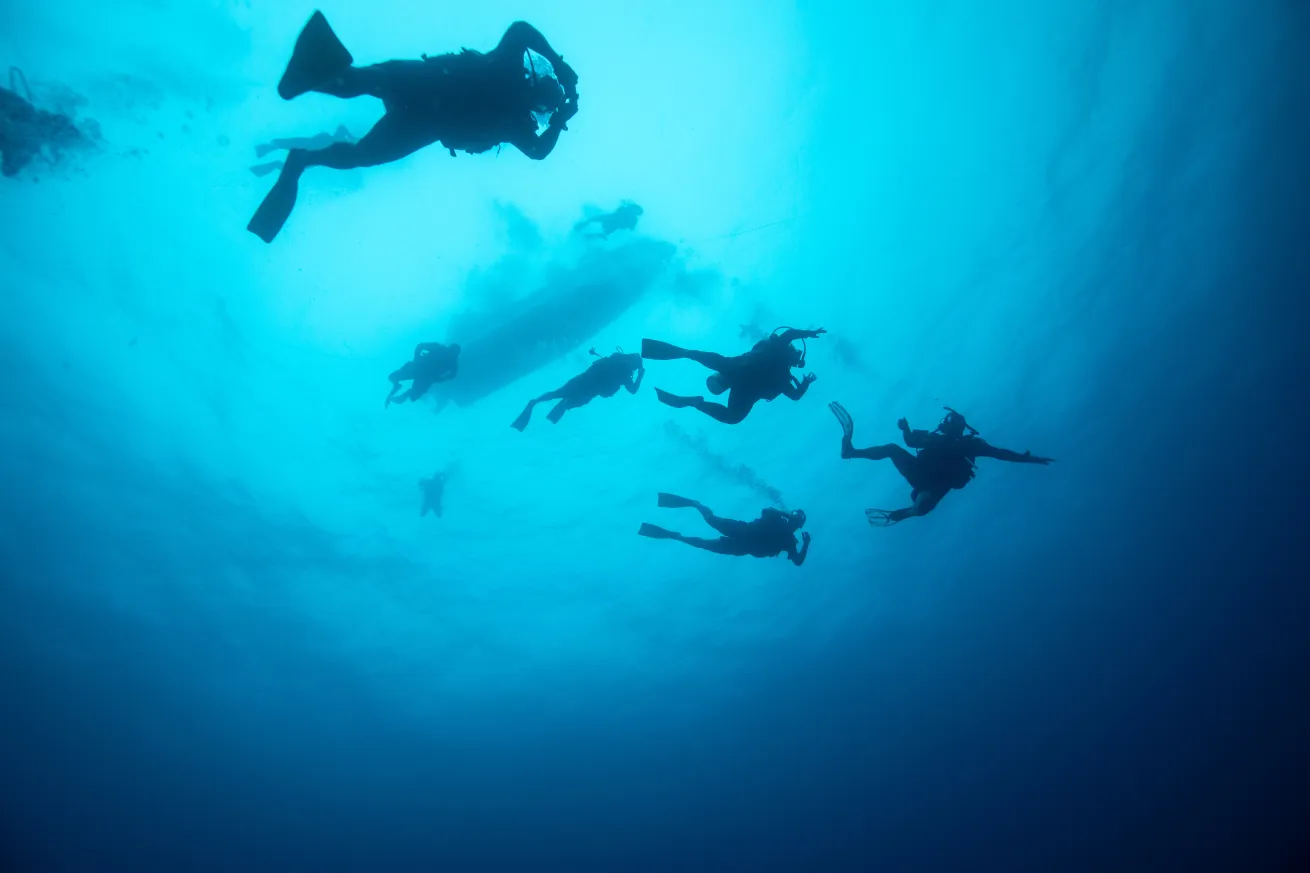
Kristin PaterakisLaunched by a small boutique dive travel company, the Quiet Descent bills itself as the world’s first acoustically intentional liveaboard—a vessel purpose-built for divers who love the underwater world deeply, sincerely and in complete silence.
In the heart of the Coral Triangle, a 12-cabin liveaboard called the Quiet Descent is preparing for its inaugural season. There is no welcome party. No, “So, how many dives do you have?” No man named Gerald explaining your own camera housing to you while you’re actively assembling it.
Launched by a small boutique dive travel company, the Quiet Descent bills itself as the world’s first acoustically intentional liveaboard—a vessel purpose-built for divers who love the underwater world deeply, sincerely and in complete silence.
The concept is simple: from the moment guests board until they disembark, human communication is not permitted on the boat. Not on the dive deck. Not at meals. Not in cabins. The company website describes the experience as “what happens when loving the ocean starts to include avoiding everyone above it.”
“We’re not anti-social,” it reads. “We’re post-social.”
Related Reading: Ultimate Diving Guide to Raja Ampat’s Magical Misool Resort
Finally, a Liveaboard Where Nobody Asks How Many Dives You Have
The idea grew out of a liveaboard trip the founder took in Raja Ampat circa 2019, during which a fellow guest spent four consecutive surface intervals describing, in granular detail, a dive that nobody else had been on. By day three, guests had begun taking their meals in their cabins.
“There is nothing wrong with enthusiasm,” the founder says. “The ocean is magnificent. We understand the impulse. But there is a diver on every liveaboard—you know the one—and we simply asked ourselves: What if he couldn’t?”
The target guest, the company clarifies, is not a misanthrope. They are a diver who has been diving long enough to know what they like—healthy coral, good vis, wildlife encounters—and the particular peace that settles in at depth, where no one can reach you.
The Rules Are Simple. And There Are a Lot of Them.
Upon boarding, guests receive a welcome packet—delivered silently, by a crew member trained in what the company calls “expressive nodding”—that outlines the ship’s code of conduct. Highlights include:
Communication of any kind—verbal, written or gestural—is prohibited in all common areas and cabins.
Pointing is the sole permitted exception on the dive deck.
Sign language is considered a loophole and is treated as such.
The phrase “you should have been in our group, you won't believe what we saw” is grounds for immediate reassignment to a solo surface interval.
The no-communication policy extends to private cabins.
The ship's communication detection system monitors for vocal vibrations throughout the vessel and will notify crew if triggered.
All guest communication from the trip leader and divemaster—meal times, dive briefings, site conditions—is delivered via a proprietary software integration pushed directly to each guest's dive computer. The system supports all major brands and 14 languages. It has also proven, the company notes, “useful underwater.”
In system testing, trial guests received messages including reminders about the day’s schedule, and on at least one occasion, a gentle but unambiguous note about buoyancy. The message “please stop touching that” has already been deployed more than the company would like to admit.
Related Reading: Best New Dive Gear January 2026
What Surface Intervals Actually Look Like Onboard
Described by early beta testers as “the first surface interval I have ever actually enjoyed,” the experience is structured around stillness. Guests may read, journal, stare at the horizon, or lie flat on the sun deck in the particular boneless way that only divers who have done three dives before noon are capable of.
A beverage service operates on a point-and-nod system. A small library of waterproof field guides is available near the camera table for solitary browsing.
On Friday evenings, the ship hosts a silent disco on the sun deck. Headphones are provided, loaded with ambient instrumentals—slow, wordless, vaguely cosmic. Eye contact with other guests is strongly discouraged and, per the ship’s code of conduct, constitutes communication. It is, staff note, more intense than it has any right to be.
The Guests Who Are Already Signing Up
The waitlist skews toward experienced divers with triple-digit logged dives, but the company also reports a cohort of “recovering dive instructors” and a group of parents who booked together and noted, in their intake form, that they were “so tired.”
The intake form asks two questions: how many dives you have (for safety purposes only, not to be shared or discussed) and what you’re hoping to leave behind. Common answers include “small talk,” “Gerald” and “the version of myself that feels obligated to explain things.”
Related Reading: Chasing the Shot: Spotting Pygmies in Raja Ampat
Is This the Future of Liveaboard Travel?
The underwater world is not a silent one—it never really was. There is the crackle of reef life, the percussion of a parrotfish taking a bite out of the reef. But it is a world without human noise, and that, it turns out, is the thing people are paying for.
The Quiet Descent isn’t really selling silence. It’s selling the feeling that the best part of every dive trip—the part that happens underwater—can finally extend all the way to the surface.
The inaugural trip launches April 1, 2027. There is no public waitlist—future guests receive a single, silent notification. You'll know it when you don't hear it.
If silence isn't your thing, check out the next PADI underwater rave.
The Quiet Descent is a fictional vessel. Any resemblance to real liveaboards, operators, or passengers named Gerald is coincidental.
If you would like to find a tribe of divers that shares your passion for the ocean, why not join PADI Club? It’s a great way to meet new buddies wherever you are in the world. As a PADI Club member, you can join exclusive PADI Club events, take part in PADI Club meetups or tune in to the virtual Speaker Series.
Otherwise, you can also get more active in your local diving community by visiting your local dive center. Check out the local dives on offer or enroll in dive courses to continue your diving education.


