

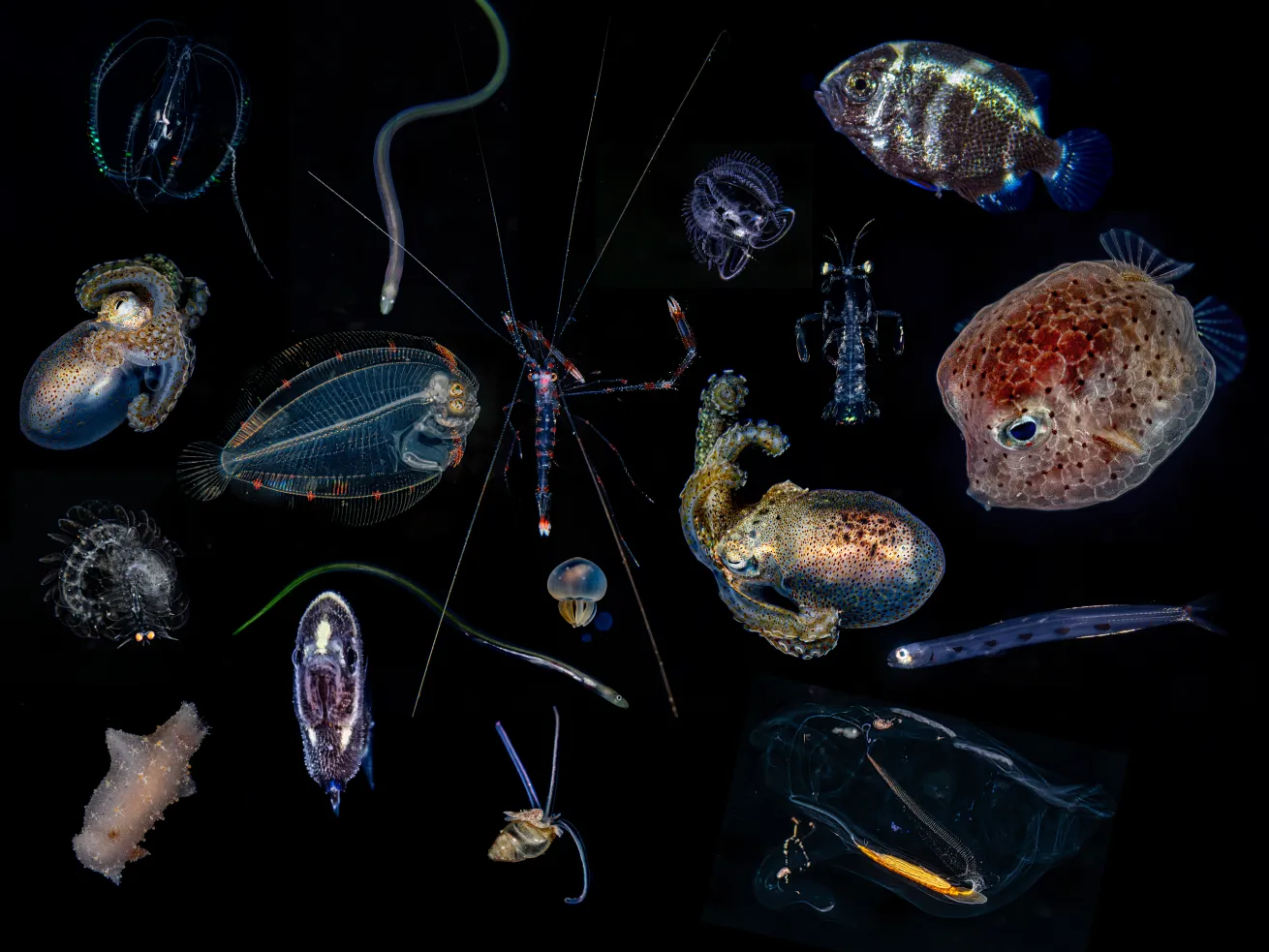
Lorenzo MittigaCommon critters to view while bonfire diving in Bonaire.
Some of the most alien-looking underwater images are made at night: tiny transparent animals suspended against black water, their eyes, fins and organs glowing under strobe light. These creatures look as if they belong to deep space, but many of them are drifting just above the reef after dark.
When divers think about photographing larval life at night, they usually picture blackwater diving, or, drifting offshore in water as deep as a thousand feet in complete darkness. It is an open-ocean night dive focused on larval fish, cephalopods and other planktonic life.
Bonfire photography is a different approach.
Instead of drifting offshore, bonfire diving takes place in relatively shallow, protected water where powerful continuous lights are fixed along a line or placed on the seafloor. The lights create a vertical column that quickly attracts larval reef fish, pelagic juveniles, squid, ctenophores and other translucent animals.
The setup is more controlled than classic blackwater, where divers, hooked to a line attached to the boat, drift with it, but, from a photographic standpoint, bonfire diving is just as demanding in terms of technique.
A Different Kind of Night Macro
Photographing larval life in open water is nothing like shooting macro on the reef. There are no physical visual references and no stable background. You are suspended in the water column, trying to focus on animals that may be only a few millimeters long, nearly transparent and in constant motion.
The light column becomes both the stage and the technical challenge. It concentrates life, but it also complicates exposure. Too much ambient light from the bonfire and the background loses depth. Too little strobe control and every suspended particle turns into backscatter.
Precision matters in every part of the system.
Related Reading: Discovering Bonfire Diving in Bonaire
Camera Choice: Speed Over Spec Sheets
In this kind of work, responsiveness matters more than megapixels. Larval animals do not hold still. They twitch, pulse, dart and vanish into the dark.
A camera with fast, reliable autofocus is essential. Full-frame systems are especially useful because they offer strong dynamic range and cleaner files when exposure gets tight. Night photography often pushes the limits of contrast and available light, so flexibility in the raw file is a real advantage.
In bonfire photography, hesitation usually means a missed frame.
I generally work with continuous autofocus and a small focus area. Limiting the focus range, when possible, can also reduce hunting and improve acquisition speed. I rely on the autofocus performance of my Nikon D850 and Z8, set on wide single point and continuous focus for any full-frame mirrorless camera.
The Best Lens for the Job
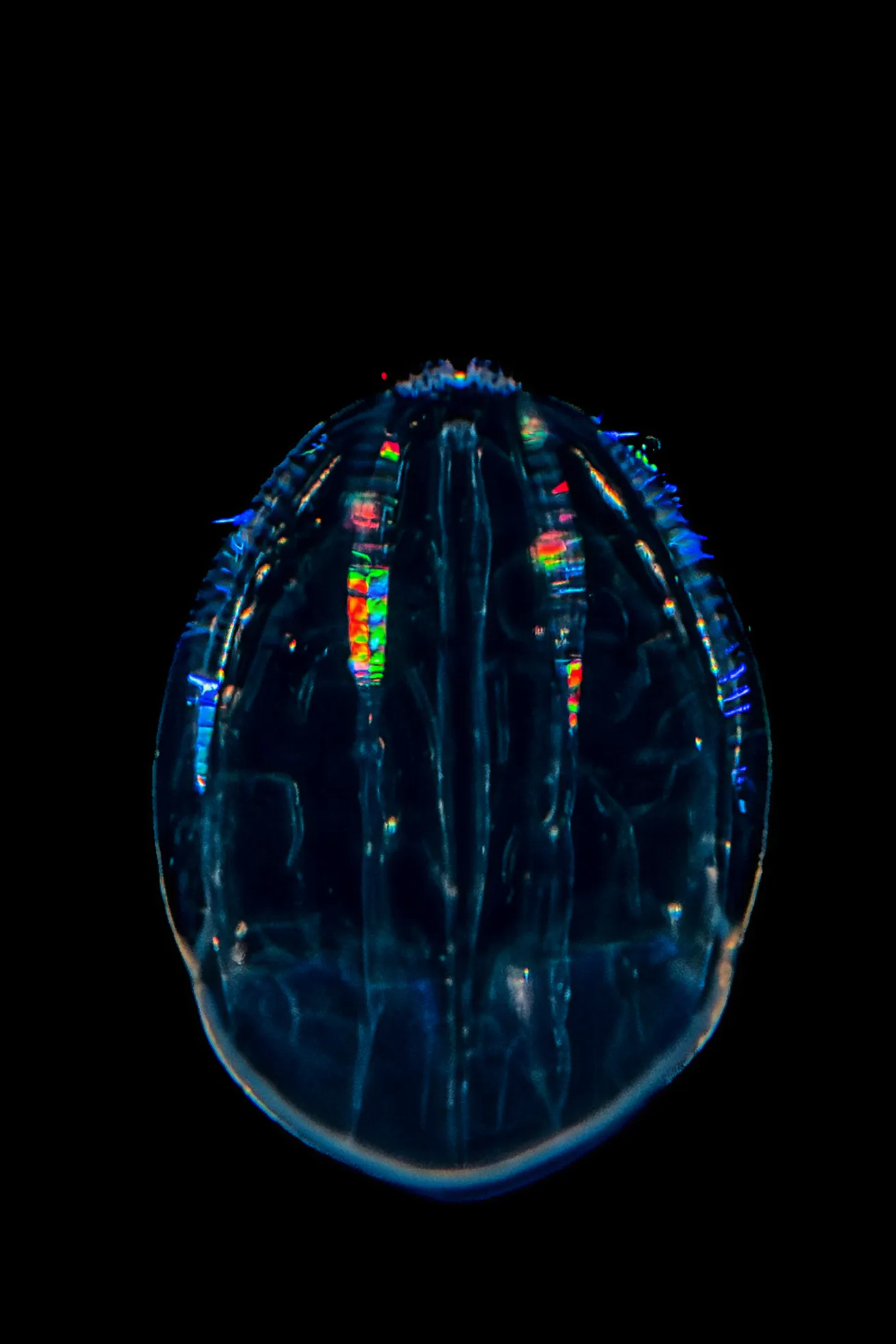
Lorenzo MittigaTranslucent iridescent ctenophore comb jelly (5mm size).
My default choice is a 50 or 60mm macro lens.
It gives me the balance I need between magnification and control. The slightly wider field of view makes it easier to find and follow a small moving subject while still allowing good separation from the background. In many situations, I also switch the camera’s image area from FX to DX. That tighter crop helps me frame very small subjects more effectively without changing lenses.
While a longer focal length, like a 100 mm lens, may be excellent for conventional macro on the reef, it becomes too restrictive for bonfire dives. The depth of field gets extremely thin and the added stability required makes tracking moving subjects much harder. With no fixed reference point and no still subject, the result is often more frustration than precision.
For the smallest planktonic organisms, a good wet diopter (from +5 to +10) can reveal extraordinary detail. At that level, I often stop down to f/16 or smaller and carefully reduce strobe output to preserve the animal's delicacy and translucency.
Related Reading: Through Your Lens Photo Contest Now Open
Why a Focus Light Is Essential
A dedicated focus light mounted on top of the housing is one of the most important tools in bonfire photography.
In open water at night, many subjects are nearly invisible until the beam catches them. A narrow, controlled light helps you spot the organism first, then gives the autofocus system enough contrast to lock on. Without it, finding a tiny transparent larva in the water column can feel almost impossible.
The beam should be strong enough to aid detection and focus, but not so broad or intense that it disturbs the subject or contaminates the exposure. Mounted above the port, it aligns naturally with your line of sight and becomes your primary tool for locating and tracking life in the column.
Strobe Placement Changes Everything
Strobe placement in bonfire photography is different from standard reef macro.
If the strobes are too wide or too flat, they immediately light suspended particles and kill contrast. I place mine slightly higher and a little forward, angled gently inward. That more forward position helps reduce backscatter and keeps the subject cleaner against the dark water.
The goal is not to flood the scene with light. It is to shape the animal without lighting the water around it.
Sometimes just a few centimeters of adjustment make the difference between a muddy frame and a clean one.
Exposure: Freeze the Motion, Keep the Mood
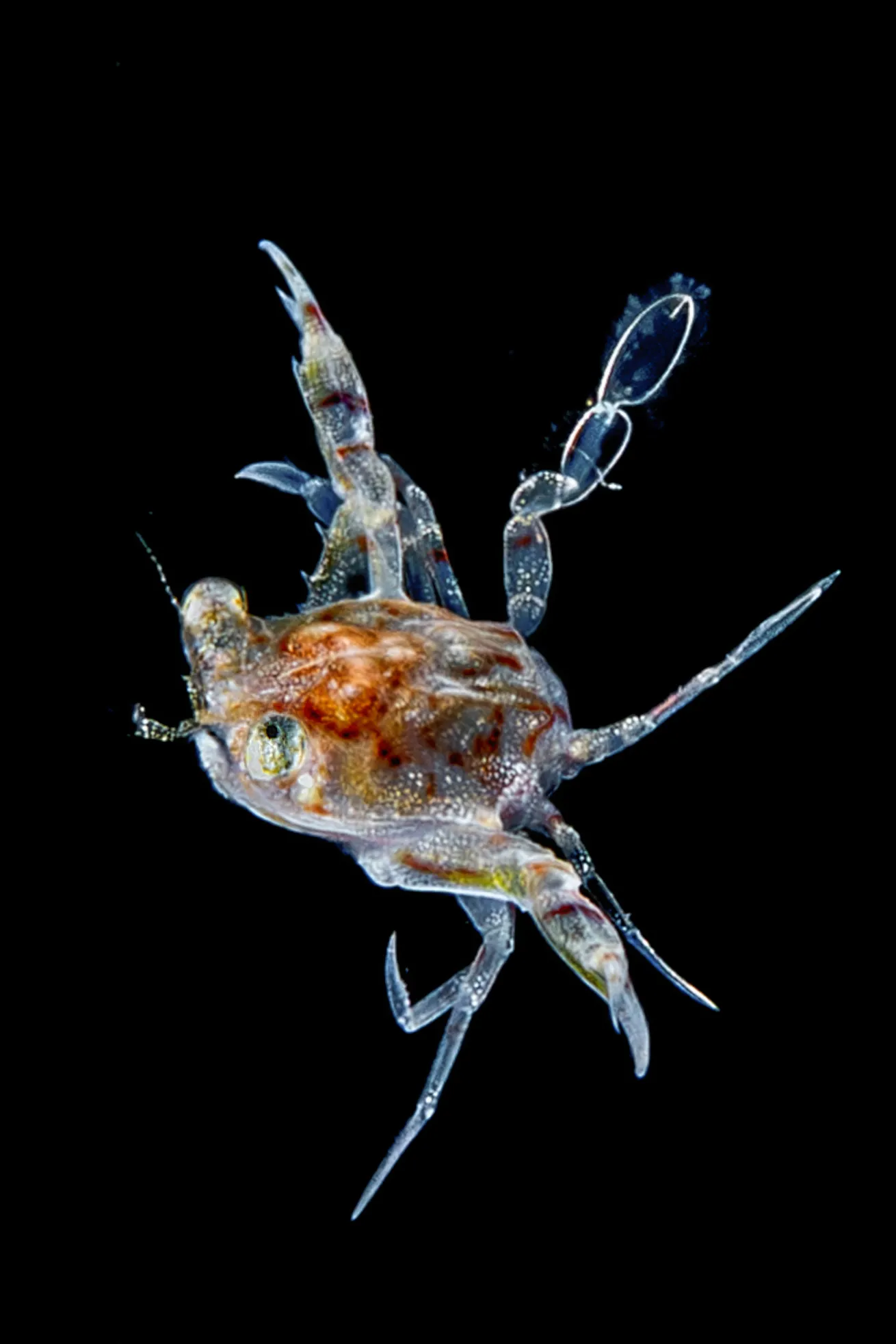
Lorenzo MittigaMegalopa of swimming crab (5mm size).
Most larval organisms never stop moving. Exposure has to be deliberate.
I usually begin around 1/200 or 1/250 sec. to limit ambient spill from the bonfire lights. If your strobes support high-speed sync, you can push the shutter faster. My Seacam D160, for example, can sync up to 1/8000 sec., which gives me more control over ambient light and helps freeze very rapid movement.
Aperture is often between f/11 and f/18, depending on the translucency or the reflectance of the subject. I keep ISO as low as practical, usually between 100 and 400, to preserve file quality.
As for strobe power, I generally start with one-quarter of my strobe's power, assuming the subject is about 3 inches away. However, this will depend on the brand you use. I only increase it if the subject is a bit more distant (between 10 and 20 inches) from the lens. In this case, I also position the strobes slightly farther forward.
The balance is delicate. Push the shutter too far and you lose the subtle blue gradient in the water. Let in too much ambient light and the frame becomes contaminated. Sometimes I want a pure black background. Other times I want a deep cobalt blue that gives the subject context.
Both are valid. It depends on the story of the image you want to create.
Tips for Light Angle
Many pelagic larvae are almost invisible. Their tissues bend and scatter light unpredictably, so overexposure is common.
This is where the lighting angle becomes critical. Side lighting often reveals internal structure, developing eyes, fin rays, membranes and body shape, without flattening detail. I often expose a little darker than I would for standard macro because preserving structure matters more than chasing brightness.
With translucent subjects, restraint usually produces a better photograph.
Related Reading: Ask a Pro Photographer: How To Take Epic Manta Ray Pictures
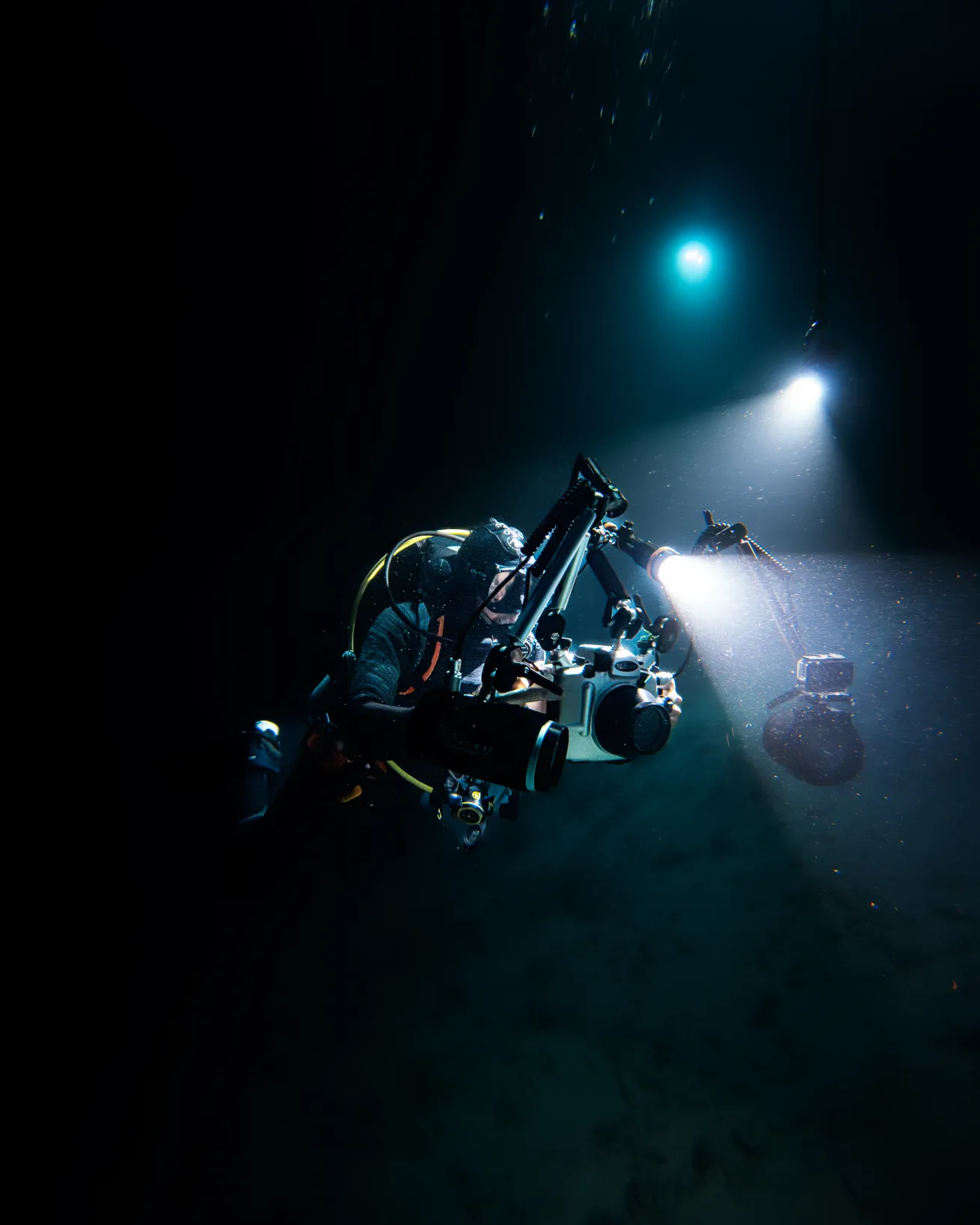
Martjin HickmannLorenzo Mittiga, the author, at work
Buoyancy Is Part of the Technique
In bonfire photography, buoyancy is not just a dive skill. It is part of the imaging technique.
There is no bottom reference and no place to stabilize yourself. Every breath changes your distance to a subject that may be only a few inches away. I try to stay just outside the brightest part of the light column and minimize fin movement. Even small disturbances can scatter plankton or add unwanted particles into the frame.
Calm breathing and small body corrections replace big movements. Without precise buoyancy, it becomes much harder to make sharp images.

Stop Chasing
One of the most useful lessons in bonfire photography is learning not to chase every subject.
Larval fish often move in short repeating arcs. Ctenophores pulse rhythmically. Squid may approach and retreat in patterns. Instead of reacting to every change, I often pre-focus at a likely working distance and wait for the subject to pass back into the plane of focus.
Short, controlled bursts are usually more effective than spraying frames. Patience makes cleaner pictures.
Related Reading: Underwater Photography Tips: How to Take Night-Dive Photos
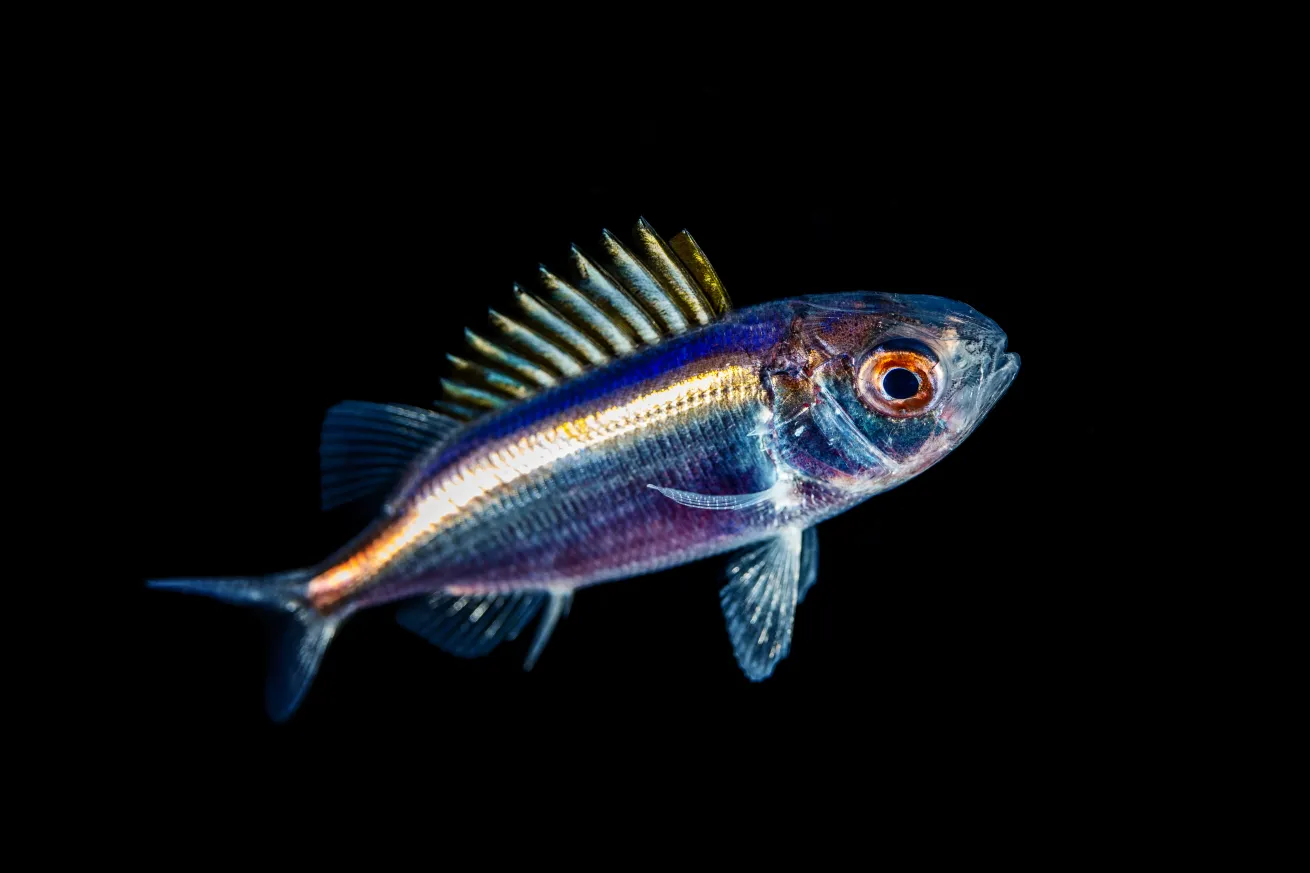
Lorenzo MittigaBigeye scad juvenile (half inch size).
Building the Background
In bonfire photography, the background is not accidental. It is a creative choice.
By adjusting my distance from the light column and controlling shutter speed, I can produce either a pure black background or a subtle blue gradient. Black isolates the
subject and emphasizes its strange shape and transparency. Blue gives a sense of space and reminds the viewer that this life is suspended in the open ocean.
I use both approaches, depending on the image and the mood I want.
Why This Technique Matters
Bonfire photography is not random plankton shooting. It is a disciplined approach that combines lighting control, exposure precision, buoyancy, and an understanding of animal behavior.
Each successful frame shows a life stage rarely seen by divers. These larval forms are the future of reef ecosystems, drifting through the night before settling into the habitats we know so well.
For me, that is the real value of this technique. It reveals a hidden chapter of marine life that exists above the reef every night. With the right gear and a careful approach, underwater photographers can bring that invisible world into focus and share it in a way that sparks curiosity, wonder and respect.


