

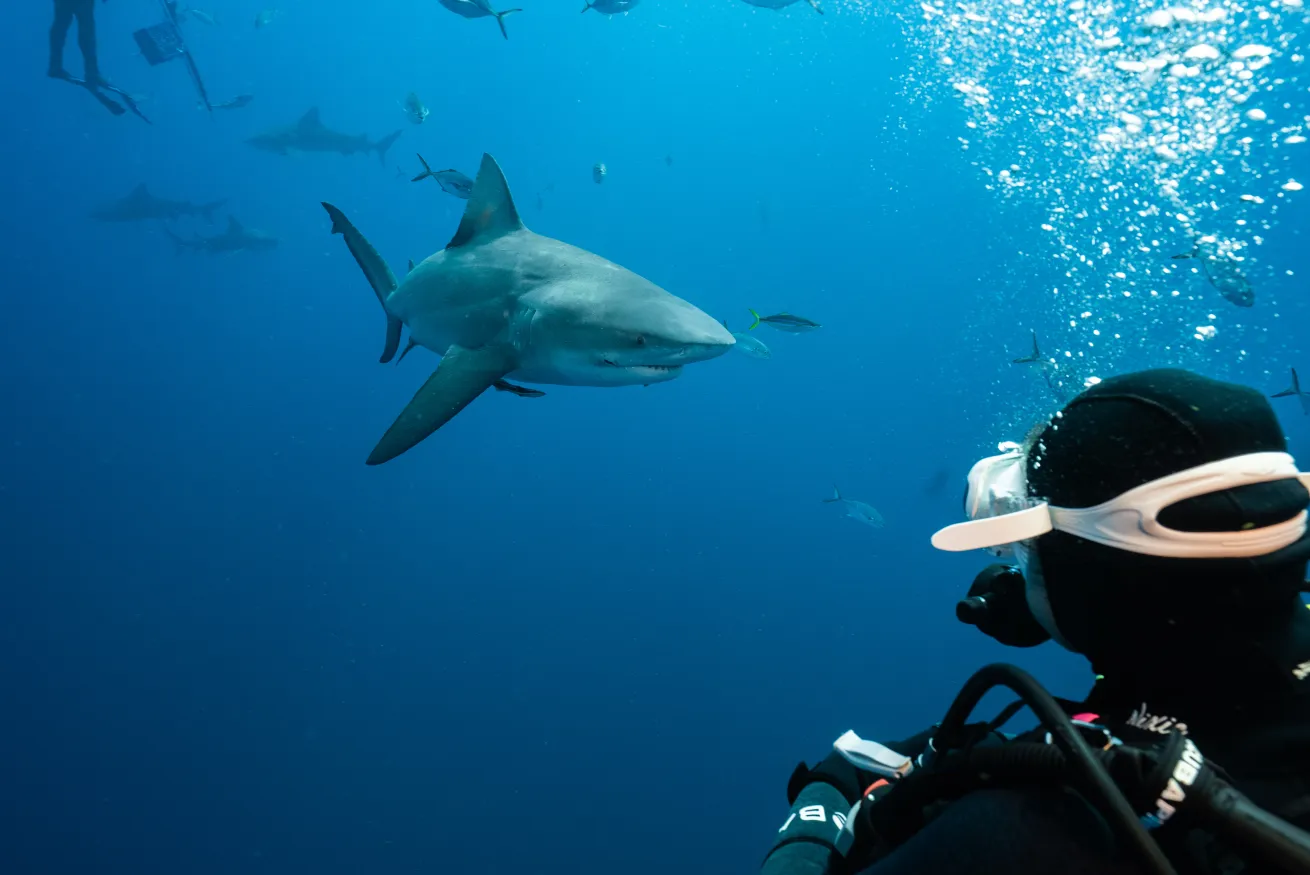
Kristin PaterakisThe Florida Safe Seas Act would ban snorkelers and scuba divers from feeding sharks in federal waters.
For divers seeking an up-close encounter with sharks, baited shark dives offer the most reliable ways to see them underwater. During these provisioned shark diving and snorkeling encounters, guides put bait or chum in the water to attract sharks closer to customers. This practice is not without controversy, and the debate over whether or not it should be allowed has reached new heights this fall.
The Florida Safe Seas Act, which would ban scuba divers and snorkelers from feeding sharks in federal waters off the state of Florida, has been introduced in the U.S. Congress by Representatives Daniel Webster (R-FL) and Darren Soto (D-FL). It’s already illegal to feed sharks while diving in Florida’s state waters, which is why several Florida-based dive operations take their customers farther from shore—out of state waters and into adjacent federal waters—to engage in this practice. This proposed law has reignited long-standing debates about the practice of shark feeding dives.
Supporters of the Florida Safe Seas Act claim that extending a ban on feeding sharks into adjacent federal waters is a “commonsense” approach, closing perceived loopholes by mirroring existing policy into a nearby jurisdiction. The press release about the Act’s introduction echoes this theme.
Does feeding sharks endanger people?
One argument for banning shark feeding dives focuses on human safety. Proponents of this argument claim that divers feeding sharks cause those sharks to associate humans with food, which can be a safety hazard for the next people the sharks encounter, people who don’t have anything to offer. In other words, if a shark approaches you looking for food and you don’t have any food, the shark might get angry or aggressive. Josh Eccles, the owner and operator of Dive Time Charters in Lake Park, Florida, disagrees. “I’ve gone diving right after a shark feeding dive, and we see sharks, but if we don’t have bait, they won’t come close to us,” he says.
Certainly, some people have been injured, or even killed, while participating in shark feeding dives (the exact number is not clear as the International Shark Attack File does not report whether an incident was during a baited excursion). But there’s no evidence that shark feeding dives endanger the safety of nonparticipants.
When directly comparing shark incidents in places that allow shark feeding against places that prohibit it, the evidence doesn’t support the argument that feeding sharks endangers people. Going back through the International Shark Attack Files to 2012, in Florida, where feeding is banned in state waters, there have been 259 non-fatal shark bites recorded. Over the same period in the Bahamas, where shark feeding is commonplace, there have only been five recorded non-fatal bites. Thankfully, serious injuries and fatalities are extremely rare.
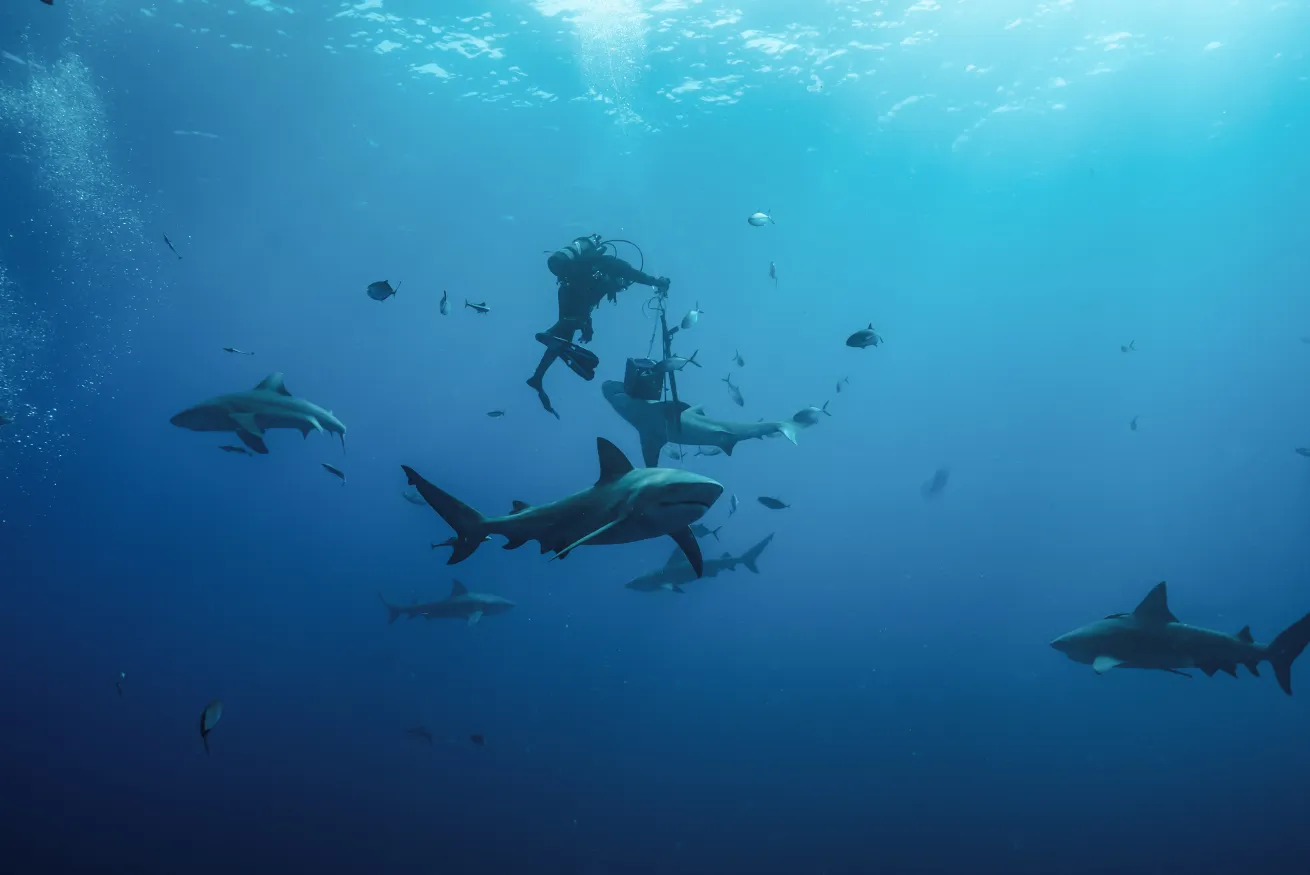
Kristin PaterakisOwner of Dive Time Charters Josh Eccles during a baited shark dive off Jupiter, Florida.
Does feeding sharks endanger sharks?
Other supporters of the bill focus on perceived harms to the sharks resulting from unethical behavior by some dive operators. This is a well-documented problem in other regions, which has resulted in Mexico banning great white cage diving. “Tourism operators can be in a bit of a bind when it comes to complying with best practices, because what’s best for the animals is not always aligned with what tourists themselves want—often an intense, up-close encounter,” Dr. Catherine Macdonald, the director of the Shark Research and Conservation Program at the University of Miami, explains. “Some of the potential effects can be mitigated by engaging with science-based best practices for wildlife tourism, which generally coalesce around respecting wildlife, including no touching or chasing for close encounters. Careful regulation can help compliant operators manage tourist expectations while keeping wildlife and people safe.”
Dr. MacDonald also notes that while many dive practices have been shown to impact the behavior and health of individual sharks, there’s limited evidence of population-wide harms as a result of these impacts.
As for Florida’s dive community, local experts tell me that most—but not all—operators are safe, ethical and respectful. “The behavior of some operators in Florida has raised concerns,” says Hannah Medd, the lead scientist of the Florida-based American Shark Conservancy. “But we have worked with the vast majority of operators, and I’ve personally seen a shift toward safe practices for guests, an interest in learning how to mitigate negative impacts on sharks and a commitment to support scientific studies.”
Related Reading: What is the Biggest Threat to Sharks in the Next Decade? What Can We Do to Stop it?
Does feeding sharks cause them to steal anglers’ catch?
One potentially surprising supporter of this bill is the recreational fishing community. Anglers in Florida (and worldwide) have reported a huge rise in depredation, which occurs when a shark or other predator eats a fish they’ve caught before they can reel it in. Though no organizations in support of the bill responded to a request for an interview, an article from SeafoodSource.com suggests that anglers blame (among other causes) shark feeding dives for this, claiming that the practice causes sharks to associate boats with food.
The experts I spoke with are skeptical of this argument. “There were more than 80 million recreational fishing trips in Florida in 2024, compared to 2,100 shark feeding dive trips, and shark diving occurs in just 0.005 percent of Florida-adjacent federal waters,” Medd says. “Does shark diving teach sharks to associate boats with food? Potentially, but that was already being taught to sharks the first moment when fishing began.”
Additionally, the experts interviewed for this article note that depredation has many causes and that shark feeding dives are, at most, a small contributor to the problem.
“We know from captive studies that sharks can be trained to approach a target in a specific area of their tank to be fed, and there is a growing body of evidence that divers feeding sharks can alter movement and behavior of sharks in the wild, so it stands to reason that sharks can learn to associate certain areas and shapes and sounds with food,” says Dr. Grace Casselberry, a postdoctoral research associate at the University of Massachusetts Amherst. “If areas where sharks are fed for dive tourism overlap with fishing, this could contribute to increased depredation. However, depredation is also happening in many areas where there is no dive tourism.”
Some members of the dive community reject blame for an increase in depredation. “We’ve overfished everything, so the sharks are adapting,” Eccles says. “If you put a fish on a line, it’s weak and bleeding; of course sharks are attracted to it. That’d be like me waving a steak in your face and saying, ‘No, sorry, this steak is mine.’”
Related Reading: How Well-Intentioned Divers Are Hurting Shark Conservation
Finding Balance in Shark Diving Regulations
Supporters of the Florida Safe Seas Act of 2025 overstate the evidence of the impact of baited shark dives on human safety and on fishing. If anglers want to reduce depredation, a variety of behavioral and technological solutions exist. And while some dive operations have problematic practices that are unsafe for sharks or humans, most follow the rules and best practices, giving divers an amazing opportunity to safely interact with some of the world’s most misunderstood animals. Problematic practices can be regulated, and specific activities can be banned, but banning all baited and chummed shark dives seems, to the researchers, conservationists and dive operators I spoke with, to be extreme and unnecessary.
Ask a Marine Biologist is a monthly column where Dr. David Shiffman answers your questions about the underwater world. Topics are chosen from reader-submitted queries as well as data from common internet searches. If you have a question you’d like answered in a future Ask a Marine Biologist column, or if you have a question about the answer given in this column, email Shiffman at [email protected] with subject line “Ask a Marine Biologist.”

Courtesy David ShiffmanImage of David Shiffman
Dr. David Shiffman is a marine conservation biologist specializing in the ecology and conservation of sharks. An award-winning public science educator, David has spoken to thousands of people around the world about marine biology and conservation and has bylines with the Washington Post, Scientific American, New Scientist, Gizmodo and more. Follow him on @WhySharksMatter on Twitter, Facebook and Instagram, where he’s always happy to answer any questions about sharks.
The views expressed in this article are those of David Shiffman, and not necessarily the views Scuba Diving magazine.


