

Certified In: 1981
Dive Certification Level: Open Water Diver
Expertise: Sea turtles and underwater photography
Social Media: @MOCMarineInstitute on Instagram and Facebook; dmcleish.com; mocmarineinstitute.org
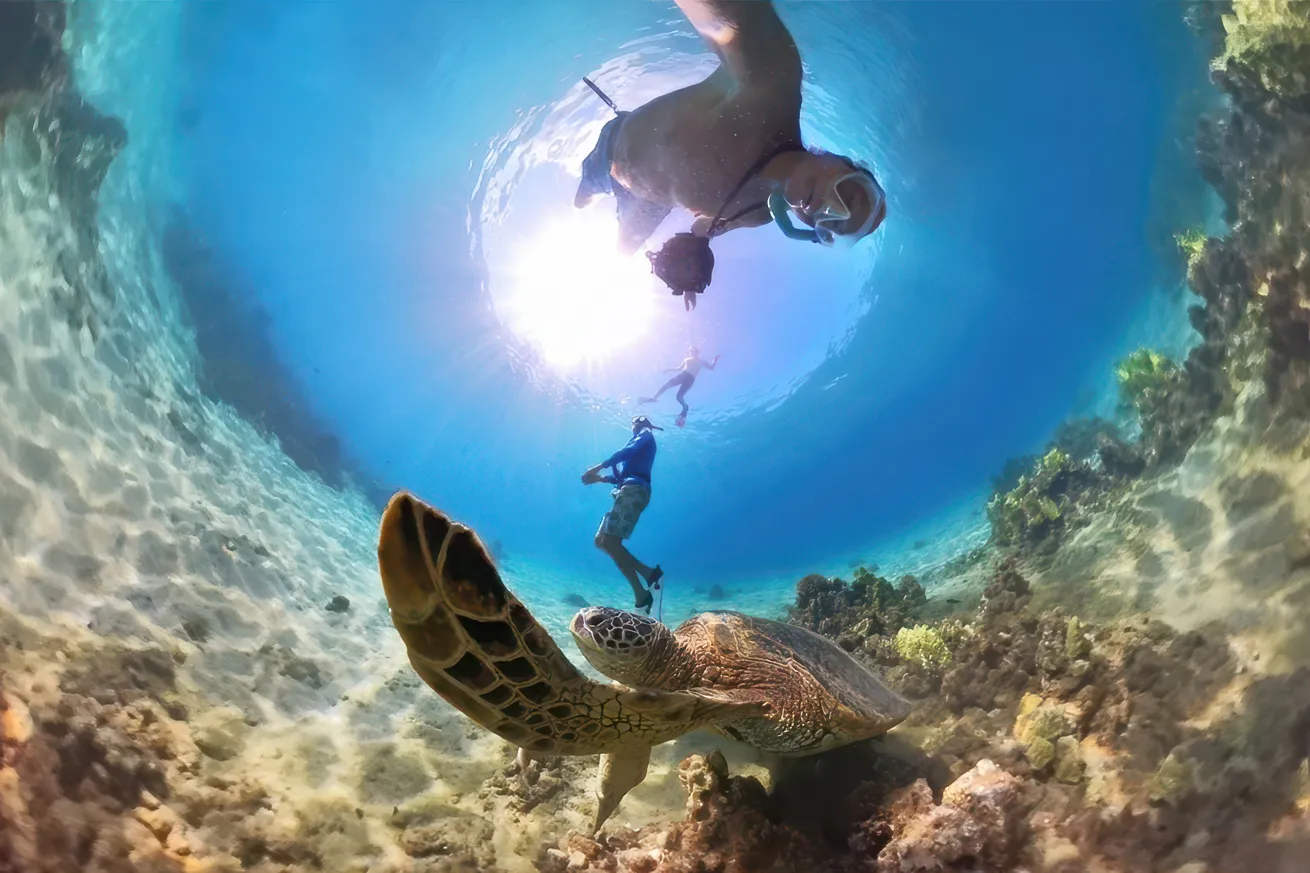
At 73 years young, Don McLeish is a dedicated sea turtle rescuer and diver. His love of ocean creatures has fueled his resolve for action in the waters surrounding Maui, Hawaii. He’s a field responder for the Maui Ocean Center Marine Institute (MOCMI), a self-described “gizmologist” and a skilled underwater photographer looking to inspire future generations to stay active in taking care of our oceans.
Q: What can you tell readers about MOCMI and its sea turtle rescue program?
A: Maui Ocean Center Marine Institute is an independent organization housed within Maui Ocean Center. It started in 2016 with turtle rescue and rehab, then branched into coral reef restoration and threat reduction work.
My participation has been as a field responder. When we are notified of or happen upon a hooked or entangled turtle, we capture them and either treat them in the water or, more often, bring them to shore. We can then remove any fishing gear, take measurements and photos, tag them with a microchip for identification and release them back to the ocean. Or, we may determine that they need to go to the ocean center for rehabilitation and medical aid. All of the information we collect is shared with the National Oceanic and Atmospheric Administration for further research.
“Don is part of a small team that is on the federally controlled permit, allowing them to touch turtles who are protected,” adds Larissa Treesse, operations manager of Maui Ocean Institute. “In the permit, it states that they can handle, disentangle and transport turtles in need of human interaction for their safety.”
Turtles that spend time at the center are cared for with rehabilitation and veterinary intervention. This can involve healing flippers that have been damaged from wrapped fishing line or treatment for buoyancy issues.
“We have a veterinarian on staff who makes the treatment call, which most of the time includes antibiotic injections, laser treatment and topical antibiotic application,” Treesse says. “The animals themselves are resilient, and most of the time all it takes is a little R&R. Most of the patients we receive are from fishing line entanglement, however we've gotten a few from boat strikes and entrapment.”
“Don is a dedicated team member who spends countless amounts of time in the water, with a keen eye to search and find turtles in need,” Treesse adds. “He has amazing knowledge of turtle behavior, where they reside and how to differentiate each turtle by their markings. And, of course, his photos are some of the most beautiful images of these captivating animals!”
Related Reading: Going Green: How to Improve Your Turtle Photography
Q: What are the biggest issues sea turtles face in Hawaii?
A: FP (fibropapillomatosis) used to be a common problem in green sea turtles, but that has disappeared to a great extent. Today, the main problem sea turtles face is being hooked or entangled by fishing gear. But candidly, I believe the greatest problem they face is the fact that nesting beaches may disappear due to sea level rise. What’s more, the beaches that remain may be too warm for any male hatchlings to develop in the nest.
Sea turtles have temperature-dependent sex determination, meaning the temperature of the nest affects whether the turtles are born male or female. If the eggs incubate below 81.9 degrees F, the turtles will be born male; between 82 and 88.7 degrees F, some will be male and others female; and above 88.8 degrees F (which is becoming most common with climate change), they’ll all be female.
We have seen a growth in sea turtle populations, but the younger ones are mostly all female, even now.
Q: How did you originally get into sea turtles and underwater photography?
A: I was always interested in photography and had a Nikonos I in the ’60s for surf photography in California and reef photography when visiting Maui. I shared images on the internet of hawksbill turtles I filmed in Maui and came to find that they were endangered and not often seen here.
About 20 years ago, I started a web log of my hawksbill sightings. As luck would have it, the beach I usually snorkel at is a popular spot for a few local hawksbills. My images and knowledge of these turtles became of interest to the NOAA turtle group in the state of Hawaii. I have since contributed videos and still images to scientific papers.
Related Reading: Why Do Sea Turtles Return to the Same Beach?
Q: What’s your advice to the next generation of divers and conservationists?
A: Life on the planet and in the ocean can adapt to change if it’s gradual and not too radical. But the rate of change these days is a serious challenge at best and potentially a death sentence for many critters. Scientists and decision-makers need as many eyes on the reef as possible providing current information and observations. The ocean needs all the help it can get!
Q: What do you view as the greatest challenges in marine conservation today? How are these challenges reflected in your own work?
A: I think the greatest challenges are increasing public awareness and encouraging public support and funding. We need to get the latest science and new technologies to solve problems our ocean and broader ecosystem are facing.
I don’t consider myself a hero but am proud of designing and funding our first rescue sled, which allows us to both treat a turtle out in the water and transport it to the beach. As for unsung heroes, one very kind couple funded the purchase of two more of the rescue sleds for our team.
Q: What's been your most satisfying moment?
A: Making eye contact with humpback whales and having them seem to show some curiosity in me, too, coming in to check me out.
Q: What's been your most surprising moment?
A: A very large female tiger shark swam past me and some sea turtles. The turtles didn’t react by “taking flight,” or swimming away. I was snorkeling by myself at the time.
Q: Who are your "sea heroes"?
A: I am impressed with too many Hawaiian surfers and watermen to list. But on the ocean awareness side, I have become good friends with Jean-Michel Cousteau and grew up glued to the TV when his dad’s programs were on. I was fortunate enough to be included on some filming permits with him, filming humpback whales by boat, drone and in the water if they chose to approach.
Ed Lyman and his Large Whale Entanglement Response Network team are heroes, as well as “Her Deepness” Sylvia Earle, and really all those who are studying the ocean and doing what they can to increase our knowledge and encourage sustainable practices.
Finally, of course, everyone who helps fund and grant research and activities to help our ocean and its critters.
Q: Is there anything we did not ask that you would like readers to know?
A: I know others who are more deserving of recognition, though I think they would agree: We are not important, but sea turtles and sea life in general are worthy of heroes—and they need as many as possible.
Each month in Scuba Diving, we feature a Sea Hero who has been nominated by their community members for their commitment to the advancement of conservation, education, and exploration. In our December issue, judges select a Sea Hero of the Year. Nominate a Sea Hero at scubadiving.com/seaheroes.


