

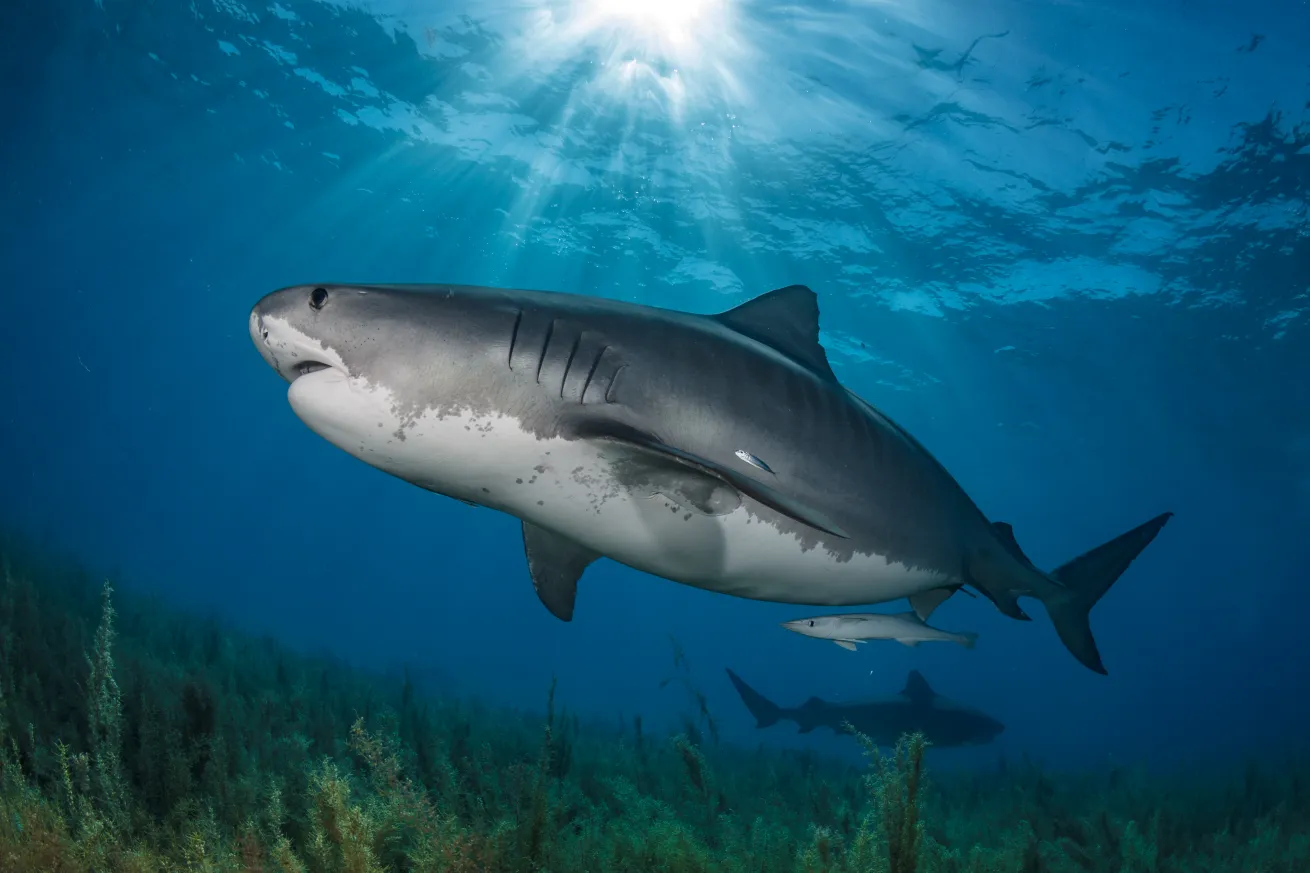
Hannes Klostermann / Ocean Image BankA tiger shark shows off its gills in the Bahamas.
Question: How do fish breathe underwater?
Answer: Using their gills, fish breathe by pulling oxygen directly from the water they swim in! Here’s how it works.
Humans, which I assume almost everyone reading this article is, are adapted to life on land. We breathe air using our lungs, inhaling oxygen and exhaling carbon dioxide. To spend even brief amounts of time underwater, we need to either take a big breath of air at the surface and hold our breath or bring a heavy tank of compressed air with us. We cannot pull oxygen directly out of the water. Neither can marine mammals like whales or marine reptiles like sea turtles, though they can hold their breath a lot better than we can.
In contrast, fish (as well as lots of types of marine invertebrates) can pull oxygen directly out of the water using their gills. You’ve probably heard of gills, but you might not have ever thought much about how they actually work.
Related Reading: What Are the Best Schools to Study Marine Biology?
First of all, yes, there is dissolved oxygen in water, but it’s at a much, much lower concentration than oxygen in the air. According to the Ocean Conservancy, there’s about 25,000 times as much oxygen in a given volume of air as there is in the same volume of water. Extracting that dissolved oxygen from the water requires specialized physiological adaptations.
Water flows over the gills, either due to current, the organism swimming, or the organism pumping water (bony fish do this with an organ called an operculum; some sharks use an organ called a spiracle). Gills are composed of lots of delicate and tiny features called lamellae. Water passes over the lamellae, where it interacts with partially permeable tiny blood vessels, which are called capillaries.
Oxygen and carbon dioxide (and indeed all chemicals) want to be in equal concentrations on both sides of the capillary barrier. Oxygen molecules pass from the water to the blood in the capillaries, and carbon dioxide passes from the capillaries into the water. Because the direction of water flow and blood flow are opposite from one another, the water with the highest dissolved oxygen first interacts with capillaries when they have the lowest oxygen, facilitating this exchange. This is called a “counter-current” system.
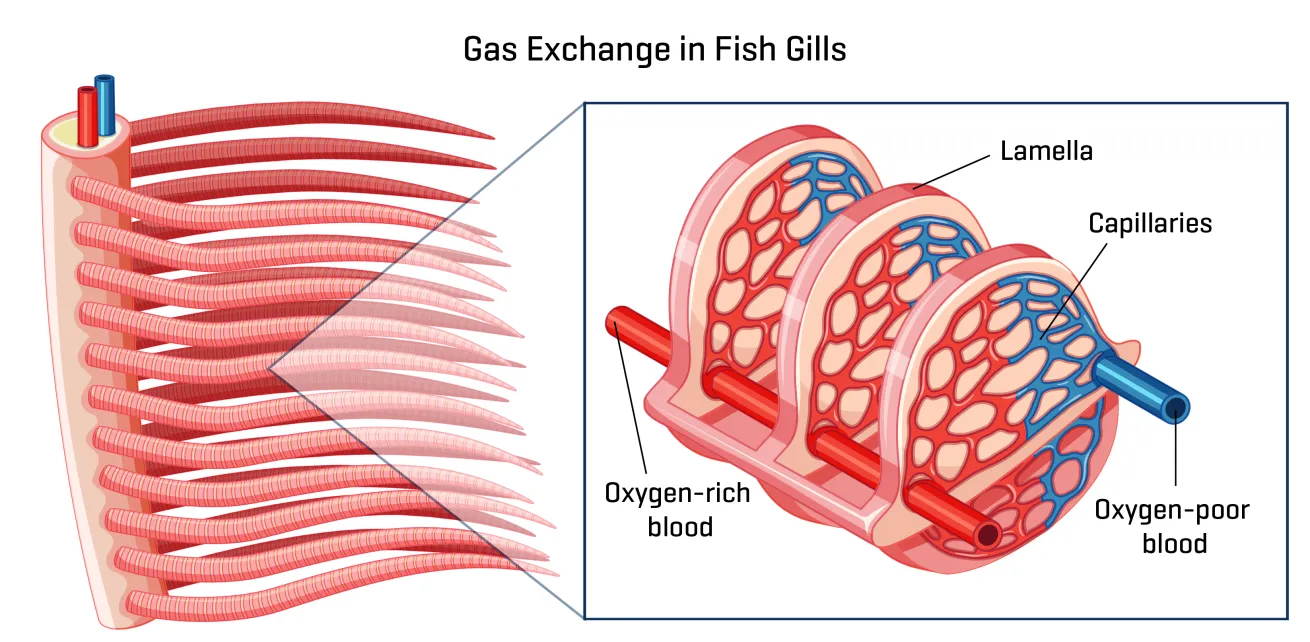
Shutterstock/BlueRingMediaLamella are tiny structures within gills that house capillaries. The capillaries bring oxygen into the fish’s blood and carbon dioxide out to the water.
Because there’s so little dissolved oxygen in water to begin with, marine life that breathes using gills is extremely sensitive to changes in dissolved oxygen levels. These fluctuations, like the Gulf of Mexico’s “dead zone” of low or no oxygen, cause massive die offs of marine life.
Related Reading: How Marine Animals Are Playing a Vital Role in Saving Our Planet
Ask a Marine Biologist is a monthly column where Dr. David Shiffman answers your questions about the underwater world. Topics are chosen from reader-submitted queries as well as data from common internet searches. If you have a question you’d like answered in a future Ask a Marine Biologist column, or if you have a question about the answer given in this column, email Shiffman at [email protected] with subject line “Ask a Marine Biologist.”

Dr. David Shiffman is a marine conservation biologist specializing in the ecology and conservation of sharks. An award-winning public science educator, David has spoken to thousands of people around the world about marine biology and conservation and has bylines with the Washington Post, Scientific American, New Scientist, Gizmodo and more. Follow him on @WhySharksMatter on Twitter, Facebook and Instagram, where he’s always happy to answer any questions about sharks.
The views expressed in this article are those of David Shiffman, and not necessarily the views Scuba Diving magazine.


