

Shutterstock/Divespin.Com
Ten minutes into the night dive, my torch finds a wrasse. It’s wedged into a crevice in the rock wall so precisely it looks like a coral—fins still, body oriented slightly downward. Its eyes are open. Fish don’t have eyelids, so there’s no visible signal that this animal is asleep except for the fact that it doesn’t bolt. It just sits there, tolerating my light as it never would during the day.
I move the beam away. I feel bad. Twenty seconds later, I sweep my light over another fish, also wedged into the rock, also unmoving. I feel worse.
Fish sleep. Not the way we do—with cushy beds and eyelids to block out the dark—but in a way that’s functionally similar. They rest either motionless near the substrate, tucked into reef structure, nested below coral branches or lying flat on the sand.
Lab studies show that sleeping fish have elevated arousal thresholds, meaning it takes a much stronger stimulus to provoke a response than it would while they’re awake. Their metabolism slows too. The process appears to support recovery and may play a role in immune function and memory consolidation. The neurochemistry involved—melatonin, adenosine and the genes that regulate circadian rhythm—overlaps with our own.
Related Reading: [Ask a Marine Biologist: How Do Fish Breathe Underwater?](How Do Fish Breathe Underwater?)
Disrupting fishes’ sleep causes harm. A bright beam can spike cortisol, force a fish from the spot it spent energy selecting and burn metabolic reserves. Research on artificial light at night—focused especially on coastal and reef species—has linked chronic light exposure to suppressed immune function, altered feeding and shifted reproductive timing. A dive torch might not be an ever-present streetlamp, but it still does damage, especially if exposure is long.
I fin further along the wall and see movement. A moray is working the reef, body ribboning over corals as it hunts. A lionfish drifts past. The night shift is clocking in, and I hope I’ll happen upon an octopus too, or perhaps a curious shark. Though plenty of marine animals are active at night, most reef fish run on strict light-dark schedules. When the sun drops, they find their spots and power down.
Related Reading: Do Dive Lights Harm Manta Rays?

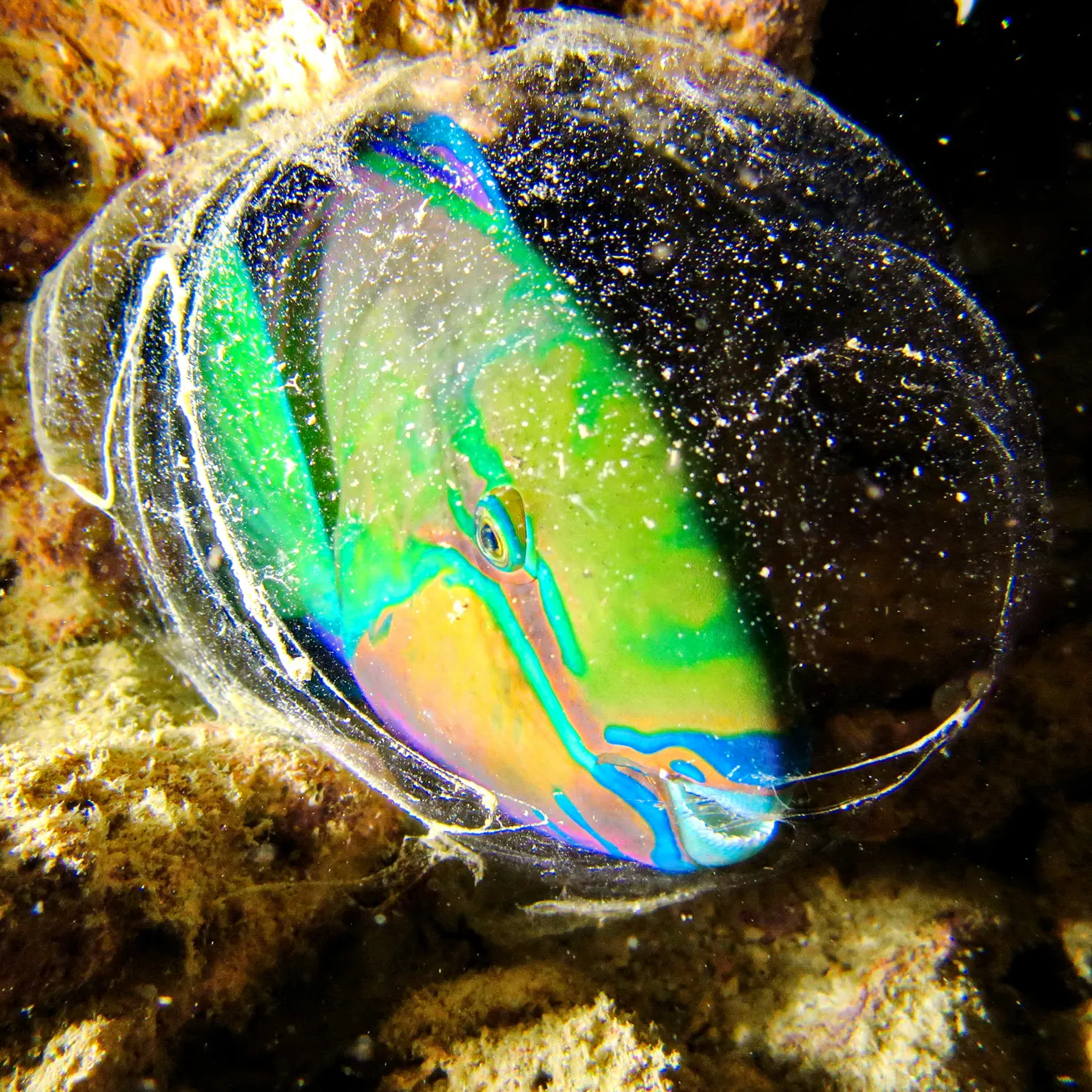
Below me, something catches the light. I drop to take a closer look. It’s a parrotfish encased in a transparent mucus envelope. The fish spend up to an hour producing this pod before settling in each night. Though the behavior has long been thought to help mask the fish’s scent from predators, research led by biologist Alexandra Grutter at the University of Queensland found a second function.
The cocoon significantly reduces overnight attacks from parasitic gnathiid isopods, creating the equivalent of a biological mosquito net. I force myself to move on. If I startle the parrotfish into flight, it will abandon its cocoon, losing that protection for the rest of the night.
I think back to other encounters that have changed how I use my light. Once, diving at dusk in the Hood Canal in Washington, I came across a ratfish gliding along the bottom. Its enormous eyes looked alien, built for near-total darkness, with a reflective layer that amplifies even the merest trace of light. My torch caused it to veer sideways and bump into a rock. I’ve reflected on that moment often. What did that feel like for an animal calibrated so precisely for the dark? It can’t have been anything but unpleasant.
Most of us are taught light etiquette as it relates to dive buddies. Few of us are taught to think about the fish. Next time you’re night diving, angle your beam toward the substrate rather than at resting animals. If you find a sleeping fish, look briefly and move on. Red-spectrum lights may not be as disruptive for some species, as many reef fish are relatively less sensitive to longer wavelengths, but evidence in dive contexts is still limited. And if you find a parrotfish in its faintly glowing cocoon, move on. It took real work to make that thing.


